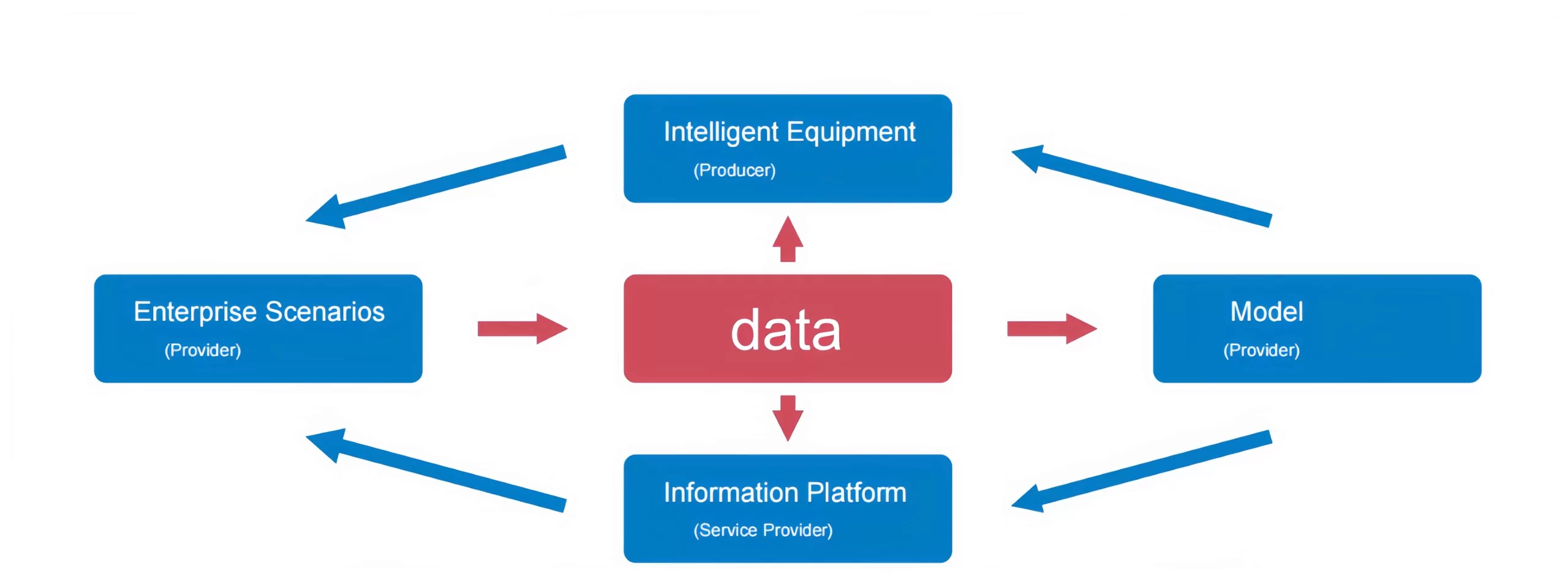
AI Technologies
Intelligent Sorting Technology for Automotive Irregular-Shaped Parts
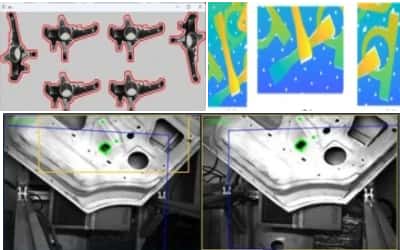
Multimodal Environmental Perception
Achieves millimeter-level recognition accuracy for highly reflective and low-texture workpieces, supporting random stacked-object segmentation, pose estimation, and dynamic perception to overcome traditional vision limitations.
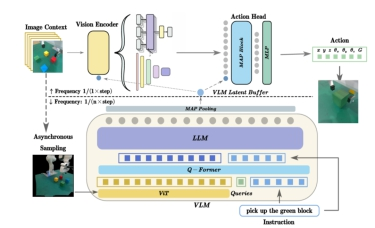
VLA Large Model + Intelligent Planning
Understands complex sorting tasks with intelligent obstacle avoidance and priority scheduling, eliminating item-by-item programming and reducing deployment costs.
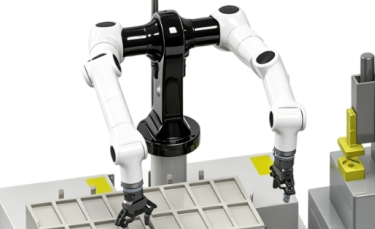
Integrated Robotic Arm and Dexterous Hand
Advanced force control enables precise, non-destructive gripping, while dual-arm collaboration increases grasping success rates to 95%, meeting automotive mass-production reliability requirements.
Intelligent Handling Technology for New Energy Vehicle Lithium Batteries

Integration of Robotic Arm and AGV Platform
Pioneering a mobile, multi-functional robotic body, it achieves precise force gripping and autonomous path planning with obstacle avoidance-thereby eliminating safety hazards associated with collisions and crushing during lithium battery handling at the source.

VLA Embodied AI Large Language Model
The robot is capable of comprehending complex tasks and dynamically adjusting its behavior, balancing generalization capabilities with industrial-grade reliability to support flexible production across multiple models-eliminating the need for frequent line reconfigurations or model changeovers.

Sub-millisecond precision sensing and operation
By integrating visual positioning with force-controlled compliance technology-and featuring omnidirectional obstacle avoidance with millisecond-level response-handling speeds are boosted by 11%, ensuring both efficiency and consistent stability on the production line.

Cloud-Edge Collaborative Swarm Intelligence
Enables multi-machine collaborative operations, integrates deeply with MES/WMS systems, and supports autonomous energy management.
Collection and Model Training Plan Data
Designed to address critical pain points in the training of industrial embodied AI models- specifically the difficulty of real-time data acquisition. The inefficiency of expert demonstration, and the fragmentation of the data-to-training pipeline- this solution establishes a complete closed-loop workflow spanning the entire process from multi-source data collection to the generation of scene-specific models.
Key Technical Features
Industrial-Grade Extreme Real-Time Performance
The data acquisition frequency exceeds 100 Hz, and the teleoperation control frequency exceeds 500 Hz, meeting the high-precision and low-latency control requirements for robotic operations.
Integrated Edge AI Design
Real-time control and AI computing power are integrated into a single terminal, with data pre-processed locally to reduce transmission load and latency.
Comprehensive Dual-Mode Teach-In Coverage
Balancing portability with high precision, it enables the rapid acquisition of expert experience data for industrial tasks of varying complexity, thereby solving the challenge of automatically annotating complex operations.
Seamless End-to-End Process
Unify data collection and training service interfaces to eliminate transition costs and enhance model iteration efficiency.
Multimodal Data Fusion and Acquisition
It synchronously acquires multi-source data, including robot kinematics, force/torque feedback, and visual perception, providing embodied AI models with comprehensive environmental and proprioceptive information.
Core Architecture and Workflow
The solution consists of three core modules, forming a complete data acquisition-processing-training pipeline:
Gathering Workbench
An integrated edge architecture comprising a “Real-time Control Unit + AI Computing Unit” enables precise control as well as multi-source data acquisition and preprocessing.
Remote Operation Component
Provides expert teaching capabilities featuring dual modes: VR relocation and master-slave mapping.
Data Collection and Training Server
Through the X-Collection service, data is processed in a standardized manner, while the X-Training service directly trains and outputs models ready for deployment.
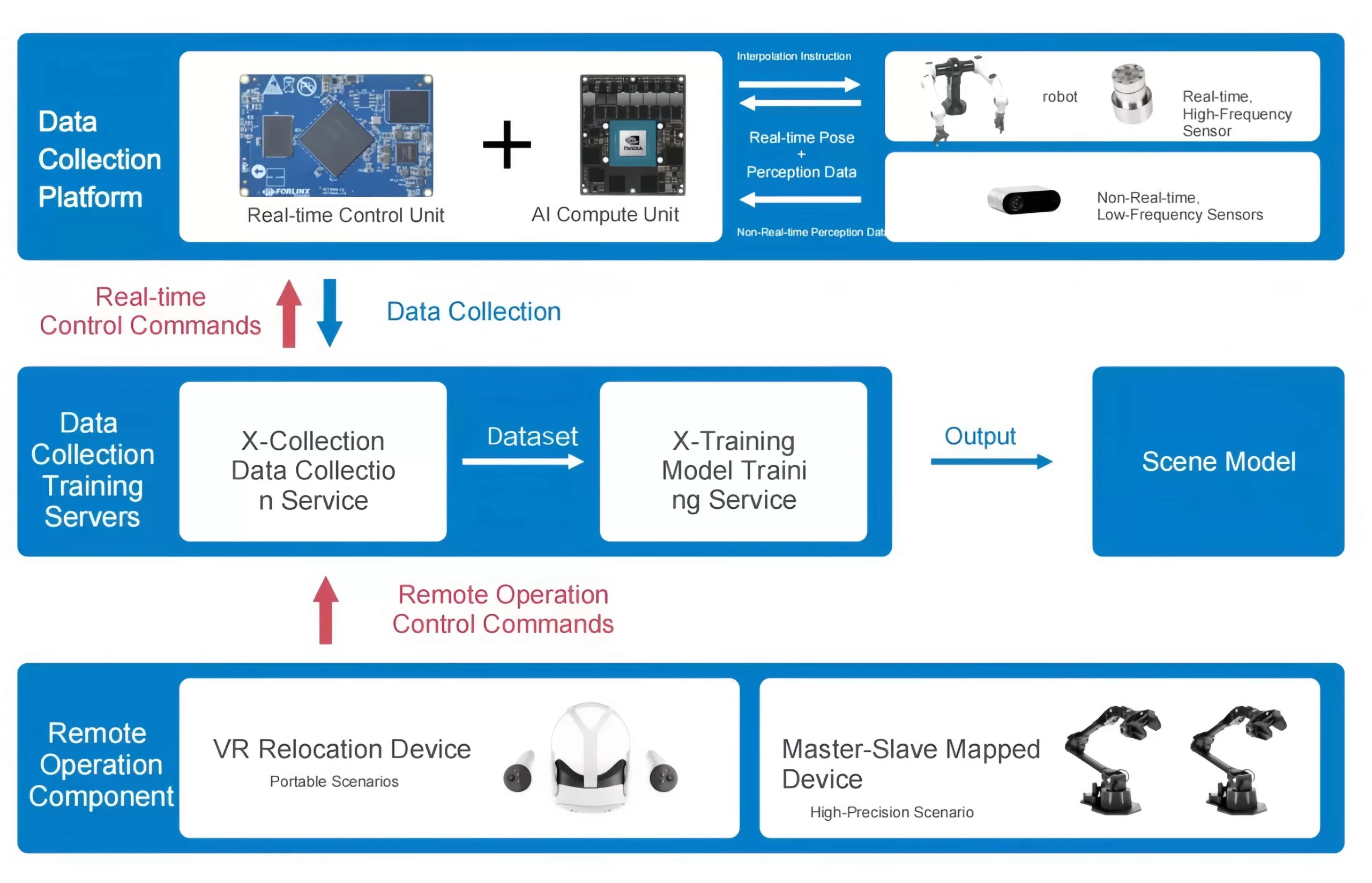
Data Collection and Model Training Plan
It employs a control core entirely identical to that of the actual robot, thereby resolving the Sim2Real transfer problem. It can be directly deployed to Isaac Sim to enable large-scale robot cluster simulation and rapidly generate massive volumes of automatically annotated training data. Featuring a containerized, cross-architecture design, it supports both ARM and AMD architectures, providing simulation and real-time motion control capabilities for various embedded industrial PCs, edge servers, and cloud computing centers.
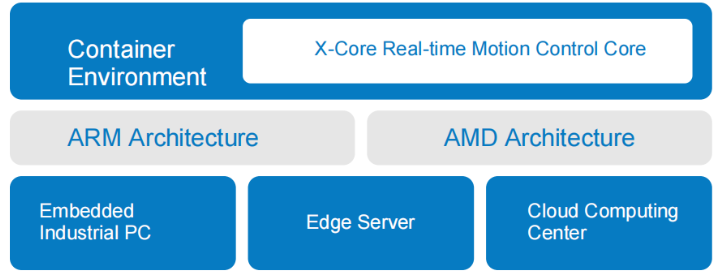
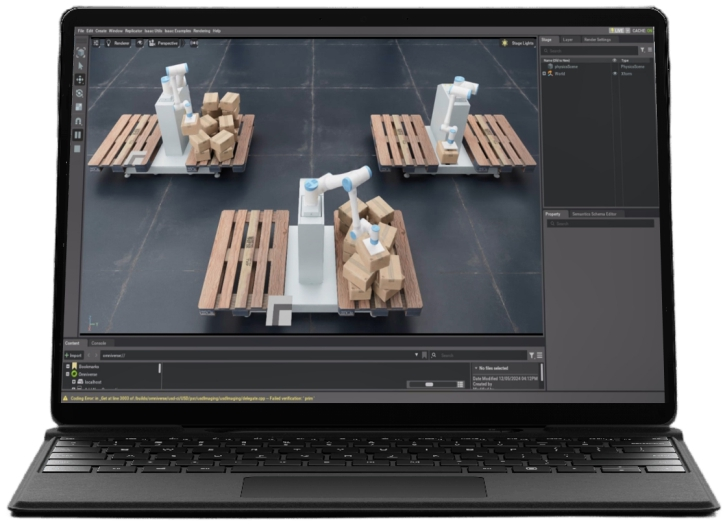
Model Inference and On-Site Deployment Solutions
Addressing the pain points of difficult deployment, slow replication, and asynchronous inference and control in industrial embodied intelligence models, this solution enables rapid deployment, stable operation, and large-scale replication.
Key Technical Features
Seamless Deployment on Identical Hardware
The data acquisition frequency exceeds 100 Hz, and the teleoperation control frequency exceeds 500 Hz, meeting the high-precision and low-latency control requirements for robotic operations.
Industrial-Grade High Real-Time Performance
Real-time control frequency > 500Hz, model inference frequency > 20Hz, ensuring high-precision and reliable execution.
Deep Fusion of Inference and Control
Deep coupling at the edge, with end-to-end latency controlled to the millisecond level.
Standardized Batch Replication Capability
A unified model inference service interface and standardized deployment process enable a single model to be quickly replicated to hundreds of robots, achieving large-scale application.
Full-Scenario Human-Computer Interaction Adaptation
Covering multiple terminals including PCs, handheld devices, and tablets, adapting to the operational needs of different scenarios.
Data Closed-Loop Mechanism
Automatic feedback of runtime data supports incremental model training and continuous optimization.
Core Architecture and Workflow
The solution adopts a three-layer distributed architecture comprising “edge inference, edge control, and human-machine interaction. The inference server provides standardized model inference services; the homogeneous operating platform executes high-precision control and feeds back perceptual data; and the multi-terminal HMI enables system management and task interaction, achieving a seamless transition from model training to execution.
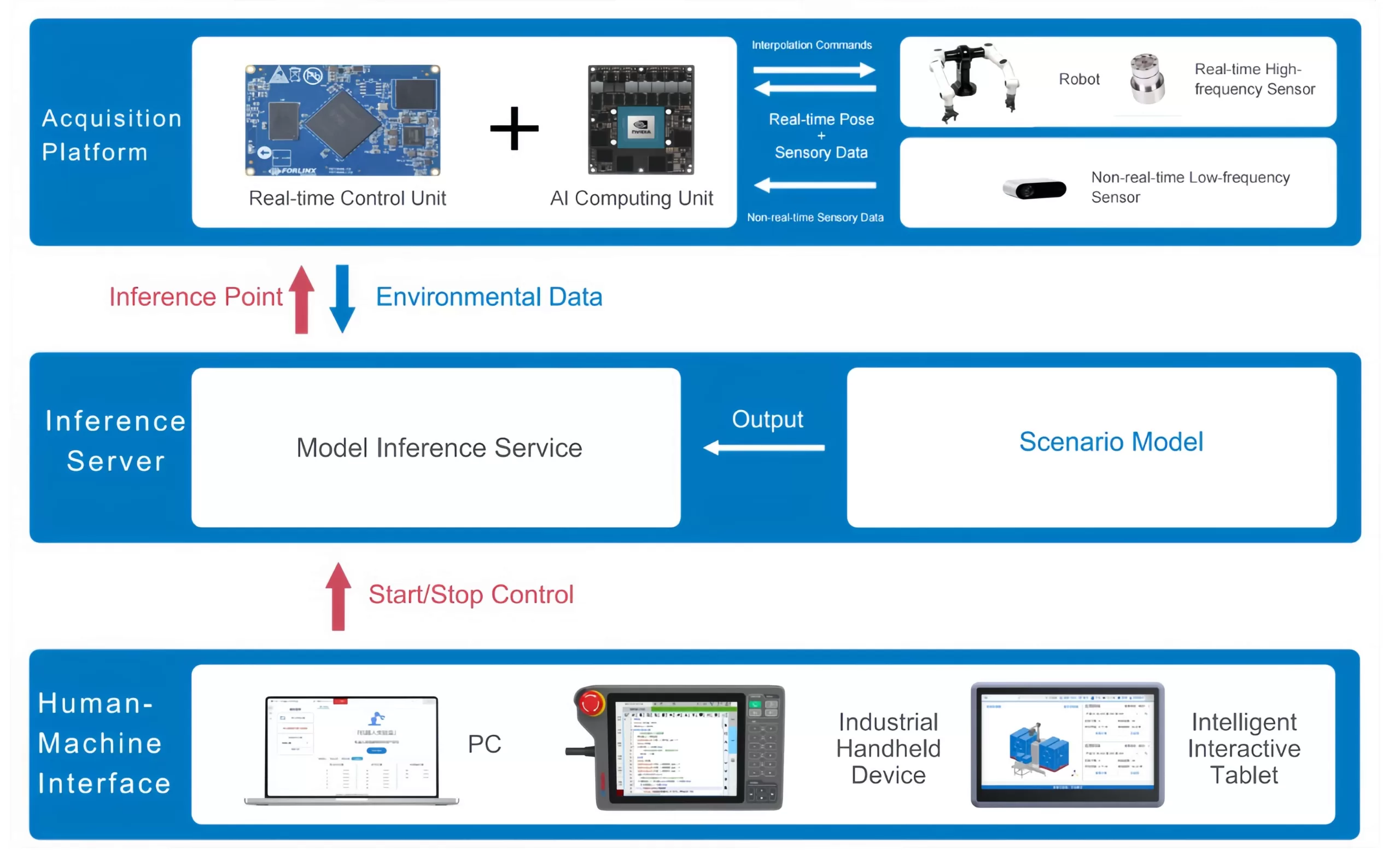
Model Inference and Technology On-Premises Deployment Solutions
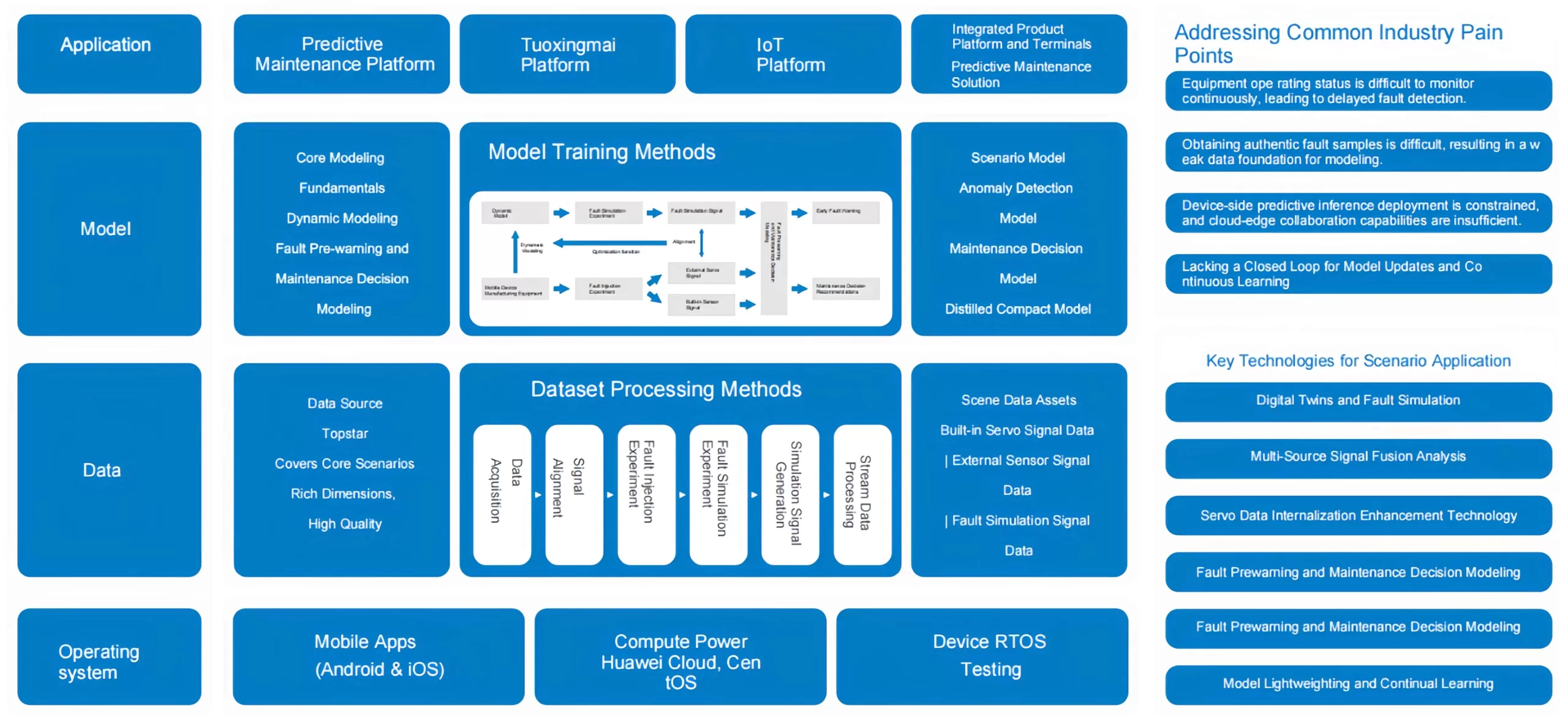
Pioneered a “Real-World Acquisition + Fault Simulation” dual-wheel data generation model.
It integrates five key technologies-including digital twins and servo data internalization-thereby fundamentally resolving the common industrial challenge of a “scarcity of real-world fault samples.”
Full-Stack Technical Architecture Support
Covering the full spectrum of environments-devices, the cloud, and mobile platforms-it generates three distinct model types, balancing both accuracy and deployment performance.
Deep Fusion of Inference and Control
Deep coupling at the edge, with end-to-end latency controlled to the millisecond level.
Four-Party Collaborative Ecosystem Model
It integrates resources from four key parties-data providers, equipment manufacturers, model users, and platform service providers-to enable the rapid replication of technology and its large-scale promotion.