Control Technologies
Cloud-Edge-End Distributed Architecture
By decomposing components-such as motion planning, business algorithm, and scheduling modules into microservices, and flexibly deploying them across cloud, edge, and terminal devices based on actual requirements, computational resources can be utilized efficiently while performance is enhanced. Simultaneously, this approach enables seamless integration with AI models, facilitating comprehensive collaboration across motion control open ecosystems and AI applications thereby addressing the industry challenge of balancing intelligence with real-time performance within industrial environments.
System Architecture
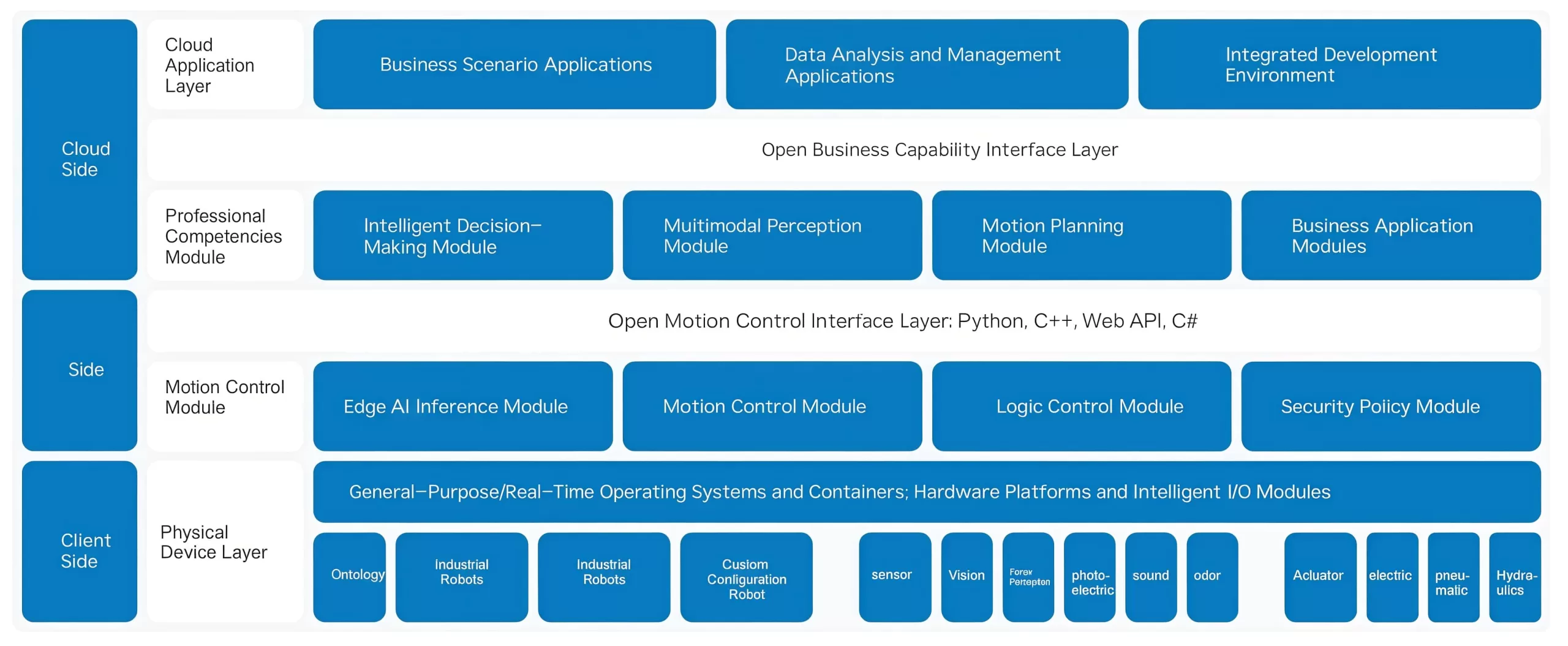
Leveraging hardware and operating systems as the underlying platform, we modularize AI and motion control capabilities to construct a distributed system architecture spanning the cloud, edge, and endpoints.
Cloud-Edge-End Distributed System
Motion planning, business algorithms, and scheduling modules are decomposed into microservices, which are deployed on-demand across cloud, edge, and terminal devices to efficiently utilize computing power and enhance performance.
Open Interfaces and Simulation Capabilities
By leveraging standardized development interfaces, AI models and algorithmic capabilities can be rapidly integrated and seamlessly embedded into mainstream simulation environments.
Hardware and Real-Time Operating Systems
The hardware solution utilizes domestically produced chips and runs on the openEuler industrial real-time operating system, thereby enhancing the reliability of the system foundation.
X-Motion UniversalControl Architecture
A highly scalable universal control architecture that enables unified cross-scenario control for industrial robots, injection molding machines, and general automation equipment. Based on domestically produced processors and the openEuler real-time operating system, it achieves architectural-level innovation.
Technological Advantages
Cross-Scenario UniversalControl
A single system supports industrial robots (meeting the needs of over 90% of models), various types of injection molding machines, and multi-axis automated production line control, significantly reducing solution development costs.
Full-Stack Domestic Foundation
Equipped with domestically produced processors and the openEuler real-time operating system, it delivers enhanced computing performance and high real-time responsiveness, ensuring supply chain security.
Universal Control Architecture
The X5 control system features an upgraded, highly scalable general-purpose control architecture. It supports control functions for various devices, including industrial robots, injection molding machines, and general automation systems, providing a single solution to meet diverse needs.
Robots
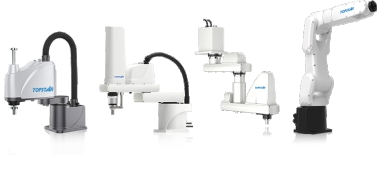
The control system’s built-in algorithms support all articulated robots defined in GB/T39405, meeting the needs of over90% of models in the industrial sector.
Injection Molding Machines
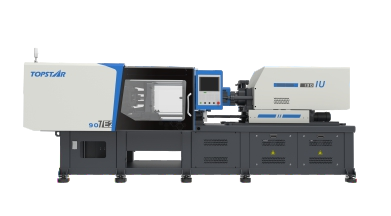
Support horizontal, vertical, multi-color, two-platen, and injection-blow molding machines, featuring one-key calibration self and temperature tuning.
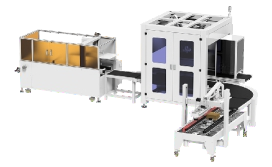
General Automation
Integrates PLC and robot control into a single unit. It supports multi-bus motion control with up to 64 axes of synchronous motion, and features built-in electronic cam and hydraulic control functions.
Open Functional Interface Ecosystem
Provides over 400 functional interfaces and a 500Hz RGM real-time control interface, meeting more than 90% of industrial robot application requirements. Effectively bridges the data gap between AI models and robotic systems, significantly lowering the development barrier for embodied intelligence applications.
Technological Advantages
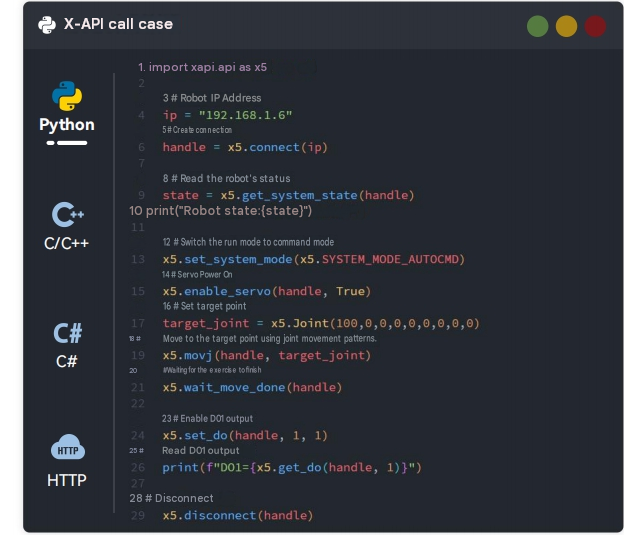
Robot Control Across Multiple Development Frameworks
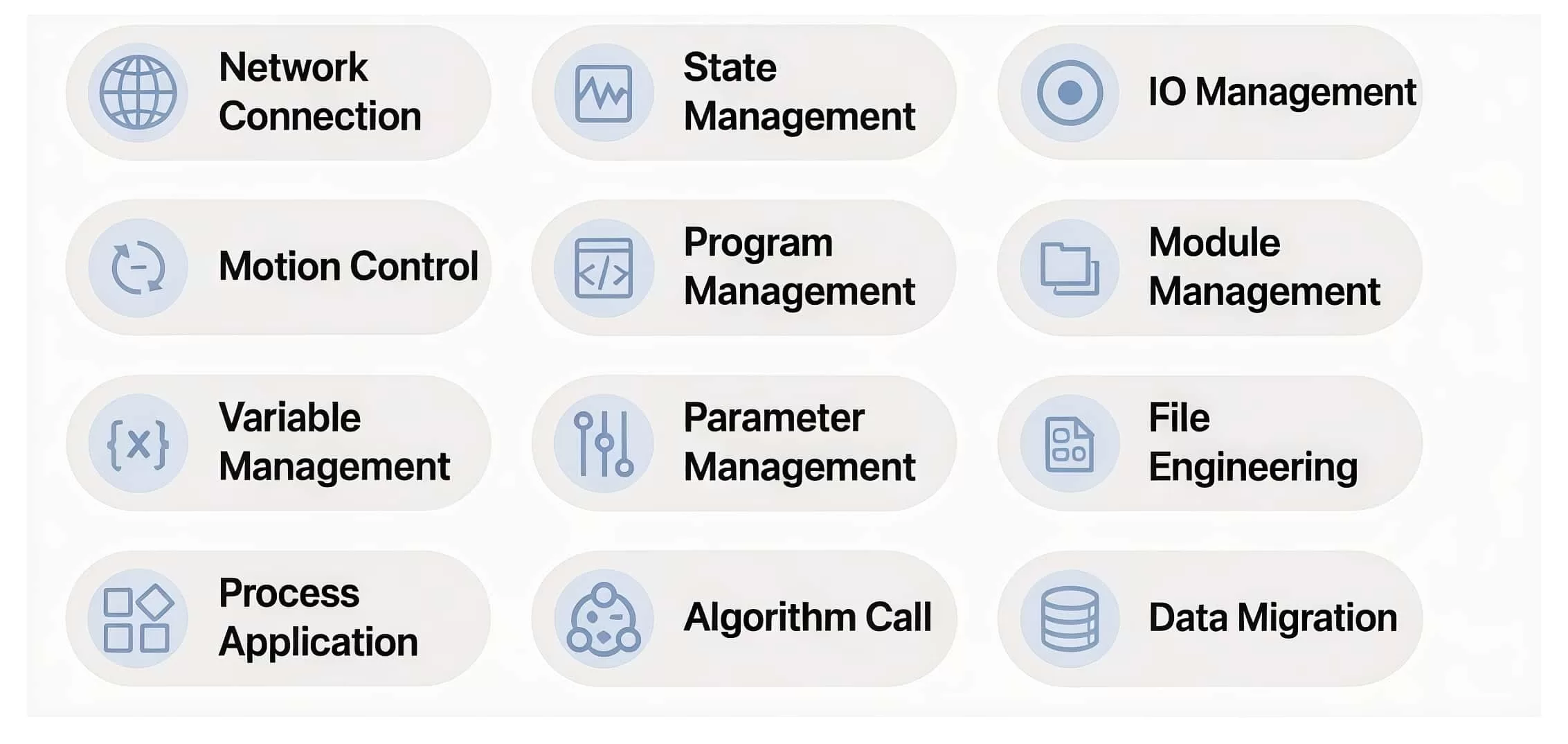
The controller supports multiple programming environments, including Python and C++, enabling easier robot integration into products. More than 400 functional interfaces are available.
Functional Categories
Development and Debugging Toolkit
Provides an integrated development and debugging tool kit comprising X-Robot Lab offline programming simulation software and the X-View teach pendant, covering the entire workflow of robot programming, simulation, and on-site commissioning. It delivers end-to-end tool support for robot application development, significantly boosting development efficiency while lowering debugging barriers and project implementation costs.
Application Advantages
Lua Language Programming
Features flexible syntax and a rich ecosystem to support highly efficient development.
Manual Control & Point Tuning
Enables manual fine-tuning of program points to ensure precise motion accuracy.
Visual Simulation
Empowers efficient development with flexible syntax and a rich ecosystem.
Debugging & Data Analysis
Provides one-stop access to all parameters and system states, fully unlocking the value of operational data.
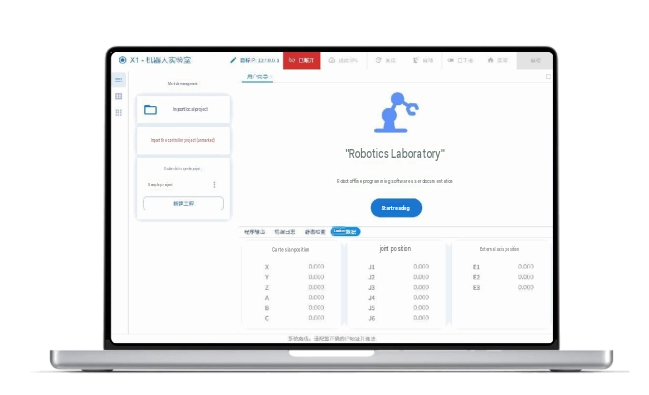
X-Robot Lab
Offline programming simulation software enables efficient robot programming, simulation validation, and application development.
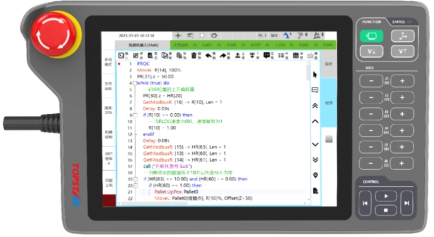
X-View Teach Pendant
Provides intuitive on-site commissioning, parameter adjustment, and system monitoring capabilities.
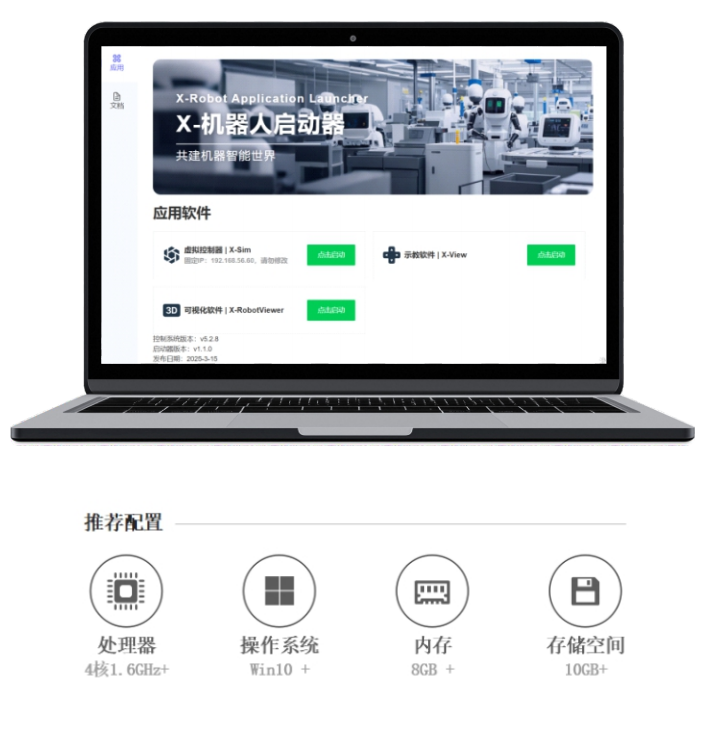
X-Sim Virtual Controller
A purely software-based simulation platform for robot control systems, designed specifically for engineers, students, and hobbyists. Compatible with mainstream personal computers, this software requires just 5 minutes to install, allowing users to fully experience a comprehensive suite of robot control functionalities-including programming, motion control, and process simulation.
Application Advantages
Pure Software Simulation
Significantly reduce learning and development costs.
High Fidelity
The user interface and operational logic are consistent with the actual device.
Scene Visualization
Companion Software Enables Virtual Robot Visualization.
Seamless Migration
Program parameters can be seamlessly imported into a physical robot.