
What Aspects of Mold Temperature Controller Quality Should Be Examined?
2022/05/23 By Topstar
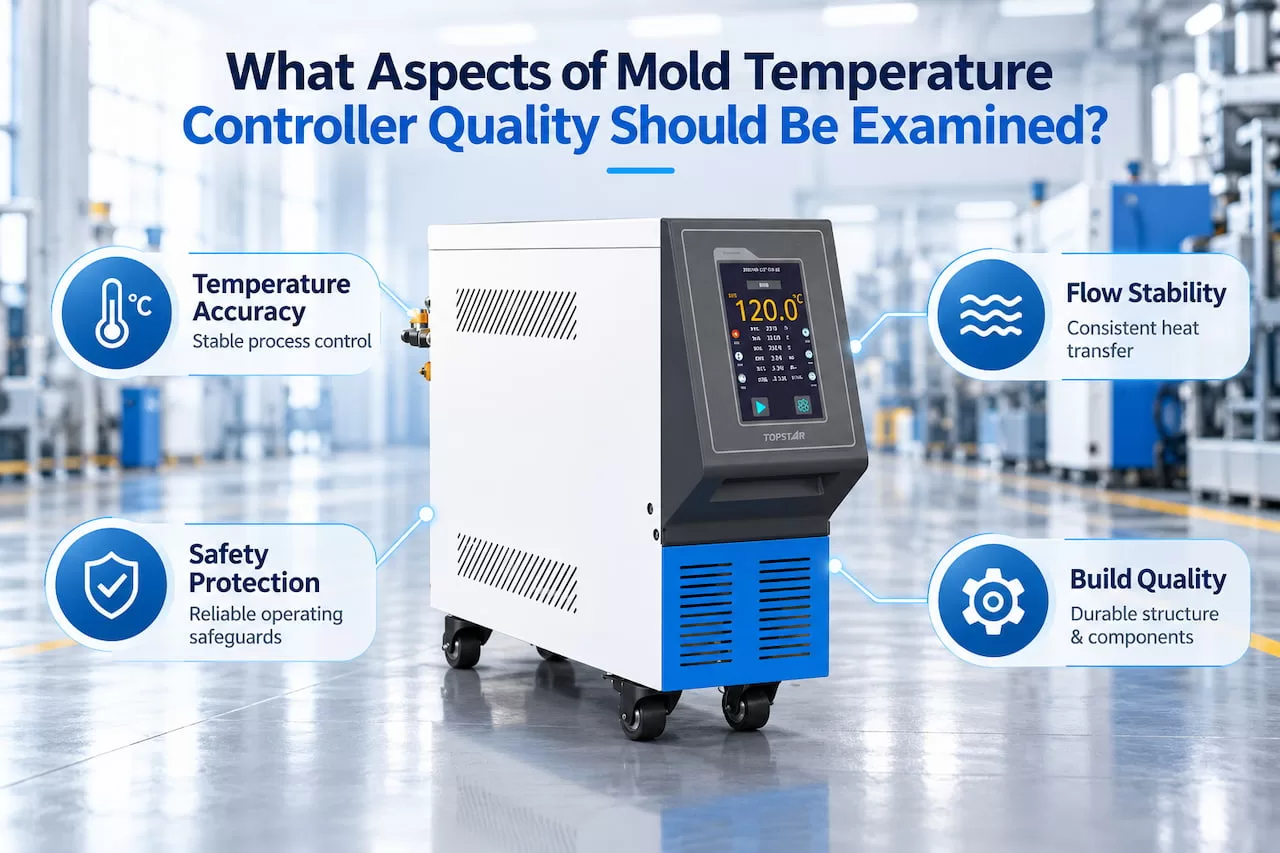
A stable temperature reading alone does not prove a mold temperature controller’s quality. During procurement, focus on the equipment’s temperature performance under load, circulation and heat-transfer capabilities, structural design and protective features, and evidence of long-term reliability. These evaluations will help you determine whether the equipment can consistently maintain the required process conditions throughout production. I recommend comparing the technical specifications with your specific mold conditions, operating temperatures, water quality requirements, and acceptance criteria. A high-quality mold temperature controller should not only deliver quantifiable performance but also be easy to inspect, maintain, and service.
Evaluating Mold Temperature Controller Quality Through Operational Performance
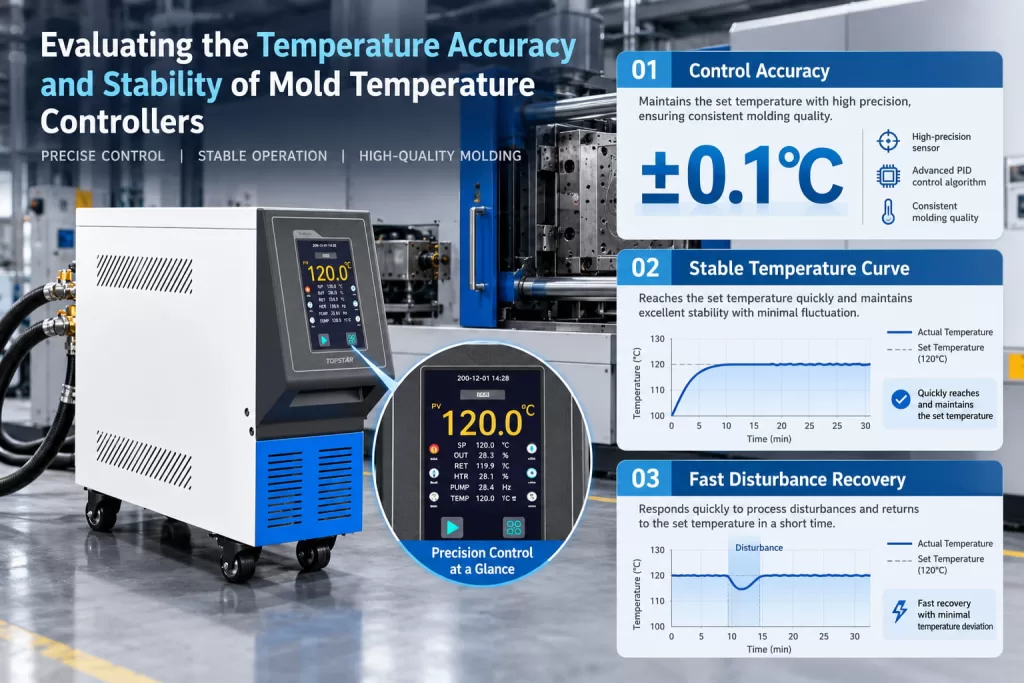
Start by evaluating the process conditions the mold temperature controller must maintain during production. Temperature accuracy and circulation capacity are interdependent: no matter how precise the sensor is, it cannot compensate for insufficient flow; no matter how powerful the pump is, it cannot correct instability in temperature regulation. Therefore, both of these metrics must be verified under representative load conditions.
Evaluating the Temperature Accuracy and Stability of Mold Temperature Controllers
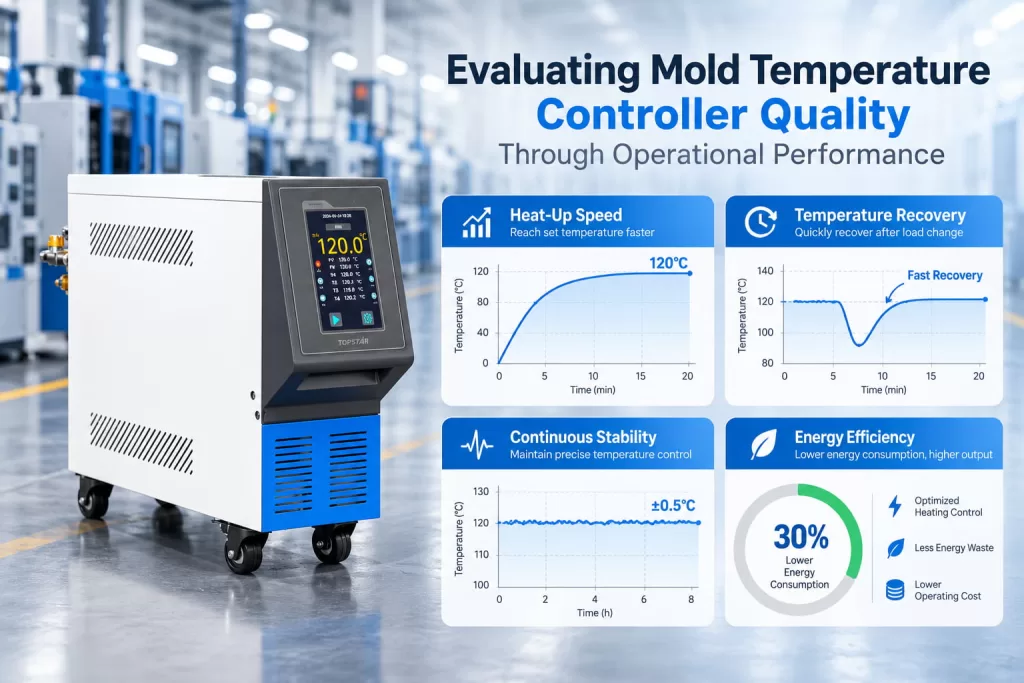
Temperature accuracy and stability can be evaluated across three dimensions:
consistency with calibration standards, temperature fluctuations during stable operation, and the ability to recover temperature after process disturbances.
Sometimes, the controller’s fluctuations may be minimal, yet the actual temperature may still deviate from the setpoint. During acceptance testing, compare the controller’s readings with the calibration standard at the agreed-upon test points. Pay particular attention to recording startup overshoot, temperature fluctuations during steady-state operation, and how quickly the controller recovers when thermal loads change. Clearly define acceptable deviation limits before testing.
In addition, the mold temperature controller’s adaptability to different molds should be evaluated. PID control regulates heating and cooling through temperature feedback, but its parameter settings must match the actual temperature, flow rate, and loop conditions. According to the manufacturer’s guidelines, you may need to retune control parameters when operating conditions change.
When assessing accuracy, rely on actual measurement data under load conditions rather than solely on the display resolution.
Evaluating Mold Temperature Controller Quality Through Cycling, Heating, and Cooling Capabilities
The mold temperature controller must deliver sufficient heat transfer through the connected mold. Verify that the heater’s power rating matches the mold’s mass, temperature-rise requirements, and expected heating time. Also evaluate its cooling capacity based on the available cooling water temperature and flow rate.
For circulation performance, request the pump’s performance curve and account for resistance from hoses, fittings, and mold runners to determine actual operating conditions. Note that maximum flow rate and maximum pressure are independent limit values; never assume the pump can reach both simultaneously.
For example, Topstar’s TTWP-1220 model has specifications of 12 kW heating power, 85 L/min maximum flow rate, and 0.69 MPa maximum pressure. These values represent only the equipment’s upper limits and do not reflect the actual flow rates achievable in a specific mold.
For multi-loop molds, in addition to monitoring the total flow rate, you must verify flow distribution across each loop. By monitoring each parallel circuit, you can identify flow obstructions or restrictions that might be masked by the total flow rate reading. It is recommended to request a live demonstration from the supplier to observe the heating time, supply and return water temperatures, and the stability of the circulation. This approach allows you to confirm whether the selected equipment can meet production cycle requirements and avoid unnecessary downtime or uneven cooling.
Evaluating the Quality of Mold Temperature Controllers Through Design and Validation
Once installed, the equipment must perform reliably. The structural design directly affects leak prevention capabilities and ease of maintenance, while protective features determine how the equipment responds under abnormal operating conditions. Therefore, when making procurement decisions, consider component inspections alongside documented testing and maintenance requirements.
Evaluating Materials, Leak Prevention, and Protective Features
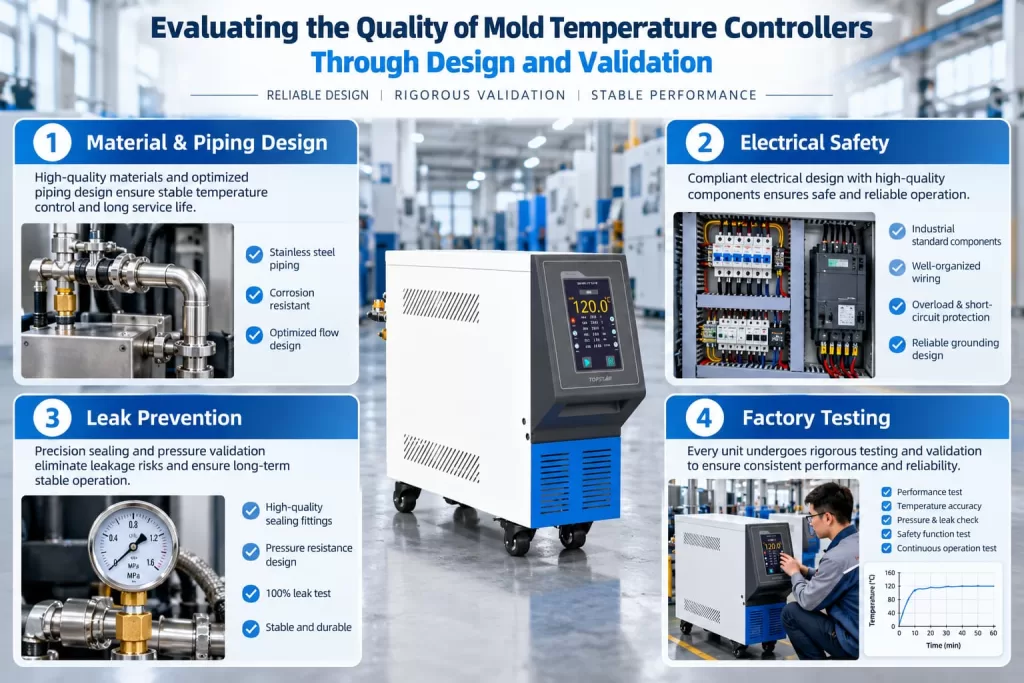
Focus on inspecting components in contact with the medium, pipe connections, heater assemblies, pump seals, and electrical enclosures. Identify which materials will contact the circulating medium, and verify that seals, hoses, and fittings suit the expected temperature, pressure, and medium type.
Pay attention to design details:
Are filters easy to install and remove? Are pipes reliably supported, and are electrical lines properly protected? If routine maintenance requires extensive disassembly, then a so-called “compact” enclosure loses its practical value. Additionally, water quality management must be considered. Filtration systems can remove particulate impurities based on their filtration precision, but they cannot remove dissolved hardness components.
Clearly define the equipment’s response mechanisms for low liquid level, overheating, pump overload, insufficient circulation, or abnormal pressure. These protective functions should be validated by qualified personnel in accordance with manufacturer-approved procedures. The protective mechanisms should trigger appropriate alarms, shut off heating, or execute a controlled shutdown—not merely display warning messages.
Acceptance Criteria and Applicability
Before purchasing a mold temperature controller, the supplier’s commitments should be translated into written acceptance criteria. Both parties must agree on the test medium, connected load, cooling water conditions, measurement locations, and operating duration.
Require the supplier to provide traceable records for the supplied equipment, including model numbers, serial numbers, configuration information, and inspection results. If the supplier claims longer service life or lower energy consumption, ask for comparison benchmarks and operating conditions.
A mold temperature controller’s quality ultimately depends on precise temperature control, sufficient heat-exchange efficiency, a robust and durable structure, effective protection mechanisms, and verifiable performance. Select equipment that demonstrates these qualities under your actual operating conditions, and ensure the supplier can provide the maintenance support needed to sustain long-term performance.
TRENDING POSTS
- TOPS DAY 2026: Turning Industrial AI into Real-World Impact 2022/05/23
- Breaking Through the Full Scene-to-AI Link! Topstar Industrial Data Collection Matrix Achieves Major Technical Breakthro 2022/05/23
- TOPSTAR Selected in “Forbes China AI Top 50” and Wins “2026 Embodied AI Industry Benchmark Award” 2022/05/23
- Topstar Achieves ISO 13849 Functional Safety Certification for Robotics 2022/05/23
HOT TOPIC
- .ervo motor-driven linear robots
- •
- 1.0 guangdong topstar technology co. ltd
- 1.0 topstar china
- 1.0 topstar robot
- 11
- 160℃ mold temperature controller
- 170 ton injection molding machine
- 2
- 21
- 220-ton injection molding machine
- 23
- 260 ton injection molding machine
- 3 axis robot
- 3 axis robots
- 3 in 1 Compact Dehumidifying Dryer
- 3-axis robot
- 3-axis robots
- 39
- 4 axis robot
- 4-axis SCARA robot
- 41
- 460T injection molding machine
- 5-axis CNC machine
- 62
- 90 ton injection molding machine
- accuracy
- Air Chillers
- air-cooled chillers
- all electric injection molding machine
- all electric injection molding machines
- all-electric injection molding machine
- All-electric injection molding machines
- and overall production quality. Therefore
- AP-RubberPlas
- auto cooling system
- auto loader
- Auto Loaders
- automated injection molding machine
- Automation changed engineering
- automation of injection molding robots
- automotive parts injection molding
- Auxiliary Equipment
- auxiliary machine
- Bench Injection Molding Machine
- cabinet dryer
- Cabinet dryer manufacturers
- Cabinet dryers
- cartesian coordinate robot
- Cartesian Coordinate Robots
- Cartesian injection robot
- Cartesian robot
- Central Feeding System
- Central Feeding Systems
- chiller
- CNC Drilling Machine
- CNC Drilling Machines
- cnc engraving machine manufacturer
- cnc laser cutting machine manufacturer
- CNC machine
- CNC Machine Center
- CNC Machine for Sale
- CNC Machine Manufacturing
- CNC Machine Tool
- CNC machine tool product
- CNC Machining Center
- CNC wood carving machine
- Compact Dehumidifying Dryer
- Cooling system
- Cross-Walking Single Axis Servo Cylinder Robot
- Cross-Walking Single-Axis Servo Cylinder Robot
- Cross-Walking Three-Axis/Five-Axis Servo Driven Robot
- cross-walking three-axis/five-axis servo-driven robot
- Dehumidifier Dryer
- Dehumidifying Dryer
- dehumidifying dryers
- delta parallel robot
- Desktop Injection Molding Machine
- Desktop injection molding machines
- Desktop Molding Machine
- desktop plastic injection machine
- Desktop Plastic Injection Molding Machine
- detachable autoloader
- Digital Transformation
- direct clamp injection molding machine
- Direct clamp injection molding machines
- Dosing & mixing system
- Drilling Centers
- Drying and dehumidification system
- drying and dehumidifying equipment
- Drying and Dehumidifying System
- drying system
- effective and efficient. Cabinet dryers are also used in other industries where large quantities of material need to be dried
- efficient injection molding machine
- elbow hydraulic injection molding machines
- electric injection molding machine
- electric injection molding machines
- energy-efficient injection molding robot
- energy-efficient water chiller
- energy-efficient water chillers
- energy-saving injection molding machine
- etc. Among injection molding robots
- exhibition
- features of CNC machine
- Feeding And Conveying System
- Five Axis Machine Center
- Flexible Production Line
- Fully automatic injection molding machine
- Gathering Topstar
- giant injection molding machine
- GMU-600 5-Axis Machining Center
- Granulating & Recycling System
- granulator machine
- gravimetric blender
- Heavy duty injection molding machine
- Heavy-Duty Take-Out Robot
- High-precision electric molding machines
- high-precision plastic molding machines
- high-speed all electric injection molding machine
- high-speed electric injection molding machine
- High-Speed Packaging Injection Molding
- Honeycomb rotor dehumidifier
- hopper dryer
- Hopper Dryers
- horizontal injection molding machine
- Horizontal Injection Molding Machines
- Horizontal Injection Moulding Machine
- Horizontal Mixer manufacturer
- How The CNC Machine Works
- hybrid injection molding machine
- hydraulic injection molding machine
- Hydraulic Injection Molding Machines
- in this article
- Industrial AI
- Industrial Automation
- Industrial robot
- Industrial Robot Chinese brand
- industrial robot parts
- industrial robot supplier
- Industrial robots
- Industry Chain
- Injection Manipulator
- injection manipulator robot
- injection mold machines
- Injection molding
- Injection molding automation
- Injection Molding Automation Solution
- injection molding dryer
- Injection molding equipment
- injection molding hopper dryer
- Injection molding machine
- injection molding machine brand
- Injection Molding Machine Factory
- Injection Molding Machine Manufacture
- Injection molding machine manufacturer
- injection molding machine manufacturers
- Injection molding machine procurement
- injection molding machine robotic arm
- injection molding machine with a robot
- Injection molding machines
- injection molding material dehumidifying
- injection molding plant
- injection molding process
- Injection Molding Robot
- injection molding robot arm
- Injection molding robot automation
- Injection molding robotic arm
- injection molding robots
- injection molding whole plant
- injection moulding dryer
- Injection moulding machine
- injection moulding machines
- Injection Moulding Robots
- Injection Robot
- Injection robot arm
- Injection robot manufacturer
- Injection robot wholesale
- injection robots
- Intelligent Factory
- intelligent injection molding machines
- Intelligent Manufacturing
- intelligent mold temperature
- intelligent mold temperature controller
- Intelligent mould temperature controller
- intelligent whole plant solution
- InterPlas Thailand 2025
- Introducing Injection Robot
- It is the best choice for drying large quantities of material at once. Cabinetmakers use these machines because they are fast
- Large flow water type mold temperature controller
- large injection molding machine
- large injection molding machines
- Learn what industrial automation and robotics is
- linear robot
- linear robots
- low speed sound-proof granulator
- machine plastic molding
- make sure to add some! Improvements (2) Keyphrase in introduction: Your keyphrase or its synonyms appear in the first paragraph of the copy
- manipulator machine
- manufacturing
- Manufacturing Innovation
- medical grade injection molding machines
- Medical Injection Molding
- medical injection molding machine
- medical injection molding machines
- micro injection molding machine
- middle speed granulator
- Mini CNC machine manufacturers.
- mobile cover making machine
- Mold Temperature Control System
- mold temperature controller
- mold temperature controllers
- molding machine
- molding material Dehumidifying System
- mould temperature control system
- mould temperature controller
- mould temperature controller
- mould temperature controllers
- New electric injection molding machine
- Nitrogen Dryer
- nitrogen dryer manufacturer
- nitrogen dryer system manufacturer
- Oil type mold temperature controller
- Oil type mold temperature controllers
- open day
- optical component injection molding
- Optical-grade dehumidifying dryer
- Outbound links: No outbound links appear in this page. Add some! Images: No images appear on this page. Add some! Internal links: No internal links appear in this page
- packaging injection molding
- Packaging Solutions
- PET Preform injection molding
- phone case maker machine
- phone case making machine
- phone cover making machine
- PID Control Mold Temperature Controller
- plastic auto loader
- plastic bottle making machine
- plastic bottle manufacturing
- plastic bucket making machine
- plastic bucket manufacturing
- Plastic chair making machine
- plastic dryer for injection molding
- plastic forming equipment
- Plastic Granulator
- Plastic Granulators
- plastic hopper dryer
- plastic injection machine
- plastic injection machines
- plastic injection molding
- Plastic injection molding equipment
- Plastic injection molding machine
- Plastic Injection Molding Machines
- plastic injection moulding machine
- plastic injection moulding machines
- plastic injection robot
- plastic molding
- Plastic Molding Industry
- Plastic Molding machine
- plastic molding machine 1
- Plastic Molding Machines
- plastic molding press
- plastic moulding machine
- plastic phone case making machine
- plastic-molding machine
- powerful granulator
- Powerful Type Sound-Proof Granulator
- precision injection molding
- precision injection molding machines
- production of plastic seats
- pure water mould temperature controller
- Robot injection molding
- robot injection molding machine
- robot manufacturing companies
- Robotic arm for injection molding machine
- robotic injection molding machines
- robotics in injection molding
- SCARA robot
- SCARA robots
- Screw dosers
- Service-oriented manufacturing
- Servo Cylinder Robot
- servo driven robot
- Servo Driven Robots
- servo injection molding machine
- servo injection robots
- servo motor-driven linear robots
- servo-driven 3-axis robot
- Servo-driven injection molding machine
- Servo-Driven Robot
- Setup of injection machine
- Silicone Injection Molding Machine
- six-axis industrial robot
- Smart Manufacturing
- soundproof granulator
- Sprue Picker
- Stainless Hopper Dryer
- Stainless Hopper Dryers
- star club
- swing arm robot
- T1 Cartesian injection robot
- take-out robot
- take-out robots
- Thailand 4.0
- the choice between servo-driven robots and hydraulic robots will have a certain impact on efficiency
- the most popular injection molding machine
- the type of injection molding robot
- TIC2000 Control System
- TMII injection molding machine
- toggle clamp injection molding machine
- Toggle Hydraulic Injection Molding Machines
- toggle injection molding machine
- Top 10 brands of injection robots
- Topstar
- Topstar Electric Injection Molding Machine InterPlas Thailand 2025 Smart Manufacturing Thailand 4.0
- Topstar Engineering
- Topstar Industrial Robots
- Topstar injection molding intelligent
- Topstar Scara Robots
- Useful Injection molding machine
- Vertical machining centers
- volumetric type blender
- Washing Machine Case Molding Solution
- water chiller
- water chillers
- water distributor
- water type mold temperature controller
- Water Type MoldTemperature Controller
- Water-Cooled Chillers
- Water-cooled Mold Temperature Controller
- water-type mold temperature controller
- Water-Type Mould Temperature Controllers
- We often face choices when performing injection molding. We will choose the type of injection molding machine
- wholesale of injection molding machines
- x carve CNC
- 热门查询 点击次数 展示 排名 topstar