
What are the characteristics of central feeding systems used in the automotive parts industry?
2026/06/29 By le zhan
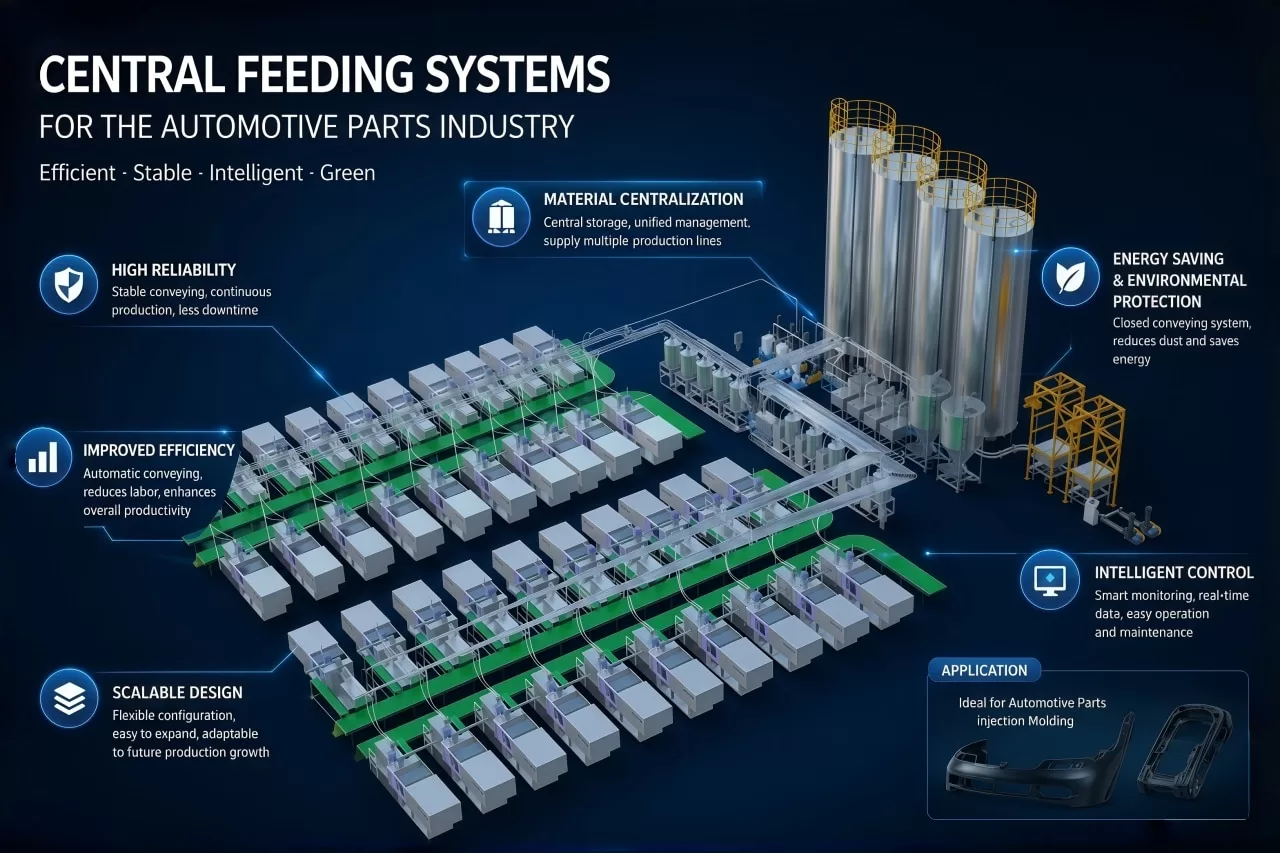
Many high-output automotive parts factories face challenges with their material handling: reliance on manual handling, isolated hoppers, and scattered drying equipment and auxiliary machinery. Operators manually load materials, and technicians manually adjust drying parameters.
As the entire automotive parts supply chain demands ever-higher standards for product precision control, the high costs associated with this traditional model have become unsustainable.
Topstar has designed a central feeding system specifically to meet the high-precision manufacturing needs of automotive parts factories. It integrates precise material ratios, end-to-end automation, innovative energy management, and broad applicability to create a highly integrated, intelligent control platform. This system addresses the issues of high energy consumption, high labor costs, and management difficulties associated with traditional centralized material supply in factories.
Precision and Stability: The Core of Central Feeding systems
All other capabilities of a central feeding system—such as automation levels, energy efficiency, and environmental compliance—are built upon the ability to continuously, precisely, and stably deliver the “right materials.” Otherwise, even the most advanced automated feeding system will produce inconsistent results, thereby compromising the quality of downstream processes.
Precision in Central Feeding Systems
In automotive parts production, resins are rarely used directly in their raw form. Typically, color concentrates, UV stabilizers, impact modifiers, flame retardants, and glass fiber reinforcements must be blended with the base resin in strict proportions to meet the mechanical properties and aesthetic requirements of each component. Any error in the mix ratio can lead to color variations in parts, reduced impact resistance, changes in surface finish, or even mechanical properties that fall outside the specified tolerance range.
Topstar’s central feeding system addresses this challenge through technologies such as automatic material selection stations and weighing and metering machines, ensuring that material ratios remain within acceptable limits during continuous production. Regardless of variations in bulk density, ambient humidity, or batch characteristics, the system guarantees that the mixed material entering each injection molding machine meets the target specifications.
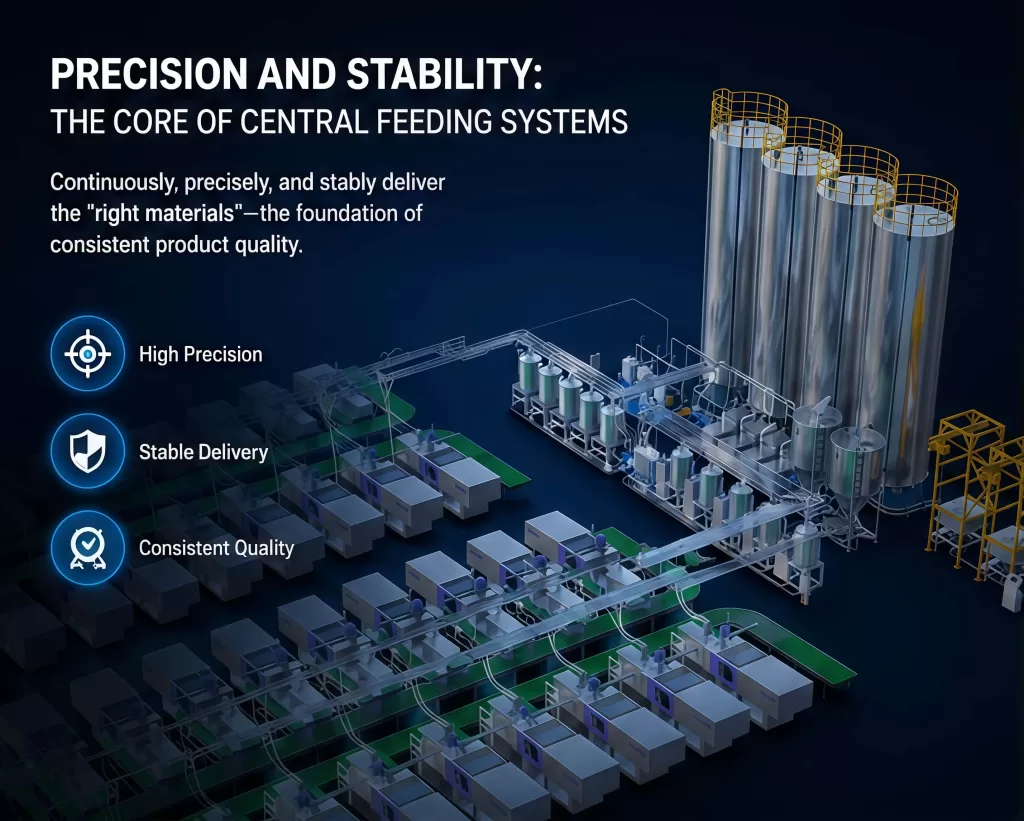
Operational Stability of the Central Feeding Systems
Operational stability is another key pillar of this system. If an automatic material feeding system can only achieve precise mixing ratios intermittently, it cannot meet the high demands for process reliability in automotive production. Topstar’s central feeding system ensures operational stability through robust mechanical design, optimized speed control for conveying, and intelligent monitoring of key system parameters.
Building End-to-End Automated Production
In automotive parts manufacturing plants, localized automation alone often fails to resolve related issues or maximize efficiency. Therefore, to truly establish an end-to-end unmanned
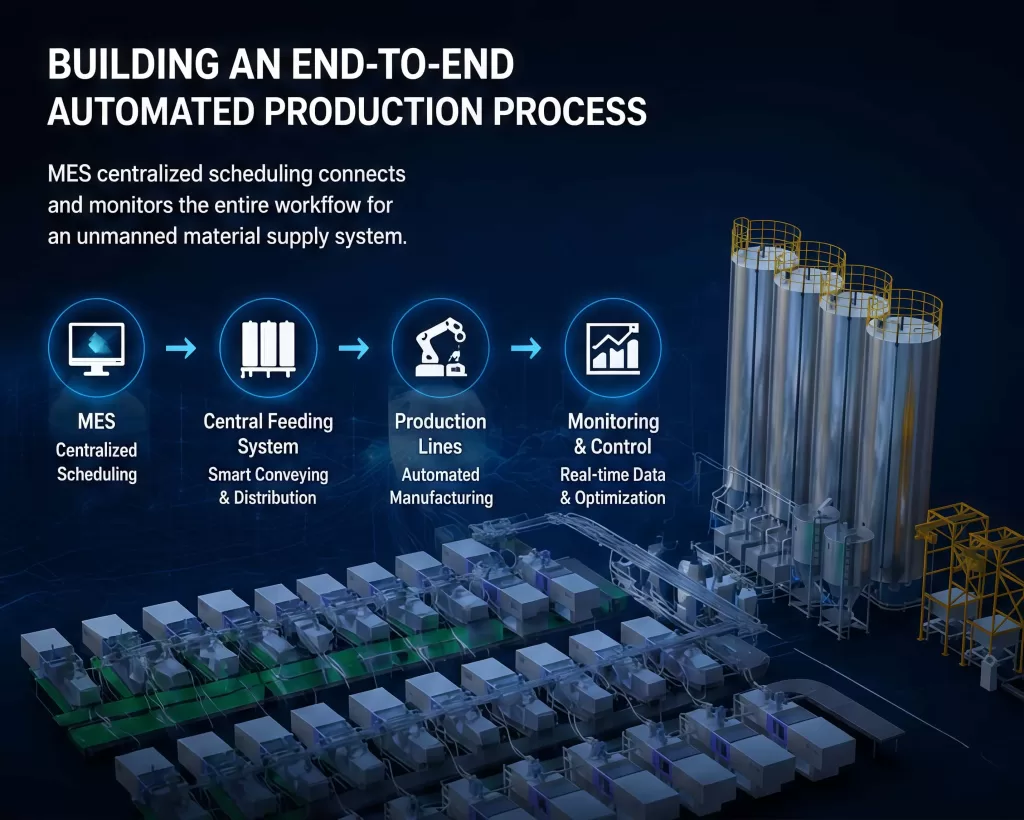
In a central feeding system, it is necessary to monitor the entire production process through central dispatch via the MES, with unified control and coordination.
Centralized MES Scheduling
The Topstar central feeding system uses the MES’s centralized scheduling function to directly interconnect material supply operations with production plans, equipment status data, and the quality management system. Serving as the intelligent core layer, the MES coordinates every aspect of the automatic material feeding system in response to real-time production demands. This includes seamless integration with intelligent warehousing, AGV transportation, robotic automatic feeding, intelligent dehumidification and drying systems, automatic material change stations, and more. Once a production order is released, the MES automatically identifies the required material types, quantities, delivery timing, and destination machines, then launches the entire workflow without requiring operators to issue step-by-step instructions.
The MES triggers and monitors the entire switching process from start to finish. As a result, it creates a fully unmanned, end-to-end material supply chain, controlling and tracking every material handling operation—from the warehouse all the way to the injection molding machine—while ensuring that every step follows the same standardized procedures.
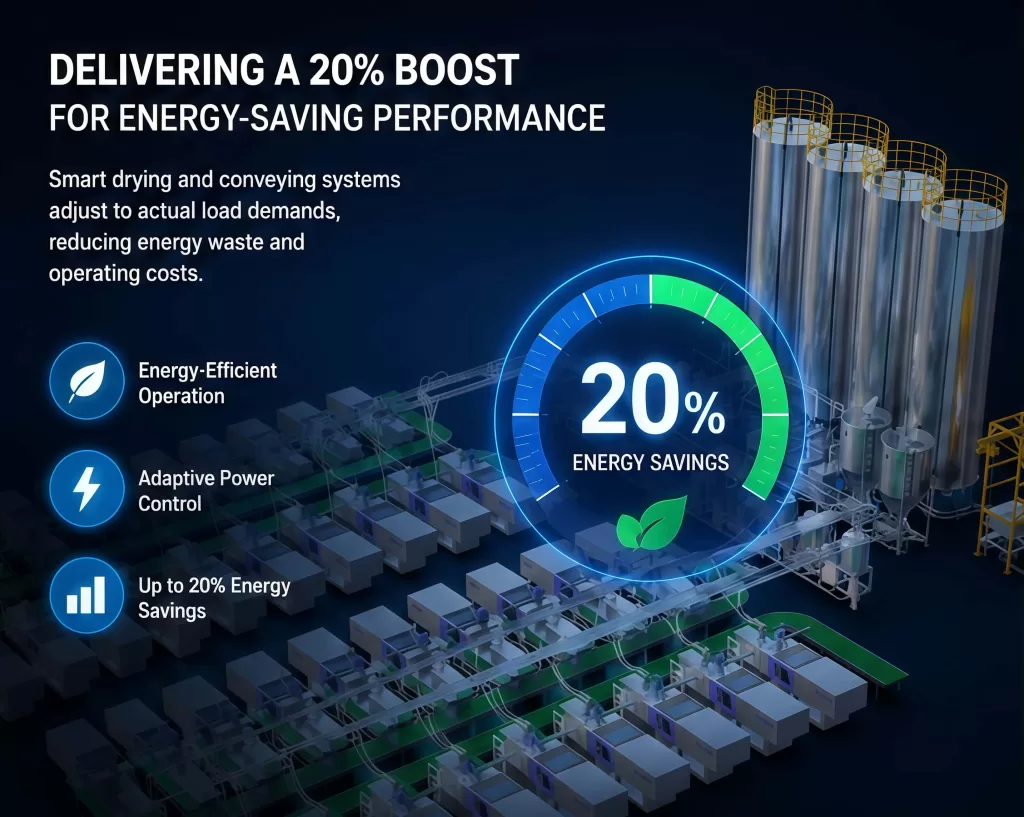
Delivering 20% Energy Savings for Automotive Parts Factories
In any factory, energy consumption is one of the highest operating costs. The drying and conveying processes are the two biggest energy consumers in material handling systems; they must operate continuously to support multi-shift production schedules, and the resulting energy costs accumulate over time. Traditional drying and dehumidification systems typically run at a fixed power level and cannot adjust to actual production demands. As a result, they often waste energy whenever production drops below full capacity or during periods such as mold changes, scheduled maintenance, and routine breaks.
Intelligent Variable-Frequency Drying and Energy-Efficient Variable-Frequency Conveying
Topstar’s automatic material feeding system enhances energy efficiency on the shop floor through two complementary technologies: intelligent variable-frequency drying and energy-efficient variable-frequency conveying.
Intelligent variable-frequency drying technology uses variable-frequency drives to control the heating and airflow systems of central dryers, continuously adjusting input power based on the actual drying load.
- When production rates are high and material throughput reaches its peak, the dryer operates at full load.
- When throughput decreases, the variable-frequency control system proportionally reduces both heating power and airflow intensity;
This dynamic power-matching mechanism, based on real-time load monitoring and temperature feedback, eliminates the energy waste caused by fixed power input in traditional drying systems.
Energy-saving variable-frequency conveying technology applies the same principle to the central material conveying network. Conveying fans and vacuum generators no longer operate at a fixed maximum output power but continuously adjust their rotational speed based on demand. While ensuring reliable conveying, this approach avoids the excessively high flow rates, pressures, and turbulence caused by excessive power in fixed-speed systems.
The combined use of these two variable-frequency technologies can achieve energy savings of over 20% compared to traditional fixed-power drying and conveying systems.
Reducing Dust Pollution in Factories Through Centralized Material Supply Systems
In modern automotive parts manufacturing plants, environmental performance has become an indispensable characteristic alongside energy efficiency. Resin dust generated during material conveying, feeding, metering, and mixing poses a threat to worker health and presents challenges for environmental compliance. If not effectively captured, fine polymer particles dispersed into the workshop air may not only exceed occupational exposure limits and result in regulatory violations but also pose secondary quality risks when they settle on mold surfaces or material handling equipment.
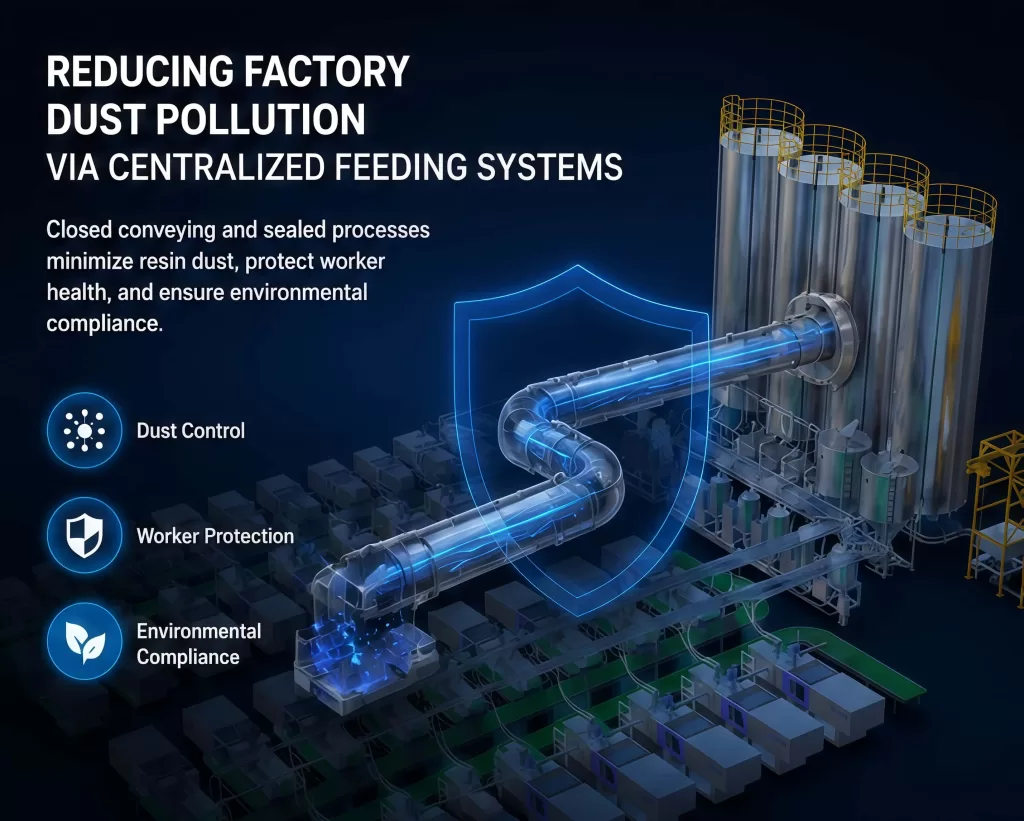
Centralized Dust Collection in Central Feeding Systems Reduces Dust Pollution
Decentralized material handling systems are inherently difficult to design for effective dust control. Each hopper, mixer, and conveyor line acts as a separate dust source; the cumulative effect of numerous independent dust sources within a large production facility results in elevated airborne particulate concentrations, which localized “point-of-use” extraction systems often struggle to control effectively.
Topstar’s centralized material supply system integrates centralized dust collection directly into the material conveying architecture. Rather than attempting to capture dust at numerous independent generation points, it consolidates material-handling operations at a central station. It uses a high-capacity dust-collection system to efficiently capture particulate matter from all sources simultaneously.
This centralized dust-collection architecture ensures that airborne particulate concentrations throughout the workshop consistently remain below environmental and occupational health standards. For automotive parts suppliers operating under specific certification frameworks—such as the environmental requirements of ISO 14001 and IATF 16949—this reliable environmental compliance capability not only helps ensure regulatory compliance but also meets the requirements of major automotive customers regarding suppliers’ audit readiness.
Automated Central Feeding Systems for the Automotive Industry and Beyond
A key distinction between a truly mature central material supply system and application-specific solutions is the former’s ability to serve a wide range of industries and manufacturing processes without requiring a fundamental redesign. Topstar’s centralized feeding solutions have not only been successfully applied in the manufacturing of various automotive components. Still, they are also widely used in home appliances, 3C electronics, medical devices, and other precision manufacturing sectors. This architectural flexibility, process adaptability, and versatility make it an intelligent, multifunctional platform that manufacturers can uniformly adopt across various production environments, thereby maximizing the return on their infrastructure investments.
Process Upgrades Enhance Factory Competitiveness
The high precision and stability, end-to-end automation, innovative energy-efficiency optimization, and broad applicability of central material supply systems have transformed the decentralized, labor-intensive production models that are still prevalent in most factories today. From multiple perspectives, when Topstar’s central material system replaces traditional material-handling methods, labor productivity, material utilization, energy costs, quality consistency, environmental compliance, and production flexibility improve.
TRENDING POSTS
- Breaking Through the Full Scene-to-AI Link! Topstar Industrial Data Collection Matrix Achieves Major Technical Breakthro 2026/06/29
- TOPSTAR Selected in “Forbes China AI Top 50” and Wins “2026 Embodied AI Industry Benchmark Award” 2026/06/29
- Topstar Achieves ISO 13849 Functional Safety Certification for Robotics 2026/06/29
- Topstar Completes Key Puzzle in Embodied Intelligence Data Closed Loop — Industrial AI Capability Foundation Now in Place 2026/06/29
HOT TOPIC
- .ervo motor-driven linear robots
- •
- 1.0 guangdong topstar technology co. ltd
- 1.0 topstar china
- 1.0 topstar robot
- 11
- 160℃ mold temperature controller
- 170 ton injection molding machine
- 2
- 21
- 220-ton injection molding machine
- 23
- 260 ton injection molding machine
- 3 axis robot
- 3 axis robots
- 3 in 1 Compact Dehumidifying Dryer
- 3-axis robot
- 3-axis robots
- 39
- 4 axis robot
- 4-axis SCARA robot
- 41
- 460T injection molding machine
- 5-axis CNC machine
- 62
- 90 ton injection molding machine
- accuracy
- Air Chillers
- air-cooled chillers
- all electric injection molding machine
- all electric injection molding machines
- all-electric injection molding machine
- All-electric injection molding machines
- and overall production quality. Therefore
- AP-RubberPlas
- auto cooling system
- auto loader
- Auto Loaders
- automated injection molding machine
- Automation changed engineering
- automation of injection molding robots
- automotive parts injection molding
- Auxiliary Equipment
- auxiliary machine
- Bench Injection Molding Machine
- cabinet dryer
- Cabinet dryer manufacturers
- Cabinet dryers
- cartesian coordinate robot
- Cartesian Coordinate Robots
- Cartesian injection robot
- Cartesian robot
- Central Feeding System
- Central Feeding Systems
- chiller
- CNC Drilling Machine
- CNC Drilling Machines
- cnc engraving machine manufacturer
- cnc laser cutting machine manufacturer
- CNC machine
- CNC Machine Center
- CNC Machine for Sale
- CNC Machine Manufacturing
- CNC Machine Tool
- CNC machine tool product
- CNC Machining Center
- CNC wood carving machine
- Compact Dehumidifying Dryer
- Cooling system
- Cross-Walking Single Axis Servo Cylinder Robot
- Cross-Walking Single-Axis Servo Cylinder Robot
- Cross-Walking Three-Axis/Five-Axis Servo Driven Robot
- cross-walking three-axis/five-axis servo-driven robot
- Dehumidifier Dryer
- Dehumidifying Dryer
- dehumidifying dryers
- delta parallel robot
- Desktop Injection Molding Machine
- Desktop injection molding machines
- Desktop Molding Machine
- desktop plastic injection machine
- Desktop Plastic Injection Molding Machine
- detachable autoloader
- Digital Transformation
- direct clamp injection molding machine
- Direct clamp injection molding machines
- Dosing & mixing system
- Drilling Centers
- Drying and dehumidification system
- drying and dehumidifying equipment
- Drying and Dehumidifying System
- drying system
- effective and efficient. Cabinet dryers are also used in other industries where large quantities of material need to be dried
- efficient injection molding machine
- elbow hydraulic injection molding machines
- electric injection molding machine
- electric injection molding machines
- energy-efficient injection molding robot
- energy-efficient water chiller
- energy-efficient water chillers
- energy-saving injection molding machine
- etc. Among injection molding robots
- exhibition
- features of CNC machine
- Feeding And Conveying System
- Five Axis Machine Center
- Flexible Production Line
- Fully automatic injection molding machine
- Gathering Topstar
- giant injection molding machine
- GMU-600 5-Axis Machining Center
- Granulating & Recycling System
- granulator machine
- gravimetric blender
- Heavy duty injection molding machine
- Heavy-Duty Take-Out Robot
- High-precision electric molding machines
- high-precision plastic molding machines
- high-speed all electric injection molding machine
- high-speed electric injection molding machine
- High-Speed Packaging Injection Molding
- Honeycomb rotor dehumidifier
- hopper dryer
- Hopper Dryers
- horizontal injection molding machine
- Horizontal Injection Molding Machines
- Horizontal Injection Moulding Machine
- Horizontal Mixer manufacturer
- How The CNC Machine Works
- hybrid injection molding machine
- hydraulic injection molding machine
- Hydraulic Injection Molding Machines
- in this article
- Industrial AI
- Industrial Automation
- Industrial robot
- Industrial Robot Chinese brand
- industrial robot parts
- industrial robot supplier
- Industrial robots
- Industry Chain
- Injection Manipulator
- injection manipulator robot
- injection mold machines
- Injection molding
- Injection molding automation
- Injection Molding Automation Solution
- injection molding dryer
- Injection molding equipment
- injection molding hopper dryer
- Injection molding machine
- injection molding machine brand
- Injection Molding Machine Factory
- Injection Molding Machine Manufacture
- Injection molding machine manufacturer
- injection molding machine manufacturers
- Injection molding machine procurement
- injection molding machine robotic arm
- injection molding machine with a robot
- Injection molding machines
- injection molding material dehumidifying
- injection molding plant
- injection molding process
- Injection Molding Robot
- injection molding robot arm
- Injection molding robot automation
- Injection molding robotic arm
- injection molding robots
- injection molding whole plant
- injection moulding dryer
- Injection moulding machine
- injection moulding machines
- Injection Moulding Robots
- Injection Robot
- Injection robot arm
- Injection robot manufacturer
- Injection robot wholesale
- injection robots
- Intelligent Factory
- intelligent injection molding machines
- Intelligent Manufacturing
- intelligent mold temperature
- intelligent mold temperature controller
- Intelligent mould temperature controller
- intelligent whole plant solution
- InterPlas Thailand 2025
- Introducing Injection Robot
- It is the best choice for drying large quantities of material at once. Cabinetmakers use these machines because they are fast
- Large flow water type mold temperature controller
- large injection molding machine
- large injection molding machines
- Learn what industrial automation and robotics is
- linear robot
- linear robots
- low speed sound-proof granulator
- machine plastic molding
- make sure to add some! Improvements (2) Keyphrase in introduction: Your keyphrase or its synonyms appear in the first paragraph of the copy
- manipulator machine
- manufacturing
- Manufacturing Innovation
- medical grade injection molding machines
- Medical Injection Molding
- medical injection molding machine
- medical injection molding machines
- micro injection molding machine
- middle speed granulator
- Mini CNC machine manufacturers.
- mobile cover making machine
- Mold Temperature Control System
- mold temperature controller
- mold temperature controllers
- molding machine
- molding material Dehumidifying System
- mould temperature control system
- mould temperature controller
- mould temperature controller
- mould temperature controllers
- New electric injection molding machine
- Nitrogen Dryer
- nitrogen dryer manufacturer
- nitrogen dryer system manufacturer
- Oil type mold temperature controller
- Oil type mold temperature controllers
- open day
- optical component injection molding
- Optical-grade dehumidifying dryer
- Outbound links: No outbound links appear in this page. Add some! Images: No images appear on this page. Add some! Internal links: No internal links appear in this page
- packaging injection molding
- Packaging Solutions
- PET Preform injection molding
- phone case maker machine
- phone case making machine
- phone cover making machine
- PID Control Mold Temperature Controller
- plastic auto loader
- plastic bottle making machine
- plastic bottle manufacturing
- plastic bucket making machine
- plastic bucket manufacturing
- Plastic chair making machine
- plastic dryer for injection molding
- plastic forming equipment
- Plastic Granulator
- Plastic Granulators
- plastic hopper dryer
- plastic injection machine
- plastic injection machines
- plastic injection molding
- Plastic injection molding equipment
- Plastic injection molding machine
- Plastic Injection Molding Machines
- plastic injection moulding machine
- plastic injection moulding machines
- plastic injection robot
- plastic molding
- Plastic Molding Industry
- Plastic Molding machine
- plastic molding machine 1
- Plastic Molding Machines
- plastic molding press
- plastic moulding machine
- plastic phone case making machine
- plastic-molding machine
- powerful granulator
- Powerful Type Sound-Proof Granulator
- precision injection molding
- precision injection molding machines
- production of plastic seats
- pure water mould temperature controller
- Robot injection molding
- robot injection molding machine
- robot manufacturing companies
- Robotic arm for injection molding machine
- robotic injection molding machines
- robotics in injection molding
- SCARA robot
- SCARA robots
- Screw dosers
- Service-oriented manufacturing
- Servo Cylinder Robot
- servo driven robot
- Servo Driven Robots
- servo injection molding machine
- servo injection robots
- servo motor-driven linear robots
- servo-driven 3-axis robot
- Servo-driven injection molding machine
- Servo-Driven Robot
- Setup of injection machine
- Silicone Injection Molding Machine
- six-axis industrial robot
- Smart Manufacturing
- soundproof granulator
- Sprue Picker
- Stainless Hopper Dryer
- Stainless Hopper Dryers
- star club
- swing arm robot
- T1 Cartesian injection robot
- take-out robot
- take-out robots
- Thailand 4.0
- the choice between servo-driven robots and hydraulic robots will have a certain impact on efficiency
- the most popular injection molding machine
- the type of injection molding robot
- TIC2000 Control System
- TMII injection molding machine
- toggle clamp injection molding machine
- Toggle Hydraulic Injection Molding Machines
- toggle injection molding machine
- Top 10 brands of injection robots
- Topstar
- Topstar Electric Injection Molding Machine InterPlas Thailand 2025 Smart Manufacturing Thailand 4.0
- Topstar Engineering
- Topstar Industrial Robots
- Topstar injection molding intelligent
- Topstar Scara Robots
- Useful Injection molding machine
- Vertical machining centers
- volumetric type blender
- Washing Machine Case Molding Solution
- water chiller
- water chillers
- water distributor
- water type mold temperature controller
- Water Type MoldTemperature Controller
- Water-Cooled Chillers
- Water-cooled Mold Temperature Controller
- water-type mold temperature controller
- Water-Type Mould Temperature Controllers
- We often face choices when performing injection molding. We will choose the type of injection molding machine
- wholesale of injection molding machines
- x carve CNC
- 热门查询 点击次数 展示 排名 topstar