
Why Do Thick-walled Parts Need Higher Mold Water Flow?
2026/09/07 By le zhan
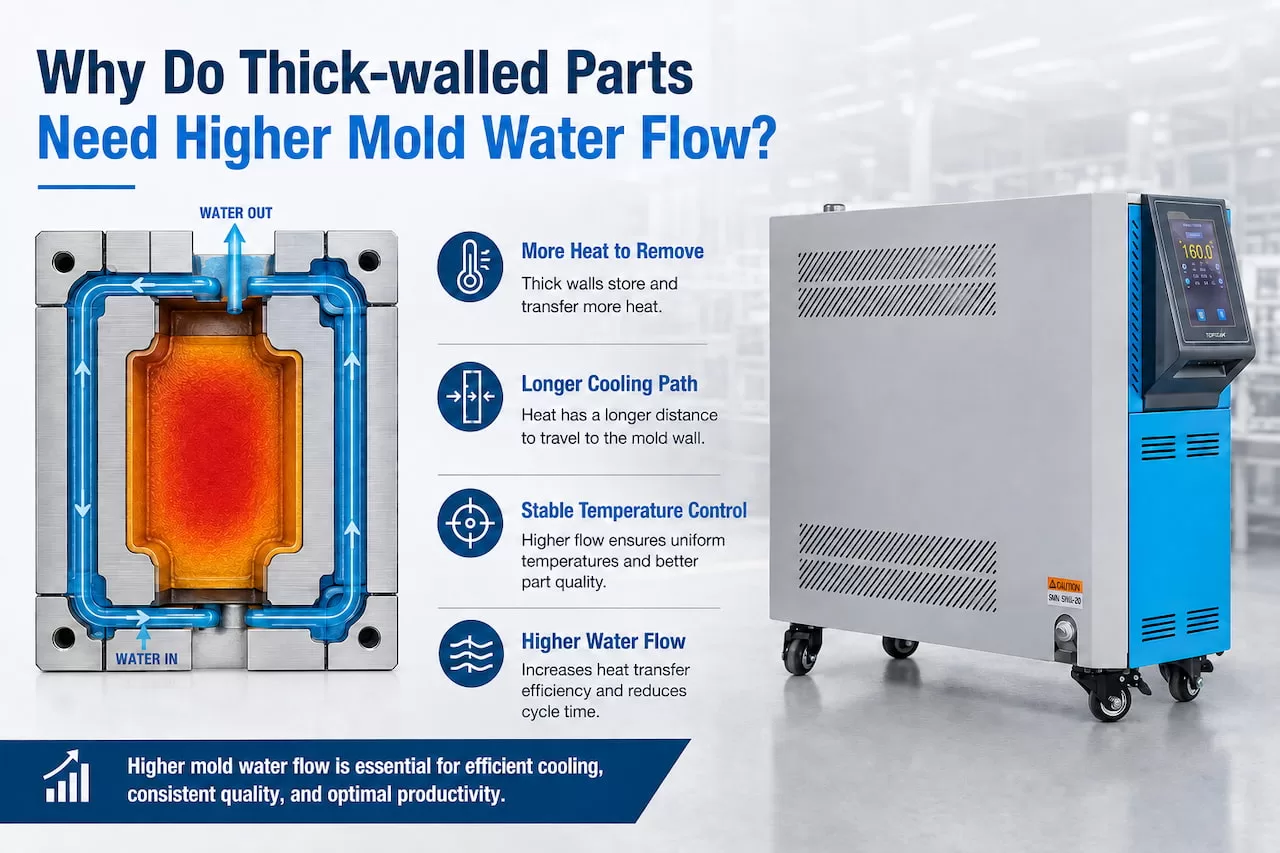
For thick-walled parts, mold temperature control is more than reaching a set temperature. Rather, it involves removing and redistributing large amounts of heat while keeping the mold surface uniformly temperature throughout each molding cycle.
Compared to thin-walled parts, thick-walled plastic products contain more molten material per unit area. As a result, more heat accumulates in the core areas, and solidification takes longer. If the mold water flow rate is insufficient, the cooling water rapidly absorbs heat as it flows through the runner, increasing the inlet-to-outlet temperature difference. This causes different areas of the mold to operate at different temperatures, thereby prolonging cooling time and increasing the risk of shrinkage, sink marks, warpage, or dimensional inconsistencies. For this reason, high-flow mold temperature controllers are required for mold temperature control in automotive parts and other thick-walled injection molding applications.
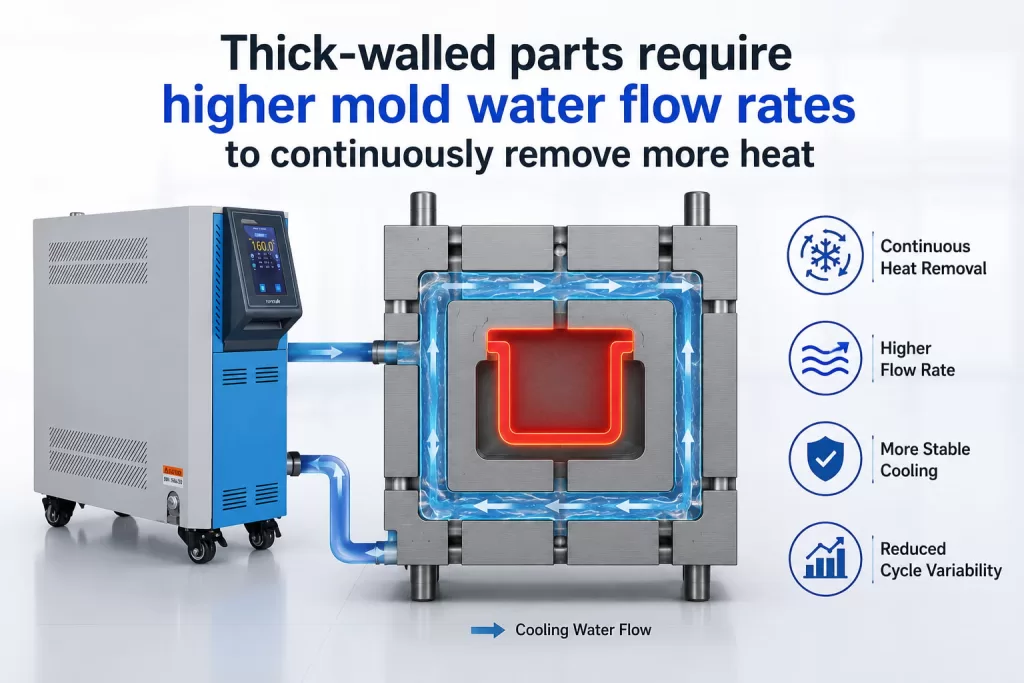
Thick-walled parts require higher mold water flow rates to continuously remove more heat
The main reason thick-walled parts require higher water flow rates is that more material means more accumulated heat must be removed before the part can be safely demolded.
During the injection molding cycle, the temperature of the molten polymer entering the cavity is much higher than the mold temperature. Heat then transfers from the plastic to the mold steel, and then from the mold to the circulating water.
From a simple heat balance perspective:
Heat removed = mass flow rate of water × specific heat capacity × temperature rise of water.
This relationship explains the importance of water flow rate. If the mold has a high heat load but the water flow rate is low, each unit of circulating water must absorb more heat. Consequently, the water’s temperature rise as it flows through the mold increases, leading to a corresponding increase in the temperature difference between the incoming and returning water. Increasing the flow rate means more water flows through the mold in the same amount of time. Under the same heat load, this typically reduces the temperature rise per unit of water and brings the cooling-channel temperature closer to the set target value.
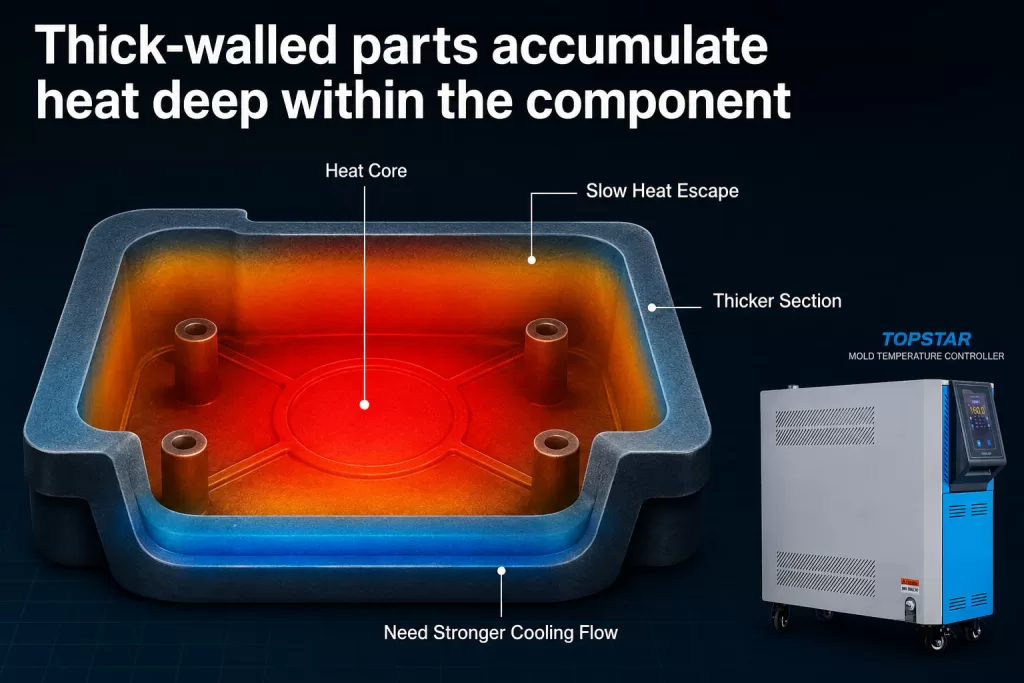
Thick-walled parts accumulate heat deep within the component
Thin-walled parts dissipate heat relatively quickly because the distance between the material center and the mold surface is short. In thick-walled parts, the center is farther from the cooling cavity wall. Even after the outer layer begins to solidify, the center may remain hot for an extended period.
This creates the following temperature gradient:
Hot center → Solidifying intermediate layer → Cooler mold surface → Circulating cooling water
Even if the part’s surface appears solidified, the cooling system must continue removing heat. If the water circulation cannot handle this sustained heat load, the mold temperature will gradually rise. In this situation, the manufacturer may have to extend the cooling time before demolding.
Increasing the mold cooling water flow rate helps the mold temperature controller remove heat continuously, preventing it from accumulating inside the mold.
Thick-walled parts require high flow rates to reduce mold temperature differences
Cooling capacity alone is not enough; you must also consider temperature distribution.
Consider a long mold cooling circuit: the cooling water entering the runner is relatively cool and continuously absorbs heat as it flows through the mold. If the flow rate is too low, the outlet water temperature may be significantly higher than the inlet temperature.
This temperature difference leads to uneven mold temperatures. One part of the cavity may cool faster, while another remains hotter. For thick-walled parts, this unevenness has a significant impact, as the cooling phase accounts for a large proportion of the molding cycle.
The resulting effects include:
- Uneven shrinkage;
- Sink marks;
- Warping;
- Extended demolding time;
- Dimensional deviations.
Increasing the flow rate can reduce the temperature difference as cooling water flows through the circuit, helping maintain a more uniform mould temperature. Therefore, increasing the mold water flow rate is not merely about increasing cooling-water volume; it is about establishing stronger, more uniform heat-transfer conditions throughout the entire mold.
Reducing Cooling Bottlenecks in the Production of Thick-Walled Parts
For many thick-walled parts, injection molding and mold movements are not the most time-consuming stages of the production cycle; instead, cooling is often the bottleneck that affects production efficiency.
Consider a thick-walled automotive component: if it requires a long cooling time before demolding to ensure sufficient rigidity, increasing injection speed will have little effect on shortening the total production cycle. A high-flow mold temperature controller helps the mold return to the required temperature more quickly after each injection. When mould cooling becomes more efficient and uniform, you can reduce unnecessary cooling time while ensuring product quality.
Design of Topstar’s Ultra-High-Flow Mold Temperature Controllers
Because thick-walled products generate higher and longer-lasting thermal loads, traditional mold temperature controllers often struggle to meet the circulation flow rates required for large molds or demanding automotive manufacturing applications.
Topstar’s high-flow mold temperature controllers emphasize high-flow water circulation technology rather than relying solely on increased heating or cooling power. Their technical configuration focuses primarily on three key areas: high-flow circulation, rapid cooling water replacement, and protection of electrical components. (Click here for specific mold temperature controller technology details.)
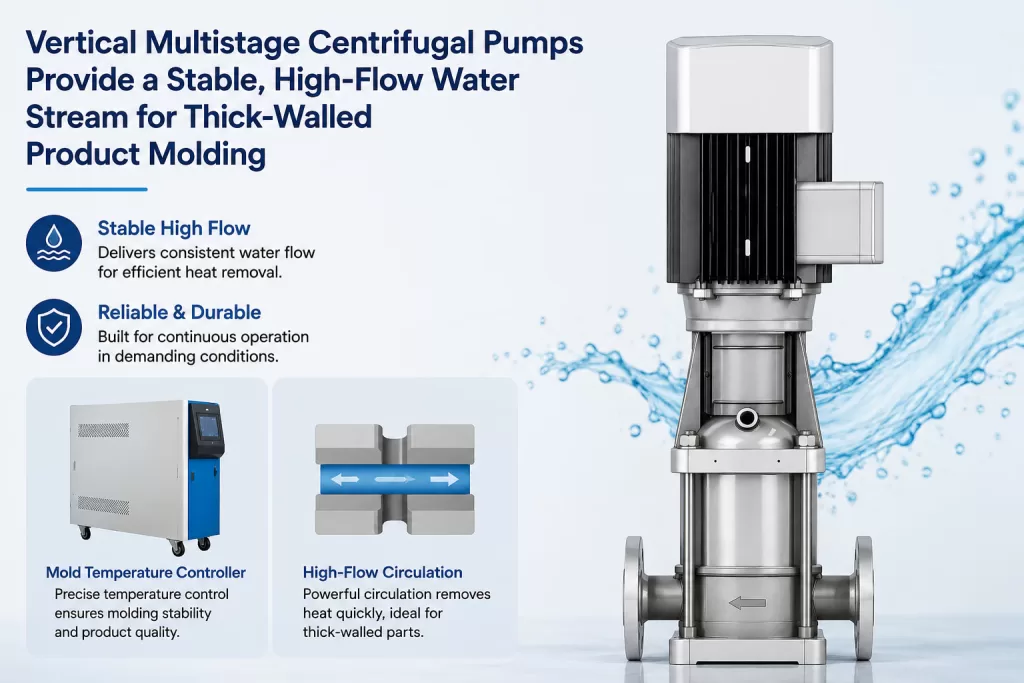
Vertical Multistage Centrifugal Pumps Provide a Stable, High-Flow Water Stream for Thick-Walled Product Molding
A core component of a high-flow mould temperature controller is a vertical multistage centrifugal pump. Its primary function is to deliver a stable, high-flow water stream to the mold’s cooling channels. For large molds, this is critical for two reasons:
First, cooling channels generate flow resistance. Long flow paths, pipe fittings, manifolds, and multiple mold cooling channels all increase the pressure the pump must overcome.
Second, thick-walled product applications require sufficient actual flow within the mold—not merely the theoretically high flow rates measured without accounting for system resistance.
Multistage centrifugal pumps provide the pressure needed to ensure continuous water circulation through complex cooling channels while maintaining high flow rates. This enables ultra-high-flow mold temperature controllers to deliver the following benefits:
- Maintain robust circulation within large molds;
- Achieve more uniform mold temperatures;
- Accelerate heat removal;
- Enhance thermal stability between production cycles.
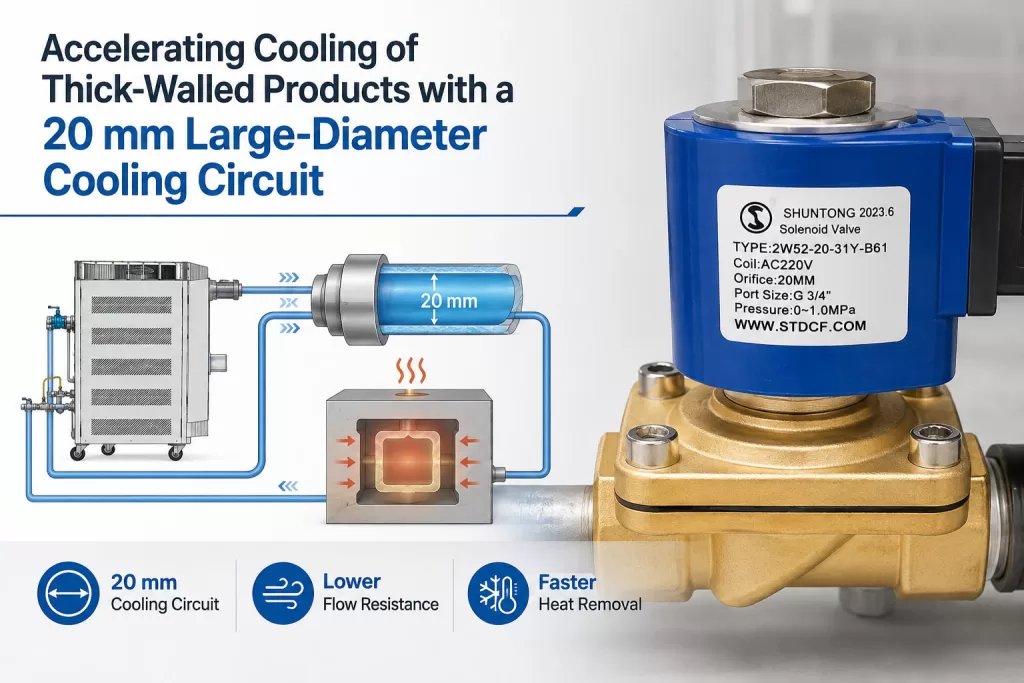
Accelerating Cooling of Thick-Walled Products with a 20 mm Large-Diameter Cooling Circuit
If the cooling water supply channel becomes a bottleneck, the benefits of high flow rates in the mold circuit will be very limited.
Therefore, our high-flow mold temperature controllers incorporate a large-diameter cooling circuit equipped with a 20 mm cooling solenoid valve. The larger flow cross-section enables faster cooling and supports more robust temperature control. It also allows for greater cooling water flow when cooling demands increase.
For thick-walled products, this design is particularly effective when significant heat builds up during continuous molding cycles or when using large molds with substantial thermal mass.
The combined solution of a “vertical multistage centrifugal pump + large-diameter cooling circuit” thus addresses two key requirements: it ensures a greater volume of cooling water flows through the mold while enabling the temperature control system to rapidly dissipate heat when needed.
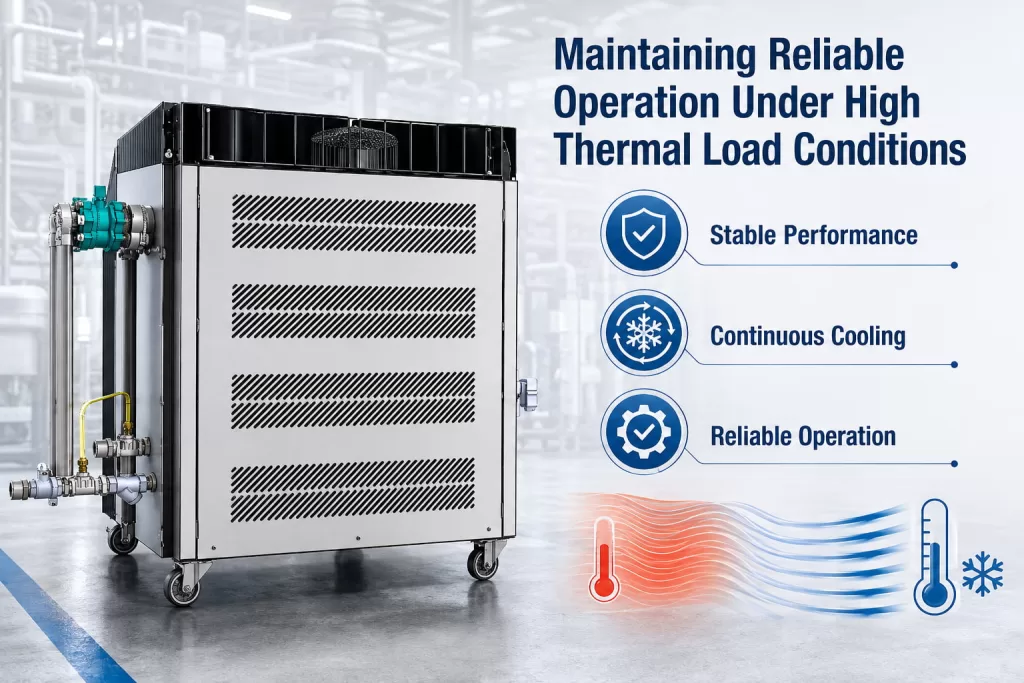
Maintaining Reliable Operation Under High Thermal Load Conditions
Topstar physically separates the electrical control cabinet from the main unit’s high-temperature areas. Although this design does not directly increase water flow, it effectively addresses a challenge in high-heat-load applications: the impact of heat on electrical components. In an integrated enclosure design, heat from piping, pumps, heaters, and the circulating medium can raise the temperature around electrical components. Topstar’s separated enclosure structure isolates these components from high-temperature heat sources, thereby protecting the electrical system.
Manage heat by controlling water flow
Thick-walled parts require a higher mold water flow rate because, compared to thin-walled parts, they store more heat and dissipate it more slowly. Insufficient circulation can lead to uneven cooling-water temperature and mold-temperature distribution, which in turn prolongs cooling time and causes issues such as shrinkage, warpage, sink marks, and dimensional deviations.
Increasing the mold water flow rate removes more heat from the mold, reduces temperature rise in the cooling circuit, improves heat-transfer uniformity, and helps the mold recover faster between molding cycles. When water circulation capacity limits cooling time and mold temperature uniformity, increasing the actual mold water flow rate—rather than simply lowering the set water temperature—is often a more effective solution.
TRENDING POSTS
- TOPS DAY 2026: Turning Industrial AI into Real-World Impact 2026/09/07
- Breaking Through the Full Scene-to-AI Link! Topstar Industrial Data Collection Matrix Achieves Major Technical Breakthro 2026/09/07
- TOPSTAR Selected in “Forbes China AI Top 50” and Wins “2026 Embodied AI Industry Benchmark Award” 2026/09/07
- Topstar Achieves ISO 13849 Functional Safety Certification for Robotics 2026/09/07
HOT TOPIC
- .ervo motor-driven linear robots
- •
- 1.0 guangdong topstar technology co. ltd
- 1.0 topstar china
- 1.0 topstar robot
- 11
- 160℃ mold temperature controller
- 170 ton injection molding machine
- 2
- 21
- 220-ton injection molding machine
- 23
- 260 ton injection molding machine
- 3 axis robot
- 3 axis robots
- 3 in 1 Compact Dehumidifying Dryer
- 3-axis robot
- 3-axis robots
- 39
- 4 axis robot
- 4-axis SCARA robot
- 41
- 460T injection molding machine
- 5-axis CNC machine
- 62
- 90 ton injection molding machine
- accuracy
- Air Chillers
- air-cooled chillers
- all electric injection molding machine
- all electric injection molding machines
- all-electric injection molding machine
- All-electric injection molding machines
- and overall production quality. Therefore
- AP-RubberPlas
- auto cooling system
- auto loader
- Auto Loaders
- automated injection molding machine
- Automation changed engineering
- automation of injection molding robots
- automotive parts injection molding
- Auxiliary Equipment
- auxiliary machine
- Bench Injection Molding Machine
- cabinet dryer
- Cabinet dryer manufacturers
- Cabinet dryers
- cartesian coordinate robot
- Cartesian Coordinate Robots
- Cartesian injection robot
- Cartesian robot
- Central Feeding System
- Central Feeding Systems
- chiller
- CNC Drilling Machine
- CNC Drilling Machines
- cnc engraving machine manufacturer
- cnc laser cutting machine manufacturer
- CNC machine
- CNC Machine Center
- CNC Machine for Sale
- CNC Machine Manufacturing
- CNC Machine Tool
- CNC machine tool product
- CNC Machining Center
- CNC wood carving machine
- Compact Dehumidifying Dryer
- Cooling system
- Cross-Walking Single Axis Servo Cylinder Robot
- Cross-Walking Single-Axis Servo Cylinder Robot
- Cross-Walking Three-Axis/Five-Axis Servo Driven Robot
- cross-walking three-axis/five-axis servo-driven robot
- Dehumidifier Dryer
- Dehumidifying Dryer
- dehumidifying dryers
- delta parallel robot
- Desktop Injection Molding Machine
- Desktop injection molding machines
- Desktop Molding Machine
- desktop plastic injection machine
- Desktop Plastic Injection Molding Machine
- detachable autoloader
- Digital Transformation
- direct clamp injection molding machine
- Direct clamp injection molding machines
- Dosing & mixing system
- Drilling Centers
- Drying and dehumidification system
- drying and dehumidifying equipment
- Drying and Dehumidifying System
- drying system
- effective and efficient. Cabinet dryers are also used in other industries where large quantities of material need to be dried
- efficient injection molding machine
- elbow hydraulic injection molding machines
- electric injection molding machine
- electric injection molding machines
- energy-efficient injection molding robot
- energy-efficient water chiller
- energy-efficient water chillers
- energy-saving injection molding machine
- etc. Among injection molding robots
- exhibition
- features of CNC machine
- Feeding And Conveying System
- Five Axis Machine Center
- Flexible Production Line
- Fully automatic injection molding machine
- Gathering Topstar
- giant injection molding machine
- GMU-600 5-Axis Machining Center
- Granulating & Recycling System
- granulator machine
- gravimetric blender
- Heavy duty injection molding machine
- Heavy-Duty Take-Out Robot
- High-precision electric molding machines
- high-precision plastic molding machines
- high-speed all electric injection molding machine
- high-speed electric injection molding machine
- High-Speed Packaging Injection Molding
- Honeycomb rotor dehumidifier
- hopper dryer
- Hopper Dryers
- horizontal injection molding machine
- Horizontal Injection Molding Machines
- Horizontal Injection Moulding Machine
- Horizontal Mixer manufacturer
- How The CNC Machine Works
- hybrid injection molding machine
- hydraulic injection molding machine
- Hydraulic Injection Molding Machines
- in this article
- Industrial AI
- Industrial Automation
- Industrial robot
- Industrial Robot Chinese brand
- industrial robot parts
- industrial robot supplier
- Industrial robots
- Industry Chain
- Injection Manipulator
- injection manipulator robot
- injection mold machines
- Injection molding
- Injection molding automation
- Injection Molding Automation Solution
- injection molding dryer
- Injection molding equipment
- injection molding hopper dryer
- Injection molding machine
- injection molding machine brand
- Injection Molding Machine Factory
- Injection Molding Machine Manufacture
- Injection molding machine manufacturer
- injection molding machine manufacturers
- Injection molding machine procurement
- injection molding machine robotic arm
- injection molding machine with a robot
- Injection molding machines
- injection molding material dehumidifying
- injection molding plant
- injection molding process
- Injection Molding Robot
- injection molding robot arm
- Injection molding robot automation
- Injection molding robotic arm
- injection molding robots
- injection molding whole plant
- injection moulding dryer
- Injection moulding machine
- injection moulding machines
- Injection Moulding Robots
- Injection Robot
- Injection robot arm
- Injection robot manufacturer
- Injection robot wholesale
- injection robots
- Intelligent Factory
- intelligent injection molding machines
- Intelligent Manufacturing
- intelligent mold temperature
- intelligent mold temperature controller
- Intelligent mould temperature controller
- intelligent whole plant solution
- InterPlas Thailand 2025
- Introducing Injection Robot
- It is the best choice for drying large quantities of material at once. Cabinetmakers use these machines because they are fast
- Large flow water type mold temperature controller
- large injection molding machine
- large injection molding machines
- Learn what industrial automation and robotics is
- linear robot
- linear robots
- low speed sound-proof granulator
- machine plastic molding
- make sure to add some! Improvements (2) Keyphrase in introduction: Your keyphrase or its synonyms appear in the first paragraph of the copy
- manipulator machine
- manufacturing
- Manufacturing Innovation
- medical grade injection molding machines
- Medical Injection Molding
- medical injection molding machine
- medical injection molding machines
- micro injection molding machine
- middle speed granulator
- Mini CNC machine manufacturers.
- mobile cover making machine
- Mold Temperature Control System
- mold temperature controller
- mold temperature controllers
- molding machine
- molding material Dehumidifying System
- mould temperature control system
- mould temperature controller
- mould temperature controller
- mould temperature controllers
- New electric injection molding machine
- Nitrogen Dryer
- nitrogen dryer manufacturer
- nitrogen dryer system manufacturer
- Oil type mold temperature controller
- Oil type mold temperature controllers
- open day
- optical component injection molding
- Optical-grade dehumidifying dryer
- Outbound links: No outbound links appear in this page. Add some! Images: No images appear on this page. Add some! Internal links: No internal links appear in this page
- packaging injection molding
- Packaging Solutions
- PET Preform injection molding
- phone case maker machine
- phone case making machine
- phone cover making machine
- PID Control Mold Temperature Controller
- plastic auto loader
- plastic bottle making machine
- plastic bottle manufacturing
- plastic bucket making machine
- plastic bucket manufacturing
- Plastic chair making machine
- plastic dryer for injection molding
- plastic forming equipment
- Plastic Granulator
- Plastic Granulators
- plastic hopper dryer
- plastic injection machine
- plastic injection machines
- plastic injection molding
- Plastic injection molding equipment
- Plastic injection molding machine
- Plastic Injection Molding Machines
- plastic injection moulding machine
- plastic injection moulding machines
- plastic injection robot
- plastic molding
- Plastic Molding Industry
- Plastic Molding machine
- plastic molding machine 1
- Plastic Molding Machines
- plastic molding press
- plastic moulding machine
- plastic phone case making machine
- plastic-molding machine
- powerful granulator
- Powerful Type Sound-Proof Granulator
- precision injection molding
- precision injection molding machines
- production of plastic seats
- pure water mould temperature controller
- Robot injection molding
- robot injection molding machine
- robot manufacturing companies
- Robotic arm for injection molding machine
- robotic injection molding machines
- robotics in injection molding
- SCARA robot
- SCARA robots
- Screw dosers
- Service-oriented manufacturing
- Servo Cylinder Robot
- servo driven robot
- Servo Driven Robots
- servo injection molding machine
- servo injection robots
- servo motor-driven linear robots
- servo-driven 3-axis robot
- Servo-driven injection molding machine
- Servo-Driven Robot
- Setup of injection machine
- Silicone Injection Molding Machine
- six-axis industrial robot
- Smart Manufacturing
- soundproof granulator
- Sprue Picker
- Stainless Hopper Dryer
- Stainless Hopper Dryers
- star club
- swing arm robot
- T1 Cartesian injection robot
- take-out robot
- take-out robots
- Thailand 4.0
- the choice between servo-driven robots and hydraulic robots will have a certain impact on efficiency
- the most popular injection molding machine
- the type of injection molding robot
- TIC2000 Control System
- TMII injection molding machine
- toggle clamp injection molding machine
- Toggle Hydraulic Injection Molding Machines
- toggle injection molding machine
- Top 10 brands of injection robots
- Topstar
- Topstar Electric Injection Molding Machine InterPlas Thailand 2025 Smart Manufacturing Thailand 4.0
- Topstar Engineering
- Topstar Industrial Robots
- Topstar injection molding intelligent
- Topstar Scara Robots
- Useful Injection molding machine
- Vertical machining centers
- volumetric type blender
- Washing Machine Case Molding Solution
- water chiller
- water chillers
- water distributor
- water type mold temperature controller
- Water Type MoldTemperature Controller
- Water-Cooled Chillers
- Water-cooled Mold Temperature Controller
- water-type mold temperature controller
- Water-Type Mould Temperature Controllers
- We often face choices when performing injection molding. We will choose the type of injection molding machine
- wholesale of injection molding machines
- x carve CNC
- 热门查询 点击次数 展示 排名 topstar