
How Can Residual Moisture Cause Splay Marks in PC Injection-Molded Parts?
2026/11/11 By le zhan
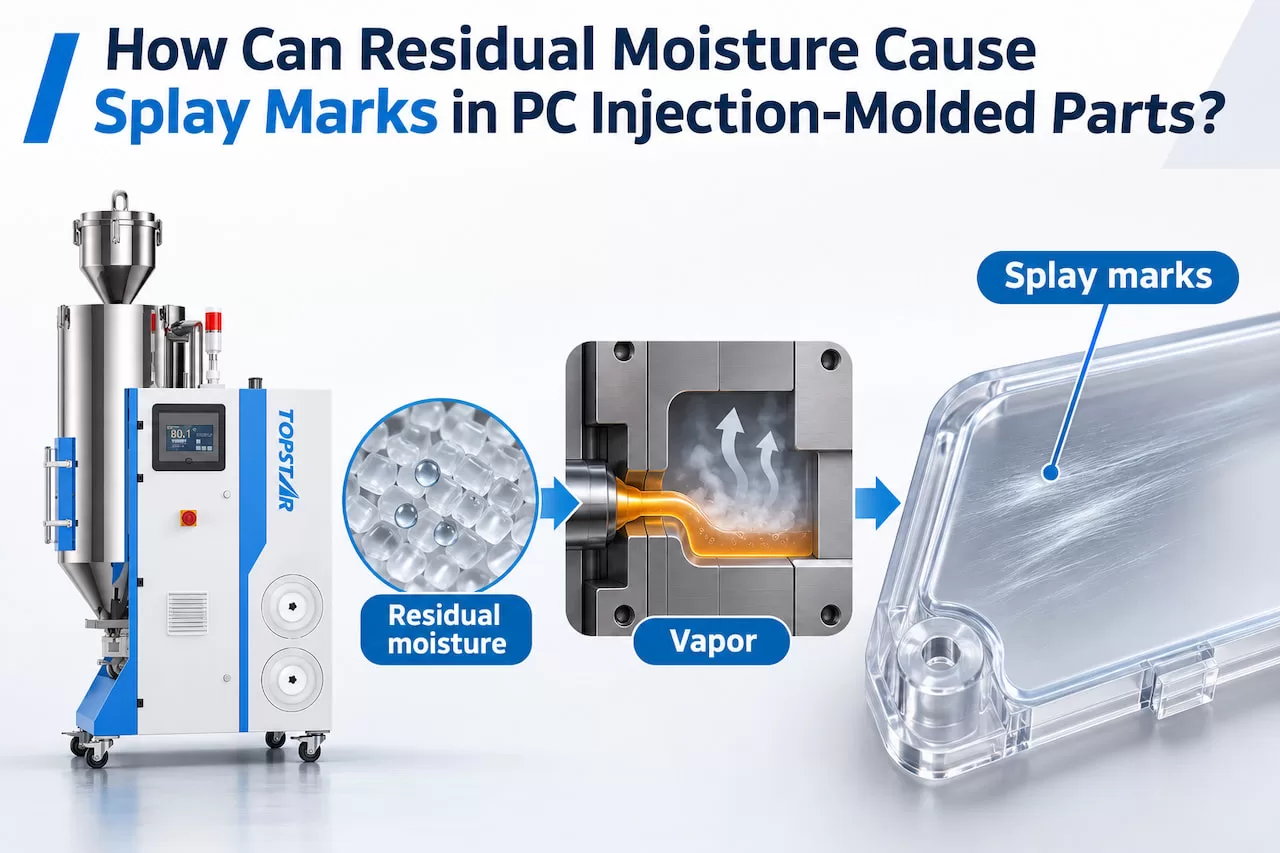
Residual moisture in PC resin can cause “silver streaks” (commonly known as “air lines” or “flow marks”) during the injection molding process. PC is hygroscopic, which means it absorbs moisture from the surrounding air during storage and material handling. When moisture-containing pellets enter the heated barrel, the absorbed moisture turns into steam. It becomes trapped in the molten polymer, forming visible streaks on the surface of the PC injection-molded parts. To prevent this defect, simply increasing the drying temperature is not enough; manufacturers need to install a suitable drying and dehumidification system to control residual moisture and prevent the resin from reabsorbing moisture before plastification.
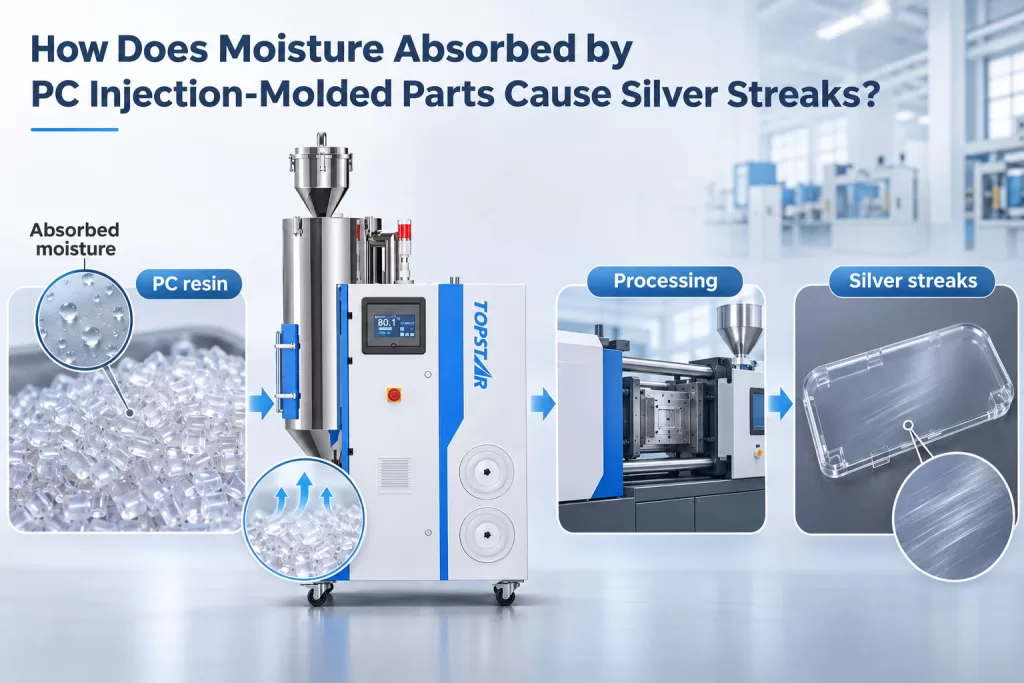
How Does Moisture Absorbed by PC Injection-Molded Parts Cause Silver Streaks?
Moisture-related “silver streaks” (splay) defects typically occur in two interconnected stages: First, PC pellets absorb moisture from the air prior to processing; subsequently, when the resin is heated inside the injection molding machine, this moisture turns into steam. The steam bubbles disrupt melt flow and leave visible “silver streaks” on the surface of the part. To understand the causes of this phenomenon, it is first necessary to understand the moisture absorption characteristics of PC and analyze how residual moisture behaves during the plasticization and cavity filling processes.
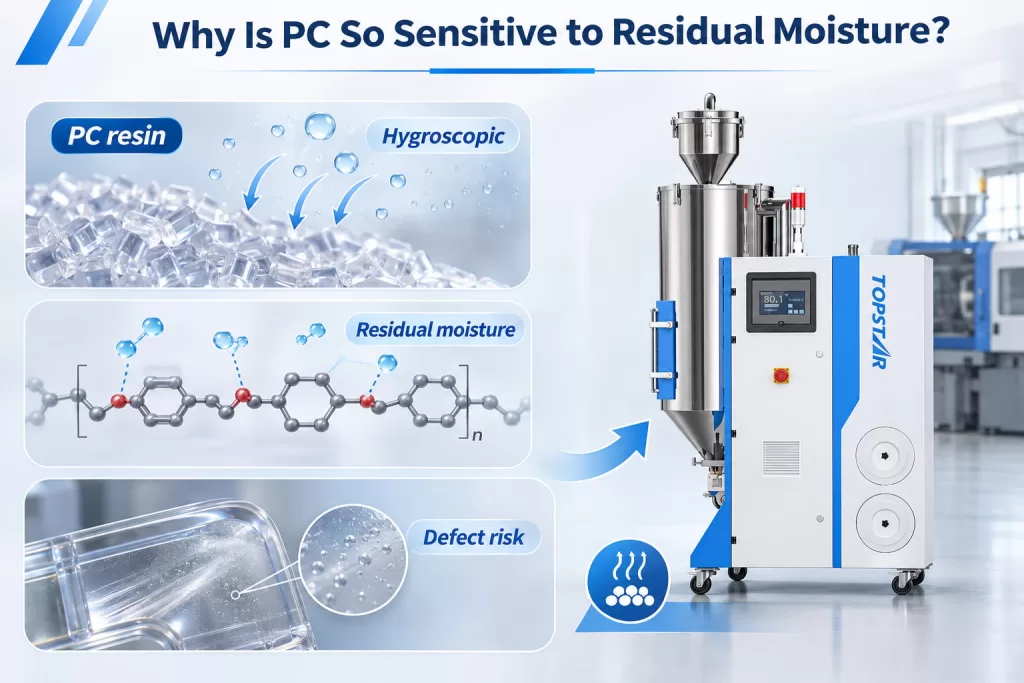
Why Is PC So Sensitive to Residual Moisture?
PC is a hygroscopic engineering plastic capable of absorbing moisture from humid air. Even if the surface of the resin pellets appears dry, moisture may still be present within their internal structure. During storage, the amount of moisture absorbed depends on ambient humidity, duration of exposure, and material handling conditions. If manufacturers feed PC pellets into the injection molding machine without adequate pre-drying, the residual moisture will cause processing issues.
The impact is not limited to surface appearance. If the pellets are not sufficiently dry, a reduction in molecular weight may occur during processing, leading to silver streaks, surface bubbles, material brittleness, and a decline in mechanical properties. This is noted in the technical documentation provided by Covestro for its Apec® copolycarbonate series. (Reference: Covestro Apec® Processing Guide)
Therefore, during PC processing, your plastic resin drying system must maintain an appropriate drying temperature and a sufficiently low dew point, while ensuring adequate residence time to thoroughly remove moisture before the pellets enter the injection molding machine.
How Does Moisture Cause Silver Streaks During Plasticization?
When moisture-containing PC pellets enter the heated barrel, the temperature rises rapidly, causing the absorbed moisture to vaporize within the molten material.
These bubbles become entrapped in the polymer melt. As the screw pushes the material toward the nozzle and mold cavity, the bubbles move along with the leading edge of the melt flow. Some bubbles reach the melt surface and expand; when the melt comes into contact with the cooler mold walls, these bubbles become trapped or deformed.
Once the polymer solidifies, these defects appear as silver streaks extending along the direction of material flow.
This defect is not merely the result of residual moisture on the surface of the finished product, but rather stems from the interaction between moisture and the melt during the plasticization and molding processes.
For PC injection-molded parts: the residual moisture content must be strictly controlled before the material enters the screw and barrel; this is because adjusting process parameters alone cannot effectively compensate for problems caused by insufficient material drying.
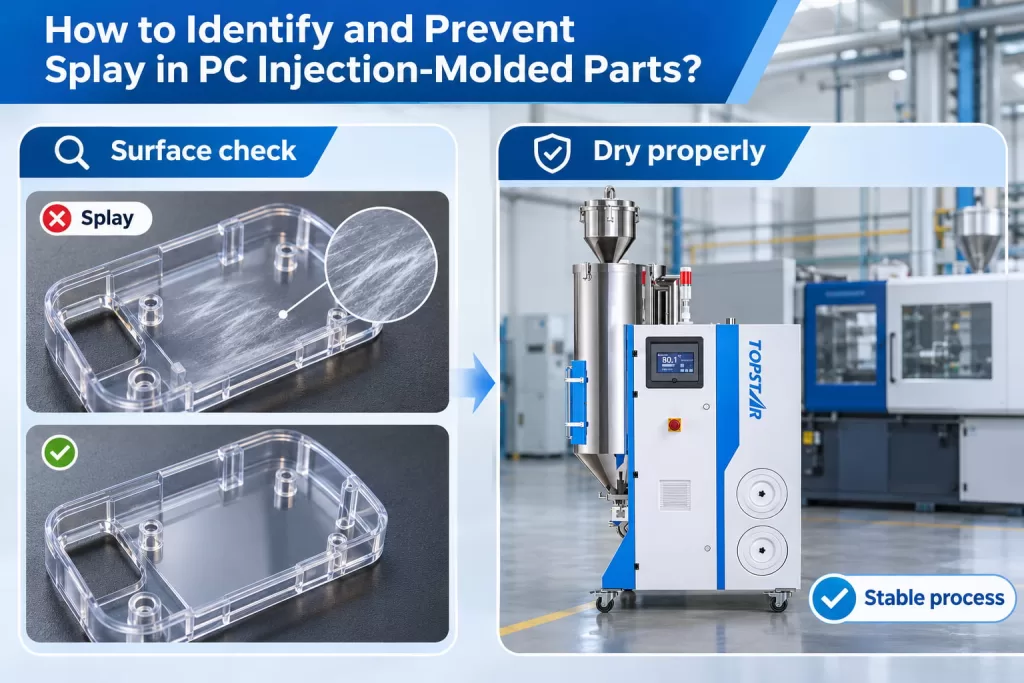
How to Identify and Prevent Splay in PC Injection-Molded Parts?
It is important to note that splay in PC injection-molded parts is not necessarily caused by residual moisture. Thermal degradation, trapped air, and other volatile contaminants can also lead to similar surface defects, but each situation requires different corrective measures. Therefore, effective prevention should begin with identifying the true root cause of the defect, followed by testing the resin for residual moisture and verifying that the drying and handling processes ensure the material remains in optimal condition at all times. The following sections will explain how to distinguish between these defects and establish a more reliable moisture control system.
How to Distinguish Between Defects Caused by Moisture-Related Splay, Thermal Degradation, and Trapped Air?
These three types of defects appear similar but require different corrective actions.
Moisture-related splay: This typically manifests as elongated silver or white streaks extending along the direction of melt flow. The primary cause is often excessive residual moisture in the pellets. The first steps in troubleshooting should include verifying the material’s moisture content and the effectiveness of the drying process.
Thermal degradation: Excessively high melt temperatures, prolonged residence time in the barrel, or excessive shear forces can all lead to polymer degradation, resulting in similar streaks. Depending on the material type and degree of degradation, defects may appear as coarser streaks, dark spots, or discoloration. Corrective actions should focus on checking barrel temperature, screw speed, material residence time, and the presence of localized hot spots.
Trapped-air defects: Air trapped within the mold can cause localized air marks, bubbles, or scorch marks. These defects typically appear in the last-filled areas of the mold cavity, in grooves, or in other locations where air is difficult to vent. The key to resolving such defects lies in optimizing mold venting and adjusting injection speed and filling conditions, rather than simply increasing the drying temperature.
The diagnostic logic is to determine whether the defect originates from the resin, the plastification process, or the mold before selecting corrective measures.
How to Measure and Control Residual Moisture?
The most reliable method to confirm whether PC resin is sufficiently dry is to measure its residual moisture, rather than relying solely on drying temperature or air dew point.
The Karl Fischer method is the recognized method for measuring moisture content in plastics. For PC pellets, since volatile substances may interfere with direct measurement, the oven-heated Karl Fischer method is more appropriate.
Operators should collect representative samples after drying and before injection molding, and store them in sealed containers to prevent moisture absorption during handling. However, even if operators confirm that the resin is dry at the sampling point, they cannot guarantee its dryness until processing begins. If humid shop air exposes the pellets to moisture during storage or conveyance, they may reabsorb it. Therefore, operators must maintain dry environmental conditions throughout the entire material conveyance process.
This requires a reliable drying and dehumidification system that combines low-dew-point air, adequate airflow, sufficient residence time, and protected material conveyance. Topstar’s TCDH and TCDHE series three-in-one dehumidifiers utilize honeycomb rotor dehumidification technology to provide stable, low-dew-point air. Their integrated drying and conveying configuration not only maintains the material in optimal condition but also minimizes secondary moisture absorption during conveyance.

Reducing Silver Streaks to Improve the Molding Quality of PC Injection-Molded Parts
If moisture is present in the material, it will vaporize during the plastification stage, thereby disrupting the flow of the polymer melt and causing silver streaks to appear on the surface of PC injection-molded parts. To prevent such defects, adjusting injection molding process parameters alone is insufficient. It is essential to understand the resin’s moisture sensitivity, distinguish between streaks caused by moisture and other defects, verify the resin’s actual moisture content, and prevent the material from reabsorbing moisture during handling. By employing appropriate drying conditions, reliable moisture measurement methods, and a closed-loop conveying system, manufacturers can reduce silver streaks, protect the performance of PC materials, and thereby achieve more consistent injection molding quality.
Specific solutions should include: measuring residual moisture after drying, comparing the results with the resin supplier’s requirements, and using a reliable drying and dehumidification system to ensure the material remains protected throughout the entire process of being conveyed to the injection molding machine.
TRENDING POSTS
- TOPS DAY 2026: Turning Industrial AI into Real-World Impact 2026/11/11
- Breaking Through the Full Scene-to-AI Link! Topstar Industrial Data Collection Matrix Achieves Major Technical Breakthro 2026/11/11
- TOPSTAR Selected in “Forbes China AI Top 50” and Wins “2026 Embodied AI Industry Benchmark Award” 2026/11/11
- Topstar Achieves ISO 13849 Functional Safety Certification for Robotics 2026/11/11
HOT TOPIC
- .ervo motor-driven linear robots
- •
- 1.0 guangdong topstar technology co. ltd
- 1.0 topstar china
- 1.0 topstar robot
- 11
- 160℃ mold temperature controller
- 170 ton injection molding machine
- 2
- 21
- 220-ton injection molding machine
- 23
- 260 ton injection molding machine
- 3 axis robot
- 3 axis robots
- 3 in 1 Compact Dehumidifying Dryer
- 3-axis robot
- 3-axis robots
- 39
- 4 axis robot
- 4-axis SCARA robot
- 41
- 460T injection molding machine
- 5-axis CNC machine
- 62
- 90 ton injection molding machine
- accuracy
- Air Chillers
- air-cooled chillers
- all electric injection molding machine
- all electric injection molding machines
- all-electric injection molding machine
- All-electric injection molding machines
- and overall production quality. Therefore
- AP-RubberPlas
- auto cooling system
- auto loader
- Auto Loaders
- automated injection molding machine
- Automation changed engineering
- automation of injection molding robots
- automotive parts injection molding
- Auxiliary Equipment
- auxiliary machine
- Bench Injection Molding Machine
- cabinet dryer
- Cabinet dryer manufacturers
- Cabinet dryers
- cartesian coordinate robot
- Cartesian Coordinate Robots
- Cartesian injection robot
- Cartesian robot
- Central Feeding System
- Central Feeding Systems
- chiller
- CNC Drilling Machine
- CNC Drilling Machines
- cnc engraving machine manufacturer
- cnc laser cutting machine manufacturer
- CNC machine
- CNC Machine Center
- CNC Machine for Sale
- CNC Machine Manufacturing
- CNC Machine Tool
- CNC machine tool product
- CNC Machining Center
- CNC wood carving machine
- Compact Dehumidifying Dryer
- Cooling system
- Cross-Walking Single Axis Servo Cylinder Robot
- Cross-Walking Single-Axis Servo Cylinder Robot
- Cross-Walking Three-Axis/Five-Axis Servo Driven Robot
- cross-walking three-axis/five-axis servo-driven robot
- Dehumidifier Dryer
- Dehumidifying Dryer
- dehumidifying dryers
- delta parallel robot
- Desktop Injection Molding Machine
- Desktop injection molding machines
- Desktop Molding Machine
- desktop plastic injection machine
- Desktop Plastic Injection Molding Machine
- detachable autoloader
- Digital Transformation
- direct clamp injection molding machine
- Direct clamp injection molding machines
- Dosing & mixing system
- Drilling Centers
- Drying and dehumidification system
- drying and dehumidifying equipment
- Drying and Dehumidifying System
- drying system
- effective and efficient. Cabinet dryers are also used in other industries where large quantities of material need to be dried
- efficient injection molding machine
- elbow hydraulic injection molding machines
- electric injection molding machine
- electric injection molding machines
- energy-efficient injection molding robot
- energy-efficient water chiller
- energy-efficient water chillers
- energy-saving injection molding machine
- etc. Among injection molding robots
- exhibition
- features of CNC machine
- Feeding And Conveying System
- Five Axis Machine Center
- Flexible Production Line
- Fully automatic injection molding machine
- Gathering Topstar
- giant injection molding machine
- GMU-600 5-Axis Machining Center
- Granulating & Recycling System
- granulator machine
- gravimetric blender
- Heavy duty injection molding machine
- Heavy-Duty Take-Out Robot
- High-precision electric molding machines
- high-precision plastic molding machines
- high-speed all electric injection molding machine
- high-speed electric injection molding machine
- High-Speed Packaging Injection Molding
- Honeycomb rotor dehumidifier
- hopper dryer
- Hopper Dryers
- horizontal injection molding machine
- Horizontal Injection Molding Machines
- Horizontal Injection Moulding Machine
- Horizontal Mixer manufacturer
- How The CNC Machine Works
- hybrid injection molding machine
- hydraulic injection molding machine
- Hydraulic Injection Molding Machines
- in this article
- Industrial AI
- Industrial Automation
- Industrial robot
- Industrial Robot Chinese brand
- industrial robot parts
- industrial robot supplier
- Industrial robots
- Industry Chain
- Injection Manipulator
- injection manipulator robot
- injection mold machines
- Injection molding
- Injection molding automation
- Injection Molding Automation Solution
- injection molding dryer
- Injection molding equipment
- injection molding hopper dryer
- Injection molding machine
- injection molding machine brand
- Injection Molding Machine Factory
- Injection Molding Machine Manufacture
- Injection molding machine manufacturer
- injection molding machine manufacturers
- Injection molding machine procurement
- injection molding machine robotic arm
- injection molding machine with a robot
- Injection molding machines
- injection molding material dehumidifying
- injection molding plant
- injection molding process
- Injection Molding Robot
- injection molding robot arm
- Injection molding robot automation
- Injection molding robotic arm
- injection molding robots
- injection molding whole plant
- injection moulding dryer
- Injection moulding machine
- injection moulding machines
- Injection Moulding Robots
- Injection Robot
- Injection robot arm
- Injection robot manufacturer
- Injection robot wholesale
- injection robots
- Intelligent Factory
- intelligent injection molding machines
- Intelligent Manufacturing
- intelligent mold temperature
- intelligent mold temperature controller
- Intelligent mould temperature controller
- intelligent whole plant solution
- InterPlas Thailand 2025
- Introducing Injection Robot
- It is the best choice for drying large quantities of material at once. Cabinetmakers use these machines because they are fast
- Large flow water type mold temperature controller
- large injection molding machine
- large injection molding machines
- Learn what industrial automation and robotics is
- linear robot
- linear robots
- low speed sound-proof granulator
- machine plastic molding
- make sure to add some! Improvements (2) Keyphrase in introduction: Your keyphrase or its synonyms appear in the first paragraph of the copy
- manipulator machine
- manufacturing
- Manufacturing Innovation
- medical grade injection molding machines
- Medical Injection Molding
- medical injection molding machine
- medical injection molding machines
- micro injection molding machine
- middle speed granulator
- Mini CNC machine manufacturers.
- mobile cover making machine
- Mold Temperature Control System
- mold temperature controller
- mold temperature controllers
- molding machine
- molding material Dehumidifying System
- mould temperature control system
- mould temperature controller
- mould temperature controller
- mould temperature controllers
- New electric injection molding machine
- Nitrogen Dryer
- nitrogen dryer manufacturer
- nitrogen dryer system manufacturer
- Oil type mold temperature controller
- Oil type mold temperature controllers
- open day
- optical component injection molding
- Optical-grade dehumidifying dryer
- Outbound links: No outbound links appear in this page. Add some! Images: No images appear on this page. Add some! Internal links: No internal links appear in this page
- packaging injection molding
- Packaging Solutions
- PET Preform injection molding
- phone case maker machine
- phone case making machine
- phone cover making machine
- PID Control Mold Temperature Controller
- plastic auto loader
- plastic bottle making machine
- plastic bottle manufacturing
- plastic bucket making machine
- plastic bucket manufacturing
- Plastic chair making machine
- plastic dryer for injection molding
- plastic forming equipment
- Plastic Granulator
- Plastic Granulators
- plastic hopper dryer
- plastic injection machine
- plastic injection machines
- plastic injection molding
- Plastic injection molding equipment
- Plastic injection molding machine
- Plastic Injection Molding Machines
- plastic injection moulding machine
- plastic injection moulding machines
- plastic injection robot
- plastic molding
- Plastic Molding Industry
- Plastic Molding machine
- plastic molding machine 1
- Plastic Molding Machines
- plastic molding press
- plastic moulding machine
- plastic phone case making machine
- plastic-molding machine
- powerful granulator
- Powerful Type Sound-Proof Granulator
- precision injection molding
- precision injection molding machines
- production of plastic seats
- pure water mould temperature controller
- Robot injection molding
- robot injection molding machine
- robot manufacturing companies
- Robotic arm for injection molding machine
- robotic injection molding machines
- robotics in injection molding
- SCARA robot
- SCARA robots
- Screw dosers
- Service-oriented manufacturing
- Servo Cylinder Robot
- servo driven robot
- Servo Driven Robots
- servo injection molding machine
- servo injection robots
- servo motor-driven linear robots
- servo-driven 3-axis robot
- Servo-driven injection molding machine
- Servo-Driven Robot
- Setup of injection machine
- Silicone Injection Molding Machine
- six-axis industrial robot
- Smart Manufacturing
- soundproof granulator
- Sprue Picker
- Stainless Hopper Dryer
- Stainless Hopper Dryers
- star club
- swing arm robot
- T1 Cartesian injection robot
- take-out robot
- take-out robots
- Thailand 4.0
- the choice between servo-driven robots and hydraulic robots will have a certain impact on efficiency
- the most popular injection molding machine
- the type of injection molding robot
- TIC2000 Control System
- TMII injection molding machine
- toggle clamp injection molding machine
- Toggle Hydraulic Injection Molding Machines
- toggle injection molding machine
- Top 10 brands of injection robots
- Topstar
- Topstar Electric Injection Molding Machine InterPlas Thailand 2025 Smart Manufacturing Thailand 4.0
- Topstar Engineering
- Topstar Industrial Robots
- Topstar injection molding intelligent
- Topstar Scara Robots
- Useful Injection molding machine
- Vertical machining centers
- volumetric type blender
- Washing Machine Case Molding Solution
- water chiller
- water chillers
- water distributor
- water type mold temperature controller
- Water Type MoldTemperature Controller
- Water-Cooled Chillers
- Water-cooled Mold Temperature Controller
- water-type mold temperature controller
- Water-Type Mould Temperature Controllers
- We often face choices when performing injection molding. We will choose the type of injection molding machine
- wholesale of injection molding machines
- x carve CNC
- 热门查询 点击次数 展示 排名 topstar