
How Do Temperature, Residence Time, and Airflow Affect Dehumidifying Dryer Performance?
2026/10/21 By le zhan
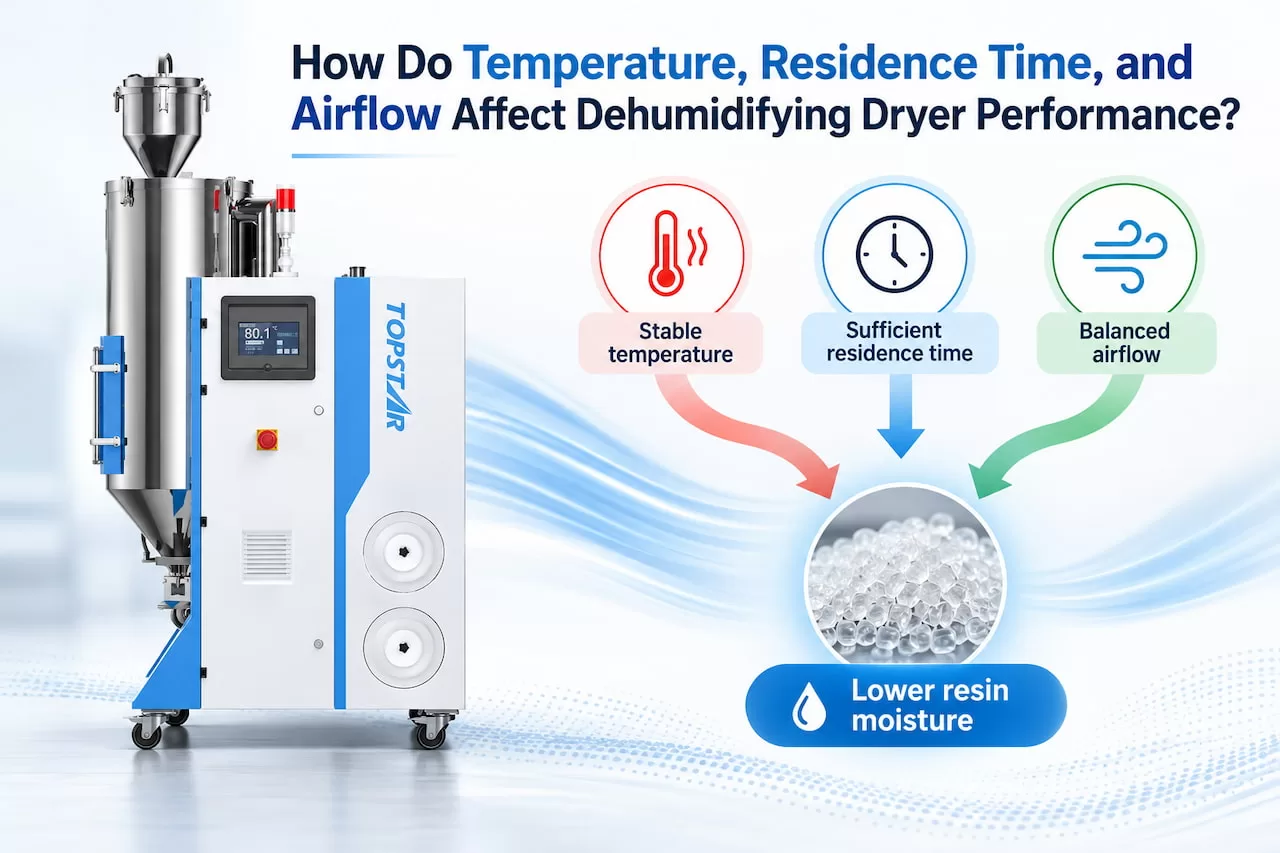
In drying plastic raw materials, temperature provides the heat needed to release moisture from the resin pellets; residence time allows moisture to migrate from the pellet interior to the surface; and airflow delivers dry air and carries the moisture away. These factors must work together under appropriate dew point conditions. The performance of a dehumidifying dryer also depends on balancing these three factors—drying temperature, residence time, and airflow—rather than maximizing any single parameter.
If any one of these elements is not properly addressed, the resin may fail to achieve a fully dried state, even if the other parameters appear to be set correctly. I recommend setting these parameters according to your resin supplier’s technical specifications and verifying the drying conditions during production.
How Do Temperature, Residence Time, and Airflow Work Together?
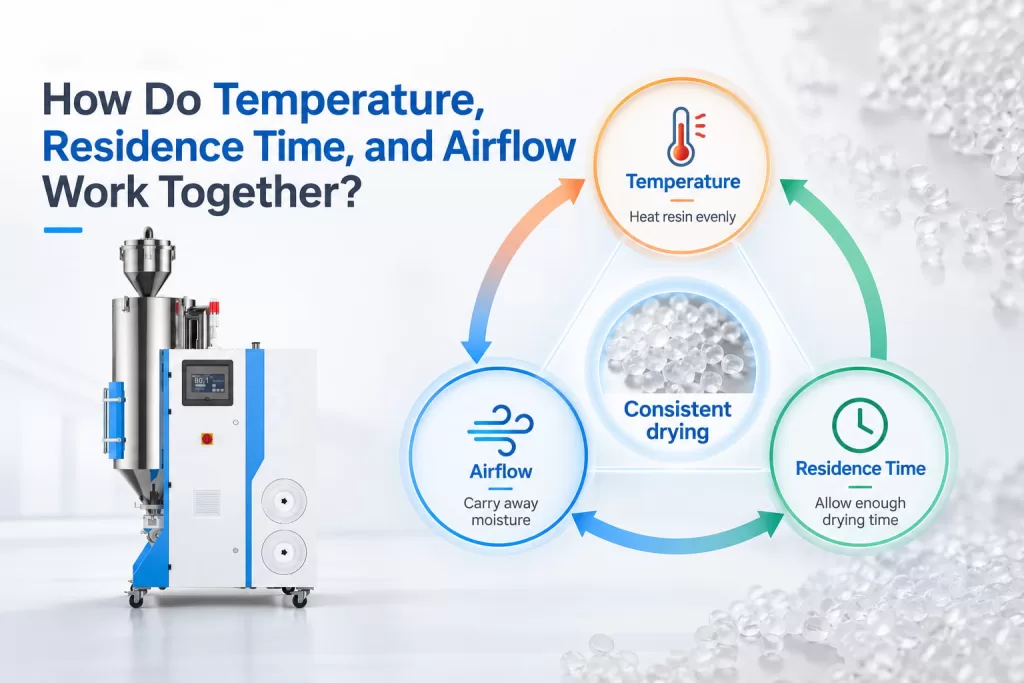
In a dehumidifying dryer, moisture removal involves heat transfer, moisture diffusion, and continuous discharge of water vapor. Drying temperature determines how much heat the pellets can absorb; residence time determines how long it takes for moisture to escape; and airflow distributes heat and carries away the moisture released from the material. These settings are interdependent, so changing any single parameter can affect the overall performance of the drying and dehumidification system. As Novatec’s technical guide notes, heat, dew point, drying time, and airflow are key factors in the resin drying process. (Source: Novatec, “Fundamentals of Resin Drying”)
What Does Each Parameter Control?
Drying temperature controls heat input. Higher temperatures increase molecular motion within the resin, promoting moisture migration toward the particle surface. If the temperature is too low, dehumidification may take longer or fail to completely remove moisture. However, the appropriate temperature depends on the resin grade and its thermal stability.
Residence time determines how long moisture has to escape from the resin. Moisture inside hygroscopic resin particles must first diffuse to the surface, where dry air can carry it away. Even air with a low dew point cannot dry the particles instantly. The material must remain under suitable drying conditions long enough to reach the desired moisture content.
Airflow controls heat distribution and moisture removal. Dry air must flow uniformly through the material bed to maintain the required temperature distribution and carry away the released moisture. If airflow is insufficient or unevenly distributed, under-dried material may still exist even if the dryer’s temperature display indicates the setpoint has been reached.
These parameters also relate closely to the dew point. A low dew point indicates that the process air contains very little water vapor, which helps maintain the driving force required for moisture migration.

Why doesn’t increasing the temperature compensate for insufficient airflow or too short a residence time?
Increasing the drying temperature may accelerate moisture migration, but it cannot replace adequate residence time or effective airflow circulation. If particles leave the hopper too early, moisture may still remain trapped inside them. If airflow is insufficient, the dryer cannot distribute heat evenly or effectively remove moisture from the material bed. Excessively high temperatures also pose other risks. Depending on the resin grade and its additives, overheating may cause material degradation, discoloration, or unwanted volatilization. We recommend following the material supplier’s guidelines, as blindly increasing the temperature may damage heat-sensitive materials or cause additives to volatilize.
How Can Drying Settings Be Optimized for Different Resins to Improve Dehumidifying Dryer Performance?
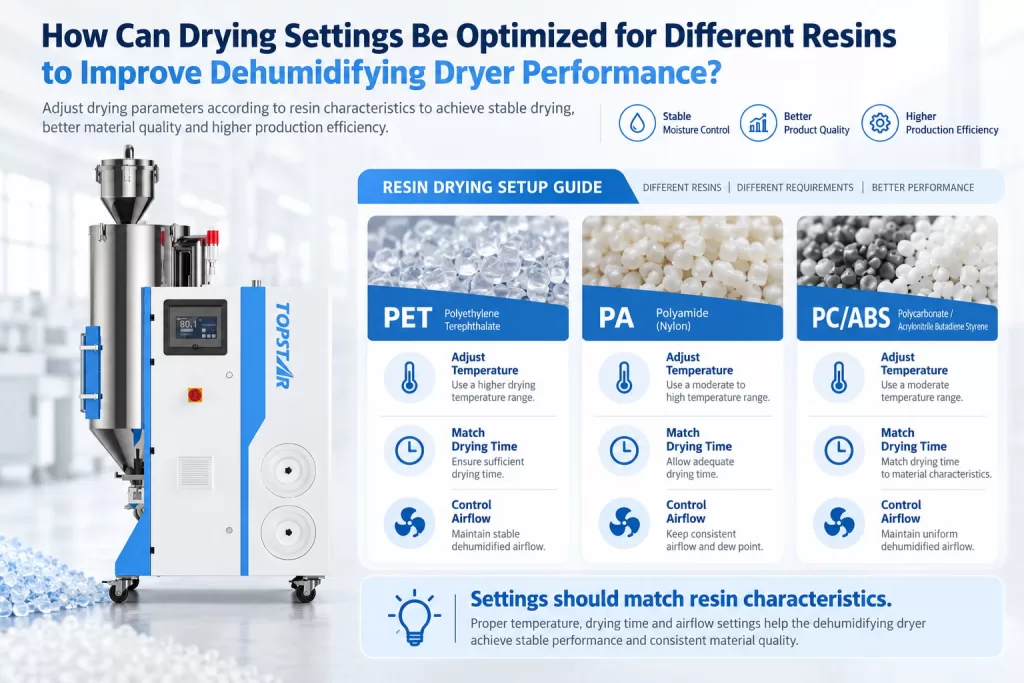
Once the relationship between these three parameters is understood, the next step is to tailor the settings to specific materials and production requirements. Different resin grades have different moisture-absorption characteristics and heat-resistance limits. Therefore, when configuring settings, consider the supplier’s recommended drying conditions, the initial moisture content, the target final moisture content, the hourly material throughput, and the dryer’s ability to maintain stable operating conditions during continuous operation. We also recommend selecting drying equipment based on resin type, production volume, temperature, required dew point, and finished product quality requirements.
How to Ensure Settings Meet Resin Requirements?
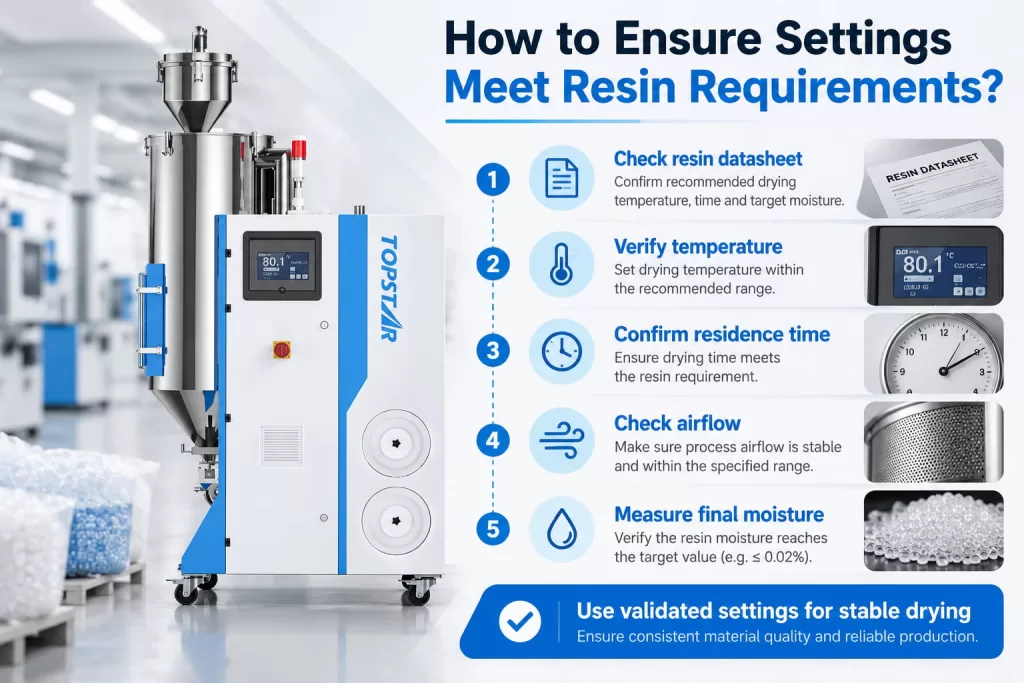
Refer to the technical data sheet for the specific resin grade rather than relying solely on general temperature recommendations for that polymer category. Confirm the supplier’s recommended drying temperature, drying duration, dew point requirements (if any), and maximum allowable moisture content before processing.
Also, ensure the dehumidifying dryer’s processing capacity matches the actual material consumption rate. In continuous production, material residence time depends on the hopper’s effective capacity and the injection molding machine’s resin consumption rate. If material consumption increases but the hopper capacity or feed rate is not adjusted accordingly, the actual residence time may fall below process requirements even if the timer and temperature settings remain unchanged.
Develop a comprehensive drying process plan for each material and production rate, rather than applying the same parameters to all resins.
How to Improve Drying Results and Enhance Dehumidifying Dryer Performance?
After setting the initial drying process parameters, operators should verify actual operating conditions rather than relying solely on the controller’s displayed setpoints. Check whether the material has reached the required temperature throughout the entire hopper, confirm that the airflow is sufficient and evenly distributed, and monitor the dew point to ensure the drying and dehumidification system operates within the specified conditions. Also, the material’s residence time in the dryer must match the actual material consumption rate. If the injection molding machine consumes resin too quickly, the pellets may leave the hopper before reaching the target moisture content. In production scenarios with strict quality requirements, measuring the resin’s residual moisture content provides a more reliable assessment of drying effectiveness than relying solely on temperature readings.
If drying performance is inconsistent, check for blockages in the filters, piping, and air distribution components, and verify the dew point and residence time; within the process parameters recommended by the resin supplier, adjust only one parameter at a time.
Ensuring Consistent Dehumidifying Dryer Performance
A dehumidifying dryer’s reliability depends on its ability to reach the required resin moisture content without overheating the material or compromising production efficiency. Temperature must provide enough heat; residence time must ensure full moisture removal; and airflow must evenly distribute dry air and carry away moisture. When these three parameters match the resin’s specific requirements and are verified through actual moisture-content measurements, the drying process becomes more stable. This maximizes the dehumidifying dryer’s performance and provides a strong guarantee of consistent injection-molded product quality.
TRENDING POSTS
- TOPS DAY 2026: Turning Industrial AI into Real-World Impact 2026/10/21
- Breaking Through the Full Scene-to-AI Link! Topstar Industrial Data Collection Matrix Achieves Major Technical Breakthro 2026/10/21
- TOPSTAR Selected in “Forbes China AI Top 50” and Wins “2026 Embodied AI Industry Benchmark Award” 2026/10/21
- Topstar Achieves ISO 13849 Functional Safety Certification for Robotics 2026/10/21
HOT TOPIC
- .ervo motor-driven linear robots
- •
- 1.0 guangdong topstar technology co. ltd
- 1.0 topstar china
- 1.0 topstar robot
- 11
- 160℃ mold temperature controller
- 170 ton injection molding machine
- 2
- 21
- 220-ton injection molding machine
- 23
- 260 ton injection molding machine
- 3 axis robot
- 3 axis robots
- 3 in 1 Compact Dehumidifying Dryer
- 3-axis robot
- 3-axis robots
- 39
- 4 axis robot
- 4-axis SCARA robot
- 41
- 460T injection molding machine
- 5-axis CNC machine
- 62
- 90 ton injection molding machine
- accuracy
- Air Chillers
- air-cooled chillers
- all electric injection molding machine
- all electric injection molding machines
- all-electric injection molding machine
- All-electric injection molding machines
- and overall production quality. Therefore
- AP-RubberPlas
- auto cooling system
- auto loader
- Auto Loaders
- automated injection molding machine
- Automation changed engineering
- automation of injection molding robots
- automotive parts injection molding
- Auxiliary Equipment
- auxiliary machine
- Bench Injection Molding Machine
- cabinet dryer
- Cabinet dryer manufacturers
- Cabinet dryers
- cartesian coordinate robot
- Cartesian Coordinate Robots
- Cartesian injection robot
- Cartesian robot
- Central Feeding System
- Central Feeding Systems
- chiller
- CNC Drilling Machine
- CNC Drilling Machines
- cnc engraving machine manufacturer
- cnc laser cutting machine manufacturer
- CNC machine
- CNC Machine Center
- CNC Machine for Sale
- CNC Machine Manufacturing
- CNC Machine Tool
- CNC machine tool product
- CNC Machining Center
- CNC wood carving machine
- Compact Dehumidifying Dryer
- Cooling system
- Cross-Walking Single Axis Servo Cylinder Robot
- Cross-Walking Single-Axis Servo Cylinder Robot
- Cross-Walking Three-Axis/Five-Axis Servo Driven Robot
- cross-walking three-axis/five-axis servo-driven robot
- Dehumidifier Dryer
- Dehumidifying Dryer
- dehumidifying dryers
- delta parallel robot
- Desktop Injection Molding Machine
- Desktop injection molding machines
- Desktop Molding Machine
- desktop plastic injection machine
- Desktop Plastic Injection Molding Machine
- detachable autoloader
- Digital Transformation
- direct clamp injection molding machine
- Direct clamp injection molding machines
- Dosing & mixing system
- Drilling Centers
- Drying and dehumidification system
- drying and dehumidifying equipment
- Drying and Dehumidifying System
- drying system
- effective and efficient. Cabinet dryers are also used in other industries where large quantities of material need to be dried
- efficient injection molding machine
- elbow hydraulic injection molding machines
- electric injection molding machine
- electric injection molding machines
- energy-efficient injection molding robot
- energy-efficient water chiller
- energy-efficient water chillers
- energy-saving injection molding machine
- etc. Among injection molding robots
- exhibition
- features of CNC machine
- Feeding And Conveying System
- Five Axis Machine Center
- Flexible Production Line
- Fully automatic injection molding machine
- Gathering Topstar
- giant injection molding machine
- GMU-600 5-Axis Machining Center
- Granulating & Recycling System
- granulator machine
- gravimetric blender
- Heavy duty injection molding machine
- Heavy-Duty Take-Out Robot
- High-precision electric molding machines
- high-precision plastic molding machines
- high-speed all electric injection molding machine
- high-speed electric injection molding machine
- High-Speed Packaging Injection Molding
- Honeycomb rotor dehumidifier
- hopper dryer
- Hopper Dryers
- horizontal injection molding machine
- Horizontal Injection Molding Machines
- Horizontal Injection Moulding Machine
- Horizontal Mixer manufacturer
- How The CNC Machine Works
- hybrid injection molding machine
- hydraulic injection molding machine
- Hydraulic Injection Molding Machines
- in this article
- Industrial AI
- Industrial Automation
- Industrial robot
- Industrial Robot Chinese brand
- industrial robot parts
- industrial robot supplier
- Industrial robots
- Industry Chain
- Injection Manipulator
- injection manipulator robot
- injection mold machines
- Injection molding
- Injection molding automation
- Injection Molding Automation Solution
- injection molding dryer
- Injection molding equipment
- injection molding hopper dryer
- Injection molding machine
- injection molding machine brand
- Injection Molding Machine Factory
- Injection Molding Machine Manufacture
- Injection molding machine manufacturer
- injection molding machine manufacturers
- Injection molding machine procurement
- injection molding machine robotic arm
- injection molding machine with a robot
- Injection molding machines
- injection molding material dehumidifying
- injection molding plant
- injection molding process
- Injection Molding Robot
- injection molding robot arm
- Injection molding robot automation
- Injection molding robotic arm
- injection molding robots
- injection molding whole plant
- injection moulding dryer
- Injection moulding machine
- injection moulding machines
- Injection Moulding Robots
- Injection Robot
- Injection robot arm
- Injection robot manufacturer
- Injection robot wholesale
- injection robots
- Intelligent Factory
- intelligent injection molding machines
- Intelligent Manufacturing
- intelligent mold temperature
- intelligent mold temperature controller
- Intelligent mould temperature controller
- intelligent whole plant solution
- InterPlas Thailand 2025
- Introducing Injection Robot
- It is the best choice for drying large quantities of material at once. Cabinetmakers use these machines because they are fast
- Large flow water type mold temperature controller
- large injection molding machine
- large injection molding machines
- Learn what industrial automation and robotics is
- linear robot
- linear robots
- low speed sound-proof granulator
- machine plastic molding
- make sure to add some! Improvements (2) Keyphrase in introduction: Your keyphrase or its synonyms appear in the first paragraph of the copy
- manipulator machine
- manufacturing
- Manufacturing Innovation
- medical grade injection molding machines
- Medical Injection Molding
- medical injection molding machine
- medical injection molding machines
- micro injection molding machine
- middle speed granulator
- Mini CNC machine manufacturers.
- mobile cover making machine
- Mold Temperature Control System
- mold temperature controller
- mold temperature controllers
- molding machine
- molding material Dehumidifying System
- mould temperature control system
- mould temperature controller
- mould temperature controller
- mould temperature controllers
- New electric injection molding machine
- Nitrogen Dryer
- nitrogen dryer manufacturer
- nitrogen dryer system manufacturer
- Oil type mold temperature controller
- Oil type mold temperature controllers
- open day
- optical component injection molding
- Optical-grade dehumidifying dryer
- Outbound links: No outbound links appear in this page. Add some! Images: No images appear on this page. Add some! Internal links: No internal links appear in this page
- packaging injection molding
- Packaging Solutions
- PET Preform injection molding
- phone case maker machine
- phone case making machine
- phone cover making machine
- PID Control Mold Temperature Controller
- plastic auto loader
- plastic bottle making machine
- plastic bottle manufacturing
- plastic bucket making machine
- plastic bucket manufacturing
- Plastic chair making machine
- plastic dryer for injection molding
- plastic forming equipment
- Plastic Granulator
- Plastic Granulators
- plastic hopper dryer
- plastic injection machine
- plastic injection machines
- plastic injection molding
- Plastic injection molding equipment
- Plastic injection molding machine
- Plastic Injection Molding Machines
- plastic injection moulding machine
- plastic injection moulding machines
- plastic injection robot
- plastic molding
- Plastic Molding Industry
- Plastic Molding machine
- plastic molding machine 1
- Plastic Molding Machines
- plastic molding press
- plastic moulding machine
- plastic phone case making machine
- plastic-molding machine
- powerful granulator
- Powerful Type Sound-Proof Granulator
- precision injection molding
- precision injection molding machines
- production of plastic seats
- pure water mould temperature controller
- Robot injection molding
- robot injection molding machine
- robot manufacturing companies
- Robotic arm for injection molding machine
- robotic injection molding machines
- robotics in injection molding
- SCARA robot
- SCARA robots
- Screw dosers
- Service-oriented manufacturing
- Servo Cylinder Robot
- servo driven robot
- Servo Driven Robots
- servo injection molding machine
- servo injection robots
- servo motor-driven linear robots
- servo-driven 3-axis robot
- Servo-driven injection molding machine
- Servo-Driven Robot
- Setup of injection machine
- Silicone Injection Molding Machine
- six-axis industrial robot
- Smart Manufacturing
- soundproof granulator
- Sprue Picker
- Stainless Hopper Dryer
- Stainless Hopper Dryers
- star club
- swing arm robot
- T1 Cartesian injection robot
- take-out robot
- take-out robots
- Thailand 4.0
- the choice between servo-driven robots and hydraulic robots will have a certain impact on efficiency
- the most popular injection molding machine
- the type of injection molding robot
- TIC2000 Control System
- TMII injection molding machine
- toggle clamp injection molding machine
- Toggle Hydraulic Injection Molding Machines
- toggle injection molding machine
- Top 10 brands of injection robots
- Topstar
- Topstar Electric Injection Molding Machine InterPlas Thailand 2025 Smart Manufacturing Thailand 4.0
- Topstar Engineering
- Topstar Industrial Robots
- Topstar injection molding intelligent
- Topstar Scara Robots
- Useful Injection molding machine
- Vertical machining centers
- volumetric type blender
- Washing Machine Case Molding Solution
- water chiller
- water chillers
- water distributor
- water type mold temperature controller
- Water Type MoldTemperature Controller
- Water-Cooled Chillers
- Water-cooled Mold Temperature Controller
- water-type mold temperature controller
- Water-Type Mould Temperature Controllers
- We often face choices when performing injection molding. We will choose the type of injection molding machine
- wholesale of injection molding machines
- x carve CNC
- 热门查询 点击次数 展示 排名 topstar