
When Does Uneven Mould Temperature Require a Different Control Configuration?
2023/04/27 By Topstar
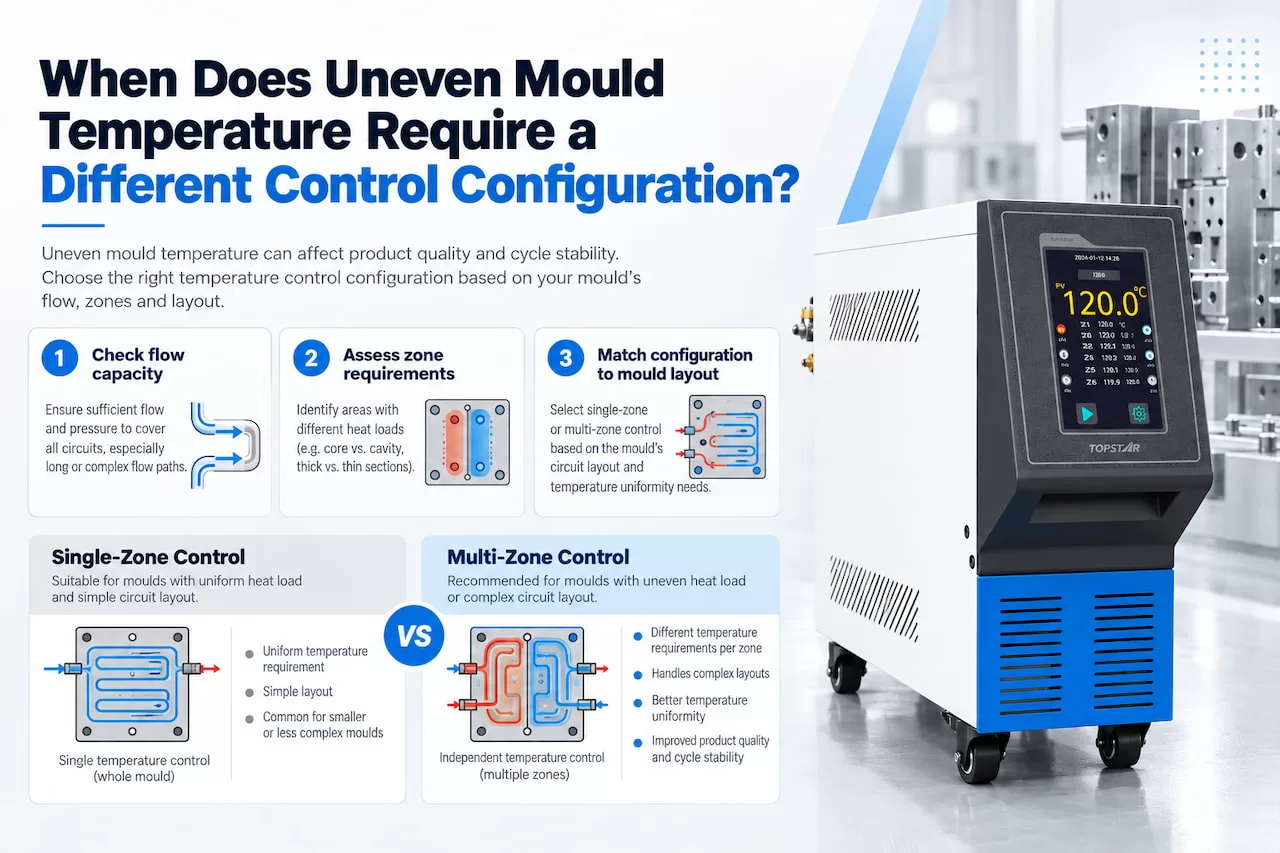
A stable reading on the mould temperature controller does not necessarily indicate that the mould temperature is uniform. The screen value reflects the temperature at a specific sensor location, while conditions inside the mould depend on circuit flow rate, runner layout, localised heat loads, and heat transfer performance. Consequently, even if the circulating medium temperature remains close to the setpoint, temperature variations may still occur across different parts of the mould. Before adjusting the temperature settings, a more prudent approach is to verify the measurement data, inspect each circuit and address the root causes of the uneven mould temperature.
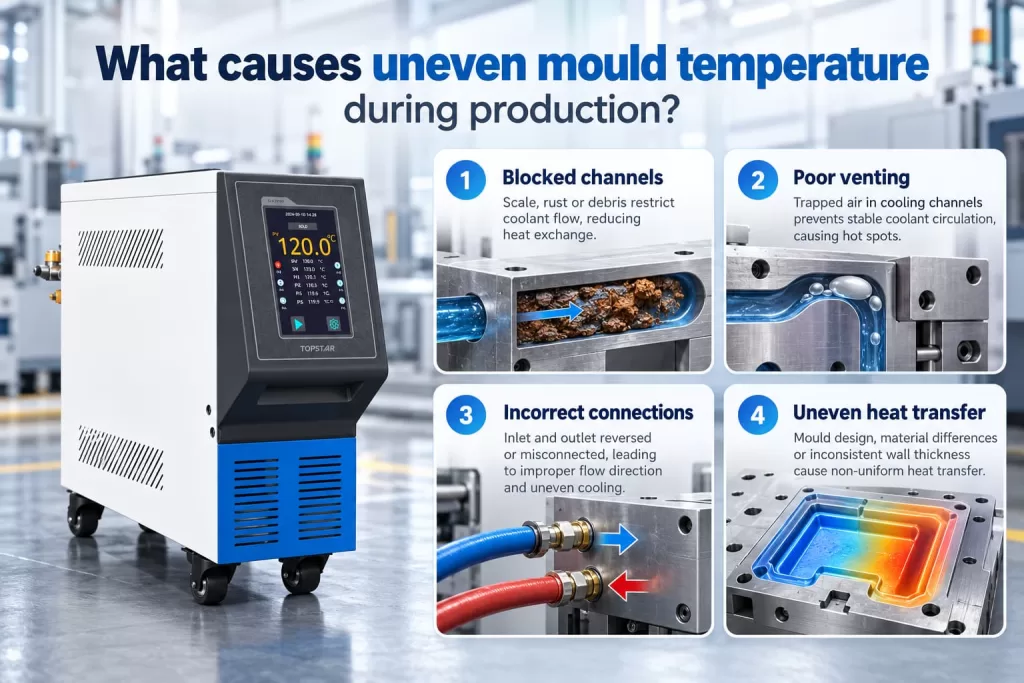
What causes uneven mould temperature during production?
Mould temperature control involves both regulating the circulating medium and transferring heat through the mould (tooling). Various issues may arise between these two stages. First, distinguish between ‘the values measured by the controller’ and ‘the actual conditions inside the mould’, then investigate why thermal control effectiveness varies across different areas.
Why do stable readings from the mould temperature controller not prove that the mould temperature is uniform?
The controller regulates the temperature based on signals fed back from sensors. Depending on the equipment type, the sensor may monitor the temperature of the supply water, return water, or an external measurement point. Before interpreting the displayed values, confirm the sensor’s specific location.
Sensor readings cannot reflect the specific conditions within every cavity, core or on the mould surface. Heat must transfer between the circulating medium and the mould; the distance between the cooling channels and areas with high heat loads directly affects the local temperature in those areas.
For example, suppose the mould temperature controller maintains the water temperature at a stable 80°C, but a local blockage in the cooling channel for a particular cavity reduces flow at that point. In this case, the controller’s screen may show a stable value, yet that cavity’s heat dissipation efficiency has already decreased. The setpoint alone cannot detect such a blockage in the cooling channel.
‘Temperature control accuracy’ and ‘mould temperature uniformity’ are two distinct performance indicators. You must check both aspects simultaneously before concluding that the thermal processing is stable.
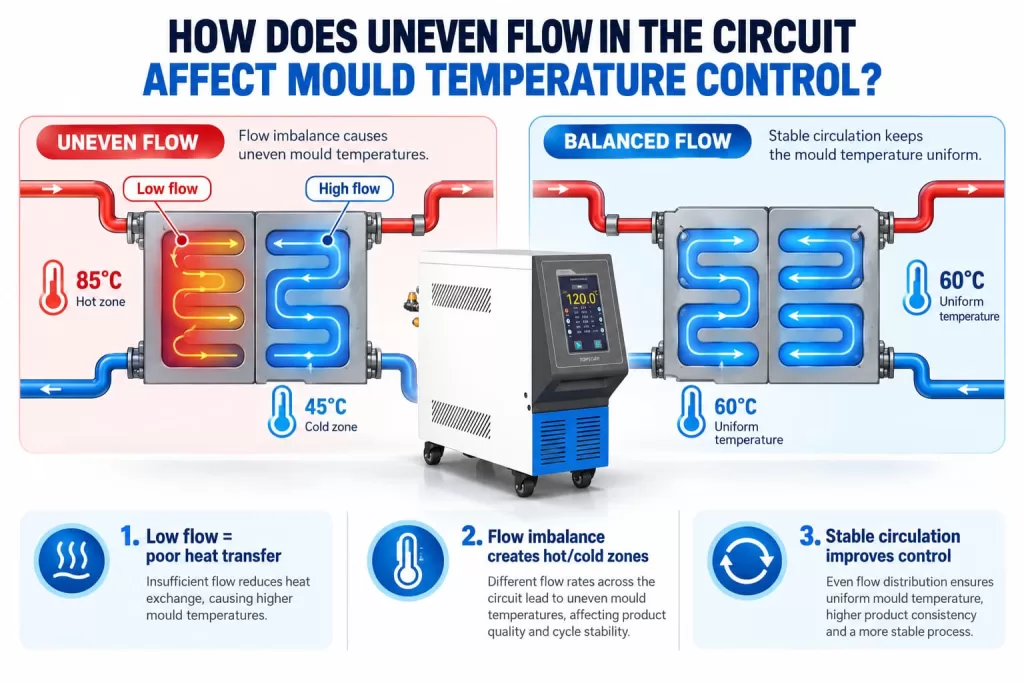
How does uneven flow in the circuit affect mould temperature control?
In a parallel circuit, the flow rate in each circuit does not automatically remain equal. Differences in channel length, diameter, fittings, valve positions, and internal conditions can create varying resistance in each circuit. When a branch becomes obstructed, the circulating water may be redistributed towards other branches with lower resistance. Consequently, although the total flow rate may appear normal, a specific circuit may still have insufficient flow.
Please check the filters, hoses, fittings and mould runners for blockages or obstructions. Trapped gas may impede circulation, while deposits may narrow the channels, reducing heat-transfer efficiency. After replacing a mould, it is essential to check all connections; particular care must be taken if the supply and return hoses look similar, to avoid confusion.
A mould temperature controller cannot fully compensate for the shortcomings caused by an ill-designed runner layout. If the root cause is not identified, simply increasing the pump output or adjusting the set temperature will not only fail to resolve the issue of the hottest areas but may also lead to temperature deviations in other areas.
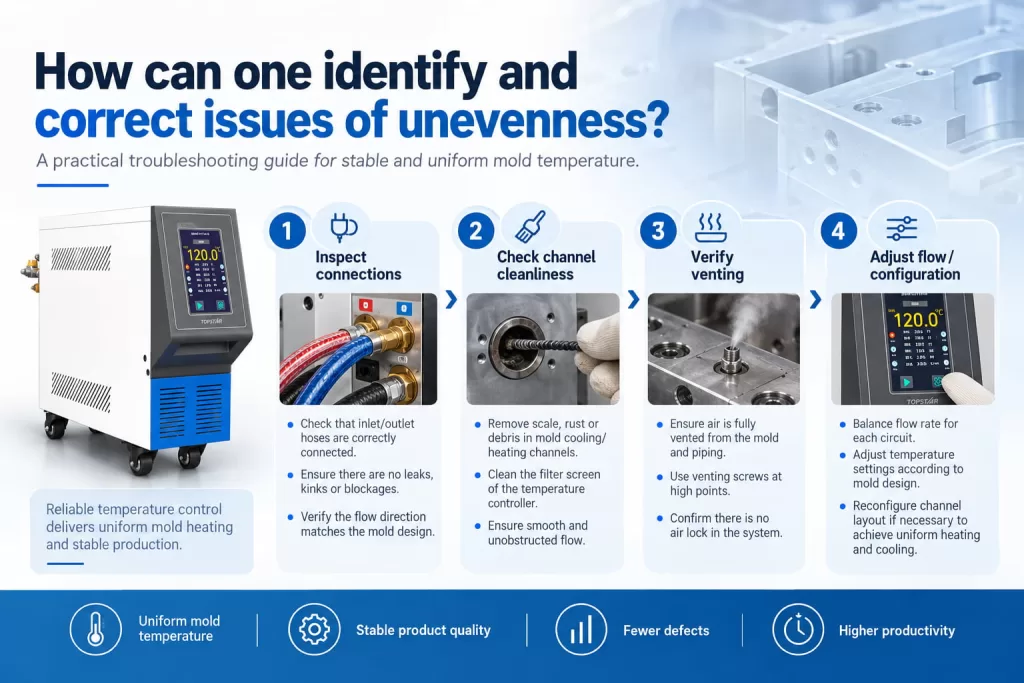
How can one identify and correct issues of unevenness?
Adopt a repeatable inspection procedure rather than making multiple adjustments simultaneously. Record thermal conditions and cycle status, identify where deviations occur, and test each corrective measure individually. This helps to distinguish between ‘maintenance issues’ and ‘problems caused by the inherent limitations of the equipment or the mould itself’.
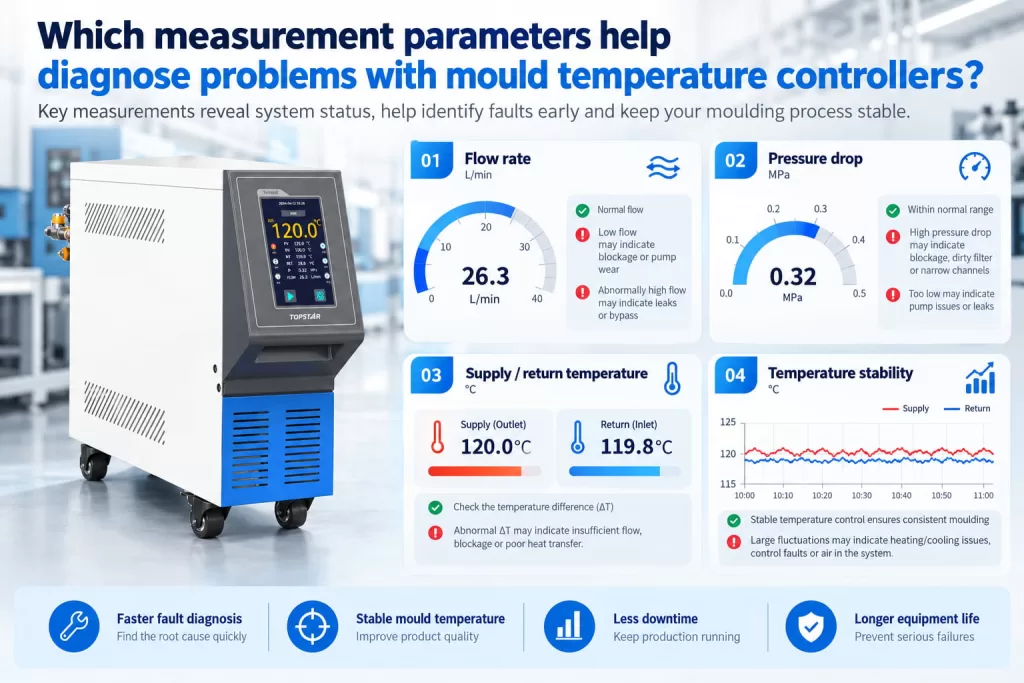
Which measurement parameters help diagnose problems with mould temperature controllers?
Start measurements only after the process has reached a repeatable operating state. Ensure the material, cycle settings, cooling water supply, and measurement timing remain consistent to ensure comparative results are meaningful.
Take temperature measurements at fixed points on the mould and at the same stage of the process cycle. If using infrared measurement instruments, account for surface reflection and measurement settings; inconsistent operating techniques can produce misleading variations in the data.
Analyse temperature differentials alongside flow rates. A significant temperature difference between the supply and return water may indicate high heat exchange, insufficient flow, or both. Conversely, a small temperature difference does not directly prove that cooling is effective. As an initial check, compare current readings with data from previous production runs where performance was satisfactory. Subsequently, inspect any abnormal circuits, rectify connection issues or clear blockages in the pipework, and repeat the measurements.
Addressing Non-Uniformity Through Targeted Adjustments
If you can restore normal performance by ensuring correct connections, cleaning the runners, and improving venting, you don’t need to replace the mould temperature controller. If the problem persists, assess whether the pump performance matches the circuit resistance and verify that the cooling capacity meets the actual thermal load requirements. Generally, you cannot achieve both maximum flow rate and maximum pressure simultaneously. When different areas of the mould require different temperature settings, independent zone control may be helpful; however, this approach cannot resolve issues such as blocked runners or an inefficient runner layout.
Topstar’s mould temperature control technology includes flow rate monitoring and gas-liquid separation and offers single-zone or dual-zone configurations, depending on the model. Before selecting a model, please provide the operating temperature, circuit layout, required flow rate, cooling water conditions and specific issues encountered during production. To resolve uneven mould temperature, one should first verify the measurement data and circulation conditions; subsequent configuration adjustments should be optimised to address the limitations identified during these checks.
TRENDING POSTS
- TOPS DAY 2026: Turning Industrial AI into Real-World Impact 2023/04/27
- Breaking Through the Full Scene-to-AI Link! Topstar Industrial Data Collection Matrix Achieves Major Technical Breakthro 2023/04/27
- TOPSTAR Selected in “Forbes China AI Top 50” and Wins “2026 Embodied AI Industry Benchmark Award” 2023/04/27
- Topstar Achieves ISO 13849 Functional Safety Certification for Robotics 2023/04/27
HOT TOPIC
- .ervo motor-driven linear robots
- •
- 1.0 guangdong topstar technology co. ltd
- 1.0 topstar china
- 1.0 topstar robot
- 11
- 160℃ mold temperature controller
- 170 ton injection molding machine
- 2
- 21
- 220-ton injection molding machine
- 23
- 260 ton injection molding machine
- 3 axis robot
- 3 axis robots
- 3 in 1 Compact Dehumidifying Dryer
- 3-axis robot
- 3-axis robots
- 39
- 4 axis robot
- 4-axis SCARA robot
- 41
- 460T injection molding machine
- 5-axis CNC machine
- 62
- 90 ton injection molding machine
- accuracy
- Air Chillers
- air-cooled chillers
- all electric injection molding machine
- all electric injection molding machines
- all-electric injection molding machine
- All-electric injection molding machines
- and overall production quality. Therefore
- AP-RubberPlas
- auto cooling system
- auto loader
- Auto Loaders
- automated injection molding machine
- Automation changed engineering
- automation of injection molding robots
- automotive parts injection molding
- Auxiliary Equipment
- auxiliary machine
- Bench Injection Molding Machine
- cabinet dryer
- Cabinet dryer manufacturers
- Cabinet dryers
- cartesian coordinate robot
- Cartesian Coordinate Robots
- Cartesian injection robot
- Cartesian robot
- Central Feeding System
- Central Feeding Systems
- chiller
- CNC Drilling Machine
- CNC Drilling Machines
- cnc engraving machine manufacturer
- cnc laser cutting machine manufacturer
- CNC machine
- CNC Machine Center
- CNC Machine for Sale
- CNC Machine Manufacturing
- CNC Machine Tool
- CNC machine tool product
- CNC Machining Center
- CNC wood carving machine
- Compact Dehumidifying Dryer
- Cooling system
- Cross-Walking Single Axis Servo Cylinder Robot
- Cross-Walking Single-Axis Servo Cylinder Robot
- Cross-Walking Three-Axis/Five-Axis Servo Driven Robot
- cross-walking three-axis/five-axis servo-driven robot
- Dehumidifier Dryer
- Dehumidifying Dryer
- dehumidifying dryers
- delta parallel robot
- Desktop Injection Molding Machine
- Desktop injection molding machines
- Desktop Molding Machine
- desktop plastic injection machine
- Desktop Plastic Injection Molding Machine
- detachable autoloader
- Digital Transformation
- direct clamp injection molding machine
- Direct clamp injection molding machines
- Dosing & mixing system
- Drilling Centers
- Drying and dehumidification system
- drying and dehumidifying equipment
- Drying and Dehumidifying System
- drying system
- effective and efficient. Cabinet dryers are also used in other industries where large quantities of material need to be dried
- efficient injection molding machine
- elbow hydraulic injection molding machines
- electric injection molding machine
- electric injection molding machines
- energy-efficient injection molding robot
- energy-efficient water chiller
- energy-efficient water chillers
- energy-saving injection molding machine
- etc. Among injection molding robots
- exhibition
- features of CNC machine
- Feeding And Conveying System
- Five Axis Machine Center
- Flexible Production Line
- Fully automatic injection molding machine
- Gathering Topstar
- giant injection molding machine
- GMU-600 5-Axis Machining Center
- Granulating & Recycling System
- granulator machine
- gravimetric blender
- Heavy duty injection molding machine
- Heavy-Duty Take-Out Robot
- High-precision electric molding machines
- high-precision plastic molding machines
- high-speed all electric injection molding machine
- high-speed electric injection molding machine
- High-Speed Packaging Injection Molding
- Honeycomb rotor dehumidifier
- hopper dryer
- Hopper Dryers
- horizontal injection molding machine
- Horizontal Injection Molding Machines
- Horizontal Injection Moulding Machine
- Horizontal Mixer manufacturer
- How The CNC Machine Works
- hybrid injection molding machine
- hydraulic injection molding machine
- Hydraulic Injection Molding Machines
- in this article
- Industrial AI
- Industrial Automation
- Industrial robot
- Industrial Robot Chinese brand
- industrial robot parts
- industrial robot supplier
- Industrial robots
- Industry Chain
- Injection Manipulator
- injection manipulator robot
- injection mold machines
- Injection molding
- Injection molding automation
- Injection Molding Automation Solution
- injection molding dryer
- Injection molding equipment
- injection molding hopper dryer
- Injection molding machine
- injection molding machine brand
- Injection Molding Machine Factory
- Injection Molding Machine Manufacture
- Injection molding machine manufacturer
- injection molding machine manufacturers
- Injection molding machine procurement
- injection molding machine robotic arm
- injection molding machine with a robot
- Injection molding machines
- injection molding material dehumidifying
- injection molding plant
- injection molding process
- Injection Molding Robot
- injection molding robot arm
- Injection molding robot automation
- Injection molding robotic arm
- injection molding robots
- injection molding whole plant
- injection moulding dryer
- Injection moulding machine
- injection moulding machines
- Injection Moulding Robots
- Injection Robot
- Injection robot arm
- Injection robot manufacturer
- Injection robot wholesale
- injection robots
- Intelligent Factory
- intelligent injection molding machines
- Intelligent Manufacturing
- intelligent mold temperature
- intelligent mold temperature controller
- Intelligent mould temperature controller
- intelligent whole plant solution
- InterPlas Thailand 2025
- Introducing Injection Robot
- It is the best choice for drying large quantities of material at once. Cabinetmakers use these machines because they are fast
- Large flow water type mold temperature controller
- large injection molding machine
- large injection molding machines
- Learn what industrial automation and robotics is
- linear robot
- linear robots
- low speed sound-proof granulator
- machine plastic molding
- make sure to add some! Improvements (2) Keyphrase in introduction: Your keyphrase or its synonyms appear in the first paragraph of the copy
- manipulator machine
- manufacturing
- Manufacturing Innovation
- medical grade injection molding machines
- Medical Injection Molding
- medical injection molding machine
- medical injection molding machines
- micro injection molding machine
- middle speed granulator
- Mini CNC machine manufacturers.
- mobile cover making machine
- Mold Temperature Control System
- mold temperature controller
- mold temperature controllers
- molding machine
- molding material Dehumidifying System
- mould temperature control system
- mould temperature controller
- mould temperature controller
- mould temperature controllers
- New electric injection molding machine
- Nitrogen Dryer
- nitrogen dryer manufacturer
- nitrogen dryer system manufacturer
- Oil type mold temperature controller
- Oil type mold temperature controllers
- open day
- optical component injection molding
- Optical-grade dehumidifying dryer
- Outbound links: No outbound links appear in this page. Add some! Images: No images appear on this page. Add some! Internal links: No internal links appear in this page
- packaging injection molding
- Packaging Solutions
- PET Preform injection molding
- phone case maker machine
- phone case making machine
- phone cover making machine
- PID Control Mold Temperature Controller
- plastic auto loader
- plastic bottle making machine
- plastic bottle manufacturing
- plastic bucket making machine
- plastic bucket manufacturing
- Plastic chair making machine
- plastic dryer for injection molding
- plastic forming equipment
- Plastic Granulator
- Plastic Granulators
- plastic hopper dryer
- plastic injection machine
- plastic injection machines
- plastic injection molding
- Plastic injection molding equipment
- Plastic injection molding machine
- Plastic Injection Molding Machines
- plastic injection moulding machine
- plastic injection moulding machines
- plastic injection robot
- plastic molding
- Plastic Molding Industry
- Plastic Molding machine
- plastic molding machine 1
- Plastic Molding Machines
- plastic molding press
- plastic moulding machine
- plastic phone case making machine
- plastic-molding machine
- powerful granulator
- Powerful Type Sound-Proof Granulator
- precision injection molding
- precision injection molding machines
- production of plastic seats
- pure water mould temperature controller
- Robot injection molding
- robot injection molding machine
- robot manufacturing companies
- Robotic arm for injection molding machine
- robotic injection molding machines
- robotics in injection molding
- SCARA robot
- SCARA robots
- Screw dosers
- Service-oriented manufacturing
- Servo Cylinder Robot
- servo driven robot
- Servo Driven Robots
- servo injection molding machine
- servo injection robots
- servo motor-driven linear robots
- servo-driven 3-axis robot
- Servo-driven injection molding machine
- Servo-Driven Robot
- Setup of injection machine
- Silicone Injection Molding Machine
- six-axis industrial robot
- Smart Manufacturing
- soundproof granulator
- Sprue Picker
- Stainless Hopper Dryer
- Stainless Hopper Dryers
- star club
- swing arm robot
- T1 Cartesian injection robot
- take-out robot
- take-out robots
- Thailand 4.0
- the choice between servo-driven robots and hydraulic robots will have a certain impact on efficiency
- the most popular injection molding machine
- the type of injection molding robot
- TIC2000 Control System
- TMII injection molding machine
- toggle clamp injection molding machine
- Toggle Hydraulic Injection Molding Machines
- toggle injection molding machine
- Top 10 brands of injection robots
- Topstar
- Topstar Electric Injection Molding Machine InterPlas Thailand 2025 Smart Manufacturing Thailand 4.0
- Topstar Engineering
- Topstar Industrial Robots
- Topstar injection molding intelligent
- Topstar Scara Robots
- Useful Injection molding machine
- Vertical machining centers
- volumetric type blender
- Washing Machine Case Molding Solution
- water chiller
- water chillers
- water distributor
- water type mold temperature controller
- Water Type MoldTemperature Controller
- Water-Cooled Chillers
- Water-cooled Mold Temperature Controller
- water-type mold temperature controller
- Water-Type Mould Temperature Controllers
- We often face choices when performing injection molding. We will choose the type of injection molding machine
- wholesale of injection molding machines
- x carve CNC
- 热门查询 点击次数 展示 排名 topstar