
0.33s Ultra-Short Cycle Time: Topstar 4 Axis Robot Motion Control Technology
2026/06/24 By le zhan
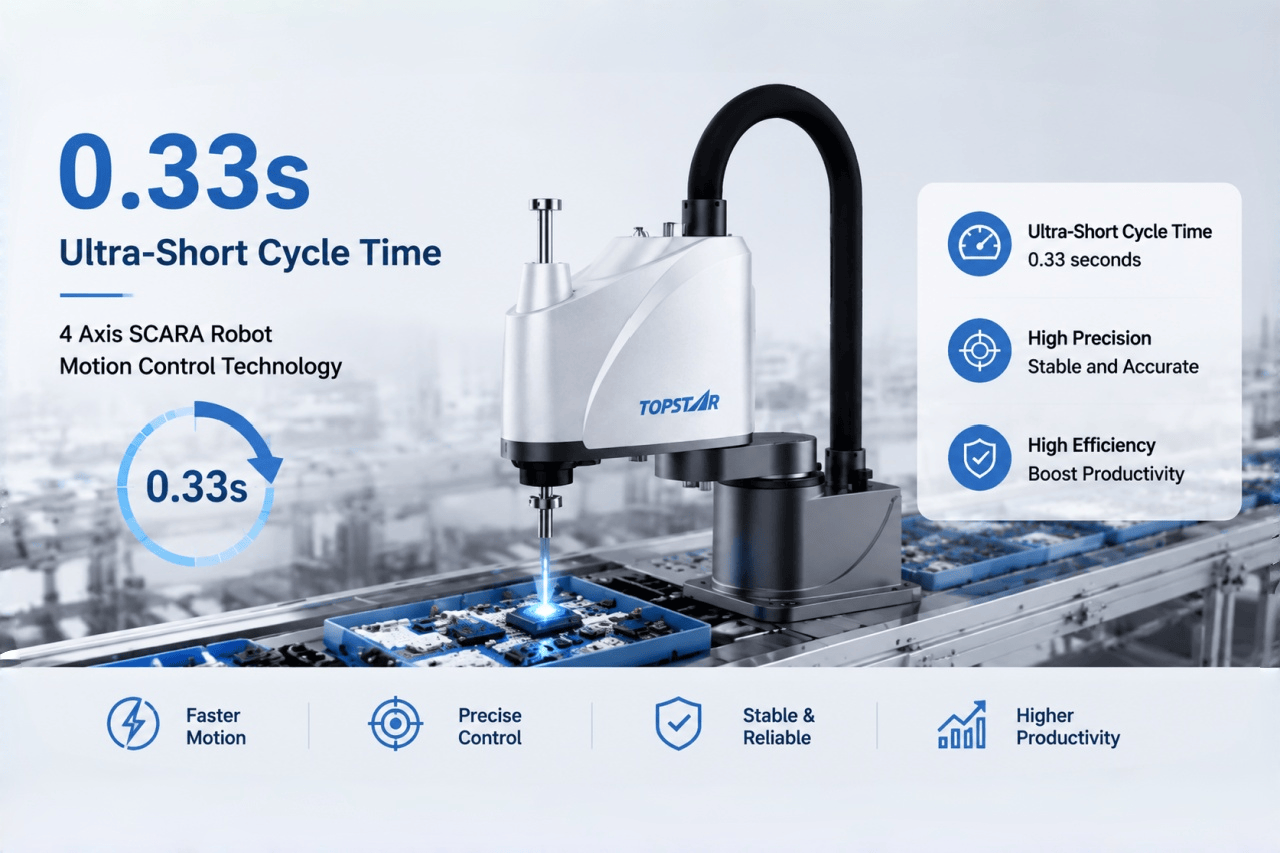
A robot that moves quickly but cannot maintain precision, coordinate its path, or ensure safety under load cannot truly improve productivity. Therefore, Topstar’s 4 axis robot technology focuses on motion control—not just motion itself. Our goal is to develop a control system that enables 4 axis SCARA robots to achieve a balance of speed, precision, and stability within a single cycle.
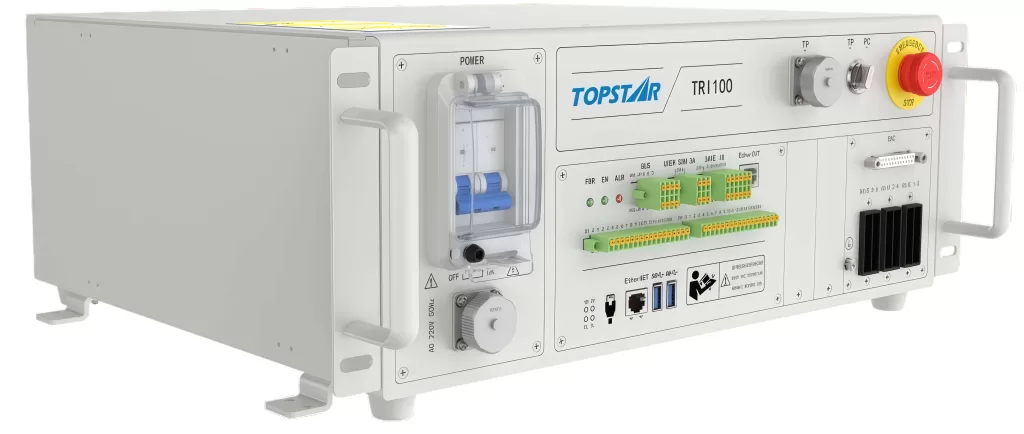
To achieve an ultra-short cycle time of 0.33 seconds with a 4 axis robot, the key lies in its controller. The TRI Robot Controller is the controller platform we designed for all our industrial robot series; it enables SCARA robots to achieve an ultra-short cycle time of 0.33 seconds, with the limit even as low as 0.25 seconds.
4 Axis Robot Control Technology: TRI Robot Controller
The core of Topstar’s 4 axis robot motion technology lies in its controller. The TRI Robot Controller is compatible with all Topstar industrial robot series, making it more than just a single-purpose control box. It serves as a shared motion and logic platform that supports a wide range of applications while maintaining a consistent control philosophy.
Customers across industries need systems that are easier to maintain, integrate with, and expand. A controller compatible with an entire robot series reduces the complexity of training, spare parts, diagnostics, and software deployment. For 4 axis and six-axis robots, this builds a more stable technical foundation.
The TRI Robot controller integrates motion control, PLC control, and network control. There is no need to rely on separate layers with slow or unstable communication. Instead, the logic path is simpler and more direct. This enables robots to achieve faster response times, better coordination, and fewer hidden delays.
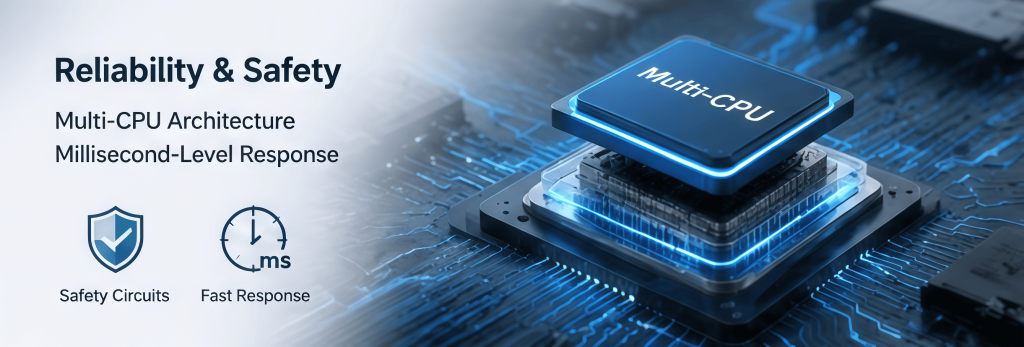
Reliability and Safety: Multi-CPU Architecture, Millisecond-Level Response
The TRI Robot controller employs a multi-CPU architecture and safety circuits, achieving millisecond-level response times. The multi-CPU design facilitates task separation, enabling the system to manage motion, logic, and safety more efficiently. This makes SCARA robots more stable under actual production conditions. Additionally, it enhances the controller’s ability to protect the workcell during abnormal situations while maintaining smooth robot operation. During high-speed material handling, 4 axis SCARA robots typically operate near conveyor belts, assembly stations, or human-robot interaction points. The controller ensures the robot remains reliable and safe every second of operation.
Eliminating Wait Times Through Motion Control
One of the primary reasons Topstar’s 4 axis robots achieve such short cycle times is that the TRI Robot controller minimizes unnecessary wait times. In many industrial robots, motion time is not the only source of delay. Other issues include dwell times, transition lags, path hesitation, and excessive readjustments between movements. When these minor delays accumulate, cycle times exceed expectations.
Topstar’s TRI Robot controller architecture reduces this waste by coordinating motion and logic more directly. Since motion commands are no longer processed in a fragmented manner, the 4 axis SCARA robot can transition between phases with minimal delay. The result is a smoother overall rhythm, enabling faster pick-up, transfer, and placement operations.
Delivering High Speed and High Precision to 4 Axis Robots
4 axis robots are typically used to handle small parts, operate within tight positioning windows, or execute repetitive assembly paths. Any deviation in the motion path can compromise the quality of the final product. If the robot is difficult to program or adjust, debugging time increases, and the production team’s flexibility is reduced. Topstar’s TRI Robot controller effectively addresses both of these issues by combining high-precision motion control, user-friendly programming, and built-in process logic.
Nano-Interpolation and Error Compensation Improve Path Accuracy
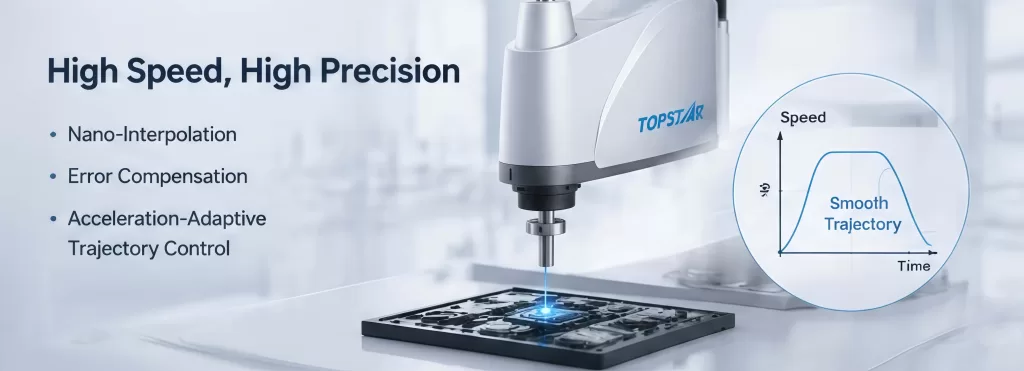
The TRI Robot controller employs high-precision nanointerpolation and multiple types of error-compensation algorithms to enhance the path accuracy of 4 axis robots. This is one of the key technical reasons it can execute precise movements within ultra-short cycles.
Nano-interpolation technology enables the controller to divide motion into extremely small increments. This allows the 4 axis robot to achieve smoother, more precise paths, which is particularly important when SCARA robots need to change direction rapidly or perform precise point-to-point positioning. The smaller the motion increments, the easier it is to maintain a straight and stable robot path.
Error compensation adds an extra layer of control. In actual production, minute deviations may arise from mechanical tolerances, load variations, or dynamic motion characteristics. The controller compensates for these errors, bringing the robot closer to the intended path. This helps maintain repeatability and reduces the likelihood that parts will be placed slightly off-target.
Acceleration-Adaptive Trajectory Control for SCARA Robot Performance
SCARA robots typically need to accelerate rapidly, move smoothly, and stop cleanly within short cycles. If the trajectory is not adjusted to account for acceleration characteristics, the robot may experience issues such as vibration, overshoot, or reduced timing efficiency. To address the application characteristics of SCARA robots, we have developed an acceleration-adaptive gate-type trajectory control technology with a gate-type motion cycle time as short as 0.25 seconds. This means the controller can manage motion more intelligently, shortening the motion cycle without compromising motion stability.
Improving the Usability of 4 Axis Robots
If a controller is too complex, debugging time increases, and production teams end up spending more time on setup than on actual production. Topstar’s TRI ROBOT controller platform addresses this issue by simplifying programming, tuning, and integrating the controller into customers’ workflows. This is one of the TRI ROBOT controller’s greatest advantages. It not only enhances motion performance but also makes SCARA robots more suitable for everyday industrial applications. The easier the system is to use, the faster the factory can reap the benefits.
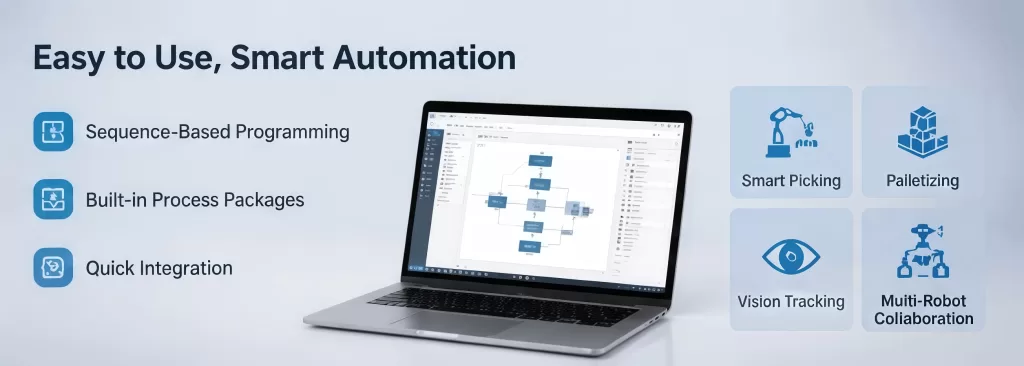
Sequence-Based Programming Approach
The TRI ROBOT controller employs a sequence-based programming approach, making it easier for users to understand and configure the robot’s movements. Rather than requiring operators to build all functions from the ground up using low-level motion logic, the controller organizes tasks in a more intuitive sequence. This reduces programming complexity and shortens debugging time. A 4 axis robot that can be programmed in operational sequence adapts more easily to different tasks. It helps teams focus on production logic rather than struggling with software. This improves deployment efficiency and lowers the barrier to entry.
Built-in Industrial Process Software Packages Enable Smarter Automation
Another key usability advantage lies in the controller’s built-in industrial process software packages. The TRI ROBOT controller supports features such as intelligent picking, intelligent palletizing, vision tracking, multi-robot collaboration, and safety-centered collaborative operations. These built-in software packages help robots transition from basic motion control to delivering real value in production applications. When the controller comes with these software packages, manufacturers can deploy robots more quickly and reduce the need for custom development. This shortens engineering time and helps factories start production faster. The built-in capabilities enable Topstar’s 4 axis robots to adapt to these tasks more efficiently.
High-Speed, High-Precision Production Enabled by Control Technology
Topstar’s 4 axis robots achieve an ultra-short cycle time of 0.33 seconds, not merely through mechanical speed, but more importantly through motion control technology. The TRI ROBOT controller integrates multi-CPU control, millisecond-level safety response, nanometer-level interpolation, error compensation, acceleration-adaptive trajectory control, and user-friendly programming capabilities. It is precisely these features that enable Topstar’s 4 axis SCARA robots to support high-speed material handling and precision assembly in actual production.
TRENDING POSTS
- Breaking Through the Full Scene-to-AI Link! Topstar Industrial Data Collection Matrix Achieves Major Technical Breakthro 2026/06/24
- TOPSTAR Selected in “Forbes China AI Top 50” and Wins “2026 Embodied AI Industry Benchmark Award” 2026/06/24
- Topstar Achieves ISO 13849 Functional Safety Certification for Robotics 2026/06/24
- Topstar Completes Key Puzzle in Embodied Intelligence Data Closed Loop — Industrial AI Capability Foundation Now in Place 2026/06/24
HOT TOPIC
- .ervo motor-driven linear robots
- •
- 1.0 guangdong topstar technology co. ltd
- 1.0 topstar china
- 1.0 topstar robot
- 11
- 160℃ mold temperature controller
- 170 ton injection molding machine
- 2
- 21
- 220-ton injection molding machine
- 23
- 260 ton injection molding machine
- 3 axis robot
- 3 axis robots
- 3 in 1 Compact Dehumidifying Dryer
- 3-axis robot
- 3-axis robots
- 39
- 4 axis robot
- 4-axis SCARA robot
- 41
- 460T injection molding machine
- 5-axis CNC machine
- 62
- 90 ton injection molding machine
- accuracy
- Air Chillers
- air-cooled chillers
- all electric injection molding machine
- all electric injection molding machines
- all-electric injection molding machine
- All-electric injection molding machines
- and overall production quality. Therefore
- AP-RubberPlas
- auto cooling system
- auto loader
- Auto Loaders
- automated injection molding machine
- Automation changed engineering
- automation of injection molding robots
- automotive parts injection molding
- Auxiliary Equipment
- auxiliary machine
- Bench Injection Molding Machine
- cabinet dryer
- Cabinet dryer manufacturers
- Cabinet dryers
- cartesian coordinate robot
- Cartesian Coordinate Robots
- Cartesian injection robot
- Cartesian robot
- Central Feeding System
- Central Feeding Systems
- chiller
- CNC Drilling Machine
- CNC Drilling Machines
- cnc engraving machine manufacturer
- cnc laser cutting machine manufacturer
- CNC machine
- CNC Machine Center
- CNC Machine for Sale
- CNC Machine Manufacturing
- CNC Machine Tool
- CNC machine tool product
- CNC Machining Center
- CNC wood carving machine
- Compact Dehumidifying Dryer
- Cooling system
- Cross-Walking Single Axis Servo Cylinder Robot
- Cross-Walking Single-Axis Servo Cylinder Robot
- Cross-Walking Three-Axis/Five-Axis Servo Driven Robot
- cross-walking three-axis/five-axis servo-driven robot
- Dehumidifier Dryer
- Dehumidifying Dryer
- dehumidifying dryers
- delta parallel robot
- Desktop Injection Molding Machine
- Desktop injection molding machines
- Desktop Molding Machine
- desktop plastic injection machine
- Desktop Plastic Injection Molding Machine
- detachable autoloader
- Digital Transformation
- direct clamp injection molding machine
- Direct clamp injection molding machines
- Dosing & mixing system
- Drilling Centers
- Drying and dehumidification system
- drying and dehumidifying equipment
- Drying and Dehumidifying System
- drying system
- effective and efficient. Cabinet dryers are also used in other industries where large quantities of material need to be dried
- efficient injection molding machine
- elbow hydraulic injection molding machines
- electric injection molding machine
- electric injection molding machines
- energy-efficient injection molding robot
- energy-efficient water chiller
- energy-efficient water chillers
- energy-saving injection molding machine
- etc. Among injection molding robots
- exhibition
- features of CNC machine
- Feeding And Conveying System
- Five Axis Machine Center
- Flexible Production Line
- Fully automatic injection molding machine
- Gathering Topstar
- giant injection molding machine
- GMU-600 5-Axis Machining Center
- Granulating & Recycling System
- granulator machine
- gravimetric blender
- Heavy duty injection molding machine
- Heavy-Duty Take-Out Robot
- High-precision electric molding machines
- high-precision plastic molding machines
- high-speed all electric injection molding machine
- high-speed electric injection molding machine
- High-Speed Packaging Injection Molding
- Honeycomb rotor dehumidifier
- hopper dryer
- Hopper Dryers
- horizontal injection molding machine
- Horizontal Injection Molding Machines
- Horizontal Injection Moulding Machine
- Horizontal Mixer manufacturer
- How The CNC Machine Works
- hybrid injection molding machine
- hydraulic injection molding machine
- Hydraulic Injection Molding Machines
- in this article
- Industrial AI
- Industrial Automation
- Industrial robot
- Industrial Robot Chinese brand
- industrial robot parts
- industrial robot supplier
- Industrial robots
- Industry Chain
- Injection Manipulator
- injection manipulator robot
- injection mold machines
- Injection molding
- Injection molding automation
- Injection Molding Automation Solution
- injection molding dryer
- Injection molding equipment
- injection molding hopper dryer
- Injection molding machine
- injection molding machine brand
- Injection Molding Machine Factory
- Injection Molding Machine Manufacture
- Injection molding machine manufacturer
- injection molding machine manufacturers
- Injection molding machine procurement
- injection molding machine robotic arm
- injection molding machine with a robot
- Injection molding machines
- injection molding material dehumidifying
- injection molding plant
- injection molding process
- Injection Molding Robot
- injection molding robot arm
- Injection molding robot automation
- Injection molding robotic arm
- injection molding robots
- injection molding whole plant
- injection moulding dryer
- Injection moulding machine
- injection moulding machines
- Injection Moulding Robots
- Injection Robot
- Injection robot arm
- Injection robot manufacturer
- Injection robot wholesale
- injection robots
- Intelligent Factory
- intelligent injection molding machines
- Intelligent Manufacturing
- intelligent mold temperature
- intelligent mold temperature controller
- Intelligent mould temperature controller
- intelligent whole plant solution
- InterPlas Thailand 2025
- Introducing Injection Robot
- It is the best choice for drying large quantities of material at once. Cabinetmakers use these machines because they are fast
- Large flow water type mold temperature controller
- large injection molding machine
- large injection molding machines
- Learn what industrial automation and robotics is
- linear robot
- linear robots
- low speed sound-proof granulator
- machine plastic molding
- make sure to add some! Improvements (2) Keyphrase in introduction: Your keyphrase or its synonyms appear in the first paragraph of the copy
- manipulator machine
- manufacturing
- Manufacturing Innovation
- medical grade injection molding machines
- Medical Injection Molding
- medical injection molding machine
- medical injection molding machines
- micro injection molding machine
- middle speed granulator
- Mini CNC machine manufacturers.
- mobile cover making machine
- Mold Temperature Control System
- mold temperature controller
- mold temperature controllers
- molding machine
- molding material Dehumidifying System
- mould temperature control system
- mould temperature controller
- mould temperature controller
- mould temperature controllers
- New electric injection molding machine
- Nitrogen Dryer
- nitrogen dryer manufacturer
- nitrogen dryer system manufacturer
- Oil type mold temperature controller
- Oil type mold temperature controllers
- open day
- optical component injection molding
- Optical-grade dehumidifying dryer
- Outbound links: No outbound links appear in this page. Add some! Images: No images appear on this page. Add some! Internal links: No internal links appear in this page
- packaging injection molding
- Packaging Solutions
- PET Preform injection molding
- phone case maker machine
- phone case making machine
- phone cover making machine
- PID Control Mold Temperature Controller
- plastic auto loader
- plastic bottle making machine
- plastic bottle manufacturing
- plastic bucket making machine
- plastic bucket manufacturing
- Plastic chair making machine
- plastic dryer for injection molding
- plastic forming equipment
- Plastic Granulator
- Plastic Granulators
- plastic hopper dryer
- plastic injection machine
- plastic injection machines
- plastic injection molding
- Plastic injection molding equipment
- Plastic injection molding machine
- Plastic Injection Molding Machines
- plastic injection moulding machine
- plastic injection moulding machines
- plastic injection robot
- plastic molding
- Plastic Molding Industry
- Plastic Molding machine
- plastic molding machine 1
- Plastic Molding Machines
- plastic molding press
- plastic moulding machine
- plastic phone case making machine
- plastic-molding machine
- powerful granulator
- Powerful Type Sound-Proof Granulator
- precision injection molding
- precision injection molding machines
- production of plastic seats
- pure water mould temperature controller
- Robot injection molding
- robot injection molding machine
- robot manufacturing companies
- Robotic arm for injection molding machine
- robotic injection molding machines
- robotics in injection molding
- SCARA robot
- SCARA robots
- Screw dosers
- Service-oriented manufacturing
- Servo Cylinder Robot
- servo driven robot
- Servo Driven Robots
- servo injection molding machine
- servo injection robots
- servo motor-driven linear robots
- servo-driven 3-axis robot
- Servo-driven injection molding machine
- Servo-Driven Robot
- Setup of injection machine
- Silicone Injection Molding Machine
- six-axis industrial robot
- Smart Manufacturing
- soundproof granulator
- Sprue Picker
- Stainless Hopper Dryer
- Stainless Hopper Dryers
- star club
- swing arm robot
- T1 Cartesian injection robot
- take-out robot
- take-out robots
- Thailand 4.0
- the choice between servo-driven robots and hydraulic robots will have a certain impact on efficiency
- the most popular injection molding machine
- the type of injection molding robot
- TIC2000 Control System
- TMII injection molding machine
- toggle clamp injection molding machine
- Toggle Hydraulic Injection Molding Machines
- toggle injection molding machine
- Top 10 brands of injection robots
- Topstar
- Topstar Electric Injection Molding Machine InterPlas Thailand 2025 Smart Manufacturing Thailand 4.0
- Topstar Engineering
- Topstar Industrial Robots
- Topstar injection molding intelligent
- Topstar Scara Robots
- Useful Injection molding machine
- Vertical machining centers
- volumetric type blender
- Washing Machine Case Molding Solution
- water chiller
- water chillers
- water distributor
- water type mold temperature controller
- Water Type MoldTemperature Controller
- Water-Cooled Chillers
- Water-cooled Mold Temperature Controller
- water-type mold temperature controller
- Water-Type Mould Temperature Controllers
- We often face choices when performing injection molding. We will choose the type of injection molding machine
- wholesale of injection molding machines
- x carve CNC
- 热门查询 点击次数 展示 排名 topstar