
Cartesian Injection Robot Weak Vacuum Suction: Troubleshooting Pneumatic System Faults
2026/07/09 By le zhan
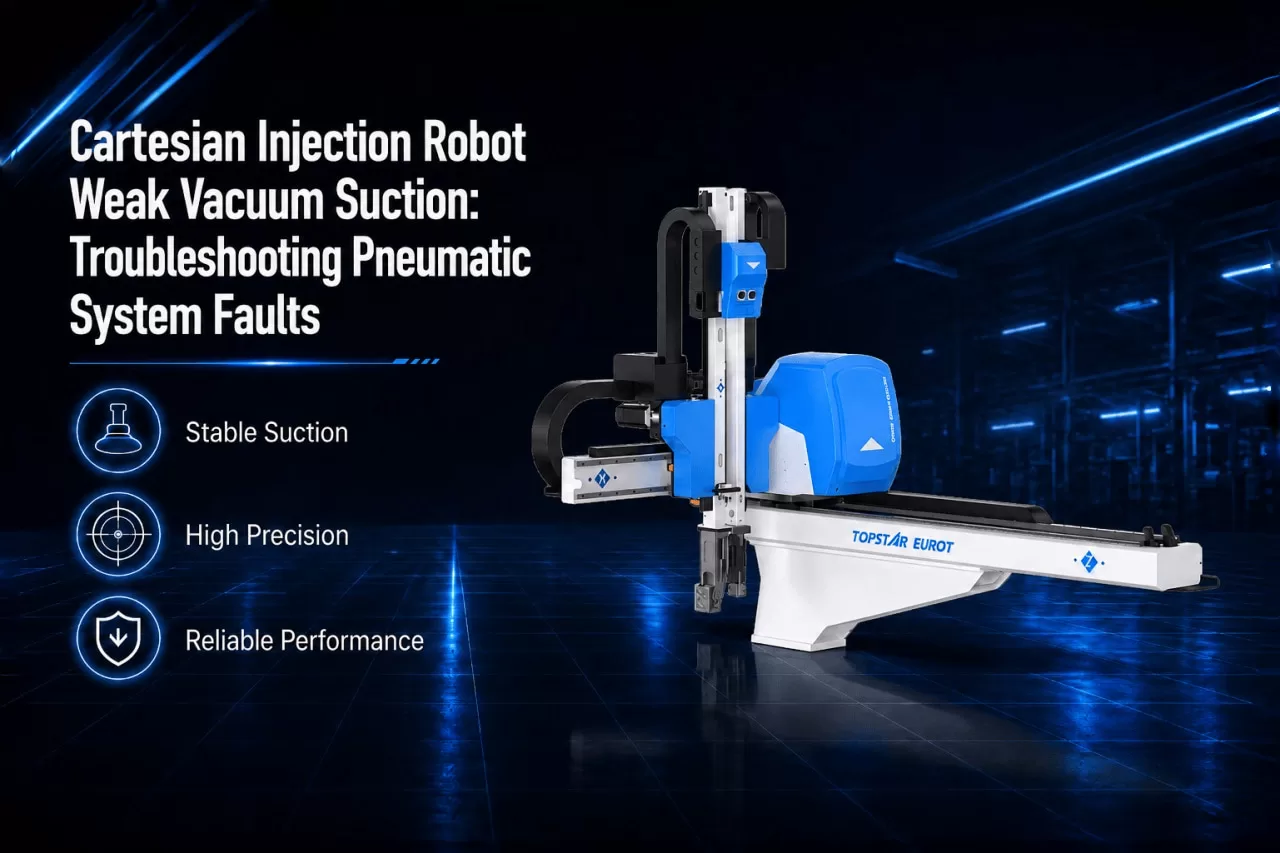
Insufficient vacuum suction force is one of the most common issues encountered with the cartesian injection robot. While it may appear to be a minor pneumatic problem, it can quickly disrupt the entire injection molding cycle. Unstable suction can lead to failed pickups, dropped workpieces during transfer, triggered alarms, or slowed production. In severe cases, unstable gripping can even damage the molded parts, the mold, or the end-effector.
When this issue arises, avoid the impulse to blindly replace parts. Instead, inspect the pneumatic system chain; a drop in performance at any link can reduce suction force. Efficient resolution requires systematic troubleshooting to pinpoint the root cause.
Diagnosing Vacuum Suction Faults in Cartesian Injection Robot
Vacuum suction performance depends primarily on two factors: the vacuum level and the airflow rate.
The vacuum level indicates the intensity of the negative pressure, while the air flow rate determines the system’s evacuation speed and its ability to maintain suction despite minor leaks.
It is crucial to distinguish between the two. Even if the vacuum gauge shows a negative pressure reading, the robot may still fail to securely grip the workpiece if the system cannot provide sufficient effective flow. For instance, gripping a large molded panel might require multiple suction cups; if just one cup leaks, the suction force across the entire circuit could be lost. In this scenario, the problem is not merely “low vacuum level,” but a loss of effective gripping capability.
We recommend troubleshooting the entire pneumatic circuit. Begin by checking the air supply, then inspect the vacuum generator, vacuum lines, suction cups, valves, and sensors in sequence. This approach saves time and prevents the unnecessary replacement of fully functional components.
Accurately Categorizing Fault Symptoms
Before adjusting air pressure or replacing parts, users should clearly define the specific symptoms of the fault. A description like “insufficient suction force” could correspond to various situations.
For example:
The robot fails to pick up the workpiece at the mold position. Issues include slow vacuum buildup, poor suction cup contact, improper gripping height, or insufficient vacuum generator capacity.
The robot successfully grips the workpiece but drops it during movement. This usually indicates leakage, insufficient gripping force, worn suction cups, excessive acceleration, or unstable vacuum levels during handling.
Problems may also arise only after several hours of operation. In such cases, the cause could be contaminants, moisture, clogged filters, aging suction cups, or unstable factory air pressure.
We recommend troubleshooting by observing the robot’s actions at these four critical moments:
- When the vacuum command is issued.
- When the suction cup contacts the product.
- When the workpiece is released from the mold.
- When the robot moves at high speed.
If the vacuum level fails to build after the command is issued, check the air supply, solenoid valves, or the vacuum generator.
If the vacuum level drops upon contact, check the suction cup seal, product surface condition, tooling alignment, and for any leaks. If the workpiece drops during movement, check the gripping force, acceleration, air tube movement, and vacuum sensor logic settings.
The air supply for Cartesian injection molding robots must be clean, dry, and stable
Pneumatic systems rely on compressed air. If the air supply is unstable, the reliability of the entire vacuum system is compromised.
First, check the pressure at the robot’s air inlet; do not rely solely on the pressure gauge reading at the factory’s air compressor.
Factors such as long pipelines, narrow hoses, clogged filter elements, or sharing the air supply with other equipment can cause pressure drops. During peak production periods, fluctuations in factory air pressure may exceed expectations. Vacuum generators require a specific inlet pressure to achieve rated performance. If pressure drops during operation, gripping force will weaken, even if all robot components are functioning correctly.
Next, check the air supply preparation unit.
Moisture, oil, and dust can impair pneumatic system performance. Moisture can cause valves to stick; oil can trap dust and clog tiny passages; and clogged filter elements reduce flow. Therefore, diagnostics should focus on both pressure and flow. Increasing pressure does not always improve gripping performance.
Vacuum Generator Performance in Cartesian Injection Robot
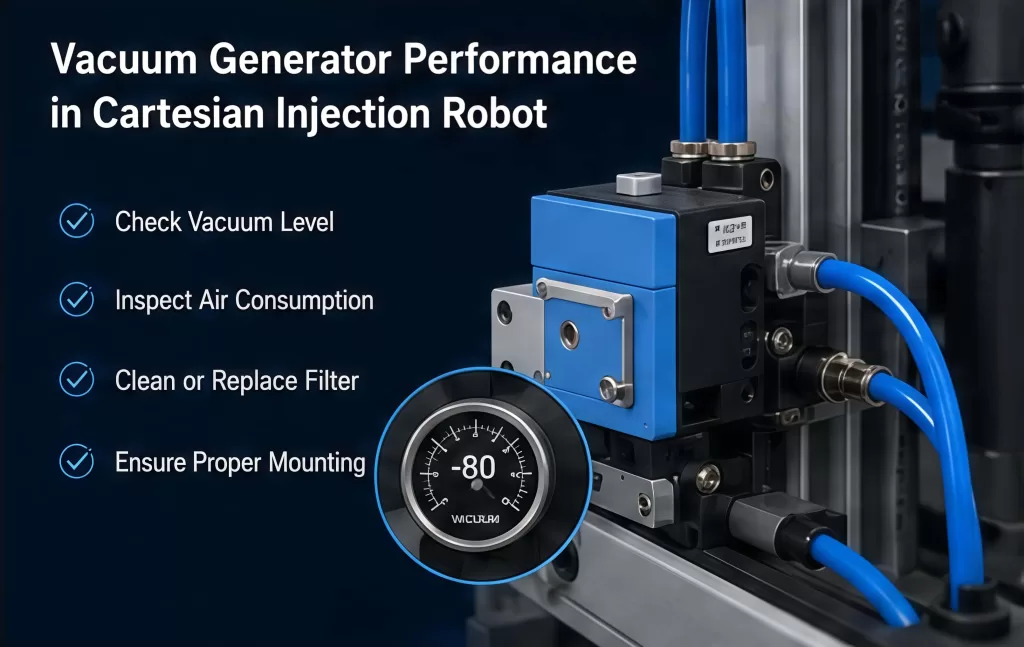
The vacuum generator is the core component for generating negative pressure. In many injection molding robot applications, pneumatic vacuum generators use compressed air to generate suction via the Venturi effect.
If the suction force diminishes, the vacuum generator should be inspected under actual operating conditions. First, check the supply air pressure and ensure it remains stable when the robot issues a vacuum command. Next, inspect the exhaust port and silencer. A clogged silencer restricts exhaust flow, thereby reducing vacuum performance—an issue that is easily overlooked.
If maintenance conditions permit, inspect the internal nozzle. Dust, oil residue, scale, or plastic particles can narrow the flow channels. Even a minor blockage can impair vacuum generation capabilities and increase response times.
If you modify the end-of-arm tool (EOAT), the original vacuum generator may no longer provide the performance the application requires. An increased number of suction cups, longer tubing, larger workpiece dimensions, or complex surface textures can all increase vacuum demand. In such cases, you may need to replace the unit with a higher-capacity vacuum generator, shorten vacuum lines, create independent vacuum zones, or install check valves.
Vacuum Generator Isolation Test
An effective testing method is to isolate the vacuum generator from the end-of-arm tool. Directly seal the vacuum inlet and check if the generator achieves the expected vacuum level. If it fails to do so, the problem likely lies with the upstream air supply, a generator blockage, or generator wear. If the generator operates correctly in isolation, the fault lies downstream; in this case, focus the inspection on tubing, fittings, suction cups, distribution blocks (manifolds), and the tool layout.
Preventing Leaks in Vacuum Lines and Fittings
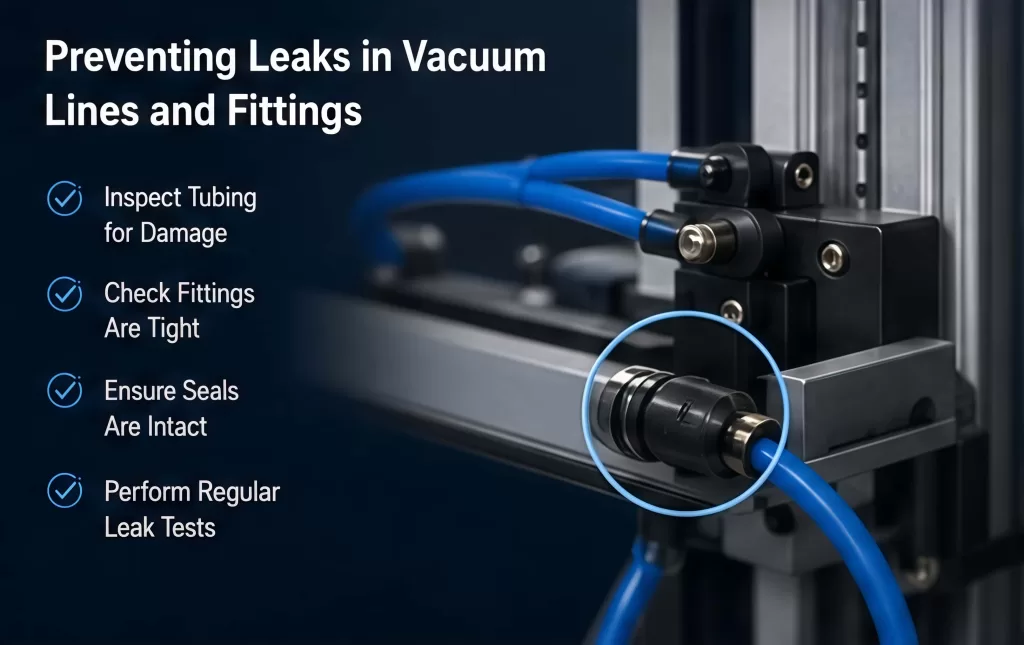
Once the vacuum generator creates negative pressure, the vacuum circuit must transmit that pressure to the suction cups. Any leakage or airflow restriction will reduce the suction force applied to the product surface.
Begin with a visual inspection.
Check for cracked tubing, loose fittings, worn seals, damaged manifolds, or hoses compressed beyond their limits. Because Cartesian injection robots move frequently, the tubing is subjected to bending, vibration, and acceleration. The tubing may seal effectively when the robot is stationary, but leak when the robotic arm moves to the gripping position.
Next, inspect the tubing layout.
Excessive length in the suction lines increases evacuation time; tubing with too small a diameter restricts airflow; and sharp bends reduce the effective flow cross-section. To achieve rapid gripping, minimize the length of the suction circuit and keep the tubing as straight as possible. If multiple suction cups share a single line, ensure the manifold and tubing can handle the total flow requirements. A leak in any branch line can compromise the suction performance of the entire circuit.
Maintenance of Valves and Sensors
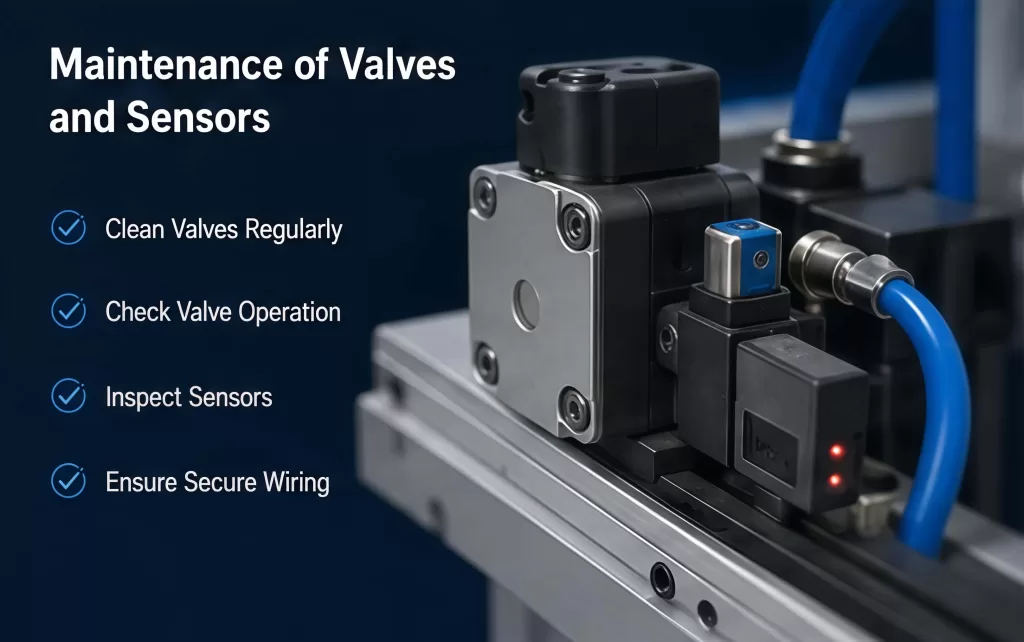
Cartesian injection robots rely on valves and sensors to control and verify the vacuum state. If these components malfunction or experience parameter drift, the robot may misinterpret the suction status.
First, inspect the vacuum solenoid valve.
When the robot issues a vacuum command, the valve must switch quickly and completely. A sticking valve delays vacuum buildup, while a leaking valve reduces suction force. If the robot features a blow-off (vacuum release) function, ensure the blow-off valve does not leak air into the suction line during gripping.
Next, inspect the vacuum sensor.
Threshold settings must align with product and process requirements. If the threshold is too high, the robot may trigger an alarm even when suction is secure; if it is too low, the robot may begin moving before the part is firmly gripped.
Finally, check the sensor’s air tubing. Blockages or leaks in the sensing line can lead to delayed or inaccurate feedback.
Preventive Maintenance Checklist for Cartesian Injection Robot
Periodically drain accumulated water from filters; check air-supply pressure; inspect suction cups; clean silencers; tighten fittings; test vacuum sensor response; and monitor vacuum level trends during production.
When troubleshooting insufficient suction force, follow this sequence: identify the fault symptoms, verify the air supply, test the vacuum generator, isolate the suction lines, inspect the suction cups, check the valves, and verify sensor settings. The issue of insufficient gripping force in Cartesian injection robot usually has traceable causes, often stemming from unstable air pressure, contaminants, leaks, poor suction cup sealing, insufficient flow, valve malfunctions, or erroneous sensor feedback.
TRENDING POSTS
- Breaking Through the Full Scene-to-AI Link! Topstar Industrial Data Collection Matrix Achieves Major Technical Breakthro 2026/07/09
- TOPSTAR Selected in “Forbes China AI Top 50” and Wins “2026 Embodied AI Industry Benchmark Award” 2026/07/09
- Topstar Achieves ISO 13849 Functional Safety Certification for Robotics 2026/07/09
- Topstar Completes Key Puzzle in Embodied Intelligence Data Closed Loop — Industrial AI Capability Foundation Now in Place 2026/07/09
HOT TOPIC
- .ervo motor-driven linear robots
- •
- 1.0 guangdong topstar technology co. ltd
- 1.0 topstar china
- 1.0 topstar robot
- 11
- 160℃ mold temperature controller
- 170 ton injection molding machine
- 2
- 21
- 220-ton injection molding machine
- 23
- 260 ton injection molding machine
- 3 axis robot
- 3 axis robots
- 3 in 1 Compact Dehumidifying Dryer
- 3-axis robot
- 3-axis robots
- 39
- 4 axis robot
- 4-axis SCARA robot
- 41
- 460T injection molding machine
- 5-axis CNC machine
- 62
- 90 ton injection molding machine
- accuracy
- Air Chillers
- air-cooled chillers
- all electric injection molding machine
- all electric injection molding machines
- all-electric injection molding machine
- All-electric injection molding machines
- and overall production quality. Therefore
- AP-RubberPlas
- auto cooling system
- auto loader
- Auto Loaders
- automated injection molding machine
- Automation changed engineering
- automation of injection molding robots
- automotive parts injection molding
- Auxiliary Equipment
- auxiliary machine
- Bench Injection Molding Machine
- cabinet dryer
- Cabinet dryer manufacturers
- Cabinet dryers
- cartesian coordinate robot
- Cartesian Coordinate Robots
- Cartesian injection robot
- Cartesian robot
- Central Feeding System
- Central Feeding Systems
- chiller
- CNC Drilling Machine
- CNC Drilling Machines
- cnc engraving machine manufacturer
- cnc laser cutting machine manufacturer
- CNC machine
- CNC Machine Center
- CNC Machine for Sale
- CNC Machine Manufacturing
- CNC Machine Tool
- CNC machine tool product
- CNC Machining Center
- CNC wood carving machine
- Compact Dehumidifying Dryer
- Cooling system
- Cross-Walking Single Axis Servo Cylinder Robot
- Cross-Walking Single-Axis Servo Cylinder Robot
- Cross-Walking Three-Axis/Five-Axis Servo Driven Robot
- cross-walking three-axis/five-axis servo-driven robot
- Dehumidifier Dryer
- Dehumidifying Dryer
- dehumidifying dryers
- delta parallel robot
- Desktop Injection Molding Machine
- Desktop injection molding machines
- Desktop Molding Machine
- desktop plastic injection machine
- Desktop Plastic Injection Molding Machine
- detachable autoloader
- Digital Transformation
- direct clamp injection molding machine
- Direct clamp injection molding machines
- Dosing & mixing system
- Drilling Centers
- Drying and dehumidification system
- drying and dehumidifying equipment
- Drying and Dehumidifying System
- drying system
- effective and efficient. Cabinet dryers are also used in other industries where large quantities of material need to be dried
- efficient injection molding machine
- elbow hydraulic injection molding machines
- electric injection molding machine
- electric injection molding machines
- energy-efficient injection molding robot
- energy-efficient water chiller
- energy-efficient water chillers
- energy-saving injection molding machine
- etc. Among injection molding robots
- exhibition
- features of CNC machine
- Feeding And Conveying System
- Five Axis Machine Center
- Flexible Production Line
- Fully automatic injection molding machine
- Gathering Topstar
- giant injection molding machine
- GMU-600 5-Axis Machining Center
- Granulating & Recycling System
- granulator machine
- gravimetric blender
- Heavy duty injection molding machine
- Heavy-Duty Take-Out Robot
- High-precision electric molding machines
- high-precision plastic molding machines
- high-speed all electric injection molding machine
- high-speed electric injection molding machine
- High-Speed Packaging Injection Molding
- Honeycomb rotor dehumidifier
- hopper dryer
- Hopper Dryers
- horizontal injection molding machine
- Horizontal Injection Molding Machines
- Horizontal Injection Moulding Machine
- Horizontal Mixer manufacturer
- How The CNC Machine Works
- hybrid injection molding machine
- hydraulic injection molding machine
- Hydraulic Injection Molding Machines
- in this article
- Industrial AI
- Industrial Automation
- Industrial robot
- Industrial Robot Chinese brand
- industrial robot parts
- industrial robot supplier
- Industrial robots
- Industry Chain
- Injection Manipulator
- injection manipulator robot
- injection mold machines
- Injection molding
- Injection molding automation
- Injection Molding Automation Solution
- injection molding dryer
- Injection molding equipment
- injection molding hopper dryer
- Injection molding machine
- injection molding machine brand
- Injection Molding Machine Factory
- Injection Molding Machine Manufacture
- Injection molding machine manufacturer
- injection molding machine manufacturers
- Injection molding machine procurement
- injection molding machine robotic arm
- injection molding machine with a robot
- Injection molding machines
- injection molding material dehumidifying
- injection molding plant
- injection molding process
- Injection Molding Robot
- injection molding robot arm
- Injection molding robot automation
- Injection molding robotic arm
- injection molding robots
- injection molding whole plant
- injection moulding dryer
- Injection moulding machine
- injection moulding machines
- Injection Moulding Robots
- Injection Robot
- Injection robot arm
- Injection robot manufacturer
- Injection robot wholesale
- injection robots
- Intelligent Factory
- intelligent injection molding machines
- Intelligent Manufacturing
- intelligent mold temperature
- intelligent mold temperature controller
- Intelligent mould temperature controller
- intelligent whole plant solution
- InterPlas Thailand 2025
- Introducing Injection Robot
- It is the best choice for drying large quantities of material at once. Cabinetmakers use these machines because they are fast
- Large flow water type mold temperature controller
- large injection molding machine
- large injection molding machines
- Learn what industrial automation and robotics is
- linear robot
- linear robots
- low speed sound-proof granulator
- machine plastic molding
- make sure to add some! Improvements (2) Keyphrase in introduction: Your keyphrase or its synonyms appear in the first paragraph of the copy
- manipulator machine
- manufacturing
- Manufacturing Innovation
- medical grade injection molding machines
- Medical Injection Molding
- medical injection molding machine
- medical injection molding machines
- micro injection molding machine
- middle speed granulator
- Mini CNC machine manufacturers.
- mobile cover making machine
- Mold Temperature Control System
- mold temperature controller
- mold temperature controllers
- molding machine
- molding material Dehumidifying System
- mould temperature control system
- mould temperature controller
- mould temperature controller
- mould temperature controllers
- New electric injection molding machine
- Nitrogen Dryer
- nitrogen dryer manufacturer
- nitrogen dryer system manufacturer
- Oil type mold temperature controller
- Oil type mold temperature controllers
- open day
- optical component injection molding
- Optical-grade dehumidifying dryer
- Outbound links: No outbound links appear in this page. Add some! Images: No images appear on this page. Add some! Internal links: No internal links appear in this page
- packaging injection molding
- Packaging Solutions
- PET Preform injection molding
- phone case maker machine
- phone case making machine
- phone cover making machine
- PID Control Mold Temperature Controller
- plastic auto loader
- plastic bottle making machine
- plastic bottle manufacturing
- plastic bucket making machine
- plastic bucket manufacturing
- Plastic chair making machine
- plastic dryer for injection molding
- plastic forming equipment
- Plastic Granulator
- Plastic Granulators
- plastic hopper dryer
- plastic injection machine
- plastic injection machines
- plastic injection molding
- Plastic injection molding equipment
- Plastic injection molding machine
- Plastic Injection Molding Machines
- plastic injection moulding machine
- plastic injection moulding machines
- plastic injection robot
- plastic molding
- Plastic Molding Industry
- Plastic Molding machine
- plastic molding machine 1
- Plastic Molding Machines
- plastic molding press
- plastic moulding machine
- plastic phone case making machine
- plastic-molding machine
- powerful granulator
- Powerful Type Sound-Proof Granulator
- precision injection molding
- precision injection molding machines
- production of plastic seats
- pure water mould temperature controller
- Robot injection molding
- robot injection molding machine
- robot manufacturing companies
- Robotic arm for injection molding machine
- robotic injection molding machines
- robotics in injection molding
- SCARA robot
- SCARA robots
- Screw dosers
- Service-oriented manufacturing
- Servo Cylinder Robot
- servo driven robot
- Servo Driven Robots
- servo injection molding machine
- servo injection robots
- servo motor-driven linear robots
- servo-driven 3-axis robot
- Servo-driven injection molding machine
- Servo-Driven Robot
- Setup of injection machine
- Silicone Injection Molding Machine
- six-axis industrial robot
- Smart Manufacturing
- soundproof granulator
- Sprue Picker
- Stainless Hopper Dryer
- Stainless Hopper Dryers
- star club
- swing arm robot
- T1 Cartesian injection robot
- take-out robot
- take-out robots
- Thailand 4.0
- the choice between servo-driven robots and hydraulic robots will have a certain impact on efficiency
- the most popular injection molding machine
- the type of injection molding robot
- TIC2000 Control System
- TMII injection molding machine
- toggle clamp injection molding machine
- Toggle Hydraulic Injection Molding Machines
- toggle injection molding machine
- Top 10 brands of injection robots
- Topstar
- Topstar Electric Injection Molding Machine InterPlas Thailand 2025 Smart Manufacturing Thailand 4.0
- Topstar Engineering
- Topstar Industrial Robots
- Topstar injection molding intelligent
- Topstar Scara Robots
- Useful Injection molding machine
- Vertical machining centers
- volumetric type blender
- Washing Machine Case Molding Solution
- water chiller
- water chillers
- water distributor
- water type mold temperature controller
- Water Type MoldTemperature Controller
- Water-Cooled Chillers
- Water-cooled Mold Temperature Controller
- water-type mold temperature controller
- Water-Type Mould Temperature Controllers
- We often face choices when performing injection molding. We will choose the type of injection molding machine
- wholesale of injection molding machines
- x carve CNC
- 热门查询 点击次数 展示 排名 topstar