
How does a compact dehumidifying dryer achieve stable and reliable drying and dehumidification?
2026/06/12 By le zhan
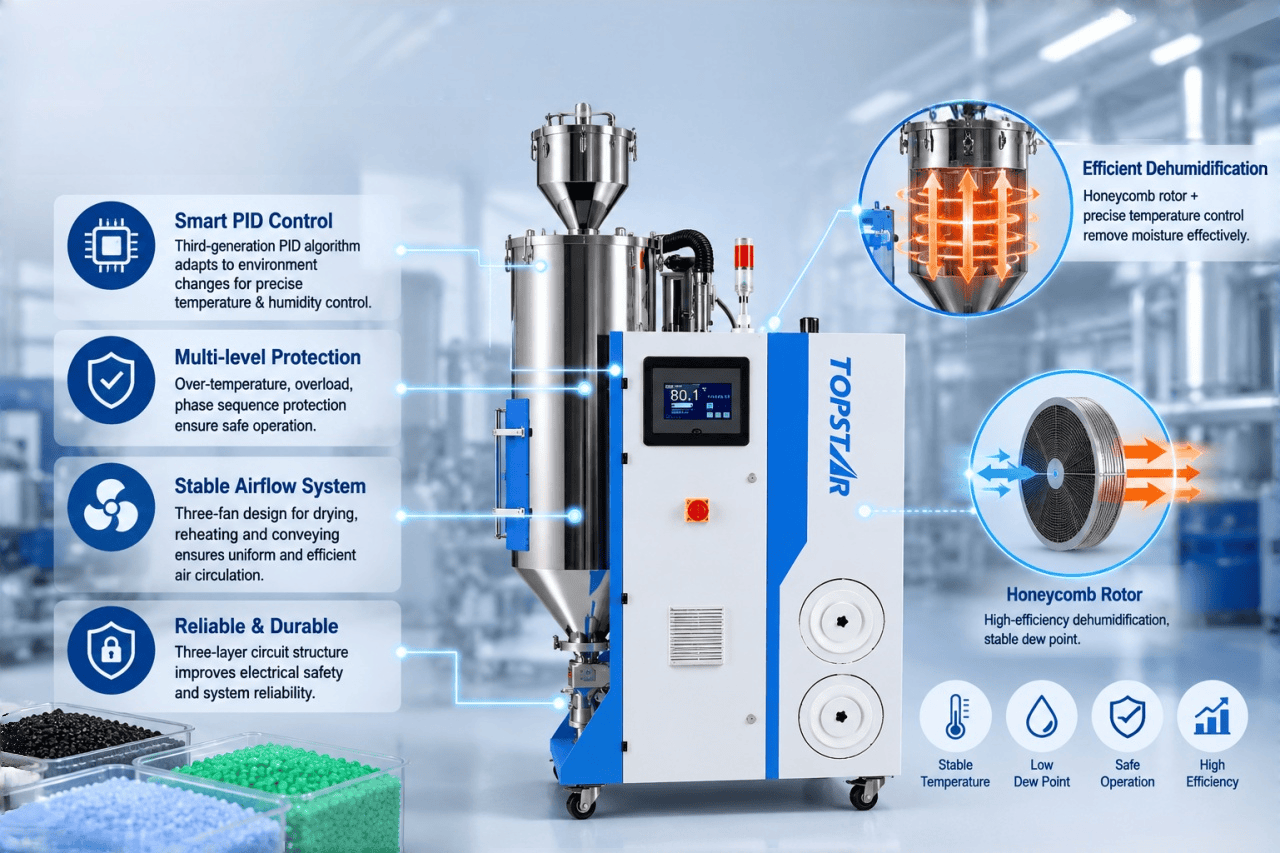
For a compact dehumidifying dryer to achieve stable, reliable performance, it must adapt to its environment, protect itself, and operate safely over the long term. To achieve this goal, Topstar has adopted a third-generation PID algorithm, a three-layer circuit structure, multi-fan overload protection, and multi-level over-temperature protection. The combination of these technologies ensures that the dryer maintains stable dehumidification performance during injection molding production.
The Stability and Reliability of Compact Dehumidifying Dryers Depend on Control
The functionality of a compact dehumidifying dryer extends far beyond simply generating hot air for drying. It must simultaneously control temperature, dehumidification capacity, airflow, and safety conditions. If any of these elements becomes unstable, the drying process will begin to deviate. This deviation will manifest in the final product.
Insufficient or unstable dehumidification capacity in a dryer can leave residual moisture in the material, leading to issues such as bubbles, flow marks, or unstable molding performance. Therefore, we have transformed the dehumidifying dryer into a controllable system that relies on smarter feedback, a safer power architecture, and robust protection logic to ensure stable operation even when workshop conditions change.
In our TCDHE compact dehumidifying dryer, we have implemented technologies including a third-generation PID algorithm, a three-layer circuit structure, multi-fan overload protection, and multi-level over-temperature protection to achieve stable, reliable drying and dehumidification performance.
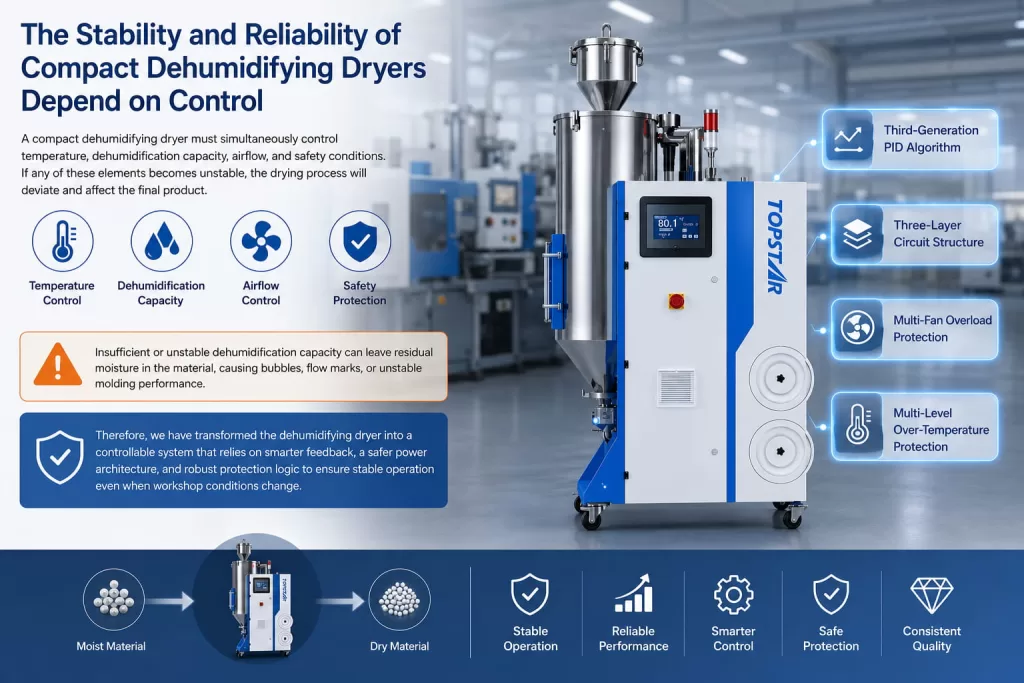
Compact Dehumidifying Dryer with Third-Generation PID Algorithm
At the intelligent control level, we have implemented a third-generation PID algorithm in our compact dehumidifying dryer. This enables the machine to respond to environmental changes with precision and balance. Topstar’s PID algorithm is specifically designed to adapt to environmental fluctuations, which is particularly crucial in unstable environments such as actual injection molding workshops.
If the ambient temperature rises or falls, or if the material load changes, the dryer must respond while maintaining control stability. The third-generation PID logic helps the system maintain target operating conditions with greater precision. It adjusts in a way that preserves stability, enhancing operational reliability.
Three-Layer Circuit Architecture Enhances Safety and Reliability
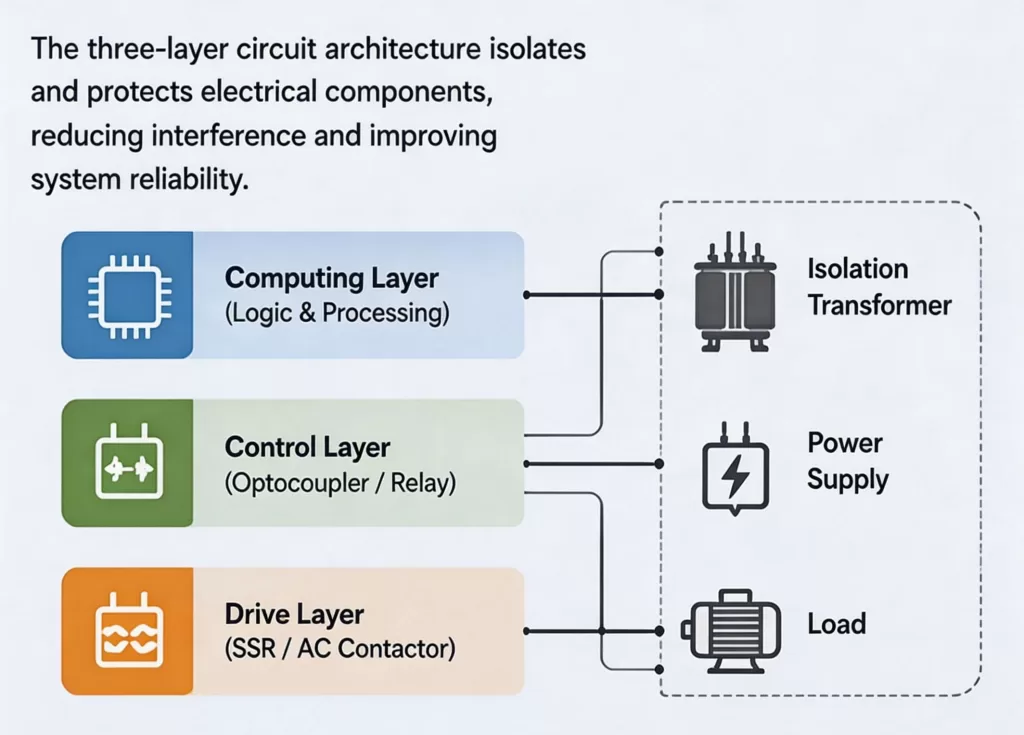
In compact dehumidifying dryers, we have also adopted a three-layer circuit architecture: the computing layer, the control layer, and the drive layer. This design includes an isolation transformer, an optocoupler/relay control layer, and a solid-state relay/AC contactor drive layer. The purpose of this architecture is to separate different electrical functions, enabling them to work together more safely and reliably.
Injection molding dryers are subjected to electrical stress daily. If any part of the circuit is excessively exposed to interference or an unstable power supply environment, the reliability of the entire system is compromised. By dividing the system into distinct layers, we reduce the risk of electrical instability spreading from one section to another, making the equipment safer and more durable.
Multi-fan protection ensures stable airflow during daily operation
A compact dehumidifying dryer requires more than heat; it also needs controllable airflow. Topstar employs three fans in its compact dehumidifying dryers: one for drying, one for reheating, and one for conveying. Each fan performs a distinct function, supporting different stages of the drying process. This functional separation helps the system maintain more stable operation and better process control. When these functions are controlled independently, the dryer can operate each stage more stably and efficiently.
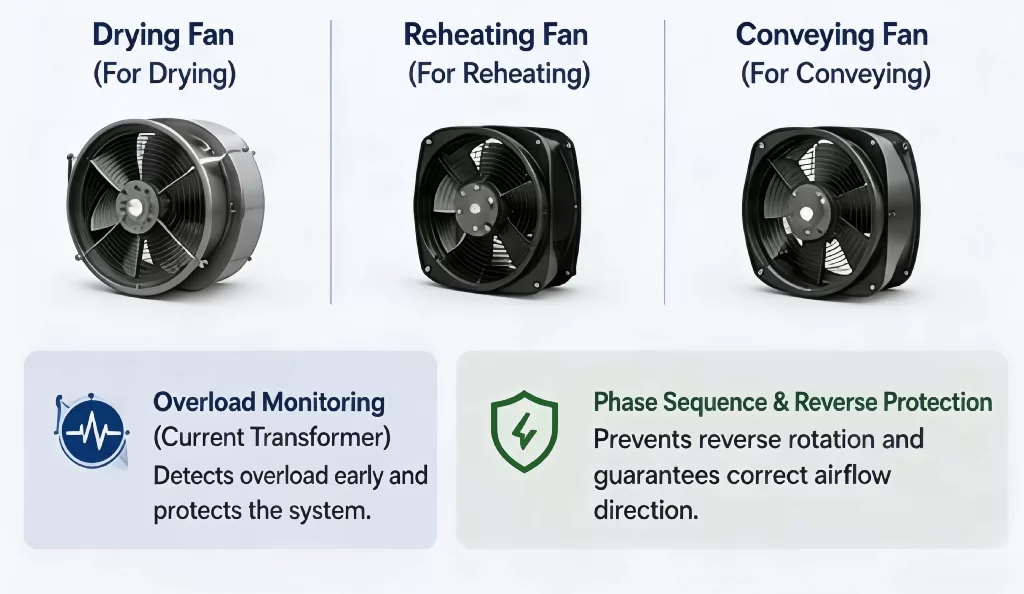
Overload Monitoring Enhances Safety and Prevents Dehumidifying Dryer Downtime
Our dehumidifying dryers also feature overload monitoring based on a current transformer. This feature helps the machine detect overload conditions in the fan system. If a fan draws excessive current, the system can detect the issue early and protect the equipment before damage occurs. During production, fans may encounter greater resistance than usual due to airflow obstructions, dust, or mechanical stress. If the system fails to detect this change early, the problem may escalate and even affect the entire dryer. Overload monitoring helps the machine identify and resolve issues before they lead to downtime.
Phase Sequence and Reverse Protection Ensure Proper Airflow Operation
Another critical safety feature is phase-sequence and reverse-protection. In industrial environments, incorrect power connections or electrical faults can cause fans to rotate in the wrong direction. If this occurs, airflow performance drops sharply, causing instability in the drying process and potentially compromising system reliability.
Therefore, our dehumidifying dryers incorporate phase protection technology to prevent such failures. The compact dehumidifying dryer can detect reverse rotation and respond before airflow is compromised. This helps ensure that the three-fan system always operates in the correct direction, thereby guaranteeing drying quality.
Multi-Layer Over-Temperature Protection Ensures Safe Drying Operations
Temperature control is only part of safe drying. A compact dehumidifying dryer must also feature over-temperature protection. If temperatures become too high, materials may be damaged, the equipment may be subjected to excessive stress, and safety may be compromised. Therefore, we employ multi-layer over-temperature protection to make the dryer safer during daily operation.
Sensor Triggers, Mechanical Cutoffs, and Drum Wall Cutoffs Work in Concert
Topstar’s over-temperature protection system employs a three-tiered approach: temperature sensor triggers, mechanical air-temperature cutoffs, and drum-wall cutoffs. Each layer addresses different risk points. Together, they build a stronger safety framework for compact dehumidifying dryers.
Key features include:
1. The temperature sensor trip function electronically detects abnormal temperature rises.
2. The mechanical air temperature cutoff device provides an additional layer of direct protection when the air temperature reaches unsafe levels.
3. The drum wall cutoff device provides additional protection at the material contact area, preventing the machine from continuing to dry beyond safe limits.
This multi-layered protection design ensures the highest level of drying safety for the dryer.
Four Core Technologies Deliver Stable and Reliable Performance
The stable and reliable drying performance of the compact dehumidifying dryer is achieved through the combination of four core technologies: the third-generation PID algorithm, a three-layer circuit structure, three-fan overload protection logic, and a multi-layer over-temperature protection system. Each technology is optimized to address specific challenges, collectively delivering more reliable and stable operation. When these four technologies work in concert, the dryer is better able to adapt to real-world production environments.
TRENDING POSTS
- TOPS DAY 2026: Turning Industrial AI into Real-World Impact 2026/06/12
- Breaking Through the Full Scene-to-AI Link! Topstar Industrial Data Collection Matrix Achieves Major Technical Breakthro 2026/06/12
- TOPSTAR Selected in “Forbes China AI Top 50” and Wins “2026 Embodied AI Industry Benchmark Award” 2026/06/12
- Topstar Achieves ISO 13849 Functional Safety Certification for Robotics 2026/06/12
HOT TOPIC
- .ervo motor-driven linear robots
- •
- 1.0 guangdong topstar technology co. ltd
- 1.0 topstar china
- 1.0 topstar robot
- 11
- 160℃ mold temperature controller
- 170 ton injection molding machine
- 2
- 21
- 220-ton injection molding machine
- 23
- 260 ton injection molding machine
- 3 axis robot
- 3 axis robots
- 3 in 1 Compact Dehumidifying Dryer
- 3-axis robot
- 3-axis robots
- 39
- 4 axis robot
- 4-axis SCARA robot
- 41
- 460T injection molding machine
- 5-axis CNC machine
- 62
- 90 ton injection molding machine
- accuracy
- Air Chillers
- air-cooled chillers
- all electric injection molding machine
- all electric injection molding machines
- all-electric injection molding machine
- All-electric injection molding machines
- and overall production quality. Therefore
- AP-RubberPlas
- auto cooling system
- auto loader
- Auto Loaders
- automated injection molding machine
- Automation changed engineering
- automation of injection molding robots
- automotive parts injection molding
- Auxiliary Equipment
- auxiliary machine
- Bench Injection Molding Machine
- cabinet dryer
- Cabinet dryer manufacturers
- Cabinet dryers
- cartesian coordinate robot
- Cartesian Coordinate Robots
- Cartesian injection robot
- Cartesian robot
- Central Feeding System
- Central Feeding Systems
- chiller
- CNC Drilling Machine
- CNC Drilling Machines
- cnc engraving machine manufacturer
- cnc laser cutting machine manufacturer
- CNC machine
- CNC Machine Center
- CNC Machine for Sale
- CNC Machine Manufacturing
- CNC Machine Tool
- CNC machine tool product
- CNC Machining Center
- CNC wood carving machine
- Compact Dehumidifying Dryer
- Cooling system
- Cross-Walking Single Axis Servo Cylinder Robot
- Cross-Walking Single-Axis Servo Cylinder Robot
- Cross-Walking Three-Axis/Five-Axis Servo Driven Robot
- cross-walking three-axis/five-axis servo-driven robot
- Dehumidifier Dryer
- Dehumidifying Dryer
- dehumidifying dryers
- delta parallel robot
- Desktop Injection Molding Machine
- Desktop injection molding machines
- Desktop Molding Machine
- desktop plastic injection machine
- Desktop Plastic Injection Molding Machine
- detachable autoloader
- Digital Transformation
- direct clamp injection molding machine
- Direct clamp injection molding machines
- Dosing & mixing system
- Drilling Centers
- Drying and dehumidification system
- drying and dehumidifying equipment
- Drying and Dehumidifying System
- drying system
- effective and efficient. Cabinet dryers are also used in other industries where large quantities of material need to be dried
- efficient injection molding machine
- elbow hydraulic injection molding machines
- electric injection molding machine
- electric injection molding machines
- energy-efficient injection molding robot
- energy-efficient water chiller
- energy-efficient water chillers
- energy-saving injection molding machine
- etc. Among injection molding robots
- exhibition
- features of CNC machine
- Feeding And Conveying System
- Five Axis Machine Center
- Flexible Production Line
- Fully automatic injection molding machine
- Gathering Topstar
- giant injection molding machine
- GMU-600 5-Axis Machining Center
- Granulating & Recycling System
- granulator machine
- gravimetric blender
- Heavy duty injection molding machine
- Heavy-Duty Take-Out Robot
- High-precision electric molding machines
- high-precision plastic molding machines
- high-speed all electric injection molding machine
- high-speed electric injection molding machine
- High-Speed Packaging Injection Molding
- Honeycomb rotor dehumidifier
- hopper dryer
- Hopper Dryers
- horizontal injection molding machine
- Horizontal Injection Molding Machines
- Horizontal Injection Moulding Machine
- Horizontal Mixer manufacturer
- How The CNC Machine Works
- hybrid injection molding machine
- hydraulic injection molding machine
- Hydraulic Injection Molding Machines
- in this article
- Industrial AI
- Industrial Automation
- Industrial robot
- Industrial Robot Chinese brand
- industrial robot parts
- industrial robot supplier
- Industrial robots
- Industry Chain
- Injection Manipulator
- injection manipulator robot
- injection mold machines
- Injection molding
- Injection molding automation
- Injection Molding Automation Solution
- injection molding dryer
- Injection molding equipment
- injection molding hopper dryer
- Injection molding machine
- injection molding machine brand
- Injection Molding Machine Factory
- Injection Molding Machine Manufacture
- Injection molding machine manufacturer
- injection molding machine manufacturers
- Injection molding machine procurement
- injection molding machine robotic arm
- injection molding machine with a robot
- Injection molding machines
- injection molding material dehumidifying
- injection molding plant
- injection molding process
- Injection Molding Robot
- injection molding robot arm
- Injection molding robot automation
- Injection molding robotic arm
- injection molding robots
- injection molding whole plant
- injection moulding dryer
- Injection moulding machine
- injection moulding machines
- Injection Moulding Robots
- Injection Robot
- Injection robot arm
- Injection robot manufacturer
- Injection robot wholesale
- injection robots
- Intelligent Factory
- intelligent injection molding machines
- Intelligent Manufacturing
- intelligent mold temperature
- intelligent mold temperature controller
- Intelligent mould temperature controller
- intelligent whole plant solution
- InterPlas Thailand 2025
- Introducing Injection Robot
- It is the best choice for drying large quantities of material at once. Cabinetmakers use these machines because they are fast
- Large flow water type mold temperature controller
- large injection molding machine
- large injection molding machines
- Learn what industrial automation and robotics is
- linear robot
- linear robots
- low speed sound-proof granulator
- machine plastic molding
- make sure to add some! Improvements (2) Keyphrase in introduction: Your keyphrase or its synonyms appear in the first paragraph of the copy
- manipulator machine
- manufacturing
- Manufacturing Innovation
- medical grade injection molding machines
- Medical Injection Molding
- medical injection molding machine
- medical injection molding machines
- micro injection molding machine
- middle speed granulator
- Mini CNC machine manufacturers.
- mobile cover making machine
- Mold Temperature Control System
- mold temperature controller
- mold temperature controllers
- molding machine
- molding material Dehumidifying System
- mould temperature control system
- mould temperature controller
- mould temperature controller
- mould temperature controllers
- New electric injection molding machine
- Nitrogen Dryer
- nitrogen dryer manufacturer
- nitrogen dryer system manufacturer
- Oil type mold temperature controller
- Oil type mold temperature controllers
- open day
- optical component injection molding
- Optical-grade dehumidifying dryer
- Outbound links: No outbound links appear in this page. Add some! Images: No images appear on this page. Add some! Internal links: No internal links appear in this page
- packaging injection molding
- Packaging Solutions
- PET Preform injection molding
- phone case maker machine
- phone case making machine
- phone cover making machine
- PID Control Mold Temperature Controller
- plastic auto loader
- plastic bottle making machine
- plastic bottle manufacturing
- plastic bucket making machine
- plastic bucket manufacturing
- Plastic chair making machine
- plastic dryer for injection molding
- plastic forming equipment
- Plastic Granulator
- Plastic Granulators
- plastic hopper dryer
- plastic injection machine
- plastic injection machines
- plastic injection molding
- Plastic injection molding equipment
- Plastic injection molding machine
- Plastic Injection Molding Machines
- plastic injection moulding machine
- plastic injection moulding machines
- plastic injection robot
- plastic molding
- Plastic Molding Industry
- Plastic Molding machine
- plastic molding machine 1
- Plastic Molding Machines
- plastic molding press
- plastic moulding machine
- plastic phone case making machine
- plastic-molding machine
- powerful granulator
- Powerful Type Sound-Proof Granulator
- precision injection molding
- precision injection molding machines
- production of plastic seats
- pure water mould temperature controller
- Robot injection molding
- robot injection molding machine
- robot manufacturing companies
- Robotic arm for injection molding machine
- robotic injection molding machines
- robotics in injection molding
- SCARA robot
- SCARA robots
- Screw dosers
- Service-oriented manufacturing
- Servo Cylinder Robot
- servo driven robot
- Servo Driven Robots
- servo injection molding machine
- servo injection robots
- servo motor-driven linear robots
- servo-driven 3-axis robot
- Servo-driven injection molding machine
- Servo-Driven Robot
- Setup of injection machine
- Silicone Injection Molding Machine
- six-axis industrial robot
- Smart Manufacturing
- soundproof granulator
- Sprue Picker
- Stainless Hopper Dryer
- Stainless Hopper Dryers
- star club
- swing arm robot
- T1 Cartesian injection robot
- take-out robot
- take-out robots
- Thailand 4.0
- the choice between servo-driven robots and hydraulic robots will have a certain impact on efficiency
- the most popular injection molding machine
- the type of injection molding robot
- TIC2000 Control System
- TMII injection molding machine
- toggle clamp injection molding machine
- Toggle Hydraulic Injection Molding Machines
- toggle injection molding machine
- Top 10 brands of injection robots
- Topstar
- Topstar Electric Injection Molding Machine InterPlas Thailand 2025 Smart Manufacturing Thailand 4.0
- Topstar Engineering
- Topstar Industrial Robots
- Topstar injection molding intelligent
- Topstar Scara Robots
- Useful Injection molding machine
- Vertical machining centers
- volumetric type blender
- Washing Machine Case Molding Solution
- water chiller
- water chillers
- water distributor
- water type mold temperature controller
- Water Type MoldTemperature Controller
- Water-Cooled Chillers
- Water-cooled Mold Temperature Controller
- water-type mold temperature controller
- Water-Type Mould Temperature Controllers
- We often face choices when performing injection molding. We will choose the type of injection molding machine
- wholesale of injection molding machines
- x carve CNC
- 热门查询 点击次数 展示 排名 topstar