
Mould Temperature Controller Cooling Malfunction: Why Temperature Cannot Drop and How to Fix
2026/07/17 By le zhan
A properly functioning mould temperature controller can maintain the mould temperature consistently within a specified operating range. However, a common fault encountered by customers during production is cooling failure: that is, whilst the controller can reach the preset heating temperature without issue, it is unable to lower the mould temperature within the expected timeframe. This can lead to slower production speeds, reduced product quality, and may even result in production stoppages.
Many users tend to suspect, first and foremost, that the cooling unit or compressor has failed. In fact, a failure to cool is rarely caused by a single component; it is usually the result of the interaction of multiple factors, including water circulation, cooling capacity, sensor feedback, heat transfer efficiency, process parameter settings or the condition of the equipment.
In many cases, these seemingly serious equipment faults can in fact be fully resolved through systematic diagnostics and preventive maintenance. This guide will show you how to troubleshoot such faults step by step. (This is a lengthy article; it will take approximately 10–15 minutes to read.)
Why Does the Mould Temperature Controller Fail to Cool Effectively?
Cooling failures do not necessarily mean that the mould temperature controller itself is faulty. Before replacing any components, you should first gain a basic understanding of how the mould temperature control system removes heat.
A mould temperature controller operates by circulating temperature-regulated water through the mould. Heat generated during the moulding process is transferred to the circulating water, which then flows through the controller. Depending on the operating mode, the heat is removed via cooling water or a dedicated heat exchanger, after which the cooled medium is returned to the mould.
Any disruption in the heat transfer cycle will reduce cooling performance.
Typical symptoms include:
1. The mould temperature drops slowly.
2. The actual temperature is significantly higher than the setpoint.
3. Cooling times gradually increase.
4. Product cycle times increase.
5. Persistent temperature fluctuations.
6. Alarm messages appear during prolonged cooling cycles.
As this involves the coordinated operation of multiple components, troubleshooting should follow a systematic sequence of checks rather than unthinkingly replacing parts based on guesswork.

The First Step in Diagnosing Cooling Faults in Mould Temperature Controllers
When the temperature fails to drop, you must first verify the following three issues:
1. Is the cooling water flow rate normal?
2. Is circulation within the mould adequate?
3. Is the data provided by the temperature sensor accurate?
Carrying out these basic checks often identifies the root cause, thereby avoiding unnecessary complex repairs.
Heat Transfer is the Core Principle of All Mould Temperature Controllers
Many users tend to focus solely on the parameter settings of the mould temperature controller. In reality, cooling performance depends primarily on the efficiency of heat transfer. Even the most advanced mould temperature controller cannot dissipate heat effectively if the water flow is insufficient, if air pockets (air locks) are obstructing circulation, if limescale is blocking internal channels, or if there are localised blockages in the mould’s flow channels. Therefore, effective troubleshooting should begin with an assessment of the entire circulation system, rather than focusing solely on the mould temperature controller itself.
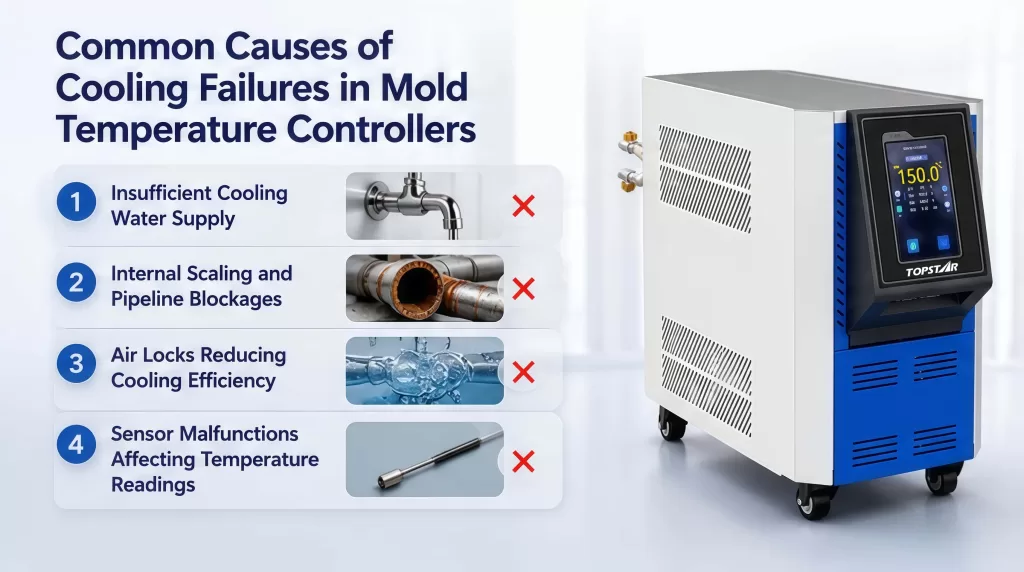
Common Causes of Cooling Failures in Mould Temperature Controllers
Once they understand how the system works, engineers can identify the common causes of poor cooling performance.
1. Insufficient cooling water supply to the mould temperature controller:
An insufficient cooling water supply is one of the most common issues. Possible causes include:
- The inlet valve is closed
- Low water supply pressure at the plant
- A blocked filter
- A faulty water supply pump
- Blockages in the cooling pipework
When the cooling water cannot effectively dissipate heat, the mould temperature will remain high regardless of the temperature controller’s settings. Engineers should check the parameters for cooling water pressure, inlet temperature, flow rate and outlet temperature. These readings allow for a rapid assessment of whether the cooling capacity is adequate.
2. Scale Buildup Inside the Temperature Controller and Blocked Piping:
Hard water gradually forms mineral scale deposits within the pipework and mould runners. Even a very thin layer of scale can significantly reduce heat transfer efficiency. Typical symptoms include:
- Extended cooling cycles
- Uneven mould temperatures
- Reduced water flow
- Increased energy consumption
Regular descaling and water quality management can significantly improve the long-term operational performance of the equipment. We recommend carrying out regular cleaning rather than waiting until severe blockages occur.
3. Air locks reducing the cooling efficiency of mould temperature controllers:
Air trapped in the circulation piping hinders the continuous flow of water. The flow becomes intermittent, preventing uniform heat transfer. This leads to temperature instability, pump cavitation, reduced circulation flow rate and abnormal pump noise. It is essential to bleed the system after maintenance or mould replacement.
4. Sensor faults affect the temperature readings of the mould temperature controller:
Sometimes the cooling process itself is functioning normally. The problem lies in inaccurate temperature measurements. Possible causes include:
- Loose sensor connections
- Ageing temperature sensors
- Incorrect installation position
- Electrical interference
Comparing the displayed temperature with the reading from a calibrated external thermometer helps verify the sensor’s accuracy.
Early Detection of Cooling Issues Through Smart Technology
Traditional controllers often only react once problems have become serious.
Topstar’s temperature control units incorporate smart monitoring technology, enabling the early identification of abnormal conditions. This includes our flagship model, which is equipped with an ultrasonic detection system that continuously monitors the flow of the cooling medium without disrupting the circulation.
Its features include:
- Real-time flow monitoring
- Bubble detection
- Pipe blockage detection
- Leak detection
- Low-flow alerts
Engineers do not need to wait until cooling efficiency has significantly declined; they receive early warnings before production quality is compromised. This predictive maintenance approach significantly reduces unplanned downtime.
Precise PID Algorithm Enhances Cooling Stability in Mould Temperature Controllers
Cooling is not simply a matter of turning on the chilled water. The controller must continuously balance the heating and cooling processes. The third-generation PID algorithm we employ in our mould temperature controllers automatically adapts to changes in mould operating conditions. Compared to traditional controllers, it offers faster response times, lower temperature overshoot, reduced fluctuations, and maintains control accuracy within ±0.1°C. This stable control reduces the number of repeated heating and cooling cycles, thereby improving overall efficiency.

How Do Topstar Engineers Troubleshoot Temperature Control Unit Faults?
When servicing customers’ equipment, Topstar engineers do not typically replace components immediately. Instead, we follow a systematic diagnostic process.
Step 1:
Verify the accuracy of the temperature sensors.
Step 2:
Measure the inlet and outlet water temperatures.
Step 3:
Check the cooling water pressure and flow rate.
Step 4:
Check the operating condition of the water pump.
Step 5:
Inspect the filters and pipework.
Step 6:
Assess the circulation conditions inside the mould.
Step 7:
Analyse the controller’s operating logs.
Only after ruling out the above external factors do we inspect the components inside the controller. This approach minimises unnecessary replacement costs whilst enabling a swifter return to production.
Systematic Diagnostics and Preventative Maintenance
Cooling failures are among the most common issues in mould temperature control systems, but their causes are rarely attributable to a single component. In most cases, a combination of factors—such as insufficient cooling water, blocked pipework, air locks, sensor errors, incorrect process parameter settings or inadequate maintenance—contributes to a decline in the cooling efficiency of the mould temperature controller. To troubleshoot effectively, it is necessary to examine the entire thermal cycle rather than focusing solely on individual components. A systematic diagnostic approach not only reduces downtime but also prevents the unnecessary replacement of expensive components.
Topstar’s range of water-based mould temperature controllers utilises intelligent technologies such as ultrasonic flow monitoring, adaptive PID control, real-time fault detection and advanced safety protection to effectively prevent related cooling faults. At the same time, it is essential to carry out appropriate preventive maintenance; routine maintenance should include:
Weekly checks:
Check water pressure and hoses; verify alarm functions; observe flow stability.
Monthly checks:
Clean the filter; inspect the pump and electrical terminals; verify sensor accuracy.
Quarterly checks:
Flush the circulation piping; remove mineral deposits; inspect valves; test safety protection functions.
Annual maintenance:
Replace worn seals; calibrate sensors; inspect heaters; verify controller parameters.
Preventative maintenance can significantly reduce emergency downtime and extend the service life of the equipment.
TRENDING POSTS
- TOPSTAR Selected in “Forbes China AI Top 50” and Wins “2026 Embodied AI Industry Benchmark Award” 2026/07/17
- Topstar Achieves ISO 13849 Functional Safety Certification for Robotics 2026/07/17
- Topstar Completes Key Puzzle in Embodied Intelligence Data Closed Loop — Industrial AI Capability Foundation Now in Place 2026/07/17
- Topstar Honored with SING TAO GLOBAL CHINA 2025 Distinguished Leading Enterprise in Global Expansion 2026/07/17
HOT TOPIC
- .ervo motor-driven linear robots
- •
- 1.0 guangdong topstar technology co. ltd
- 1.0 topstar china
- 1.0 topstar robot
- 11
- 160℃ mold temperature controller
- 170 ton injection molding machine
- 2
- 21
- 220-ton injection molding machine
- 23
- 260 ton injection molding machine
- 3 axis robot
- 3 axis robots
- 3 in 1 Compact Dehumidifying Dryer
- 3-axis robot
- 3-axis robots
- 39
- 4 axis robot
- 4-axis SCARA robot
- 41
- 460T injection molding machine
- 5-axis CNC machine
- 62
- 90 ton injection molding machine
- accuracy
- Air Chillers
- air-cooled chillers
- all electric injection molding machine
- all electric injection molding machines
- all-electric injection molding machine
- All-electric injection molding machines
- and overall production quality. Therefore
- AP-RubberPlas
- auto cooling system
- auto loader
- Auto Loaders
- automated injection molding machine
- Automation changed engineering
- automation of injection molding robots
- automotive parts injection molding
- Auxiliary Equipment
- auxiliary machine
- Bench Injection Molding Machine
- cabinet dryer
- Cabinet dryer manufacturers
- Cabinet dryers
- cartesian coordinate robot
- Cartesian Coordinate Robots
- Cartesian injection robot
- Cartesian robot
- Central Feeding System
- Central Feeding Systems
- chiller
- CNC Drilling Machine
- CNC Drilling Machines
- cnc engraving machine manufacturer
- cnc laser cutting machine manufacturer
- CNC machine
- CNC Machine Center
- CNC Machine for Sale
- CNC Machine Manufacturing
- CNC Machine Tool
- CNC machine tool product
- CNC Machining Center
- CNC wood carving machine
- Compact Dehumidifying Dryer
- Cooling system
- Cross-Walking Single Axis Servo Cylinder Robot
- Cross-Walking Single-Axis Servo Cylinder Robot
- Cross-Walking Three-Axis/Five-Axis Servo Driven Robot
- cross-walking three-axis/five-axis servo-driven robot
- Dehumidifier Dryer
- Dehumidifying Dryer
- dehumidifying dryers
- delta parallel robot
- Desktop Injection Molding Machine
- Desktop injection molding machines
- Desktop Molding Machine
- desktop plastic injection machine
- Desktop Plastic Injection Molding Machine
- detachable autoloader
- Digital Transformation
- direct clamp injection molding machine
- Direct clamp injection molding machines
- Dosing & mixing system
- Drilling Centers
- Drying and dehumidification system
- drying and dehumidifying equipment
- Drying and Dehumidifying System
- drying system
- effective and efficient. Cabinet dryers are also used in other industries where large quantities of material need to be dried
- efficient injection molding machine
- elbow hydraulic injection molding machines
- electric injection molding machine
- electric injection molding machines
- energy-efficient injection molding robot
- energy-efficient water chiller
- energy-efficient water chillers
- energy-saving injection molding machine
- etc. Among injection molding robots
- exhibition
- features of CNC machine
- Feeding And Conveying System
- Five Axis Machine Center
- Flexible Production Line
- Fully automatic injection molding machine
- Gathering Topstar
- giant injection molding machine
- GMU-600 5-Axis Machining Center
- Granulating & Recycling System
- granulator machine
- gravimetric blender
- Heavy duty injection molding machine
- Heavy-Duty Take-Out Robot
- High-precision electric molding machines
- high-precision plastic molding machines
- high-speed all electric injection molding machine
- high-speed electric injection molding machine
- High-Speed Packaging Injection Molding
- Honeycomb rotor dehumidifier
- hopper dryer
- Hopper Dryers
- horizontal injection molding machine
- Horizontal Injection Molding Machines
- Horizontal Injection Moulding Machine
- Horizontal Mixer manufacturer
- How The CNC Machine Works
- hybrid injection molding machine
- hydraulic injection molding machine
- Hydraulic Injection Molding Machines
- in this article
- Industrial AI
- Industrial Automation
- Industrial robot
- Industrial Robot Chinese brand
- industrial robot parts
- industrial robot supplier
- Industrial robots
- Industry Chain
- Injection Manipulator
- injection manipulator robot
- injection mold machines
- Injection molding
- Injection molding automation
- Injection Molding Automation Solution
- injection molding dryer
- Injection molding equipment
- injection molding hopper dryer
- Injection molding machine
- injection molding machine brand
- Injection Molding Machine Factory
- Injection Molding Machine Manufacture
- Injection molding machine manufacturer
- injection molding machine manufacturers
- Injection molding machine procurement
- injection molding machine robotic arm
- injection molding machine with a robot
- Injection molding machines
- injection molding material dehumidifying
- injection molding plant
- injection molding process
- Injection Molding Robot
- injection molding robot arm
- Injection molding robot automation
- Injection molding robotic arm
- injection molding robots
- injection molding whole plant
- injection moulding dryer
- Injection moulding machine
- injection moulding machines
- Injection Moulding Robots
- Injection Robot
- Injection robot arm
- Injection robot manufacturer
- Injection robot wholesale
- injection robots
- Intelligent Factory
- intelligent injection molding machines
- Intelligent Manufacturing
- intelligent mold temperature
- intelligent mold temperature controller
- Intelligent mould temperature controller
- intelligent whole plant solution
- InterPlas Thailand 2025
- Introducing Injection Robot
- It is the best choice for drying large quantities of material at once. Cabinetmakers use these machines because they are fast
- Large flow water type mold temperature controller
- large injection molding machine
- large injection molding machines
- Learn what industrial automation and robotics is
- linear robot
- linear robots
- low speed sound-proof granulator
- machine plastic molding
- make sure to add some! Improvements (2) Keyphrase in introduction: Your keyphrase or its synonyms appear in the first paragraph of the copy
- manipulator machine
- manufacturing
- Manufacturing Innovation
- medical grade injection molding machines
- Medical Injection Molding
- medical injection molding machine
- medical injection molding machines
- micro injection molding machine
- middle speed granulator
- Mini CNC machine manufacturers.
- mobile cover making machine
- Mold Temperature Control System
- mold temperature controller
- mold temperature controllers
- molding machine
- molding material Dehumidifying System
- mould temperature control system
- mould temperature controller
- mould temperature controller
- mould temperature controllers
- New electric injection molding machine
- Nitrogen Dryer
- nitrogen dryer manufacturer
- nitrogen dryer system manufacturer
- Oil type mold temperature controller
- Oil type mold temperature controllers
- open day
- optical component injection molding
- Optical-grade dehumidifying dryer
- Outbound links: No outbound links appear in this page. Add some! Images: No images appear on this page. Add some! Internal links: No internal links appear in this page
- packaging injection molding
- Packaging Solutions
- PET Preform injection molding
- phone case maker machine
- phone case making machine
- phone cover making machine
- PID Control Mold Temperature Controller
- plastic auto loader
- plastic bottle making machine
- plastic bottle manufacturing
- plastic bucket making machine
- plastic bucket manufacturing
- Plastic chair making machine
- plastic dryer for injection molding
- plastic forming equipment
- Plastic Granulator
- Plastic Granulators
- plastic hopper dryer
- plastic injection machine
- plastic injection machines
- plastic injection molding
- Plastic injection molding equipment
- Plastic injection molding machine
- Plastic Injection Molding Machines
- plastic injection moulding machine
- plastic injection moulding machines
- plastic injection robot
- plastic molding
- Plastic Molding Industry
- Plastic Molding machine
- plastic molding machine 1
- Plastic Molding Machines
- plastic molding press
- plastic moulding machine
- plastic phone case making machine
- plastic-molding machine
- powerful granulator
- Powerful Type Sound-Proof Granulator
- precision injection molding
- precision injection molding machines
- production of plastic seats
- pure water mould temperature controller
- Robot injection molding
- robot injection molding machine
- robot manufacturing companies
- Robotic arm for injection molding machine
- robotic injection molding machines
- robotics in injection molding
- SCARA robot
- SCARA robots
- Screw dosers
- Service-oriented manufacturing
- Servo Cylinder Robot
- servo driven robot
- Servo Driven Robots
- servo injection molding machine
- servo injection robots
- servo motor-driven linear robots
- servo-driven 3-axis robot
- Servo-driven injection molding machine
- Servo-Driven Robot
- Setup of injection machine
- Silicone Injection Molding Machine
- six-axis industrial robot
- Smart Manufacturing
- soundproof granulator
- Sprue Picker
- Stainless Hopper Dryer
- Stainless Hopper Dryers
- star club
- swing arm robot
- T1 Cartesian injection robot
- take-out robot
- take-out robots
- Thailand 4.0
- the choice between servo-driven robots and hydraulic robots will have a certain impact on efficiency
- the most popular injection molding machine
- the type of injection molding robot
- TIC2000 Control System
- TMII injection molding machine
- toggle clamp injection molding machine
- Toggle Hydraulic Injection Molding Machines
- toggle injection molding machine
- Top 10 brands of injection robots
- Topstar
- Topstar Electric Injection Molding Machine InterPlas Thailand 2025 Smart Manufacturing Thailand 4.0
- Topstar Engineering
- Topstar Industrial Robots
- Topstar injection molding intelligent
- Topstar Scara Robots
- Useful Injection molding machine
- Vertical machining centers
- volumetric type blender
- Washing Machine Case Molding Solution
- water chiller
- water chillers
- water distributor
- water type mold temperature controller
- Water Type MoldTemperature Controller
- Water-Cooled Chillers
- Water-cooled Mold Temperature Controller
- water-type mold temperature controller
- Water-Type Mould Temperature Controllers
- We often face choices when performing injection molding. We will choose the type of injection molding machine
- wholesale of injection molding machines
- x carve CNC
- 热门查询 点击次数 展示 排名 topstar