
How Does IO Expansion Make Cartesian Robots More Flexible?
2026/09/02 By le zhan
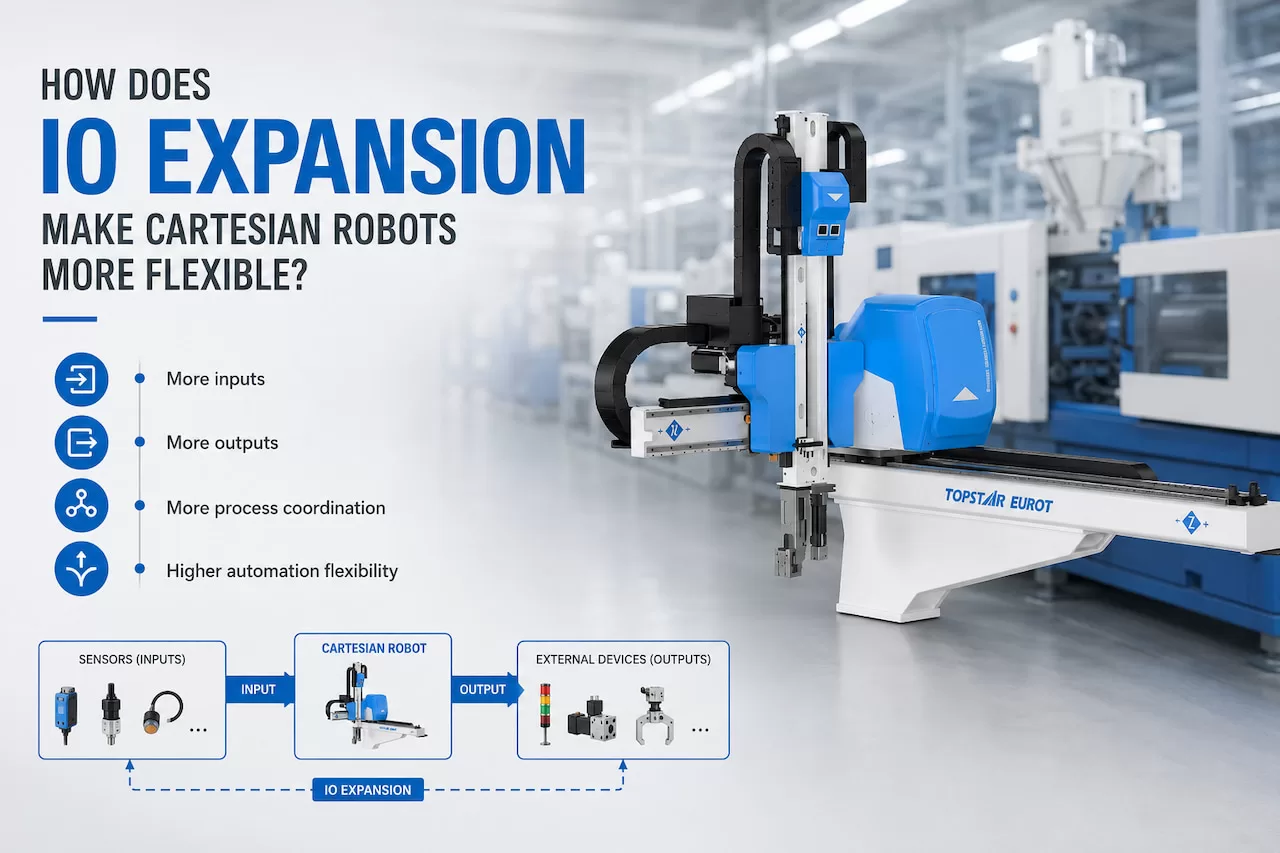
Topstar Cartesian robots reserve additional I/O capacity beyond the signals used by the standard program. Based on the standard control configuration, users still have room to expand by at least 11 input and 11 output channels. Although the standard program supports 4 vacuum grippers and 4 fixtures, the control architecture can be expanded to support up to 8 vacuum grippers or 8 fixtures, depending on the specific application configuration.
These additional signals enable the Cartesian robot to perform more independent actions within a single production cycle. Manufacturers need not limit the robot to simple part-handling operations; instead, they can program it to perform insert molding, multi-point gripping, punching or shearing, and collaborative operations with external equipment.
Additional I/O expansion lets you add sensing, control, and collaboration with more devices without replacing the entire robot control platform.
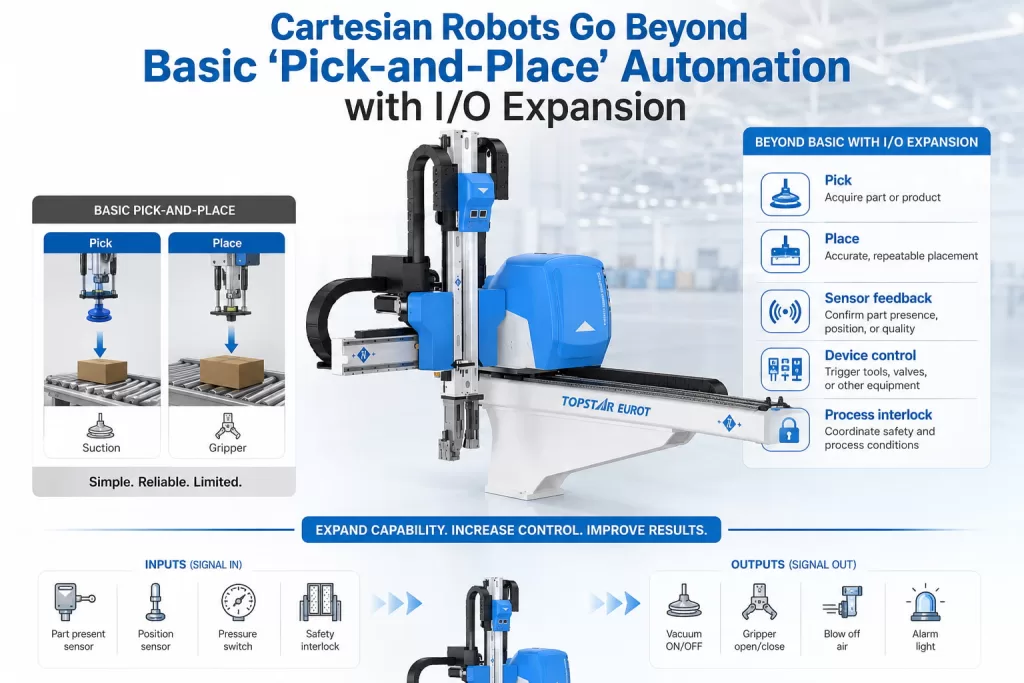
Cartesian Robots Go Beyond Basic “Pick-and-Place” Automation with I/O Expansion
Standard injection molding robots typically allocate some I/O resources to basic functions, such as communicating with the injection molding machine, monitoring mold status, and controlling vacuum cups or grippers. If these standard functions occupy all available I/O points, expanding the robot’s capabilities becomes difficult when subsequent production processes require additional sensors, tooling, or peripheral equipment.
Topstar addresses this limitation by reserving additional I/O capacity beyond the signals defined in standard programs. Its controller supports expansion with at least 11 additional input points and 11 additional output points, providing customers the flexibility to add new process functions without immediately replacing the robot controller.
Enabling New Process Conditions and Actions with Additional I/O
The purpose of these additional signals is clear:
Input signals enable Cartesian robots to obtain more information from sensors or external devices.
Output signals enable the robot to control more devices or trigger additional actions.
However, if you add an in-mold insert process to the same production cell, the robot may need additional signals to confirm whether the insert is ready and positioned accurately. In this case, the motion sequence might become:
Insert feeder ready → Robot picks up insert → Sensor confirms insert → Robot places insert → Confirm placement → Robot retracts → Mold closes.
In this scenario, the additional input signals give the robot more process feedback. In contrast, the additional output signals let it control the insert feeder, grippers, vacuum circuits, or other equipment involved in the sequence.
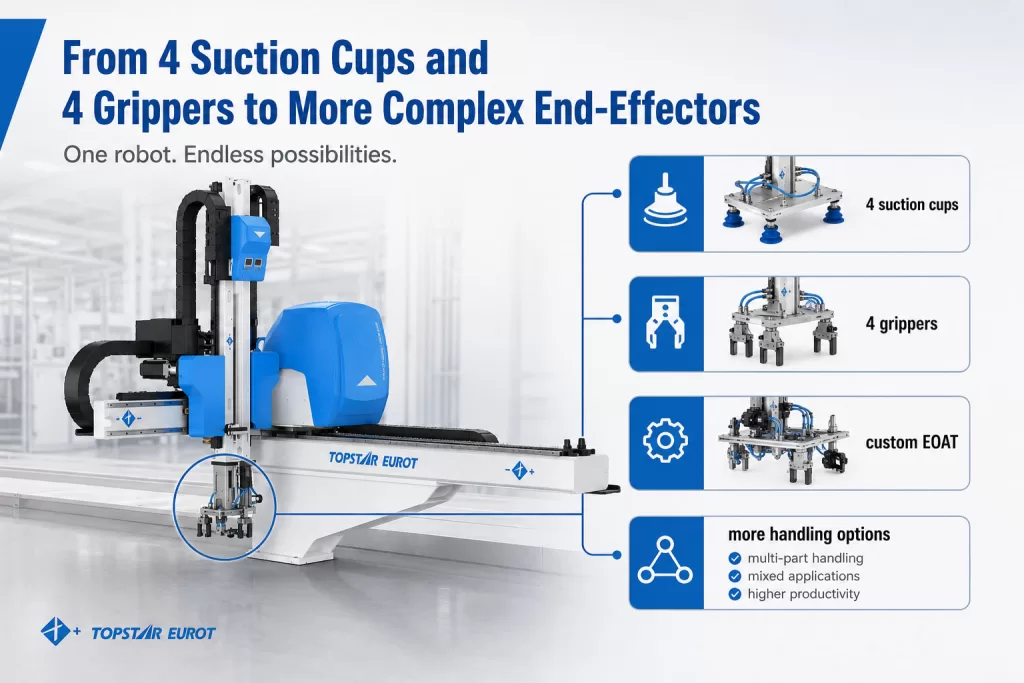
From 4 Suction Cups and 4 Grippers to More Complex End-Effectors
One of the most practical applications of I/O flexibility is at the end of a robotic arm.
A basic injection molding part-removal system may require only 1–2 gripping points. However, more complex molds may require simultaneous handling of multiple parts, runners, or inserts.
Topstar’s standard robot programs support control of:
- 4 suction cups
- 4 grippers
Depending on the tooling and application design, this configuration can be expanded to:
- 8 suction cups or 8 grippers
This is not merely an increase in the number of pneumatic components. The true advantage lies in the independent control capabilities of Topstar’s Cartesian robots.
Enabling Multi-Point Independent Gripping with Cartesian Robots
Take a four-cavity injection mold as an example:
If a single vacuum command can remove all molded parts, the tooling structure is relatively simple. However, certain applications require independent operation for each part or gripping point.
For example:
- Suction cup 1 picks up part A;
- Suction cup 2 picks up part B;
- Suction cup 3 picks up part C;
- Suction cup 4 picks up part D.
When the handling sequence involves different timing or logic, independent control gives the robot greater flexibility. It also supports more complex end-effectors, allowing different parts to perform different tasks. For example, one part may pick up the finished product, while another removes the sprue.
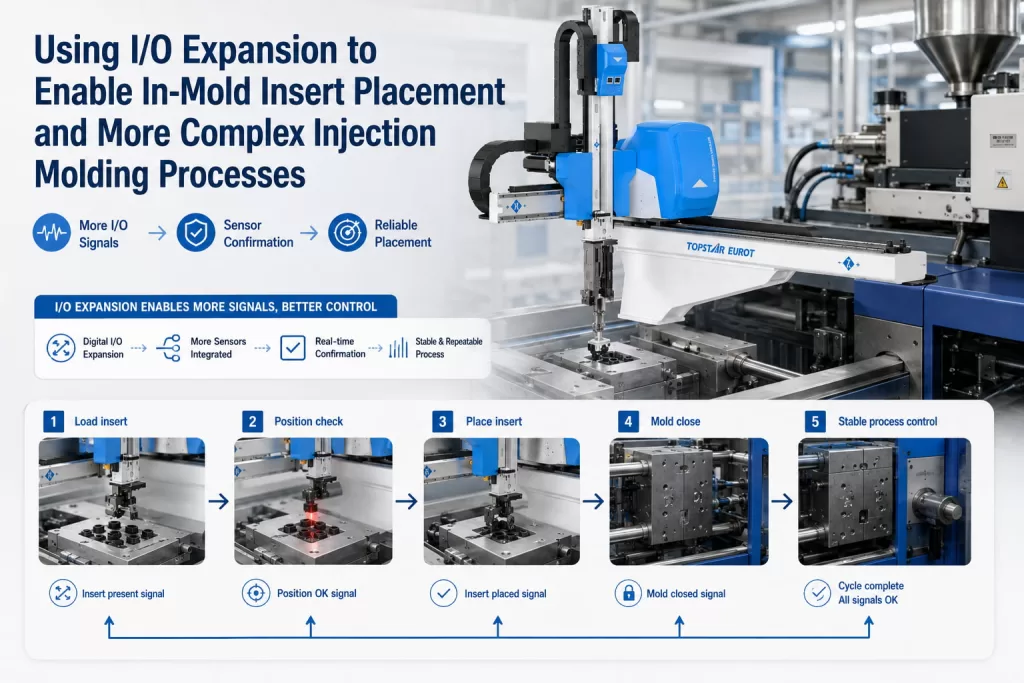
Using I/O Expansion to Enable In-Mold Insert Placement and More Complex Injection Molding Processes
When a Cartesian injection molding robot performs tasks beyond simply retrieving finished products, I/O expansion capabilities become particularly important.
In-mold insert placement is a common application. In the in-mold insert molding process, the robot may need to perform the following steps:
Grip one or more inserts;
Confirm that the inserts have been successfully gripped;
Enter the mold area;
Position the inserts;
Release the inserts;
Confirm successful placement;
Exit the mold area;
Send a signal to allow the injection molding machine to resume operation.
This process involves multiple independent conditional checks.
Support for Multiple Inserts or Multiple Placement Points
As the number of inserts increases, this scalability also rises. A mold may need to accommodate multiple metal inserts, nuts, terminals, decorative parts, or other components. Different inserts may require different vacuum suction or gripping commands, and Cartesian robots may also need corresponding verification sensors.
Controllers with limited I/O port resources quickly become system bottlenecks.
By providing ample input/output capacity and scalable suction/gripping control, Topstar enables customers to develop more complex in-mold automation applications using a single Cartesian robot.
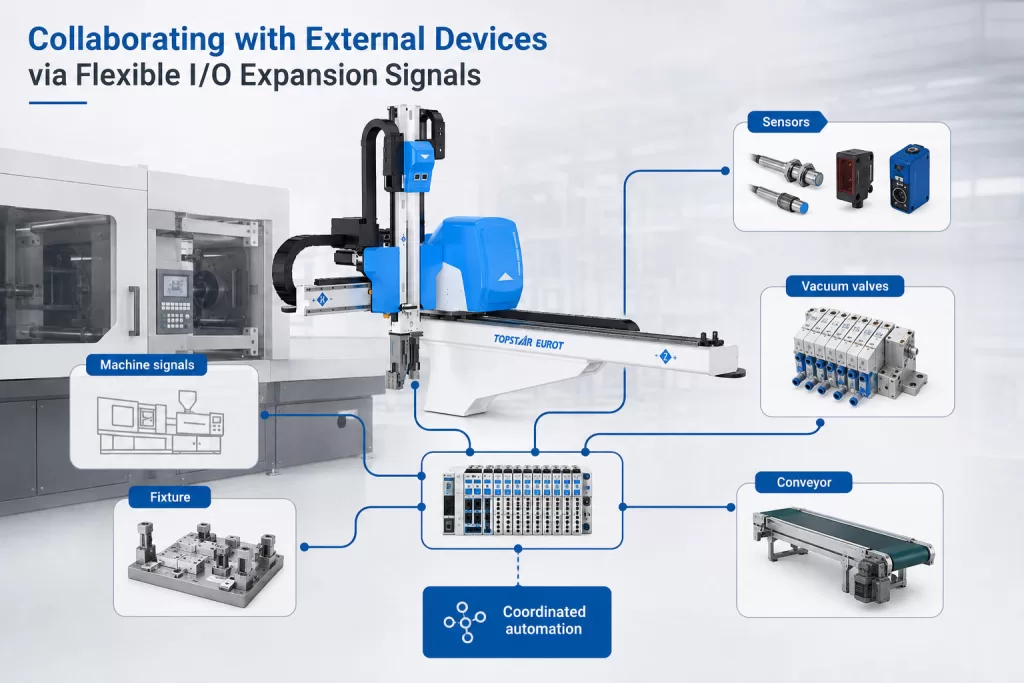
Collaborating with External Devices via Flexible I/O Expansion Signals
Expanded I/O capabilities enable Cartesian robots to collaborate directly with external devices, such as insert feeders and conveyor belts. Rather than relying on fixed delay settings, the robot uses real-time signals to confirm whether external devices are ready before entering a workstation. Then it sends status signals—such as “product loaded” or “robot has retreated”—to trigger subsequent actions.
This approach helps the production process remain responsive and reliable even when cycle times fluctuate.
At the same time, I/O-based handshake communication helps prevent motion conflicts between the robot and peripheral equipment. These signals improve process coordination and operational interlocking, although dedicated safety circuits should still be used for safety-critical functions. Thus, I/O expansion enables Cartesian robots to integrate more easily into complex automated injection molding production cells.
IO Expansion Provides Process-Level Flexibility for Cartesian Robots
The flexibility of a Cartesian robot depends not only on the number of axes but also on the size of its working range. In injection molding automation applications, flexibility also depends on how many devices the robot can sense, control, and coordinate.
The flexibility of IO expansion provides Cartesian robots with greater versatility:
- In addition to the signals used by standard programs, it provides at least 11 additional input interfaces;
- It provides at least 11 additional output interfaces for expansion;
- It supports 4 vacuum grippers and 4 fixtures as standard;
- Can be expanded to up to 8 vacuum grippers or 8 fixtures based on application requirements;
- Supports independent multi-point control and customer-defined programming operations.
These features enable Cartesian robots to move beyond simple product removal to more complex tasks, such as in-mold insert placement, multi-point handling, punching operations, and coordinated control with external equipment.
TRENDING POSTS
- TOPS DAY 2026: Turning Industrial AI into Real-World Impact 2026/09/02
- Breaking Through the Full Scene-to-AI Link! Topstar Industrial Data Collection Matrix Achieves Major Technical Breakthro 2026/09/02
- TOPSTAR Selected in “Forbes China AI Top 50” and Wins “2026 Embodied AI Industry Benchmark Award” 2026/09/02
- Topstar Achieves ISO 13849 Functional Safety Certification for Robotics 2026/09/02
HOT TOPIC
- .ervo motor-driven linear robots
- •
- 1.0 guangdong topstar technology co. ltd
- 1.0 topstar china
- 1.0 topstar robot
- 11
- 160℃ mold temperature controller
- 170 ton injection molding machine
- 2
- 21
- 220-ton injection molding machine
- 23
- 260 ton injection molding machine
- 3 axis robot
- 3 axis robots
- 3 in 1 Compact Dehumidifying Dryer
- 3-axis robot
- 3-axis robots
- 39
- 4 axis robot
- 4-axis SCARA robot
- 41
- 460T injection molding machine
- 5-axis CNC machine
- 62
- 90 ton injection molding machine
- accuracy
- Air Chillers
- air-cooled chillers
- all electric injection molding machine
- all electric injection molding machines
- all-electric injection molding machine
- All-electric injection molding machines
- and overall production quality. Therefore
- AP-RubberPlas
- auto cooling system
- auto loader
- Auto Loaders
- automated injection molding machine
- Automation changed engineering
- automation of injection molding robots
- automotive parts injection molding
- Auxiliary Equipment
- auxiliary machine
- Bench Injection Molding Machine
- cabinet dryer
- Cabinet dryer manufacturers
- Cabinet dryers
- cartesian coordinate robot
- Cartesian Coordinate Robots
- Cartesian injection robot
- Cartesian robot
- Central Feeding System
- Central Feeding Systems
- chiller
- CNC Drilling Machine
- CNC Drilling Machines
- cnc engraving machine manufacturer
- cnc laser cutting machine manufacturer
- CNC machine
- CNC Machine Center
- CNC Machine for Sale
- CNC Machine Manufacturing
- CNC Machine Tool
- CNC machine tool product
- CNC Machining Center
- CNC wood carving machine
- Compact Dehumidifying Dryer
- Cooling system
- Cross-Walking Single Axis Servo Cylinder Robot
- Cross-Walking Single-Axis Servo Cylinder Robot
- Cross-Walking Three-Axis/Five-Axis Servo Driven Robot
- cross-walking three-axis/five-axis servo-driven robot
- Dehumidifier Dryer
- Dehumidifying Dryer
- dehumidifying dryers
- delta parallel robot
- Desktop Injection Molding Machine
- Desktop injection molding machines
- Desktop Molding Machine
- desktop plastic injection machine
- Desktop Plastic Injection Molding Machine
- detachable autoloader
- Digital Transformation
- direct clamp injection molding machine
- Direct clamp injection molding machines
- Dosing & mixing system
- Drilling Centers
- Drying and dehumidification system
- drying and dehumidifying equipment
- Drying and Dehumidifying System
- drying system
- effective and efficient. Cabinet dryers are also used in other industries where large quantities of material need to be dried
- efficient injection molding machine
- elbow hydraulic injection molding machines
- electric injection molding machine
- electric injection molding machines
- energy-efficient injection molding robot
- energy-efficient water chiller
- energy-efficient water chillers
- energy-saving injection molding machine
- etc. Among injection molding robots
- exhibition
- features of CNC machine
- Feeding And Conveying System
- Five Axis Machine Center
- Flexible Production Line
- Fully automatic injection molding machine
- Gathering Topstar
- giant injection molding machine
- GMU-600 5-Axis Machining Center
- Granulating & Recycling System
- granulator machine
- gravimetric blender
- Heavy duty injection molding machine
- Heavy-Duty Take-Out Robot
- High-precision electric molding machines
- high-precision plastic molding machines
- high-speed all electric injection molding machine
- high-speed electric injection molding machine
- High-Speed Packaging Injection Molding
- Honeycomb rotor dehumidifier
- hopper dryer
- Hopper Dryers
- horizontal injection molding machine
- Horizontal Injection Molding Machines
- Horizontal Injection Moulding Machine
- Horizontal Mixer manufacturer
- How The CNC Machine Works
- hybrid injection molding machine
- hydraulic injection molding machine
- Hydraulic Injection Molding Machines
- in this article
- Industrial AI
- Industrial Automation
- Industrial robot
- Industrial Robot Chinese brand
- industrial robot parts
- industrial robot supplier
- Industrial robots
- Industry Chain
- Injection Manipulator
- injection manipulator robot
- injection mold machines
- Injection molding
- Injection molding automation
- Injection Molding Automation Solution
- injection molding dryer
- Injection molding equipment
- injection molding hopper dryer
- Injection molding machine
- injection molding machine brand
- Injection Molding Machine Factory
- Injection Molding Machine Manufacture
- Injection molding machine manufacturer
- injection molding machine manufacturers
- Injection molding machine procurement
- injection molding machine robotic arm
- injection molding machine with a robot
- Injection molding machines
- injection molding material dehumidifying
- injection molding plant
- injection molding process
- Injection Molding Robot
- injection molding robot arm
- Injection molding robot automation
- Injection molding robotic arm
- injection molding robots
- injection molding whole plant
- injection moulding dryer
- Injection moulding machine
- injection moulding machines
- Injection Moulding Robots
- Injection Robot
- Injection robot arm
- Injection robot manufacturer
- Injection robot wholesale
- injection robots
- Intelligent Factory
- intelligent injection molding machines
- Intelligent Manufacturing
- intelligent mold temperature
- intelligent mold temperature controller
- Intelligent mould temperature controller
- intelligent whole plant solution
- InterPlas Thailand 2025
- Introducing Injection Robot
- It is the best choice for drying large quantities of material at once. Cabinetmakers use these machines because they are fast
- Large flow water type mold temperature controller
- large injection molding machine
- large injection molding machines
- Learn what industrial automation and robotics is
- linear robot
- linear robots
- low speed sound-proof granulator
- machine plastic molding
- make sure to add some! Improvements (2) Keyphrase in introduction: Your keyphrase or its synonyms appear in the first paragraph of the copy
- manipulator machine
- manufacturing
- Manufacturing Innovation
- medical grade injection molding machines
- Medical Injection Molding
- medical injection molding machine
- medical injection molding machines
- micro injection molding machine
- middle speed granulator
- Mini CNC machine manufacturers.
- mobile cover making machine
- Mold Temperature Control System
- mold temperature controller
- mold temperature controllers
- molding machine
- molding material Dehumidifying System
- mould temperature control system
- mould temperature controller
- mould temperature controller
- mould temperature controllers
- New electric injection molding machine
- Nitrogen Dryer
- nitrogen dryer manufacturer
- nitrogen dryer system manufacturer
- Oil type mold temperature controller
- Oil type mold temperature controllers
- open day
- optical component injection molding
- Optical-grade dehumidifying dryer
- Outbound links: No outbound links appear in this page. Add some! Images: No images appear on this page. Add some! Internal links: No internal links appear in this page
- packaging injection molding
- Packaging Solutions
- PET Preform injection molding
- phone case maker machine
- phone case making machine
- phone cover making machine
- PID Control Mold Temperature Controller
- plastic auto loader
- plastic bottle making machine
- plastic bottle manufacturing
- plastic bucket making machine
- plastic bucket manufacturing
- Plastic chair making machine
- plastic dryer for injection molding
- plastic forming equipment
- Plastic Granulator
- Plastic Granulators
- plastic hopper dryer
- plastic injection machine
- plastic injection machines
- plastic injection molding
- Plastic injection molding equipment
- Plastic injection molding machine
- Plastic Injection Molding Machines
- plastic injection moulding machine
- plastic injection moulding machines
- plastic injection robot
- plastic molding
- Plastic Molding Industry
- Plastic Molding machine
- plastic molding machine 1
- Plastic Molding Machines
- plastic molding press
- plastic moulding machine
- plastic phone case making machine
- plastic-molding machine
- powerful granulator
- Powerful Type Sound-Proof Granulator
- precision injection molding
- precision injection molding machines
- production of plastic seats
- pure water mould temperature controller
- Robot injection molding
- robot injection molding machine
- robot manufacturing companies
- Robotic arm for injection molding machine
- robotic injection molding machines
- robotics in injection molding
- SCARA robot
- SCARA robots
- Screw dosers
- Service-oriented manufacturing
- Servo Cylinder Robot
- servo driven robot
- Servo Driven Robots
- servo injection molding machine
- servo injection robots
- servo motor-driven linear robots
- servo-driven 3-axis robot
- Servo-driven injection molding machine
- Servo-Driven Robot
- Setup of injection machine
- Silicone Injection Molding Machine
- six-axis industrial robot
- Smart Manufacturing
- soundproof granulator
- Sprue Picker
- Stainless Hopper Dryer
- Stainless Hopper Dryers
- star club
- swing arm robot
- T1 Cartesian injection robot
- take-out robot
- take-out robots
- Thailand 4.0
- the choice between servo-driven robots and hydraulic robots will have a certain impact on efficiency
- the most popular injection molding machine
- the type of injection molding robot
- TIC2000 Control System
- TMII injection molding machine
- toggle clamp injection molding machine
- Toggle Hydraulic Injection Molding Machines
- toggle injection molding machine
- Top 10 brands of injection robots
- Topstar
- Topstar Electric Injection Molding Machine InterPlas Thailand 2025 Smart Manufacturing Thailand 4.0
- Topstar Engineering
- Topstar Industrial Robots
- Topstar injection molding intelligent
- Topstar Scara Robots
- Useful Injection molding machine
- Vertical machining centers
- volumetric type blender
- Washing Machine Case Molding Solution
- water chiller
- water chillers
- water distributor
- water type mold temperature controller
- Water Type MoldTemperature Controller
- Water-Cooled Chillers
- Water-cooled Mold Temperature Controller
- water-type mold temperature controller
- Water-Type Mould Temperature Controllers
- We often face choices when performing injection molding. We will choose the type of injection molding machine
- wholesale of injection molding machines
- x carve CNC
- 热门查询 点击次数 展示 排名 topstar