
How can molding machine parameters be precisely adjusted to stabilize the plasticization quality of the melt?
2026/08/10 By le zhan
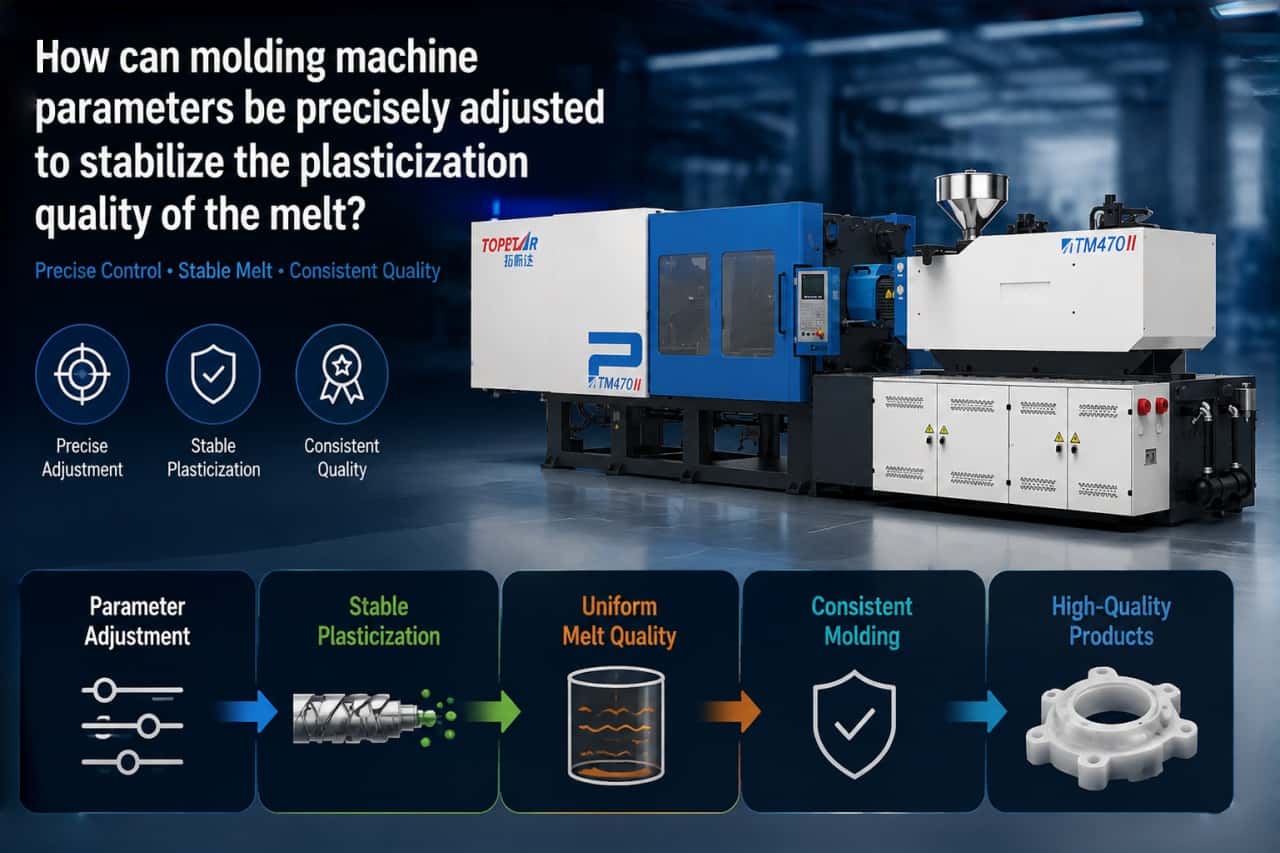
The stability of the plastification process inside the molding machine is one of the key factors affecting the consistency of the final product. During the molding process, the plastic raw material must undergo controlled heating, melting, mixing, and homogenization before entering the mold cavity. If the melt quality fluctuates during the plastification stage, the product may suffer from defects such as uneven filling, short shots, and flow marks.
We have found that many production issues that appear to stem from the mold or material are actually related to improper process parameter settings on the injection molding machine. Even with high-performance equipment, stable production cannot be achieved if operators fail to correctly adjust process parameters based on material properties, product structure, and molding requirements. Therefore, we need to precisely adjust key parameters—such as barrel temperature, screw speed, back pressure, plasticizing time, injection speed, and holding pressure—to ensure consistent melt quality.
The Quality of Plastification in Molding Machine Depends on the Melting Characteristics of the Material
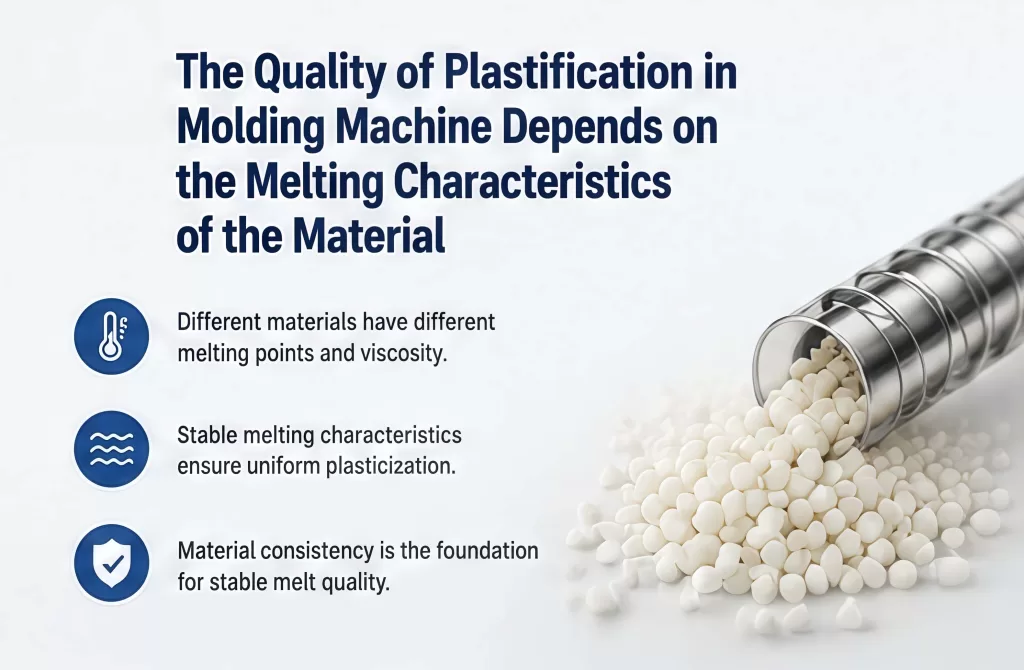
Every plastic injection molding machine relies on a stable plastification process to convert solid polymer pellets into a uniform melt. However, different materials require different processing conditions. Engineering plastics such as PC, PA, and POM require strict temperature control because they have narrow processing windows; while general-purpose plastics such as PP and PE, although they have a wider processing range, still require precise parameter adjustments to maintain consistency.
During plastic injection molding machine operation, the screw primarily performs three functions:
- Feeding solid pellets forward;
- Generating shear heat through rotation;
- Mixing and homogenizing the molten material.
If any parameter is set incorrectly, melt quality may become unstable.
For example: Excessively high screw speed may generate excessive shear heat, leading to material degradation; insufficient back pressure may reduce mixing efficiency; improper barrel temperature settings may result in incomplete melting, and so on.
Therefore, engineers must understand the material’s properties before adjusting the injection molding machine’s parameters.
Key Indicators for Evaluating Melt Stability
Before adjusting parameters, engineers should evaluate several indicators that reflect the quality of plastification.
1. Melt Temperature Consistency:
During continuous production, the actual melt temperature should remain stable. Significant temperature fluctuations typically indicate unstable heating control, improper screw speed, or inconsistent material feeding. The plastic injection molding machine should maintain a uniform melt temperature between cycles to ensure that the material conditions used for each molded part remain consistent.
2. Consistency of Plastification Time:
Plastification time reflects the screw’s ability to prepare the required volume of melt within a predictable timeframe. If there are significant variations in plastification time between cycles, possible causes include inconsistent feeding, improper backpressure settings, excessive screw speed, or inconsistent barrel temperatures.
3. Melt Appearance and Product Quality
Operators can also assess the plasticizing process by examining product quality issues. Common quality issues include:
- Silver streaks caused by moisture or overheating;
- Flow marks caused by unstable melt temperature;
- Black spots caused by material degradation;
- Color variations caused by insufficient mixing.
By correlating these defects with machine parameters, the root causes can be identified more efficiently.
Temperature Control in Molding Machine: Achieving Stable Melt Plastification
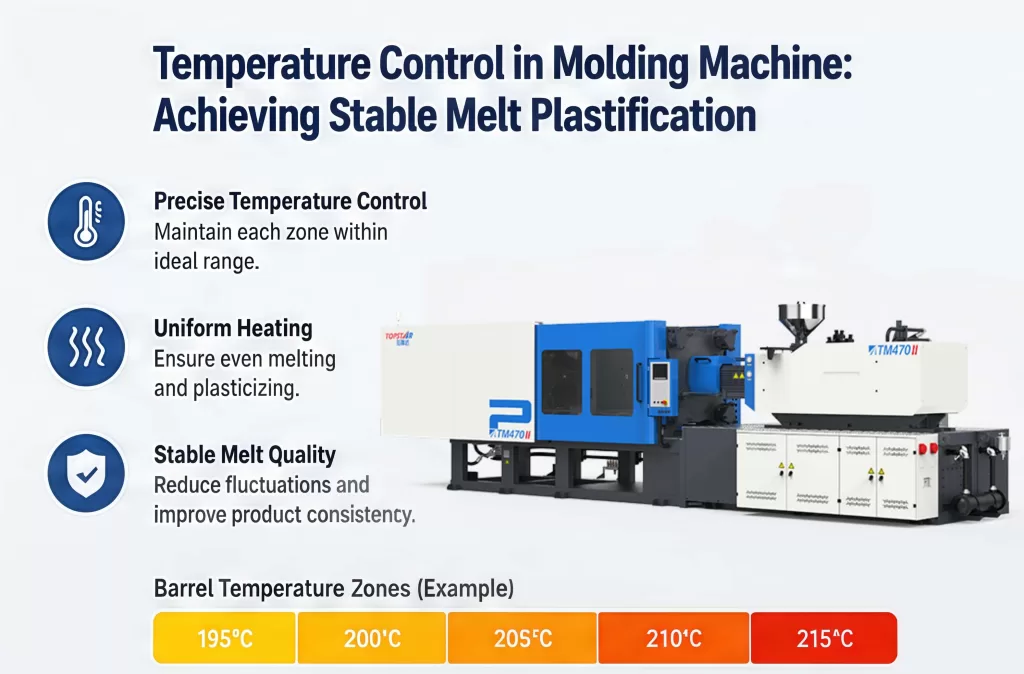
Temperature regulation is the first step in ensuring stable melt quality, as the barrel temperature of an injection molding machine must meet the material processing requirements. The barrel heating system controls the gradual melting process as the material flows through different heating zones. Typically, engineers divide barrel temperature control into several zones:
- Feeding zone;
- Compression zone;
- Metering zone;
- Nozzle zone.
Each zone serves a distinct function.
1. The feed zone is primarily responsible for softening the material and ensuring smooth flow.
2. The compression zone is responsible for melting and mixing the material.
3. The metering zone stabilizes the melt temperature and prepares the required amount of melt for injection.
4. The nozzle zone ensures that the melt enters the mold smoothly.
Different materials require different temperature gradients during parameter adjustment. For example, if the temperature in the rear section of the barrel is too high, it may cause the material to melt prematurely, thereby reducing feeding stability; conversely, if the temperature in the front section is insufficient, it may result in inadequate plasticization.
Therefore, operators should adjust the temperature distribution based on factors such as material viscosity, screw design, product wall thickness, and molding cycle requirements.
Temperature Optimization for Injection Molding Machine Requires Coordination with Other Parameters
Temperature settings cannot be determined in isolation.
While higher barrel temperatures can reduce melt viscosity, they may also increase the risk of material degradation.
Lower temperatures, while helpful for maintaining material properties, may result in higher injection pressures.
Therefore, engineers must strike a balance between temperature and other parameters, including screw speed, back pressure, injection speed, and holding pressure. This coordinated adjustment approach enables the molding machine to achieve stable plasticization without relying solely on a single parameter.
How to Optimize Injection Pressure and Speed for Stable Melt Filling?
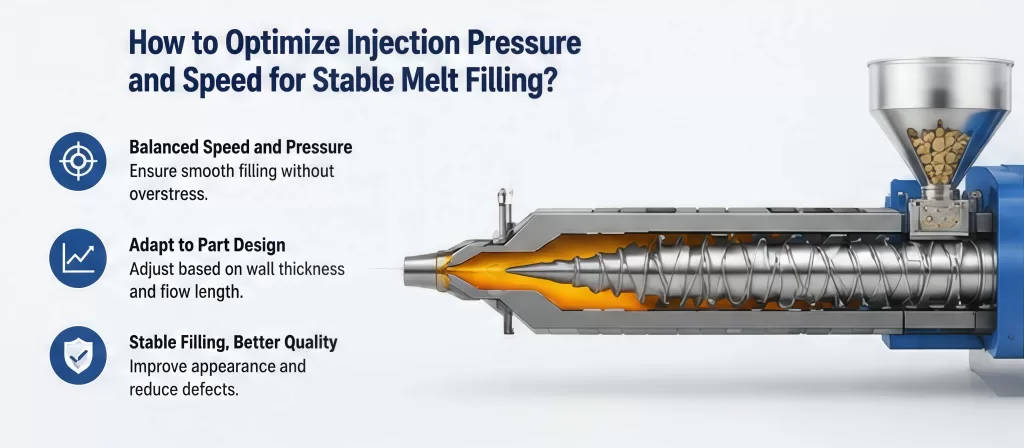
After optimizing the plastification parameters, the next critical step is to adjust the injection phase. The injection process directly determines how the molten plastic enters the mold cavity; even slight fluctuations in pressure or speed can affect the product’s appearance, dimensional accuracy, and internal structure. Operators need to understand the relationship between injection speed, pressure, position, and material properties. By coordinating these settings, the molding machine can achieve stable melt filling and ensure consistent product quality.
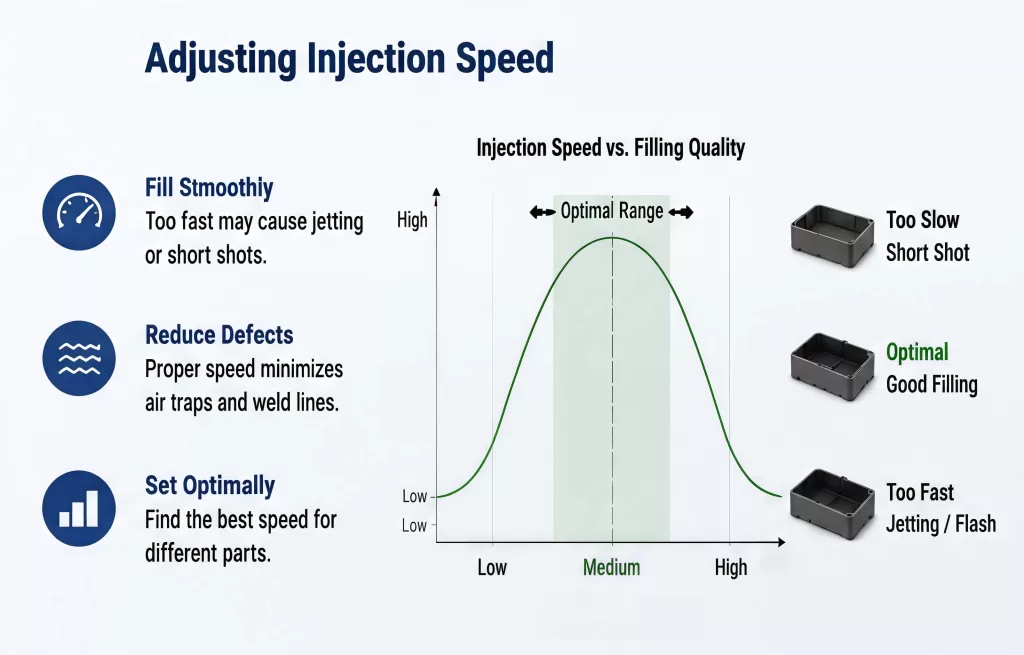
Adjusting Injection Speed on Molding Machines
Injection speed determines how quickly the molten material enters the mold cavity. Excessively high injection speeds may lead to defects such as flow marks, spatter marks, and scorch marks caused by compressed air.
An injection speed that is too slow may result in premature cooling of the melt, poor weld lines, insufficient filling, and uneven product density.
Therefore, operators can adopt a multi-stage injection speed strategy rather than a single, constant speed. For example, molding machines producing optical components or automotive interior parts require:
- Low-speed filling during the initial stage
- High-speed filling during the intermediate stage
- Low-speed filling during the final stage
The speed is reduced before the mold cavity is filled to minimize impact pressure and protect the mold.
This multi-stage injection method allows the injection molding machine to control melt behavior more precisely, making it particularly suitable for products with complex structures or thin walls.
Injection Pressure Adjustment for Molding Machine
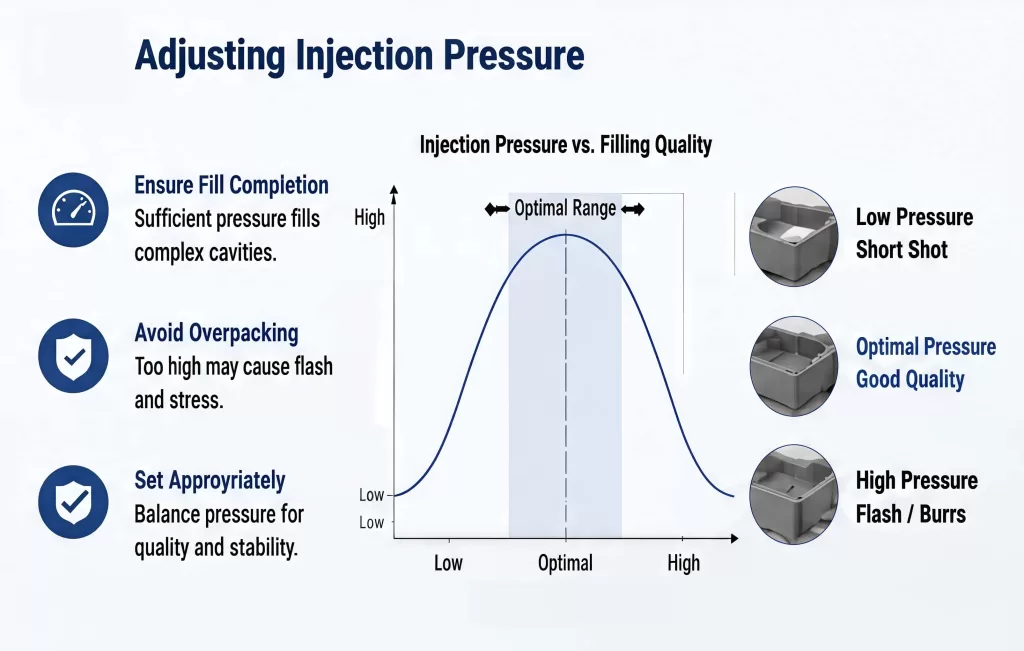
Injection pressure provides the force to push the molten material into the mold cavity. Proper pressure adjustment ensures that the melt reaches all areas of the mold cavity while maintaining uniform density.
If injection pressure is insufficient, the plastic injection molding machine may experience short shots, incomplete filling, poor surface reproduction, and significant dimensional deviations.
If injection pressure is too high, it can lead to increased internal stress, mold deformation, a higher risk of flash (burrs), and increased energy consumption.
During parameter tuning, operators should gradually increase the injection pressure while observing the product’s condition.
The recommended adjustment method is as follows:
Step 1: Set a Moderate Initial Pressure
Operators should set the base injection pressure based on material properties and product dimensions.
Step 2: Observe the Filling Condition
Check whether the melt fills the cavity and whether any defects are present.
Step 3: Fine-Tune the Pressure According to Product Requirements
For precision products, the injection molding machine should prioritize ensuring stable pressure delivery rather than simply increasing the pressure value.
Adjusting Holding and Cooling Parameters
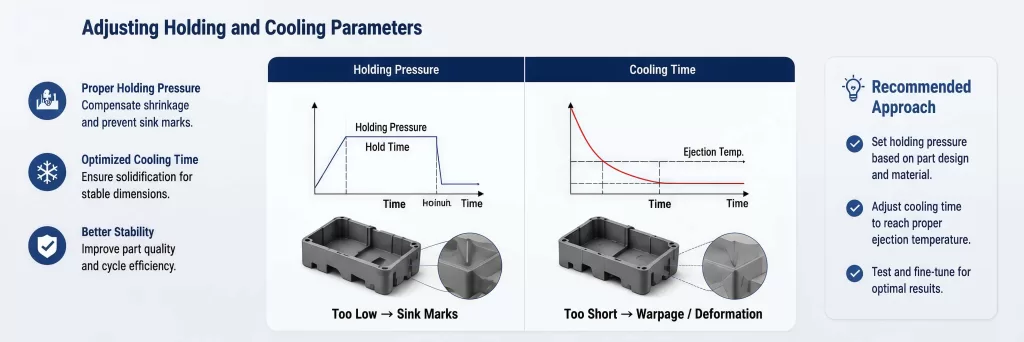
After the mold-filling phase concludes, the molding machine enters the holding and cooling phases. These two stages determine whether the product retains its final shape and whether internal defects occur. Many molding issues stem not from insufficient filling, but from improper holding or cooling settings. Therefore, engineers must carefully adjust these parameters to ensure consistent product quality.
Adjusting Holding Parameters: Minimizing Shrinkage and Internal Defects
Plastic material naturally shrinks during the cooling process. The function of the holding phase is to continuously replenish the mold cavity with molten material before the gate freezes, thereby compensating for this shrinkage. A properly adjusted molding machine maintains sufficient holding pressure until the gate is completely sealed.
Operators can adjust holding parameters based on three factors:
1. Holding Pressure Level:
The pressure value determines the amount of additional material entering the cavity. Different materials require different holding pressure settings; for instance, crystalline materials typically require higher holding pressures, whereas amorphous materials generally require moderate pressure.
2. Holding Time:
The holding time should match the gate freeze time. If the holding time is too short, material replenishment is insufficient; if it is too long, the molding cycle is unnecessarily prolonged.
3. Pressure Switch-over Position:
The transition point from injection pressure to holding pressure is critical. An improper switch-over position can lead to over-packing (over-filling), under-filling, or fluctuations in product weight.
Adjusting Cooling Parameters: Controlling Cycle Time and Product Stability
The cooling process accounts for a significant portion of the injection molding cycle. Properly adjusting cooling parameters helps balance production efficiency with product quality.
Key cooling parameters include:
- Cooling time;
- Mold temperature;
- Cooling water flow rate;
- Cooling channel efficiency.
- Optimizing Cooling Time
Operators should determine the cooling time based on factors such as material properties, product thickness, mold structure, required dimensional accuracy, and mold temperature coordination.
Adjusting Parameters for Stable, High-Quality Injection Molding Production
The plasticization quality of the molten material forms the foundation for the quality of the final molded product. By precisely adjusting injection molding machine parameters including temperature, screw speed, back pressure, injection speed, holding pressure, and cooling conditions, manufacturers can achieve stable melt preparation and consistent product quality.
TRENDING POSTS
- Breaking Through the Full Scene-to-AI Link! Topstar Industrial Data Collection Matrix Achieves Major Technical Breakthro 2026/08/10
- TOPSTAR Selected in “Forbes China AI Top 50” and Wins “2026 Embodied AI Industry Benchmark Award” 2026/08/10
- Topstar Achieves ISO 13849 Functional Safety Certification for Robotics 2026/08/10
- Topstar Completes Key Puzzle in Embodied Intelligence Data Closed Loop — Industrial AI Capability Foundation Now in Place 2026/08/10
HOT TOPIC
- .ervo motor-driven linear robots
- •
- 1.0 guangdong topstar technology co. ltd
- 1.0 topstar china
- 1.0 topstar robot
- 11
- 160℃ mold temperature controller
- 170 ton injection molding machine
- 2
- 21
- 220-ton injection molding machine
- 23
- 260 ton injection molding machine
- 3 axis robot
- 3 axis robots
- 3 in 1 Compact Dehumidifying Dryer
- 3-axis robot
- 3-axis robots
- 39
- 4 axis robot
- 4-axis SCARA robot
- 41
- 460T injection molding machine
- 5-axis CNC machine
- 62
- 90 ton injection molding machine
- accuracy
- Air Chillers
- air-cooled chillers
- all electric injection molding machine
- all electric injection molding machines
- all-electric injection molding machine
- All-electric injection molding machines
- and overall production quality. Therefore
- AP-RubberPlas
- auto cooling system
- auto loader
- Auto Loaders
- automated injection molding machine
- Automation changed engineering
- automation of injection molding robots
- automotive parts injection molding
- Auxiliary Equipment
- auxiliary machine
- Bench Injection Molding Machine
- cabinet dryer
- Cabinet dryer manufacturers
- Cabinet dryers
- cartesian coordinate robot
- Cartesian Coordinate Robots
- Cartesian injection robot
- Cartesian robot
- Central Feeding System
- Central Feeding Systems
- chiller
- CNC Drilling Machine
- CNC Drilling Machines
- cnc engraving machine manufacturer
- cnc laser cutting machine manufacturer
- CNC machine
- CNC Machine Center
- CNC Machine for Sale
- CNC Machine Manufacturing
- CNC Machine Tool
- CNC machine tool product
- CNC Machining Center
- CNC wood carving machine
- Compact Dehumidifying Dryer
- Cooling system
- Cross-Walking Single Axis Servo Cylinder Robot
- Cross-Walking Single-Axis Servo Cylinder Robot
- Cross-Walking Three-Axis/Five-Axis Servo Driven Robot
- cross-walking three-axis/five-axis servo-driven robot
- Dehumidifier Dryer
- Dehumidifying Dryer
- dehumidifying dryers
- delta parallel robot
- Desktop Injection Molding Machine
- Desktop injection molding machines
- Desktop Molding Machine
- desktop plastic injection machine
- Desktop Plastic Injection Molding Machine
- detachable autoloader
- Digital Transformation
- direct clamp injection molding machine
- Direct clamp injection molding machines
- Dosing & mixing system
- Drilling Centers
- Drying and dehumidification system
- drying and dehumidifying equipment
- Drying and Dehumidifying System
- drying system
- effective and efficient. Cabinet dryers are also used in other industries where large quantities of material need to be dried
- efficient injection molding machine
- elbow hydraulic injection molding machines
- electric injection molding machine
- electric injection molding machines
- energy-efficient injection molding robot
- energy-efficient water chiller
- energy-efficient water chillers
- energy-saving injection molding machine
- etc. Among injection molding robots
- exhibition
- features of CNC machine
- Feeding And Conveying System
- Five Axis Machine Center
- Flexible Production Line
- Fully automatic injection molding machine
- Gathering Topstar
- giant injection molding machine
- GMU-600 5-Axis Machining Center
- Granulating & Recycling System
- granulator machine
- gravimetric blender
- Heavy duty injection molding machine
- Heavy-Duty Take-Out Robot
- High-precision electric molding machines
- high-precision plastic molding machines
- high-speed all electric injection molding machine
- high-speed electric injection molding machine
- High-Speed Packaging Injection Molding
- Honeycomb rotor dehumidifier
- hopper dryer
- Hopper Dryers
- horizontal injection molding machine
- Horizontal Injection Molding Machines
- Horizontal Injection Moulding Machine
- Horizontal Mixer manufacturer
- How The CNC Machine Works
- hybrid injection molding machine
- hydraulic injection molding machine
- Hydraulic Injection Molding Machines
- in this article
- Industrial AI
- Industrial Automation
- Industrial robot
- Industrial Robot Chinese brand
- industrial robot parts
- industrial robot supplier
- Industrial robots
- Industry Chain
- Injection Manipulator
- injection manipulator robot
- injection mold machines
- Injection molding
- Injection molding automation
- Injection Molding Automation Solution
- injection molding dryer
- Injection molding equipment
- injection molding hopper dryer
- Injection molding machine
- injection molding machine brand
- Injection Molding Machine Factory
- Injection Molding Machine Manufacture
- Injection molding machine manufacturer
- injection molding machine manufacturers
- Injection molding machine procurement
- injection molding machine robotic arm
- injection molding machine with a robot
- Injection molding machines
- injection molding material dehumidifying
- injection molding plant
- injection molding process
- Injection Molding Robot
- injection molding robot arm
- Injection molding robot automation
- Injection molding robotic arm
- injection molding robots
- injection molding whole plant
- injection moulding dryer
- Injection moulding machine
- injection moulding machines
- Injection Moulding Robots
- Injection Robot
- Injection robot arm
- Injection robot manufacturer
- Injection robot wholesale
- injection robots
- Intelligent Factory
- intelligent injection molding machines
- Intelligent Manufacturing
- intelligent mold temperature
- intelligent mold temperature controller
- Intelligent mould temperature controller
- intelligent whole plant solution
- InterPlas Thailand 2025
- Introducing Injection Robot
- It is the best choice for drying large quantities of material at once. Cabinetmakers use these machines because they are fast
- Large flow water type mold temperature controller
- large injection molding machine
- large injection molding machines
- Learn what industrial automation and robotics is
- linear robot
- linear robots
- low speed sound-proof granulator
- machine plastic molding
- make sure to add some! Improvements (2) Keyphrase in introduction: Your keyphrase or its synonyms appear in the first paragraph of the copy
- manipulator machine
- manufacturing
- Manufacturing Innovation
- medical grade injection molding machines
- Medical Injection Molding
- medical injection molding machine
- medical injection molding machines
- micro injection molding machine
- middle speed granulator
- Mini CNC machine manufacturers.
- mobile cover making machine
- Mold Temperature Control System
- mold temperature controller
- mold temperature controllers
- molding machine
- molding material Dehumidifying System
- mould temperature control system
- mould temperature controller
- mould temperature controller
- mould temperature controllers
- New electric injection molding machine
- Nitrogen Dryer
- nitrogen dryer manufacturer
- nitrogen dryer system manufacturer
- Oil type mold temperature controller
- Oil type mold temperature controllers
- open day
- optical component injection molding
- Optical-grade dehumidifying dryer
- Outbound links: No outbound links appear in this page. Add some! Images: No images appear on this page. Add some! Internal links: No internal links appear in this page
- packaging injection molding
- Packaging Solutions
- PET Preform injection molding
- phone case maker machine
- phone case making machine
- phone cover making machine
- PID Control Mold Temperature Controller
- plastic auto loader
- plastic bottle making machine
- plastic bottle manufacturing
- plastic bucket making machine
- plastic bucket manufacturing
- Plastic chair making machine
- plastic dryer for injection molding
- plastic forming equipment
- Plastic Granulator
- Plastic Granulators
- plastic hopper dryer
- plastic injection machine
- plastic injection machines
- plastic injection molding
- Plastic injection molding equipment
- Plastic injection molding machine
- Plastic Injection Molding Machines
- plastic injection moulding machine
- plastic injection moulding machines
- plastic injection robot
- plastic molding
- Plastic Molding Industry
- Plastic Molding machine
- plastic molding machine 1
- Plastic Molding Machines
- plastic molding press
- plastic moulding machine
- plastic phone case making machine
- plastic-molding machine
- powerful granulator
- Powerful Type Sound-Proof Granulator
- precision injection molding
- precision injection molding machines
- production of plastic seats
- pure water mould temperature controller
- Robot injection molding
- robot injection molding machine
- robot manufacturing companies
- Robotic arm for injection molding machine
- robotic injection molding machines
- robotics in injection molding
- SCARA robot
- SCARA robots
- Screw dosers
- Service-oriented manufacturing
- Servo Cylinder Robot
- servo driven robot
- Servo Driven Robots
- servo injection molding machine
- servo injection robots
- servo motor-driven linear robots
- servo-driven 3-axis robot
- Servo-driven injection molding machine
- Servo-Driven Robot
- Setup of injection machine
- Silicone Injection Molding Machine
- six-axis industrial robot
- Smart Manufacturing
- soundproof granulator
- Sprue Picker
- Stainless Hopper Dryer
- Stainless Hopper Dryers
- star club
- swing arm robot
- T1 Cartesian injection robot
- take-out robot
- take-out robots
- Thailand 4.0
- the choice between servo-driven robots and hydraulic robots will have a certain impact on efficiency
- the most popular injection molding machine
- the type of injection molding robot
- TIC2000 Control System
- TMII injection molding machine
- toggle clamp injection molding machine
- Toggle Hydraulic Injection Molding Machines
- toggle injection molding machine
- Top 10 brands of injection robots
- Topstar
- Topstar Electric Injection Molding Machine InterPlas Thailand 2025 Smart Manufacturing Thailand 4.0
- Topstar Engineering
- Topstar Industrial Robots
- Topstar injection molding intelligent
- Topstar Scara Robots
- Useful Injection molding machine
- Vertical machining centers
- volumetric type blender
- Washing Machine Case Molding Solution
- water chiller
- water chillers
- water distributor
- water type mold temperature controller
- Water Type MoldTemperature Controller
- Water-Cooled Chillers
- Water-cooled Mold Temperature Controller
- water-type mold temperature controller
- Water-Type Mould Temperature Controllers
- We often face choices when performing injection molding. We will choose the type of injection molding machine
- wholesale of injection molding machines
- x carve CNC
- 热门查询 点击次数 展示 排名 topstar