
How Does Uneven Cooling Cause Warpage in Molded Parts?
2026/11/27 By le zhan
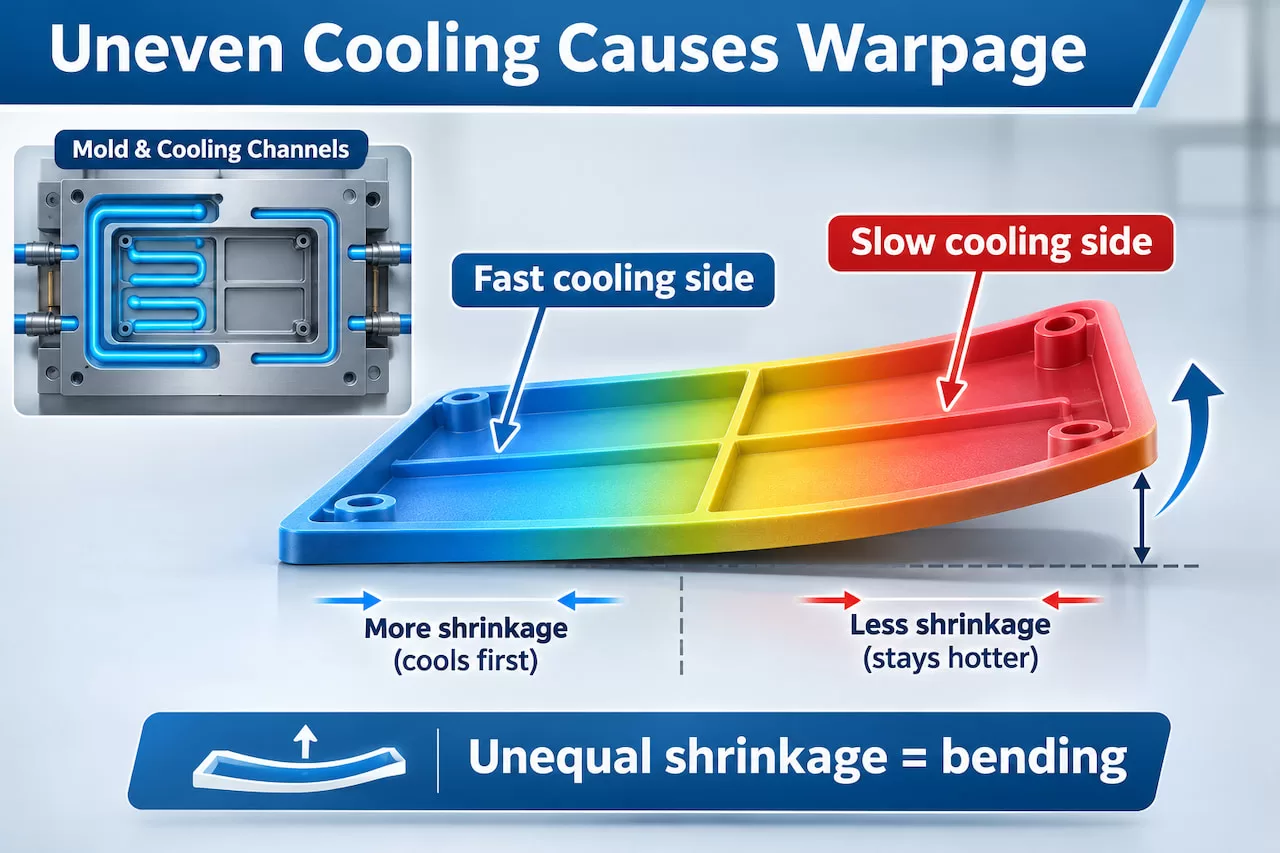
When different areas of an injection-molded part cool at different rates, they undergo different amounts of shrinkage. Because these areas are connected, their unequal contraction creates internal stresses within the part. While the mold restricts these dimensional changes, the stresses may remain locked inside the material. After ejection, they can relax and cause the part to bend, twist, or warp. Uneven Cooling is therefore a major contributor to molded-part warpage, particularly in products with varying wall thicknesses or uneven mold temperatures. Preventing it requires balanced heat removal, suitable packing conditions, and consistent mold temperature control.
How Does Uneven Cooling Lead to the Warping of Injection-molded Parts?
Warpage develops through the interaction between heat transfer, material shrinkage, and residual stress during cooling. After molten plastic enters the cavity, heat transfers from the polymer to the mold, causing the material near the cavity and core surfaces to solidify first. The inner regions continue cooling and shrinking afterward. Holding pressure compensates for part of this volumetric shrinkage, but it cannot eliminate differences caused by uneven temperature distribution. Understanding these stages explains why cooling conditions have such a significant influence on the final shape.
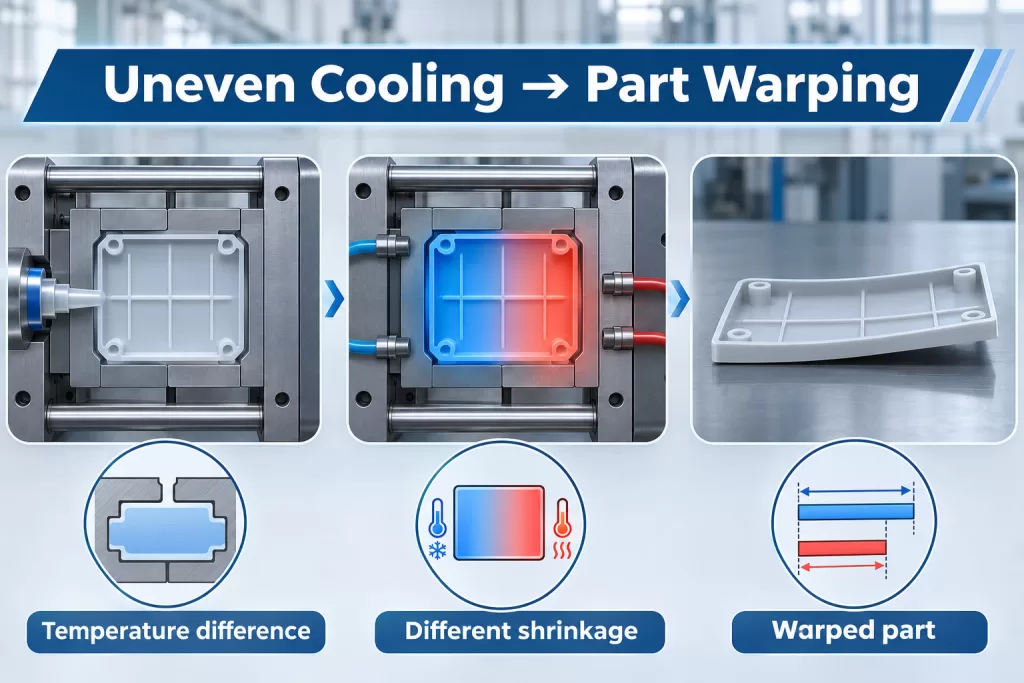
How Does Normal Cooling Affect Part Shrinkage?
After molten plastic fills the mold cavity, heat transfers through the polymer to the mold surfaces and then into the cooling channels. The material near the cavity and core surfaces begins to solidify first, while the inner sections retain heat for longer.
During the packing and holding stage, additional molten material enters the cavity to compensate for volumetric shrinkage. This helps reduce excessive local shrinkage, particularly in sections that remain molten for longer. However, the effectiveness of holding pressure depends on the gate remaining open. Once the gate freezes, additional material can no longer enter the cavity.
As cooling continues, the polymer gradually develops sufficient rigidity for ejection. A properly designed cooling process aims to maintain a reasonably uniform temperature distribution and control shrinkage across different sections of the part.
How Do Different Cooling Rates Generate Internal Stress?
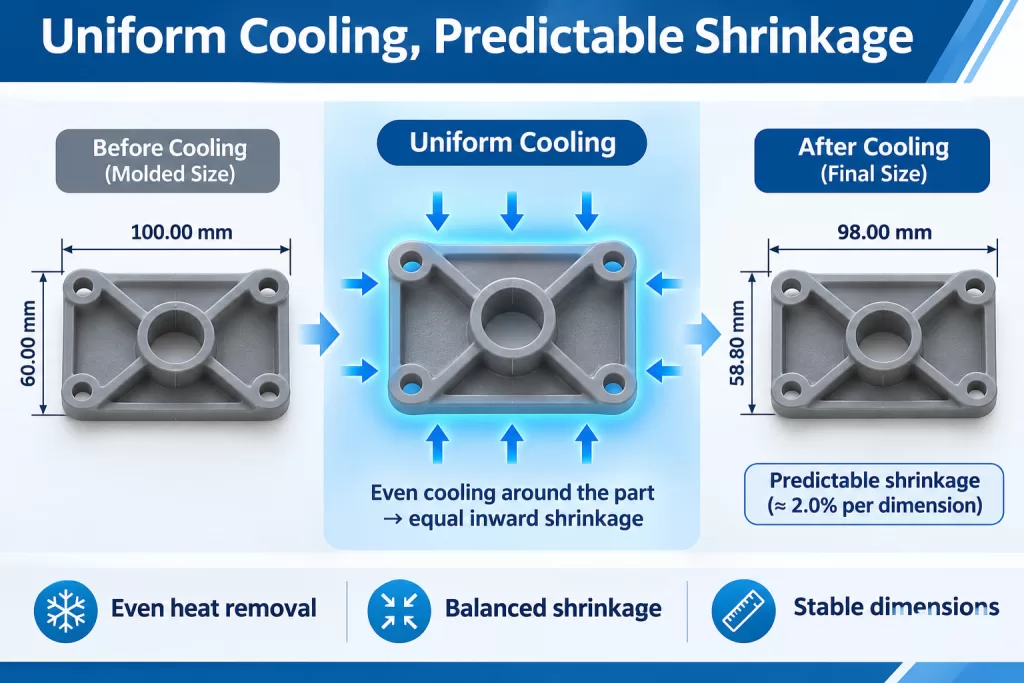
When different areas cool at different rates, they also solidify and shrink at different times. Because these regions are physically connected, one area cannot contract freely without being constrained by the surrounding material.
For example, thicker sections generally retain heat longer than thinner sections. If the thinner areas solidify first while the thicker areas continue to shrink, the difference in contraction creates internal stress.
Temperature differences between the mold core and cavity can produce similar effects. If one side cools faster, the two surfaces may undergo different amounts of shrinkage, creating an imbalance that causes the part to bend after ejection.
These stresses may not be immediately visible while the part remains inside the mold. Once the mold releases the part, the stored stresses can relax, resulting in warpage. (Research on Cooling Conditions and Injection-Molded Part Warpage)
What Are the Causes of Uneven Cooling, and How Can It Be Prevented?
In actual injection molding production, uneven cooling usually results from a combination of mold temperature differences, variations in part wall thickness, cooling-channel design, and water circulation conditions. These factors influence how efficiently heat moves away from different areas of the mold. Therefore, troubleshooting should begin with identifying where temperature differences occur, followed by checking the cooling-channel layout and operating conditions. Improving one factor without addressing the others may not eliminate the underlying cause of warpage.
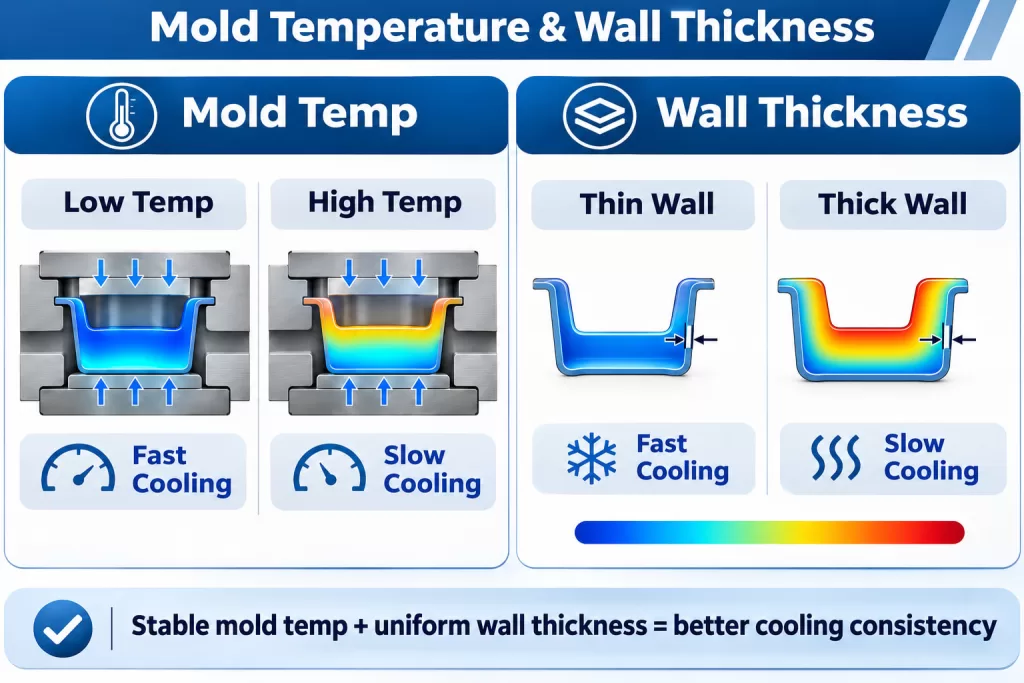
How Do Mold Temperature and Wall Thickness Affect Cooling Uniformity?
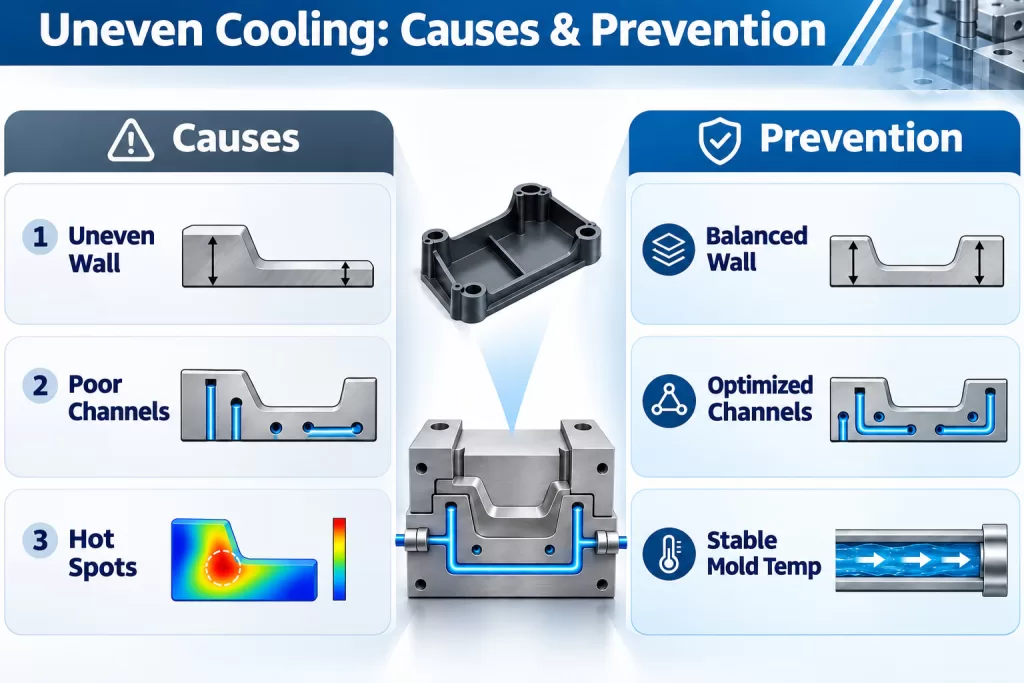
Uneven mold temperatures and significant wall-thickness variations are two common causes of differential cooling.
If the core and cavity operate at different temperatures, the two sides of the molded part may cool and shrink at different rates. Similarly, thick sections, ribs, and bosses retain more heat than surrounding thin areas, extending their cooling time.
To reduce these differences, manufacturers should:
- Maintain suitable and stable temperatures across the core and cavity.
- Avoid unnecessary wall-thickness variations during product design.
- Pay particular attention to thick sections, ribs, and bosses where heat can accumulate.
- Provide adequate cooling near areas with higher thermal loads.
The objective is not simply to lower the mold temperature, but to maintain a more uniform temperature distribution so that different sections of the part shrink more consistently.
How Does Poor Cooling-Channel Design Cause Uneven Cooling?
Even with a stable cooling-water supply, an inefficient cooling-channel layout can create localized hot spots inside the mold.
If channels are positioned too far from the cavity surface, heat removal may become less effective. Uneven channel spacing can also produce temperature differences between mold regions. Deep cores and complex mold geometries are particularly challenging because conventional cooling channels may not reach every critical area effectively.
In addition, scale buildup, blocked passages, and restricted water flow can reduce heat transfer, causing certain mold sections to cool more slowly.
Improvements should focus on three areas:
- Cooling-channel layout: Optimize channel positioning and spacing to provide more uniform heat removal around the cavity and core.
- Water circulation: Check for blockages, scale buildup, insufficient flow, and imbalanced cooling circuits.
- Localized cooling: Pay particular attention to deep cores, thick sections, and other areas prone to heat accumulation.
Research on conformal cooling channels shows that improving channel positioning can help achieve more uniform mold temperatures, reduce cooling time, and minimize differential shrinkage and warpage. (Review of Conformal Cooling Channel Design)
How Should Cooling Conditions Be Optimized During Production?
After checking the mold structure and cooling circuits, manufacturers should optimize three operating conditions together.
1. Mold Temperature
Use an appropriate Mold Temperature Controller to maintain stable temperatures across the core and cavity. Monitor temperature differences between mold regions rather than relying on a single temperature reading.
2. Cooling Water Flow
Ensure that each cooling circuit receives sufficient and consistent water flow. A properly sized Water-cooled Chiller can provide the required cooling capacity, while the pump and piping system must deliver suitable flow and pressure. Regularly inspect the channels for scale buildup, blockages, and restricted circulation.
3. Holding Pressure and Cooling Time
Set holding pressure and holding time according to the material, gate-freeze behavior, and part geometry. Allow sufficient cooling after the holding stage so that the part develops enough rigidity for safe ejection without deformation.
During mold trials, measure part dimensions and warpage after ejection and cooling. Change one process variable at a time when conducting controlled trials so that the effect of each adjustment can be evaluated accurately.
How Can Uneven Cooling-Related Warpage Be Reduced?
Warpage caused by uneven cooling results from differences in regional shrinkage and the residual stresses generated during solidification. Reducing it requires balanced mold temperatures, appropriate wall-thickness design, effective cooling-channel layouts, and stable water circulation. Holding pressure and cooling time must also be coordinated to ensure sufficient packing and dimensional stability before ejection. By controlling these conditions together, manufacturers can reduce differential shrinkage and produce injection-molded parts with more consistent dimensions and less deformation.
TRENDING POSTS
- TOPS DAY 2026: Serving AI with AI, Multiple Cooperation Agreements Signed Including Humanoid Robots 2026/11/27
- Topstar Chairman Wu Fengli: Serving the AI Industry with the Power of AI 2026/11/27
- TOPS DAY 2026: Turning Industrial AI into Real-World Impact 2026/11/27
- Breaking Through the Full Scene-to-AI Link! Topstar Industrial Data Collection Matrix Achieves Major Technical Breakthro 2026/11/27
HOT TOPIC
- .ervo motor-driven linear robots
- •
- 1.0 guangdong topstar technology co. ltd
- 1.0 topstar china
- 1.0 topstar robot
- 11
- 160℃ mold temperature controller
- 170 ton injection molding machine
- 2
- 21
- 220-ton injection molding machine
- 23
- 260 ton injection molding machine
- 3 axis robot
- 3 axis robots
- 3 in 1 Compact Dehumidifying Dryer
- 3-axis robot
- 3-axis robots
- 39
- 4 axis robot
- 4-axis SCARA robot
- 41
- 460T injection molding machine
- 5-axis CNC machine
- 62
- 90 ton injection molding machine
- accuracy
- Air Chillers
- air-cooled chillers
- all electric injection molding machine
- all electric injection molding machines
- all-electric injection molding machine
- All-electric injection molding machines
- and overall production quality. Therefore
- AP-RubberPlas
- auto cooling system
- auto loader
- Auto Loaders
- automated injection molding machine
- Automation changed engineering
- automation of injection molding robots
- automotive parts injection molding
- Auxiliary Equipment
- auxiliary machine
- Bench Injection Molding Machine
- cabinet dryer
- Cabinet dryer manufacturers
- Cabinet dryers
- cartesian coordinate robot
- Cartesian Coordinate Robots
- Cartesian injection robot
- Cartesian robot
- Central Feeding System
- Central Feeding Systems
- chiller
- CNC Drilling Machine
- CNC Drilling Machines
- cnc engraving machine manufacturer
- cnc laser cutting machine manufacturer
- CNC machine
- CNC Machine Center
- CNC Machine for Sale
- CNC Machine Manufacturing
- CNC Machine Tool
- CNC machine tool product
- CNC Machining Center
- CNC wood carving machine
- Compact Dehumidifying Dryer
- Cooling system
- Cross-Walking Single Axis Servo Cylinder Robot
- Cross-Walking Single-Axis Servo Cylinder Robot
- Cross-Walking Three-Axis/Five-Axis Servo Driven Robot
- cross-walking three-axis/five-axis servo-driven robot
- Dehumidifier Dryer
- Dehumidifying Dryer
- dehumidifying dryers
- delta parallel robot
- Desktop Injection Molding Machine
- Desktop injection molding machines
- Desktop Molding Machine
- desktop plastic injection machine
- Desktop Plastic Injection Molding Machine
- detachable autoloader
- Digital Transformation
- direct clamp injection molding machine
- Direct clamp injection molding machines
- Dosing & mixing system
- Drilling Centers
- Drying and dehumidification system
- drying and dehumidifying equipment
- Drying and Dehumidifying System
- drying system
- effective and efficient. Cabinet dryers are also used in other industries where large quantities of material need to be dried
- efficient injection molding machine
- elbow hydraulic injection molding machines
- electric injection molding machine
- electric injection molding machines
- energy-efficient injection molding robot
- energy-efficient water chiller
- energy-efficient water chillers
- energy-saving injection molding machine
- etc. Among injection molding robots
- exhibition
- features of CNC machine
- Feeding And Conveying System
- Five Axis Machine Center
- Flexible Production Line
- Fully automatic injection molding machine
- Gathering Topstar
- giant injection molding machine
- GMU-600 5-Axis Machining Center
- Granulating & Recycling System
- granulator machine
- gravimetric blender
- Heavy duty injection molding machine
- Heavy-Duty Take-Out Robot
- High-precision electric molding machines
- high-precision plastic molding machines
- high-speed all electric injection molding machine
- high-speed electric injection molding machine
- High-Speed Packaging Injection Molding
- Honeycomb rotor dehumidifier
- hopper dryer
- Hopper Dryers
- horizontal injection molding machine
- Horizontal Injection Molding Machines
- Horizontal Injection Moulding Machine
- Horizontal Mixer manufacturer
- How The CNC Machine Works
- hybrid injection molding machine
- hydraulic injection molding machine
- Hydraulic Injection Molding Machines
- in this article
- Industrial AI
- Industrial Automation
- Industrial robot
- Industrial Robot Chinese brand
- industrial robot parts
- industrial robot supplier
- Industrial robots
- Industry Chain
- Injection Manipulator
- injection manipulator robot
- injection mold machines
- Injection molding
- Injection molding automation
- Injection Molding Automation Solution
- injection molding dryer
- Injection molding equipment
- injection molding hopper dryer
- Injection molding machine
- injection molding machine brand
- Injection Molding Machine Factory
- Injection Molding Machine Manufacture
- Injection molding machine manufacturer
- injection molding machine manufacturers
- Injection molding machine procurement
- injection molding machine robotic arm
- injection molding machine with a robot
- Injection molding machines
- injection molding material dehumidifying
- injection molding plant
- injection molding process
- Injection Molding Robot
- injection molding robot arm
- Injection molding robot automation
- Injection molding robotic arm
- injection molding robots
- injection molding whole plant
- injection moulding dryer
- Injection moulding machine
- injection moulding machines
- Injection Moulding Robots
- Injection Robot
- Injection robot arm
- Injection robot manufacturer
- Injection robot wholesale
- injection robots
- Intelligent Factory
- intelligent injection molding machines
- Intelligent Manufacturing
- intelligent mold temperature
- intelligent mold temperature controller
- Intelligent mould temperature controller
- intelligent whole plant solution
- InterPlas Thailand 2025
- Introducing Injection Robot
- It is the best choice for drying large quantities of material at once. Cabinetmakers use these machines because they are fast
- Large flow water type mold temperature controller
- large injection molding machine
- large injection molding machines
- Learn what industrial automation and robotics is
- linear robot
- linear robots
- low speed sound-proof granulator
- machine plastic molding
- make sure to add some! Improvements (2) Keyphrase in introduction: Your keyphrase or its synonyms appear in the first paragraph of the copy
- manipulator machine
- manufacturing
- Manufacturing Innovation
- medical grade injection molding machines
- Medical Injection Molding
- medical injection molding machine
- medical injection molding machines
- micro injection molding machine
- middle speed granulator
- Mini CNC machine manufacturers.
- mobile cover making machine
- Mold Temperature Control System
- mold temperature controller
- mold temperature controllers
- molding machine
- molding material Dehumidifying System
- mould temperature control system
- mould temperature controller
- mould temperature controller
- mould temperature controllers
- New electric injection molding machine
- Nitrogen Dryer
- nitrogen dryer manufacturer
- nitrogen dryer system manufacturer
- Oil type mold temperature controller
- Oil type mold temperature controllers
- open day
- optical component injection molding
- Optical-grade dehumidifying dryer
- Outbound links: No outbound links appear in this page. Add some! Images: No images appear on this page. Add some! Internal links: No internal links appear in this page
- packaging injection molding
- Packaging Solutions
- PET Preform injection molding
- phone case maker machine
- phone case making machine
- phone cover making machine
- PID Control Mold Temperature Controller
- plastic auto loader
- plastic bottle making machine
- plastic bottle manufacturing
- plastic bucket making machine
- plastic bucket manufacturing
- Plastic chair making machine
- plastic dryer for injection molding
- plastic forming equipment
- Plastic Granulator
- Plastic Granulators
- plastic hopper dryer
- plastic injection machine
- plastic injection machines
- plastic injection molding
- Plastic injection molding equipment
- Plastic injection molding machine
- Plastic Injection Molding Machines
- plastic injection moulding machine
- plastic injection moulding machines
- plastic injection robot
- plastic molding
- Plastic Molding Industry
- Plastic Molding machine
- plastic molding machine 1
- Plastic Molding Machines
- plastic molding press
- plastic moulding machine
- plastic phone case making machine
- plastic-molding machine
- powerful granulator
- Powerful Type Sound-Proof Granulator
- precision injection molding
- precision injection molding machines
- production of plastic seats
- pure water mould temperature controller
- Robot injection molding
- robot injection molding machine
- robot manufacturing companies
- Robotic arm for injection molding machine
- robotic injection molding machines
- robotics in injection molding
- SCARA robot
- SCARA robots
- Screw dosers
- Service-oriented manufacturing
- Servo Cylinder Robot
- servo driven robot
- Servo Driven Robots
- servo injection molding machine
- servo injection robots
- servo motor-driven linear robots
- servo-driven 3-axis robot
- Servo-driven injection molding machine
- Servo-Driven Robot
- Setup of injection machine
- Silicone Injection Molding Machine
- six-axis industrial robot
- Smart Manufacturing
- soundproof granulator
- Sprue Picker
- Stainless Hopper Dryer
- Stainless Hopper Dryers
- star club
- swing arm robot
- T1 Cartesian injection robot
- take-out robot
- take-out robots
- Thailand 4.0
- the choice between servo-driven robots and hydraulic robots will have a certain impact on efficiency
- the most popular injection molding machine
- the type of injection molding robot
- TIC2000 Control System
- TMII injection molding machine
- toggle clamp injection molding machine
- Toggle Hydraulic Injection Molding Machines
- toggle injection molding machine
- Top 10 brands of injection robots
- Topstar
- Topstar Electric Injection Molding Machine InterPlas Thailand 2025 Smart Manufacturing Thailand 4.0
- Topstar Engineering
- Topstar Industrial Robots
- Topstar injection molding intelligent
- Topstar Scara Robots
- Useful Injection molding machine
- Vertical machining centers
- volumetric type blender
- Washing Machine Case Molding Solution
- water chiller
- water chillers
- water distributor
- water type mold temperature controller
- Water Type MoldTemperature Controller
- Water-Cooled Chillers
- Water-cooled Mold Temperature Controller
- water-type mold temperature controller
- Water-Type Mould Temperature Controllers
- We often face choices when performing injection molding. We will choose the type of injection molding machine
- wholesale of injection molding machines
- x carve CNC
- 热门查询 点击次数 展示 排名 topstar