
Topstar Chairman Wu Fengli: Serving the AI Industry with the Power of AI
2026/11/28 By topstar
The AI wave is reshaping manufacturing. Embodied intelligence is accelerating into real industrial scenarios and becoming a key engine for industrial upgrading. Amid the boom, the industry still faces a shared challenge: how to truly root cutting-edge intelligent technologies in production lines and turn trends into tangible industrial value?
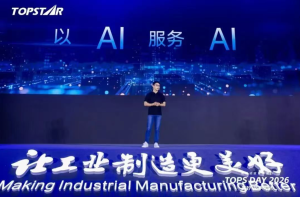
On November 7–8, TOPS DAY 2026 Topstar Global Open Day, themed “Beauty Within Reach,” opened in Dongguan, Guangdong.
TOPS DAY 2026 was an industrial grand event that brought together trend insights, the debut of AI+ product solutions, analysis of benchmark cases, and industrial ecosystem connections. It not only reflected an ongoing technological wave but also aimed to explore pathways for industrial AI implementation and new opportunities in smart manufacturing.
Let us look back at the highlights of this event and experience the real power of industrial AI taking root in workshops and shining into manufacturing sites.
Topstar Technology Chairman and President Wu Fengli shared Topstar’s transformation path in embracing AI. He frankly stated: “Challenges are often opportunities in another form.” Building on its deep accumulation in vast industrial scenarios, Topstar firmly pursues the embodied intelligence route. Through internal digital-intelligent efficiency improvements, refining core robot capabilities, and laying out the industrial ecosystem, it advances the practical implementation of “serving AI with AI.”
In his speech, he particularly pointed out: “Rather than fantasizing about the future in the cloud, we prefer to take root on the production line and do practical things. For an enterprise to go far and steady, it relies on two things: solid products, and a system that supports continuous product iteration.”
The following is the edited transcript of the speech by Topstar Technology Chairman and President Wu Fengli:
Distinguished guests, partners, and all friends who have long supported and cared about Topstar, good afternoon!
It is a great honor, and I sincerely thank everyone for taking time from your busy schedules to be here. First, on behalf of all Topstar colleagues, please allow me to extend the warmest welcome and most heartfelt thanks to all the friends who have long cared for and supported us. Thank you!
Seeing many familiar faces and long-time friends again fills me with warmth. I often feel that our generation is fortunate: in just two or three decades, we have passed through several eras—from the agricultural age and industrial age, through the internet and mobile internet eras, to the artificial intelligence era that is now surging toward us.
As entrepreneurs, many of us have experienced this era, but some have also missed it. For example, not everyone managed to catch the internet or mobile internet express. But facing the roaring artificial intelligence era today, we indeed face many challenges, and of course many opportunities as well.
I believe that over the past year, everyone has experienced some changes and had many reflections. If there is one highest-frequency word from the past year, everyone’s answer may differ, but one word is unavoidable: AI.
As a company that has been entrepreneurial for more than 20 years, Topstar, like everyone else, faced many confusions when the AI era arrived. So today I would like to share with you the confusions, thoughts, explorations, and attempts that Topstar has made over the past year.
The theme of my sharing today is: Serving AI with AI. These two AIs are different. The first AI refers more to technology and products—how we use AI technology to create tools and capabilities; the second AI refers more to customers and the market—whom we serve. Sometimes cognition determines definition, and definition determines our way of thinking.
So when facing this topic, the first question I asked myself was: What is AI in your eyes?
You can think along with me. There are a thousand Hamlets in a thousand people’s eyes; everyone’s definition is different.
From an individual perspective, I think AI can be a smarter search engine, a thoughtful life assistant, or a private emotional confidant. From an operator’s perspective, AI is a tool that helps us improve quality, reduce costs, and increase efficiency in operations. And when it comes to our product track—industrial robots and embodied intelligence—AI is turning traditionally programmed equipment into a completely new system that can perceive, make autonomous decisions, continuously iterate, has a lower operating threshold, broader applicable scenarios, and stronger generality.
Different definitions of AI lead us to see different worlds. If we expand our view to the macroeconomic level, we can read clear signals from the first-half 2026 economic data released by the National Bureau of Statistics, the General Administration of Customs, and other departments: exports of high-tech products such as integrated circuits, new energy vehicles, and industrial robots continue to rise; at the same time, traditional automobiles, consumer goods, furniture and home appliances, and other sectors are under pressure. One rising and one falling—half flame, half seawater.
What we see is: “carbon-based” is declining, while “silicon-based” is rapidly rising. There is even a saying now that it has become an “I-shaped” structure: the tiny tip at the top—AI computing power, high-end chips, large models, and a few other AI-related tracks—rises independently upward, while below lies the vast traditional manufacturing, catering, retail, and other industries, disconnected from each other, as if the world has been divided into the “AI camp” and the “non-AI camp.”
When talking about AI, everyone should be familiar with the widely circulated NVIDIA AI “five-layer cake.” From the bottom layer of energy, chips, and infrastructure, to large models and upper-layer applications, we might as well ask ourselves: Where do we stand on this industrial map? Which tracks are closely related to us?
In the past, AI mostly existed in the digital world, but in the future we can see that AI will gradually connect with the physical world, and the integration of the AI world and the physical world is an inevitable trend. In the past, intelligent driving was the main carrier for AI to land in physical space; now and in the future, robots will become the most important carrier. For robots to enter the physical world, industrial scenarios are an inevitable path—both a valuable training ground and a continuous source of data. The vast majority of partners here are rooted in manufacturing, and manufacturing is the most important fertile soil for training physical AI.
From the industrial path perspective, overseas AI laid out earlier in general large models, language logical reasoning, and other software intelligence directions; China, relying on its complete manufacturing industry chain advantages, has richer scenarios for AI combined with robots and embodied intelligence oriented toward the physical world, and scales up faster. In addition to refining the “brain,” we are better positioned to train the robot’s hands and legs. Relying on 20 years of industrial accumulation, Topstar chooses to focus on refining the robot’s arms.
When we look at this “five-layer cake” diagram, we cannot help but ask ourselves: If we have not yet truly stepped into this new AI track, are there partners of ours already in the track? Are our customers already in it? As the saying goes, “You need relatives in the city.” If we already have such “relatives in the city,” how should we build pathways and complete the docking? As an enterprise with both traditional manufacturing roots and high-tech attributes, this is precisely the proposition Topstar has been thinking about.
At the same time, I also believe: Challenges are often opportunities in another form. Fluctuations are the normal state of business; a period of decline may very well be the starting point of the next round of growth.
In my mind, AI has four key words: it can be a technology, it can be a tool, it can be a core capability, and ultimately it will also become a vast industry.
We can understand it from three dimensions:
The first dimension is that AI is a technology. When we treat it as a dialogue or generation tool, it is technology; when we use it in operations to generate reports, edit videos, and empower various positions, it is an efficiency tool derived from technology; going further, AI is more of a capability, embedded in products and becoming our unique competitiveness; and ultimately, we hope AI becomes the vast market we serve.
They can be parallel relationships, or more of a progressive relationship: technology gives birth to tools, tools are transformed into capabilities, and capabilities support a monetizable and sustainable industry.
As a manager, I often say: In the short term look at sales, in the medium term look at products, in the long term look at operations. This does not mean these three have a sequential order. In the short term, sales more easily bring rapid growth; truly robust and sustainable competitiveness comes from continuously refined and repeatedly verified products, so the medium term looks at products; and the long term looks at operations, which is the hardest part. Operations is not a single-point breakthrough but a systemic capability that requires us to be more refined in every detail.
Sales and products are about doing incremental business well; operations is about refining the stock business. Stock competition is like an exam, like being in deep water—when you already have 95 points, every additional point is especially difficult. Opening a new track and building a second curve to get two 80-point scores is actually easier for achieving increment. But even if it is difficult, how to do the stock business well is the difficult yet correct thing that requires us to stand on the present and adhere to long-termism.
So today, I will share Topstar’s explorations from the three dimensions of operations, products, and sales.
I. Operations
Before diving in, I repeatedly asked myself two questions: If AI is technology and a tool, what goals do we hope to achieve with it? And how should we apply it to the extreme?
Tools are never the end; goals are the core. Holding the idea of beginning with the end in mind, led by business departments and supported by the IT department, we conducted a comprehensive scan of all departments and all positions across the company, mining implementation opportunities in human resources, finance, legal, sales, R&D, and other sectors—for example, intelligent sales quotation assistants, AI headhunter sourcing, server inspection, internal knowledge bases, and so on.
But not all directions that “look feasible” are worth investing in. We advanced in three stages between “want to do, can do, and may do”: the first stage is extensive scanning to collect all potential scenarios; the second stage is convergence and screening to lock in directions that we have the capability and value to implement; and finally focusing on the highest-priority projects. After screening, we converged from a large number of candidate scenarios into 25 pilot directions, and ultimately achieved implementation in 15 scenarios, verifying six categories of truly usable AI capabilities.
In this process, we cultivated 41 AI seeds from the frontline of business. It is precisely these seedlings rooted in business that helped us precipitate replicable and promotable AI capabilities.
Here I would also like to report to everyone that our original Process IT Center has been officially renamed the Process Digital-Intelligence Center. This is not just a name change; it is our determination to fully embrace AI and go All-in on AI. In the past, we relied on software and programs; AI opens up completely new space for us. The capability models and capability profiles of the Digital-Intelligence Center have all been reshaped together.
We formed an AI efficiency group, pairing business seeds with professional personnel from the Digital-Intelligence Center to advance together. I have always firmly believed that truly vital AI must be born from business, not purely driven by technology. Supplemented by external mentor guidance, internal project selection, and cross-departmental reviews, our goal is clear: free people from repetitive labor and put them into more creative work.
Take a typical case: the intelligent outbound call project. In the past, before equipment installation, we needed personnel to repeatedly communicate with customers to confirm on-site conditions, register information, coordinate times, and assign work by zones. It was highly dependent on manpower, records were prone to errors and omissions, and manpower investment was huge. We connected AI to the CRM; work orders are automatically triggered, and AI independently confirms installation conditions, returns data, and coordinates scheduling. The links that were previously purely manual docking are now independently handled by AI.
In nearly a year, this project has cumulatively processed 7,149 work orders, connected 4,463 calls, with a connection rate of 62% and a dispatch conversion rate of 43%. Response is faster, processes are standardized, and information is less likely to be missed. This intelligent agent has taken on the workload of what used to require ten people, with very obvious efficiency improvements.
This case gave us deep inspiration: you do not necessarily need to be proficient in algorithms. Business experts, even technical novices, can use AI well and build tools. The deeper the understanding of business pain points, the stronger the effectiveness of the tools created. The same set of AI, if only understanding the surface of the business, may produce only a tricycle; by thoroughly understanding the underlying pain points and the real customer demands, we can build a Ferrari.
At the same time, how tools are used must also revolve around goals. The same Ferrari, if pursuing extreme speed, can sprint at full force; if requiring safety and compliance, it needs steady speed control. Goals determine the way we build and use tools.
After more than a year of internal operations implementation, we already have more than ten projects achieving efficiency improvements of over 50%. Among them, the new supplier development Agent compressed work that originally took more than 20 minutes to the second level, improving efficiency by dozens of times; fault code maintenance automation can achieve all-weather uninterrupted operation.
In practice, I observed that people generally go through five stages when contacting AI: curiosity, fear, trying to use, habit, and finally cautious coexistence. Some worry they cannot learn it, some worry about job replacement, but no matter what, the most important step is to start.
Many people ask: Is AI coming to replace humans? In our practice, I have my own answer. Young people naturally find it easier to get started with AI and have stronger willingness; while practitioners with 20–30 years of experience also have unique advantages: solid professional foundation, keen business feel, critical thinking, and the ability to master tools. The gap brought by generational differences is being leveled.
My conclusion is that humans will not be replaced by AI, with four core points:
First, the ability to ask questions. The deeper the understanding of the business, the more one can point directly to the core and ask questions that touch the essence; high-quality follow-up questions can continuously approach the truth and obtain more valuable answers.
Second, judgment. No matter what results AI returns, humans can distinguish truth from falsehood, cross-verify, and infinitely approach the facts.
Third, decision-making. Judgment stays at the cognitive level, while decision-making is from knowing to acting.
Fourth, taking responsibility for results. Once a decision is implemented, results can be good or bad. If things do not go as expected, humans can proactively take the fall, build safety nets, and keep risks within a controllable range. Taking responsibility for results is something AI can never replace.
So for operations, even if results are slow, as long as the value is recognized, we must start immediately and persist in the long term.
II. Products
After talking about operations, let’s look at products. AI at the operations level is more about borrowing external tools; in the product sector, we need to internalize capabilities and precipitate them into unique competitiveness that others cannot take away.
Here I also asked myself two questions: If AI is a capability, what unique capabilities do we need? What unique value can these capabilities create for customers?
If AI is only a general tool, everyone can buy it; only when it grows on oneself can it form differentiated barriers. This is like building a car: no matter how good the car is, it is ultimately just a tool; our goal is to evolve into a cheetah. Making good use of external things is important, but ultimately we hope to grow our own capabilities.
Looking back at Topstar’s 20-year evolution: starting from injection molding equipment, gradually expanding to automation, CNC machining centers, industrial robots, and today laying out embodied intelligence, products have iterated all the way, but the original intention has never changed: to serve a broader range of manufacturing customers. Over 20 years, we have reached more than 200,000 manufacturing enterprises and served more than 15,000 customers. The most precious asset left to us is the massive real scenarios.
Scenarios continue to precipitate and in turn drive product iteration: from single injection molding scenarios to multiple industrial scenarios, giving rise to Cartesian robots, multi-joint robots, collaborative robots—different scenarios have completely different requirements for product configurations; when we move toward broader commercial scenarios, we began developing quadruped robot dogs, wheeled robots, and today’s dual-legged robots. Scenarios define functions, and functions determine configurations—this is our most precious scenario asset.
And AI gives these equipment a soul. Traditional equipment can only execute preset instructions; after integrating AI, robots achieve self-perception, self-adaptation, self-feedback, and self-decision-making, transforming into embodied intelligence. Relying on multi-sensor fusion—from position feedback, vision, and force sensing to multi-sensor collaboration—every piece of equipment delivered is also a data collection terminal. Massive scenarios and continuous data continuously iterate our models, from the underlying control “cerebellum” and vertical small models all the way up to feed back into the base large model; the continuously iterating “brain” further generalizes and adapts to more scenarios, forming a closed loop.
This closed loop not only creates value for customers but also obtains value feedback through orders, achieving self-hematopoiesis. From the third-quarter financial report this year, we can see that we maintained positive cash flow and steady profitability. This is our greatest confidence in building the ecosystem.
Our underlying technologies, starting from controllers, servo technology, and vision, have precipitated to support multiple robot products, serving 3C, automotive parts, home appliances, daily chemicals, packaging, and many other tracks. After divesting the green energy business, Topstar has become a pure product company. And the core of our product differentiation is the capability of the “arm,” which is also the direction we have continuously cultivated for 20 years. These hands are the foundation for creating value for customers.
Take an example: last year we released the Xiaotuo wheeled robot. After the release, I successively visited more than 100 customers, scanned a large number of scenarios, and followed our consistent methodology: scan, converge, focus, locking in three major directions—material handling, sorting, and glass wiping. The material handling solution relies on the CloudRobo model, which can autonomously parse visual and force information, automatically complete identification, material picking, transfer, and stacking. It has already won bids in multiple large factories and operates stably on production lines around the clock; one robot replaces two to three workers. While creating on-site value, it continuously returns data, allowing the robot to continuously evolve and gradually expand to sorting, wiping, and more tasks.
Here, I also thank our partners such as Feijieke and Wuwen Zhike for providing important support for industrial implementation.
To summarize our product route in three sentences: Understand the process, can do the work, and can land.
Understanding the process comes from long-term scanning of industries and scenarios, continuously accumulating into experience; being able to do the work is precipitation—equipment that can continuously create returns; and the most important is being able to land. Landing means we must choose the right battlefield, serve the right customers, and create repurchaseable and sustainable value. Rather than fantasizing about the future in the cloud, we prefer to take root in the “fields” and do practical things. For an enterprise to go far and steady, it relies on two things: solid products, and a system that supports continuous product iteration.
III. Sales
So, where is our “field”—our main battlefield? If AI is an industry, what is our ecological niche in the ecosystem? Why Topstar?
I have always believed that how far an enterprise can go depends on whom it walks with. Returning to the five-layer cake map, we have been looking for our own ecological niche.
Timing, location, and people—none can be missing. If the track is already mature, forcing entry makes it hard to create value; currently, the industrial control, vision, and robot application capabilities we have accumulated exactly match the needs for embodied intelligence landing—location is favorable; at the same time, the customers and partners we are familiar with are largely pouring into the AI hardware track—that is, the “relatives in the city” I mentioned.
We cannot make optical modules or optical chips themselves, but the production lines for optical modules and optical chips urgently need intelligent manufacturing and robots, and capacity is expanding exponentially. So we entered this track, visited customers, and sought partners. Choosing the right main field is key to victory.
Some time ago, we announced the acquisition of 49% of the shares of Laile Optoelectronics. My connection with Mr. Zhang is very interesting. At our first meeting, after listening to him introduce Laile’s technology, products, and plans, I was deeply fascinated. I then asked him about next year’s capacity; he told me that the targets for coupling equipment, chip testing equipment, and CPO eutectic equipment were all to grow several times. I then asked him what his troubles were; he said there were too many orders, customers were urging delivery, and capacity, space, and resources could not keep up.
At that moment I was deeply moved: people standing in the light carry their own radiance. His troubles are completely different from traditional manufacturing. We often worry about lacking orders when capacity is sufficient, worrying about profits when orders are obtained, and worrying about collections when there are profits; his biggest difficulty is that capacity delivery cannot keep up with vigorous demand. And this is exactly the field Topstar is best at: manufacturing, supply chain management, and site construction. We hit it off immediately.
After the cooperation landed, we immediately started the Wuhan new base; after it is put into use, capacity will expand threefold; at the same time, we allocated an independent floor in our Dongguan manufacturing park as the second production base. Topstar’s technical team deeply stationed itself, learning the process and technical understanding of the optical chip and optical module fields, and the customer resources of both sides were integrated. All of Laile’s customers need intelligent manufacturing and robots, and capacity planning is generally 5 to 10 times expansion—the space is huge.
The first time I accompanied Mr. Zhang to visit customers as an optical module equipment supporting partner, the experience completely overturned the past. After meeting, the customer only asked four things: How is the delivery capability? Can it be stably fulfilled? If capacity expands threefold, can you keep up? How much capacity can you allocate to us? After asking, they went straight to the workshop to look at the equipment. There was no lengthy price comparison or bidding—efficient and direct. The dialogue was “simple and crude”—this is the unique rhythm of the AI upstream hardware track.
So our layout logic is already clear: we use AI to empower ourselves with technology, tools, and products, becoming an enterprise deeply cultivating physical AI. On the hardware side, we lay out intelligent equipment, robots, and embodied intelligence; on the software side, we lay out vertical models, data, and computing power. In the new AI era, we have found a new direction: while holding the basic board, use the ecosystem accumulated over 20 years to serve the brand-new AI industry.
The acquisition of Laile is by no means just acquiring a set of optical chip equipment business. It is our entry into the optical module and optical chip track, opening brand-new scenarios for embodied intelligence, and laying out both ends of the smile curve—using AI technology to serve the AI industry, truly realizing “serving AI with AI.”
The acquisition of Laile is only a starting point for our comprehensive entry into the AI industry—the vast ocean of stars of the AI industry has just unfolded.
Through explorations and attempts in the three modules of operations, products, and sales, we have been changing. But I often ask myself: The world changes every day—what remains unchanged?
My answer is very simple: No matter how technology changes, only by continuously creating real value and truly solving customers’ pain points can an enterprise thrive forever. This old saying is precisely Topstar’s unchanging values: wholeheartedly serve customers, group struggle, and group success.
Thank you everyone!
TRENDING POSTS
- TOPS DAY 2026: Serving AI with AI, Multiple Cooperation Agreements Signed Including Humanoid Robots 2026/11/28
- Topstar Chairman Wu Fengli: Serving the AI Industry with the Power of AI 2026/11/28
- TOPS DAY 2026: Turning Industrial AI into Real-World Impact 2026/11/28
- Breaking Through the Full Scene-to-AI Link! Topstar Industrial Data Collection Matrix Achieves Major Technical Breakthro 2026/11/28
HOT TOPIC
- .ervo motor-driven linear robots
- •
- 1.0 guangdong topstar technology co. ltd
- 1.0 topstar china
- 1.0 topstar robot
- 11
- 160℃ mold temperature controller
- 170 ton injection molding machine
- 2
- 21
- 220-ton injection molding machine
- 23
- 260 ton injection molding machine
- 3 axis robot
- 3 axis robots
- 3 in 1 Compact Dehumidifying Dryer
- 3-axis robot
- 3-axis robots
- 39
- 4 axis robot
- 4-axis SCARA robot
- 41
- 460T injection molding machine
- 5-axis CNC machine
- 62
- 90 ton injection molding machine
- accuracy
- Air Chillers
- air-cooled chillers
- all electric injection molding machine
- all electric injection molding machines
- all-electric injection molding machine
- All-electric injection molding machines
- and overall production quality. Therefore
- AP-RubberPlas
- auto cooling system
- auto loader
- Auto Loaders
- automated injection molding machine
- Automation changed engineering
- automation of injection molding robots
- automotive parts injection molding
- Auxiliary Equipment
- auxiliary machine
- Bench Injection Molding Machine
- cabinet dryer
- Cabinet dryer manufacturers
- Cabinet dryers
- cartesian coordinate robot
- Cartesian Coordinate Robots
- Cartesian injection robot
- Cartesian robot
- Central Feeding System
- Central Feeding Systems
- chiller
- CNC Drilling Machine
- CNC Drilling Machines
- cnc engraving machine manufacturer
- cnc laser cutting machine manufacturer
- CNC machine
- CNC Machine Center
- CNC Machine for Sale
- CNC Machine Manufacturing
- CNC Machine Tool
- CNC machine tool product
- CNC Machining Center
- CNC wood carving machine
- Compact Dehumidifying Dryer
- Cooling system
- Cross-Walking Single Axis Servo Cylinder Robot
- Cross-Walking Single-Axis Servo Cylinder Robot
- Cross-Walking Three-Axis/Five-Axis Servo Driven Robot
- cross-walking three-axis/five-axis servo-driven robot
- Dehumidifier Dryer
- Dehumidifying Dryer
- dehumidifying dryers
- delta parallel robot
- Desktop Injection Molding Machine
- Desktop injection molding machines
- Desktop Molding Machine
- desktop plastic injection machine
- Desktop Plastic Injection Molding Machine
- detachable autoloader
- Digital Transformation
- direct clamp injection molding machine
- Direct clamp injection molding machines
- Dosing & mixing system
- Drilling Centers
- Drying and dehumidification system
- drying and dehumidifying equipment
- Drying and Dehumidifying System
- drying system
- effective and efficient. Cabinet dryers are also used in other industries where large quantities of material need to be dried
- efficient injection molding machine
- elbow hydraulic injection molding machines
- electric injection molding machine
- electric injection molding machines
- energy-efficient injection molding robot
- energy-efficient water chiller
- energy-efficient water chillers
- energy-saving injection molding machine
- etc. Among injection molding robots
- exhibition
- features of CNC machine
- Feeding And Conveying System
- Five Axis Machine Center
- Flexible Production Line
- Fully automatic injection molding machine
- Gathering Topstar
- giant injection molding machine
- GMU-600 5-Axis Machining Center
- Granulating & Recycling System
- granulator machine
- gravimetric blender
- Heavy duty injection molding machine
- Heavy-Duty Take-Out Robot
- High-precision electric molding machines
- high-precision plastic molding machines
- high-speed all electric injection molding machine
- high-speed electric injection molding machine
- High-Speed Packaging Injection Molding
- Honeycomb rotor dehumidifier
- hopper dryer
- Hopper Dryers
- horizontal injection molding machine
- Horizontal Injection Molding Machines
- Horizontal Injection Moulding Machine
- Horizontal Mixer manufacturer
- How The CNC Machine Works
- hybrid injection molding machine
- hydraulic injection molding machine
- Hydraulic Injection Molding Machines
- in this article
- Industrial AI
- Industrial Automation
- Industrial robot
- Industrial Robot Chinese brand
- industrial robot parts
- industrial robot supplier
- Industrial robots
- Industry Chain
- Injection Manipulator
- injection manipulator robot
- injection mold machines
- Injection molding
- Injection molding automation
- Injection Molding Automation Solution
- injection molding dryer
- Injection molding equipment
- injection molding hopper dryer
- Injection molding machine
- injection molding machine brand
- Injection Molding Machine Factory
- Injection Molding Machine Manufacture
- Injection molding machine manufacturer
- injection molding machine manufacturers
- Injection molding machine procurement
- injection molding machine robotic arm
- injection molding machine with a robot
- Injection molding machines
- injection molding material dehumidifying
- injection molding plant
- injection molding process
- Injection Molding Robot
- injection molding robot arm
- Injection molding robot automation
- Injection molding robotic arm
- injection molding robots
- injection molding whole plant
- injection moulding dryer
- Injection moulding machine
- injection moulding machines
- Injection Moulding Robots
- Injection Robot
- Injection robot arm
- Injection robot manufacturer
- Injection robot wholesale
- injection robots
- Intelligent Factory
- intelligent injection molding machines
- Intelligent Manufacturing
- intelligent mold temperature
- intelligent mold temperature controller
- Intelligent mould temperature controller
- intelligent whole plant solution
- InterPlas Thailand 2025
- Introducing Injection Robot
- It is the best choice for drying large quantities of material at once. Cabinetmakers use these machines because they are fast
- Large flow water type mold temperature controller
- large injection molding machine
- large injection molding machines
- Learn what industrial automation and robotics is
- linear robot
- linear robots
- low speed sound-proof granulator
- machine plastic molding
- make sure to add some! Improvements (2) Keyphrase in introduction: Your keyphrase or its synonyms appear in the first paragraph of the copy
- manipulator machine
- manufacturing
- Manufacturing Innovation
- medical grade injection molding machines
- Medical Injection Molding
- medical injection molding machine
- medical injection molding machines
- micro injection molding machine
- middle speed granulator
- Mini CNC machine manufacturers.
- mobile cover making machine
- Mold Temperature Control System
- mold temperature controller
- mold temperature controllers
- molding machine
- molding material Dehumidifying System
- mould temperature control system
- mould temperature controller
- mould temperature controller
- mould temperature controllers
- New electric injection molding machine
- Nitrogen Dryer
- nitrogen dryer manufacturer
- nitrogen dryer system manufacturer
- Oil type mold temperature controller
- Oil type mold temperature controllers
- open day
- optical component injection molding
- Optical-grade dehumidifying dryer
- Outbound links: No outbound links appear in this page. Add some! Images: No images appear on this page. Add some! Internal links: No internal links appear in this page
- packaging injection molding
- Packaging Solutions
- PET Preform injection molding
- phone case maker machine
- phone case making machine
- phone cover making machine
- PID Control Mold Temperature Controller
- plastic auto loader
- plastic bottle making machine
- plastic bottle manufacturing
- plastic bucket making machine
- plastic bucket manufacturing
- Plastic chair making machine
- plastic dryer for injection molding
- plastic forming equipment
- Plastic Granulator
- Plastic Granulators
- plastic hopper dryer
- plastic injection machine
- plastic injection machines
- plastic injection molding
- Plastic injection molding equipment
- Plastic injection molding machine
- Plastic Injection Molding Machines
- plastic injection moulding machine
- plastic injection moulding machines
- plastic injection robot
- plastic molding
- Plastic Molding Industry
- Plastic Molding machine
- plastic molding machine 1
- Plastic Molding Machines
- plastic molding press
- plastic moulding machine
- plastic phone case making machine
- plastic-molding machine
- powerful granulator
- Powerful Type Sound-Proof Granulator
- precision injection molding
- precision injection molding machines
- production of plastic seats
- pure water mould temperature controller
- Robot injection molding
- robot injection molding machine
- robot manufacturing companies
- Robotic arm for injection molding machine
- robotic injection molding machines
- robotics in injection molding
- SCARA robot
- SCARA robots
- Screw dosers
- Service-oriented manufacturing
- Servo Cylinder Robot
- servo driven robot
- Servo Driven Robots
- servo injection molding machine
- servo injection robots
- servo motor-driven linear robots
- servo-driven 3-axis robot
- Servo-driven injection molding machine
- Servo-Driven Robot
- Setup of injection machine
- Silicone Injection Molding Machine
- six-axis industrial robot
- Smart Manufacturing
- soundproof granulator
- Sprue Picker
- Stainless Hopper Dryer
- Stainless Hopper Dryers
- star club
- swing arm robot
- T1 Cartesian injection robot
- take-out robot
- take-out robots
- Thailand 4.0
- the choice between servo-driven robots and hydraulic robots will have a certain impact on efficiency
- the most popular injection molding machine
- the type of injection molding robot
- TIC2000 Control System
- TMII injection molding machine
- toggle clamp injection molding machine
- Toggle Hydraulic Injection Molding Machines
- toggle injection molding machine
- Top 10 brands of injection robots
- Topstar
- Topstar Electric Injection Molding Machine InterPlas Thailand 2025 Smart Manufacturing Thailand 4.0
- Topstar Engineering
- Topstar Industrial Robots
- Topstar injection molding intelligent
- Topstar Scara Robots
- Useful Injection molding machine
- Vertical machining centers
- volumetric type blender
- Washing Machine Case Molding Solution
- water chiller
- water chillers
- water distributor
- water type mold temperature controller
- Water Type MoldTemperature Controller
- Water-Cooled Chillers
- Water-cooled Mold Temperature Controller
- water-type mold temperature controller
- Water-Type Mould Temperature Controllers
- We often face choices when performing injection molding. We will choose the type of injection molding machine
- wholesale of injection molding machines
- x carve CNC
- 热门查询 点击次数 展示 排名 topstar