
Technical Features Regarding the Corrosion Resistance of the Topstar Injection Molding Chiller Series
2026/10/23 By le zhan
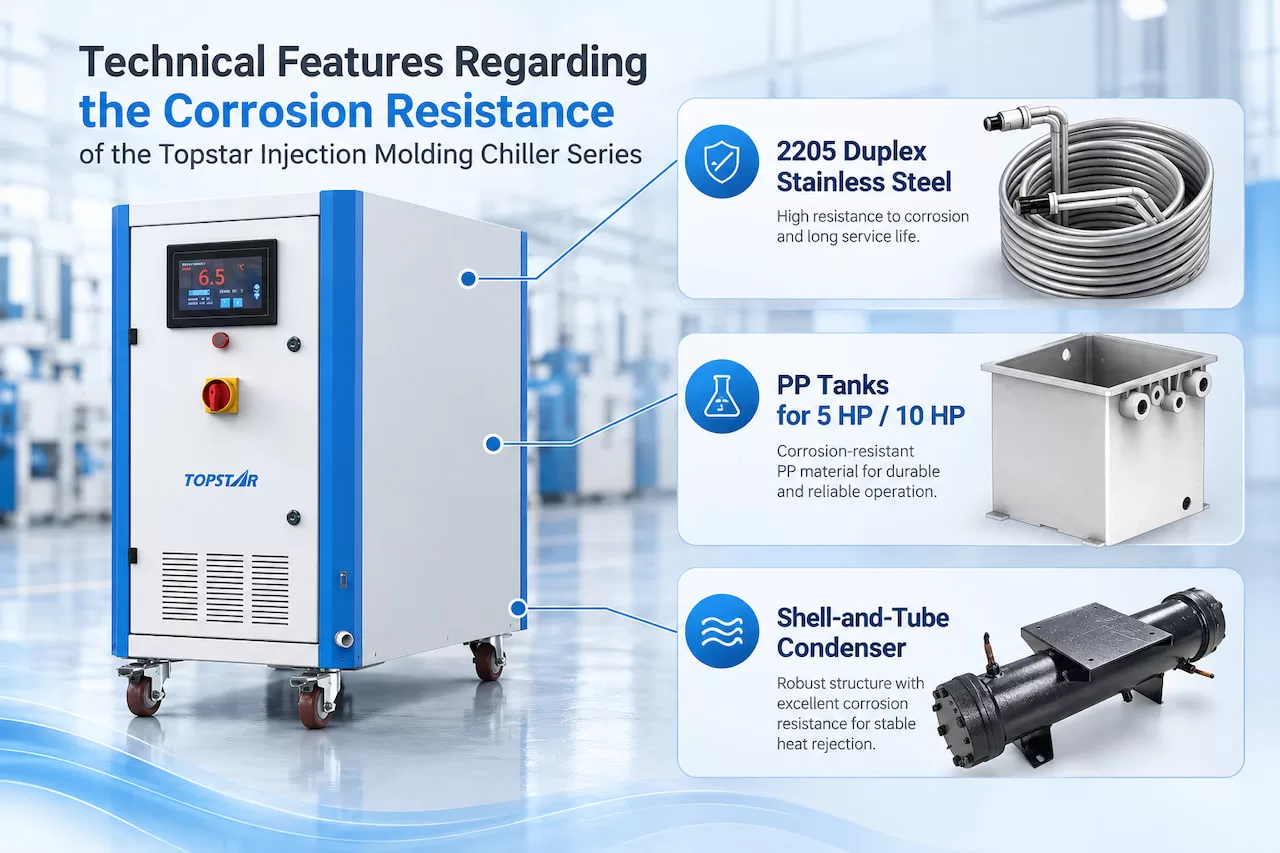
Corrosion resistance directly affects the service life, leak risk, and maintenance requirements of injection molding chillers. Topstar’s injection molding chiller series enhances durability through three key design features:
- They utilize nut-type coil connections to reduce reliance on welded refrigerant fittings and employ 2205 duplex stainless steel to enhance corrosion resistance;
- Selected 5 HP and 10 HP models are equipped with thickened polypropylene (PP) water tanks;
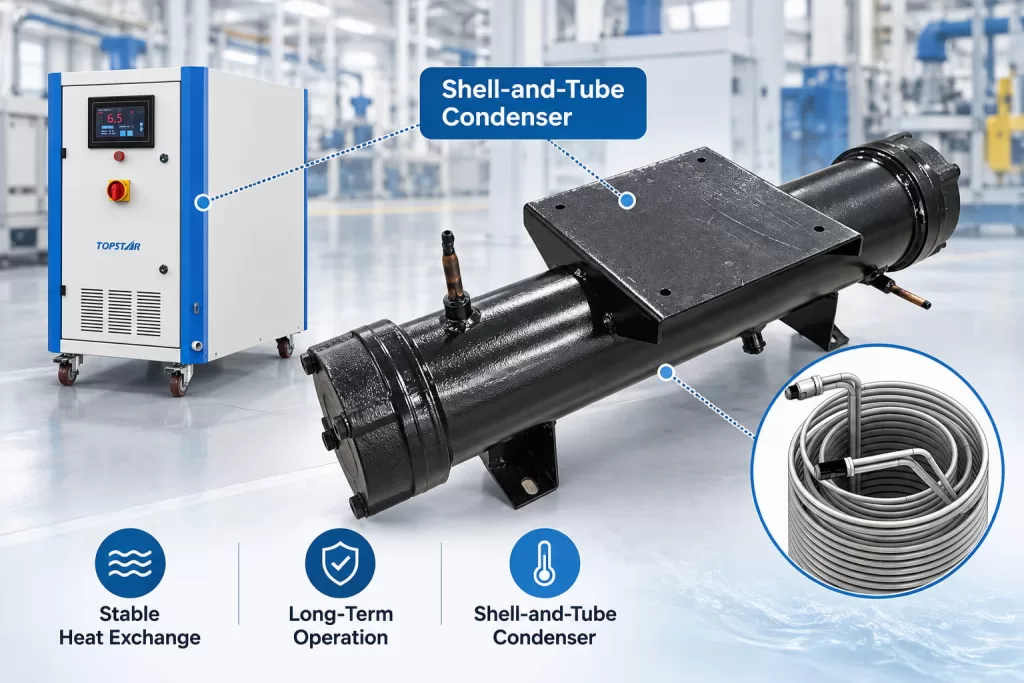
- For water-cooled chillers, the use of robust shell-and-tube condensers further ensures reliable heat dissipation and facilitates routine maintenance.
These features collectively address potential failures in the refrigerant and water circuits, helping manufacturers minimize downtime, maintain cooling stability during the injection molding process, and improve corrosion resistance.
How do the coil connection methods and materials in the Topstar injection molding chiller series reduce corrosion and leaks?
The refrigerant circuit is a critical component that determines a chiller’s reliability. A leak not only reduces the refrigerant charge and decreases cooling capacity but often requires professional repair. Although corrosion and joint failure are distinct issues, they can exacerbate each other: corrosion weakens component strength, while poorly designed or aged connections can become pathways for refrigerant leaks. By adopting mechanical coil connections and upgrading to stainless steel materials, Topstar has effectively reduced reliance on vulnerable joints and enhanced the equipment’s resistance to corrosive operating conditions.
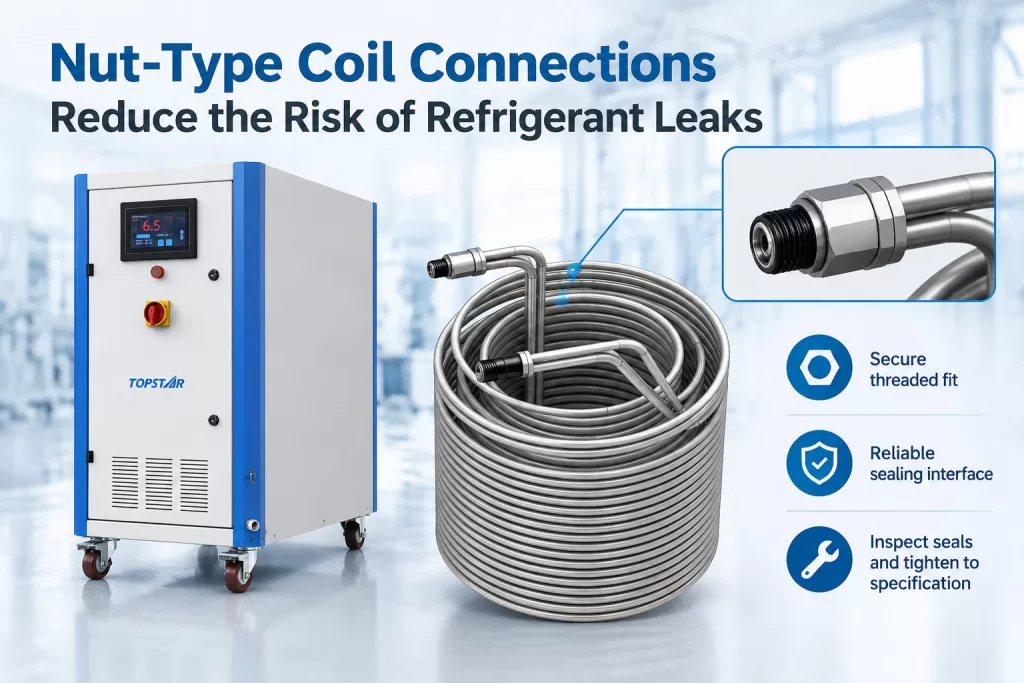
Nut-type coil connections reduce the risk of refrigerant leaks
Traditional coil assemblies often use welding to connect stainless steel components to copper tubing. Because these materials have different properties, this approach often creates challenges during manufacturing and in service—especially under pressure, vibration, and frequent temperature fluctuations—where joints must remain tight and reliable at all times.
Topstar’s chiller machine uses a nut-type mechanical connection at the coil joints, replacing traditional welding between stainless steel and copper tubing. This design reduces reliance on welded joints and simplifies the connection structure. Fewer weak joints mean fewer potential points for refrigerant leaks. The nut-type connection design aims to reduce risks at connection points, not to replace standard assembly procedures and quality control.
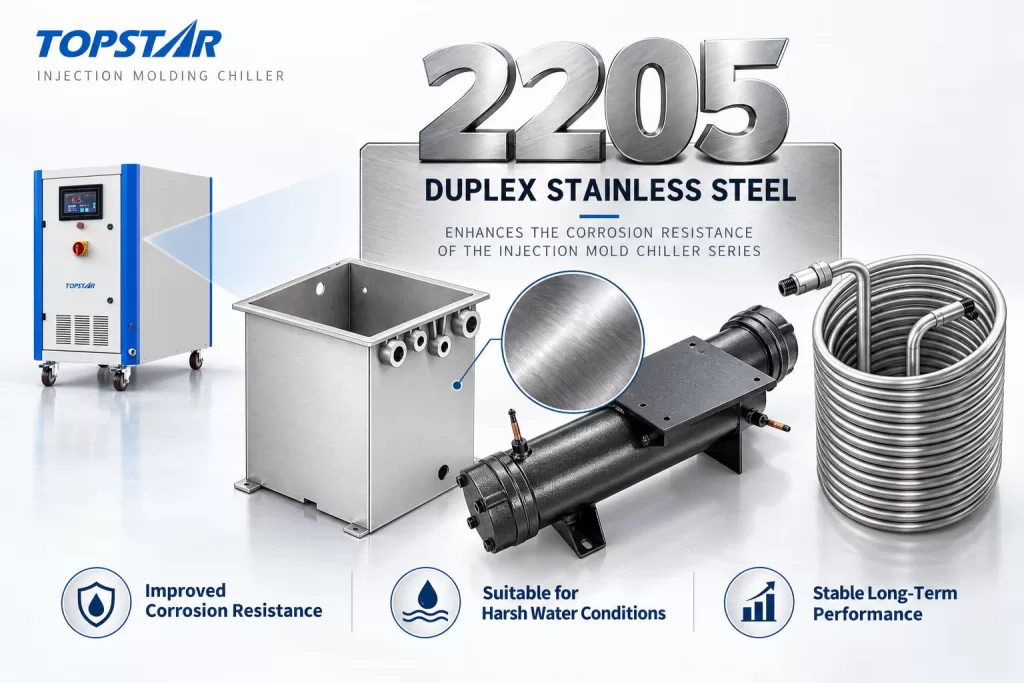
2205 duplex stainless steel enhances the corrosion resistance of the injection mold chiller series
Material selection is another key factor in extending the service life of injection molding chillers. In specific coil designs, Topstar uses duplex stainless steel 2205 instead of traditional 304 or 316 stainless steel to enhance the equipment’s corrosion resistance.
Duplex stainless steel 2205 combines an austenitic and ferritic microstructure and contains alloying elements such as chromium, molybdenum, and nitrogen. These elements help improve the material’s resistance to pitting corrosion, crevice corrosion, and chloride-induced stress corrosion cracking. (According to Alleima’s technical data sheet for SAF 2205, this grade offers better overall corrosion resistance than 316L in most environments.) Compared to traditional 304L and 316L, it demonstrates significant advantages in resisting chloride-induced stress corrosion cracking.
In Topstar’s injection molding chiller series, 2205 (duplex stainless steel) offers greater resistance to specific corrosion mechanisms, helping protect the coils and prevent premature material degradation.
How Do Topstar’s Injection Molding Chiller Series Enhance Corrosion Resistance in Water Tanks and Condensers?
Corrosion protection must extend beyond the refrigeration coils. The water circuit also affects equipment reliability because circulating water, dissolved minerals, and potential deposits constantly expose water tanks and heat exchangers to corrosive conditions. Topstar addresses these challenges through optimized material selection for small-capacity water tanks and durable heat exchanger design for water-cooled models. The optimal solution depends on the components’ operating environment: the water tank material must be compatible with expected water quality. At the same time, the condenser must withstand the cooling-water environment and allow easy inspection and cleaning.
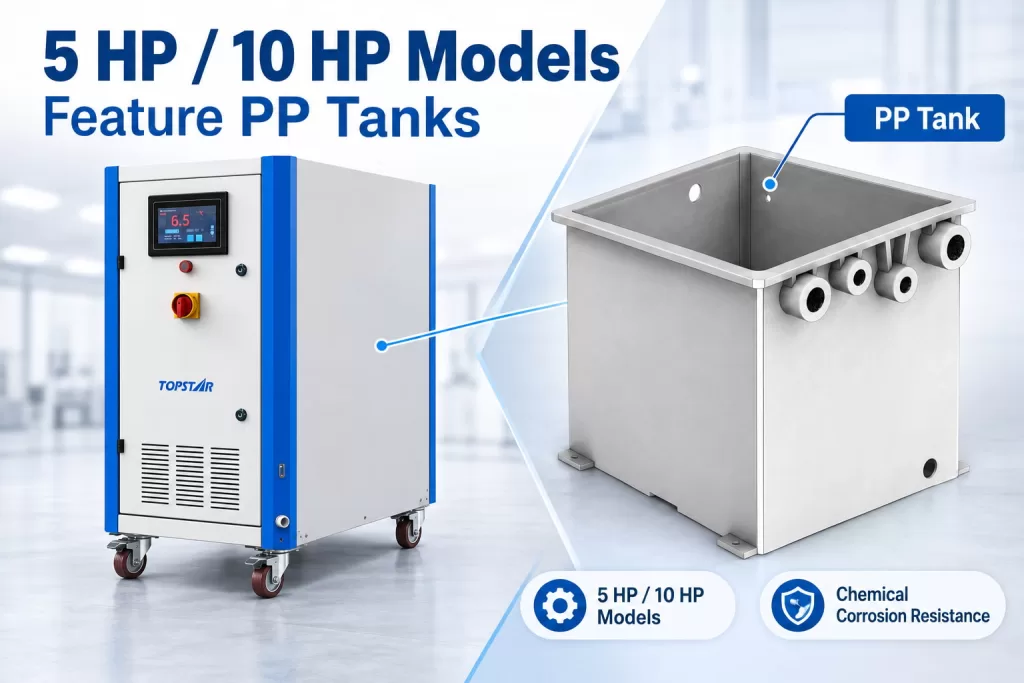
5 HP and 10 HP Models Feature PP Tanks
In select 5 HP and 10 HP injection molding chiller models, Topstar uses thickened, eco-friendly PP tanks instead of traditional stainless steel tanks.
Although stainless steel tanks are inherently durable, their performance still depends on the water’s chemical properties, manufacturing quality, and weld integrity. If manufacturing defects, localized corrosion, or operational stress are present, the structural integrity of the welded areas may be compromised, creating a weak point.
PP tanks eliminate metal corrosion in the tank body and remove the risk of leaks caused by corrosion or stainless-steel weld failure. The reinforced structural design provides a water-storage solution that doesn’t rely on welded stainless steel tanks. For small chillers, this reduces corrosion-related maintenance and simplifies the tank structure.
Shell-and-Tube Condensers Enable Long-Term, Stable Operation of Water-Cooled Chillers
Topstar’s water-cooled chillers use shell-and-tube condensers, which offer a robust design, efficient heat dissipation, and easy maintenance. The heat transfer surface keeps the refrigerant circuit separate from the cooling water circuit while allowing heat to flow from the refrigerant into the external cooling water.
Shell-and-tube condensers are widely used in industrial chillers; their tube-bundle structure offers excellent heat transfer performance and facilitates maintenance. If sediment accumulates in the water-side channels, technicians can inspect and clean the tube bundle to restore heat-transfer efficiency. Topstar’s shell-and-tube design supports long-term operation and handles fluctuations in cooling water conditions better than designs that require frequent maintenance.
Corrosion-Resistant Chillers for Various Production Environments
The corrosion-resistant technology employed in Topstar’s injection molding chiller series effectively addresses a variety of potential risks.
By connecting the coils with nuts, reliance on vulnerable welded joints is reduced; the use of 2205 duplex stainless steel enhances resistance to localized corrosion and chloride-induced corrosion; the use of PP water tanks eliminates the risk of metal corrosion in specific components; and the use of shell-and-tube condensers ensures that the equipment’s heat dissipation system is both durable and easy to maintain.
These design advantages reduce performance degradation and corrosion-related leakage risks, simplify maintenance, and provide more reliable cooling for injection molding production.
TRENDING POSTS
- TOPS DAY 2026: Turning Industrial AI into Real-World Impact 2026/10/23
- Breaking Through the Full Scene-to-AI Link! Topstar Industrial Data Collection Matrix Achieves Major Technical Breakthro 2026/10/23
- TOPSTAR Selected in “Forbes China AI Top 50” and Wins “2026 Embodied AI Industry Benchmark Award” 2026/10/23
- Topstar Achieves ISO 13849 Functional Safety Certification for Robotics 2026/10/23
HOT TOPIC
- .ervo motor-driven linear robots
- •
- 1.0 guangdong topstar technology co. ltd
- 1.0 topstar china
- 1.0 topstar robot
- 11
- 160℃ mold temperature controller
- 170 ton injection molding machine
- 2
- 21
- 220-ton injection molding machine
- 23
- 260 ton injection molding machine
- 3 axis robot
- 3 axis robots
- 3 in 1 Compact Dehumidifying Dryer
- 3-axis robot
- 3-axis robots
- 39
- 4 axis robot
- 4-axis SCARA robot
- 41
- 460T injection molding machine
- 5-axis CNC machine
- 62
- 90 ton injection molding machine
- accuracy
- Air Chillers
- air-cooled chillers
- all electric injection molding machine
- all electric injection molding machines
- all-electric injection molding machine
- All-electric injection molding machines
- and overall production quality. Therefore
- AP-RubberPlas
- auto cooling system
- auto loader
- Auto Loaders
- automated injection molding machine
- Automation changed engineering
- automation of injection molding robots
- automotive parts injection molding
- Auxiliary Equipment
- auxiliary machine
- Bench Injection Molding Machine
- cabinet dryer
- Cabinet dryer manufacturers
- Cabinet dryers
- cartesian coordinate robot
- Cartesian Coordinate Robots
- Cartesian injection robot
- Cartesian robot
- Central Feeding System
- Central Feeding Systems
- chiller
- CNC Drilling Machine
- CNC Drilling Machines
- cnc engraving machine manufacturer
- cnc laser cutting machine manufacturer
- CNC machine
- CNC Machine Center
- CNC Machine for Sale
- CNC Machine Manufacturing
- CNC Machine Tool
- CNC machine tool product
- CNC Machining Center
- CNC wood carving machine
- Compact Dehumidifying Dryer
- Cooling system
- Cross-Walking Single Axis Servo Cylinder Robot
- Cross-Walking Single-Axis Servo Cylinder Robot
- Cross-Walking Three-Axis/Five-Axis Servo Driven Robot
- cross-walking three-axis/five-axis servo-driven robot
- Dehumidifier Dryer
- Dehumidifying Dryer
- dehumidifying dryers
- delta parallel robot
- Desktop Injection Molding Machine
- Desktop injection molding machines
- Desktop Molding Machine
- desktop plastic injection machine
- Desktop Plastic Injection Molding Machine
- detachable autoloader
- Digital Transformation
- direct clamp injection molding machine
- Direct clamp injection molding machines
- Dosing & mixing system
- Drilling Centers
- Drying and dehumidification system
- drying and dehumidifying equipment
- Drying and Dehumidifying System
- drying system
- effective and efficient. Cabinet dryers are also used in other industries where large quantities of material need to be dried
- efficient injection molding machine
- elbow hydraulic injection molding machines
- electric injection molding machine
- electric injection molding machines
- energy-efficient injection molding robot
- energy-efficient water chiller
- energy-efficient water chillers
- energy-saving injection molding machine
- etc. Among injection molding robots
- exhibition
- features of CNC machine
- Feeding And Conveying System
- Five Axis Machine Center
- Flexible Production Line
- Fully automatic injection molding machine
- Gathering Topstar
- giant injection molding machine
- GMU-600 5-Axis Machining Center
- Granulating & Recycling System
- granulator machine
- gravimetric blender
- Heavy duty injection molding machine
- Heavy-Duty Take-Out Robot
- High-precision electric molding machines
- high-precision plastic molding machines
- high-speed all electric injection molding machine
- high-speed electric injection molding machine
- High-Speed Packaging Injection Molding
- Honeycomb rotor dehumidifier
- hopper dryer
- Hopper Dryers
- horizontal injection molding machine
- Horizontal Injection Molding Machines
- Horizontal Injection Moulding Machine
- Horizontal Mixer manufacturer
- How The CNC Machine Works
- hybrid injection molding machine
- hydraulic injection molding machine
- Hydraulic Injection Molding Machines
- in this article
- Industrial AI
- Industrial Automation
- Industrial robot
- Industrial Robot Chinese brand
- industrial robot parts
- industrial robot supplier
- Industrial robots
- Industry Chain
- Injection Manipulator
- injection manipulator robot
- injection mold machines
- Injection molding
- Injection molding automation
- Injection Molding Automation Solution
- injection molding dryer
- Injection molding equipment
- injection molding hopper dryer
- Injection molding machine
- injection molding machine brand
- Injection Molding Machine Factory
- Injection Molding Machine Manufacture
- Injection molding machine manufacturer
- injection molding machine manufacturers
- Injection molding machine procurement
- injection molding machine robotic arm
- injection molding machine with a robot
- Injection molding machines
- injection molding material dehumidifying
- injection molding plant
- injection molding process
- Injection Molding Robot
- injection molding robot arm
- Injection molding robot automation
- Injection molding robotic arm
- injection molding robots
- injection molding whole plant
- injection moulding dryer
- Injection moulding machine
- injection moulding machines
- Injection Moulding Robots
- Injection Robot
- Injection robot arm
- Injection robot manufacturer
- Injection robot wholesale
- injection robots
- Intelligent Factory
- intelligent injection molding machines
- Intelligent Manufacturing
- intelligent mold temperature
- intelligent mold temperature controller
- Intelligent mould temperature controller
- intelligent whole plant solution
- InterPlas Thailand 2025
- Introducing Injection Robot
- It is the best choice for drying large quantities of material at once. Cabinetmakers use these machines because they are fast
- Large flow water type mold temperature controller
- large injection molding machine
- large injection molding machines
- Learn what industrial automation and robotics is
- linear robot
- linear robots
- low speed sound-proof granulator
- machine plastic molding
- make sure to add some! Improvements (2) Keyphrase in introduction: Your keyphrase or its synonyms appear in the first paragraph of the copy
- manipulator machine
- manufacturing
- Manufacturing Innovation
- medical grade injection molding machines
- Medical Injection Molding
- medical injection molding machine
- medical injection molding machines
- micro injection molding machine
- middle speed granulator
- Mini CNC machine manufacturers.
- mobile cover making machine
- Mold Temperature Control System
- mold temperature controller
- mold temperature controllers
- molding machine
- molding material Dehumidifying System
- mould temperature control system
- mould temperature controller
- mould temperature controller
- mould temperature controllers
- New electric injection molding machine
- Nitrogen Dryer
- nitrogen dryer manufacturer
- nitrogen dryer system manufacturer
- Oil type mold temperature controller
- Oil type mold temperature controllers
- open day
- optical component injection molding
- Optical-grade dehumidifying dryer
- Outbound links: No outbound links appear in this page. Add some! Images: No images appear on this page. Add some! Internal links: No internal links appear in this page
- packaging injection molding
- Packaging Solutions
- PET Preform injection molding
- phone case maker machine
- phone case making machine
- phone cover making machine
- PID Control Mold Temperature Controller
- plastic auto loader
- plastic bottle making machine
- plastic bottle manufacturing
- plastic bucket making machine
- plastic bucket manufacturing
- Plastic chair making machine
- plastic dryer for injection molding
- plastic forming equipment
- Plastic Granulator
- Plastic Granulators
- plastic hopper dryer
- plastic injection machine
- plastic injection machines
- plastic injection molding
- Plastic injection molding equipment
- Plastic injection molding machine
- Plastic Injection Molding Machines
- plastic injection moulding machine
- plastic injection moulding machines
- plastic injection robot
- plastic molding
- Plastic Molding Industry
- Plastic Molding machine
- plastic molding machine 1
- Plastic Molding Machines
- plastic molding press
- plastic moulding machine
- plastic phone case making machine
- plastic-molding machine
- powerful granulator
- Powerful Type Sound-Proof Granulator
- precision injection molding
- precision injection molding machines
- production of plastic seats
- pure water mould temperature controller
- Robot injection molding
- robot injection molding machine
- robot manufacturing companies
- Robotic arm for injection molding machine
- robotic injection molding machines
- robotics in injection molding
- SCARA robot
- SCARA robots
- Screw dosers
- Service-oriented manufacturing
- Servo Cylinder Robot
- servo driven robot
- Servo Driven Robots
- servo injection molding machine
- servo injection robots
- servo motor-driven linear robots
- servo-driven 3-axis robot
- Servo-driven injection molding machine
- Servo-Driven Robot
- Setup of injection machine
- Silicone Injection Molding Machine
- six-axis industrial robot
- Smart Manufacturing
- soundproof granulator
- Sprue Picker
- Stainless Hopper Dryer
- Stainless Hopper Dryers
- star club
- swing arm robot
- T1 Cartesian injection robot
- take-out robot
- take-out robots
- Thailand 4.0
- the choice between servo-driven robots and hydraulic robots will have a certain impact on efficiency
- the most popular injection molding machine
- the type of injection molding robot
- TIC2000 Control System
- TMII injection molding machine
- toggle clamp injection molding machine
- Toggle Hydraulic Injection Molding Machines
- toggle injection molding machine
- Top 10 brands of injection robots
- Topstar
- Topstar Electric Injection Molding Machine InterPlas Thailand 2025 Smart Manufacturing Thailand 4.0
- Topstar Engineering
- Topstar Industrial Robots
- Topstar injection molding intelligent
- Topstar Scara Robots
- Useful Injection molding machine
- Vertical machining centers
- volumetric type blender
- Washing Machine Case Molding Solution
- water chiller
- water chillers
- water distributor
- water type mold temperature controller
- Water Type MoldTemperature Controller
- Water-Cooled Chillers
- Water-cooled Mold Temperature Controller
- water-type mold temperature controller
- Water-Type Mould Temperature Controllers
- We often face choices when performing injection molding. We will choose the type of injection molding machine
- wholesale of injection molding machines
- x carve CNC
- 热门查询 点击次数 展示 排名 topstar