
Which dehumidifying dryers are suitable for specific industries?
2026/04/17 By le zhan

Industries such as optics, automotive lighting, high-end photosensitive components, and those that use oil-containing raw materials each have distinct requirements for drying and dehumidification systems. To address these diverse needs, we offer a range of specialized dehumidifying dryers tailored specifically for these sectors, including the TCDH-S, TDN, TCDH, and TCDE series. Unlike our standard product lines, these specialized units are engineered to meet the unique production conditions and operational demands inherent to these industries.
Dehumidifying Dryers for High-End Optical Manufacturing
The production of optical products imposes extremely rigorous demands on drying systems. Products such as lenses, LED chips, and light guide plates are highly sensitive to dust, air bubbles, and impurities. Standard dehumidifying dryers are often insufficient to meet the exacting requirements of the optical industry.
Topstar’s TCDH-S series is designed specifically for optical applications and can achieve optical-grade levels of cleanliness.
- ISO 14644-1 Class 6 Certification: Compliant with the optical industry’s ISO 14644-1 Class 6 cleanroom standard, effectively minimizing surface defects, air bubbles, and impurities.
- 0.3μm High-Efficiency Filter: Compliant with the EU EN1822 standard, effectively capturing 99.97% of suspended particulates; this meets the high-end manufacturing requirements for lenses, LED beads, light guide plates, and similar optical components.
In the optical industry, a dehumidifying dryer equipped with this certification and a 0.3 μm high-efficiency filter ensures the absolute cleanliness of the material flow throughout the entire drying and conveying process.
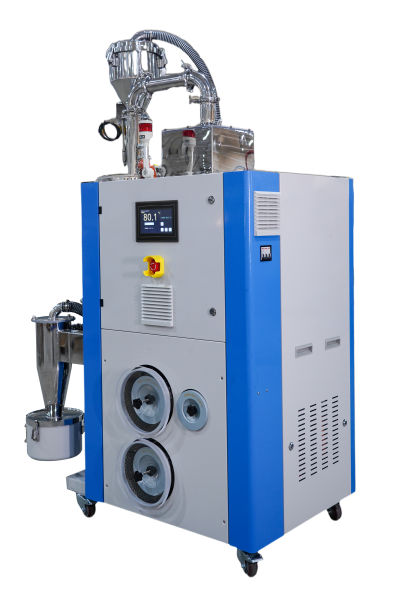
Optical-Grade Construction: Minimizing Dust and Contamination
In addition to meeting ISO 14644-1 Class 6 certification, the TCDH-S series incorporates a suite of optical-grade components. These include:
- Wear-Resistant, Optical-Grade PU Conveying Hoses: Minimizing dust generation caused by abrasion.
- Dust-Removing Material Hoppers: Reducing the risk of dust-related anomalies.
- Short-Circuit Air-Cut Conveying System: Preventing dust generation caused by frictional contact during material transport.
- Optical-Grade Storage Bins: Minimizing contamination of stored materials.
- Sealed Air Ducts: Preventing the ingress of external dust.
- Honeycomb Rotor Dehumidification: Achieving a dew point as low as -40°C.
The manufacturing of optical products typically entails exceptionally high quality standards. Component rejection is often not the result of an incorrect resin choice, but rather stems from contamination introduced during the drying and conveying stages of the production process. By implementing more precise control of the material-conveying path, the TCDH-S series dehumidifying dryers ensure consistency and stability throughout the process, from drying to molding. Furthermore, the honeycomb rotor, capable of achieving a dew point of -40°C, creates a more stable drying environment, thereby enhancing process stability and yielding higher-quality optical products.
Nitrogen Dryers for High-End Photosensitive Optical Component Manufacturing
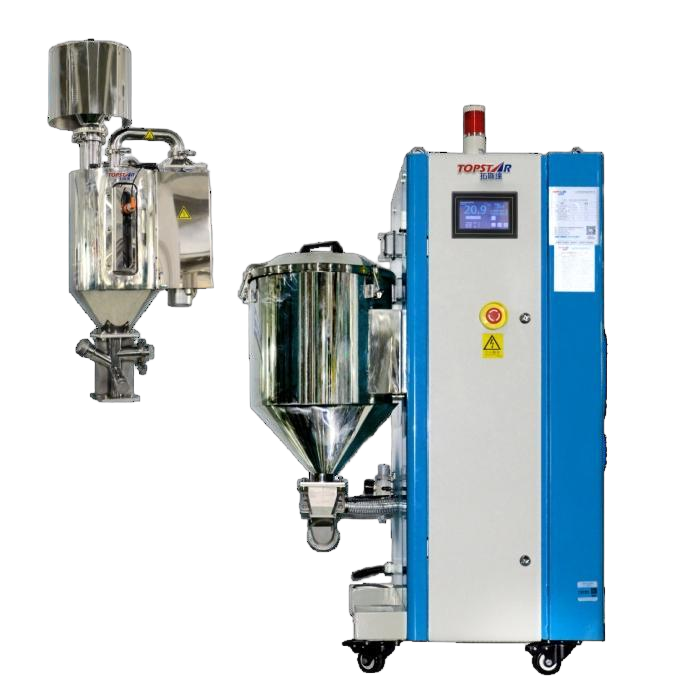
Topstar designs its TDN series nitrogen dehumidifying dryers specifically for high-end photosensitive optical components. The manufacturing requirements for premium photosensitive optics, such as lenses, extend beyond mere drying; they also demand protection against oxidation and yellowing during the molding process. While standard dehumidifying dryers can effectively remove moisture, they may not be sufficient to mitigate oxidation risk. Consequently, for our optical-grade “three-in-one” dehumidifying dryers, we have integrated specialized anti-oxidation and anti-yellowing capabilities, making them ideally suited for high-end optical molding processes.
Utilizing Nitrogen Preparation and Conveying to Minimize Yellowing
The TDN series features an imported, original-equipment nitrogen generator capable of supplying high-purity nitrogen (> 98%) to blanket the raw materials. This minimizes yellowing during the molding process and increases yield. When nitrogen is introduced into the screw barrel, it reduces the carbonization time of the screw and minimizes carbon buildup. Additionally, the TDN series dryers feature a closed-loop nitrogen-conveying system, further enhancing process stability. The system is also supplemented with -40°C dew-point gas generated via an imported compressed-air dehumidifying membrane. These combined features make the system exceptionally well-suited for the high-end optical industry, where both precise humidity control and protection against oxidation are critical requirements.
Dehumidifying Dryers for Automotive Lighting and Energy-Efficient Production
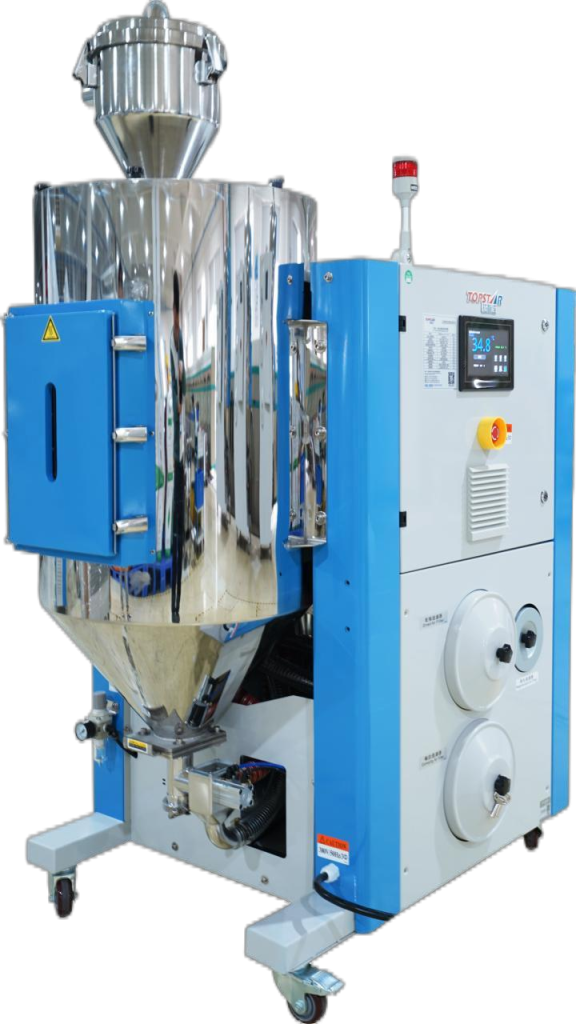
The materials used in automotive lighting fixtures, lamp housings, and related components typically require stable humidity control and a highly clean processing environment. The TCDH series is specifically designed for automotive lighting applications, making it the ideal dehumidifying dryer solution for this industry sector.
Meeting Cleanliness Requirements:
In the TCDH series dehumidifying dryers, the drying hopper, material bin, and internal and external conveying pipelines undergo meticulous polishing to prevent contamination of raw materials. The air intake, supplementary air supply, and air delivery systems all utilize multi-stage 0.5 μm filtration to ensure clean airflow throughout the entire process. Furthermore, the incorporation of a specialized, sealed material inlet minimizes dust ingress, thereby increasing production yields.
Achieving Precise Dehumidification:
It employs a seamless honeycomb design that minimizes dew-point fluctuations and enhances dehumidification efficiency. The honeycomb rotor, along with its top and bottom covers, uses cast-iron dividers to split into three distinct zones, providing excellent thermal insulation. Furthermore, an offset inlet and outlet design for the cooling water circuit further boosts dehumidification efficiency.
High Efficiency and Energy Savings:
The TCDH series dryers feature an optional heat recovery system that captures and recycles waste heat, reducing heat emissions in the workshop environment and achieving approximately 25% energy savings. Additionally, the units incorporate a variable-frequency energy-saving function; this feature automatically adjusts airflow volume and temperature based on material usage rates, further reducing energy consumption by roughly 25% and delivering highly efficient performance.
Dehumidifying Dryers Optimized for Processing Oil-Containing Raw Materials
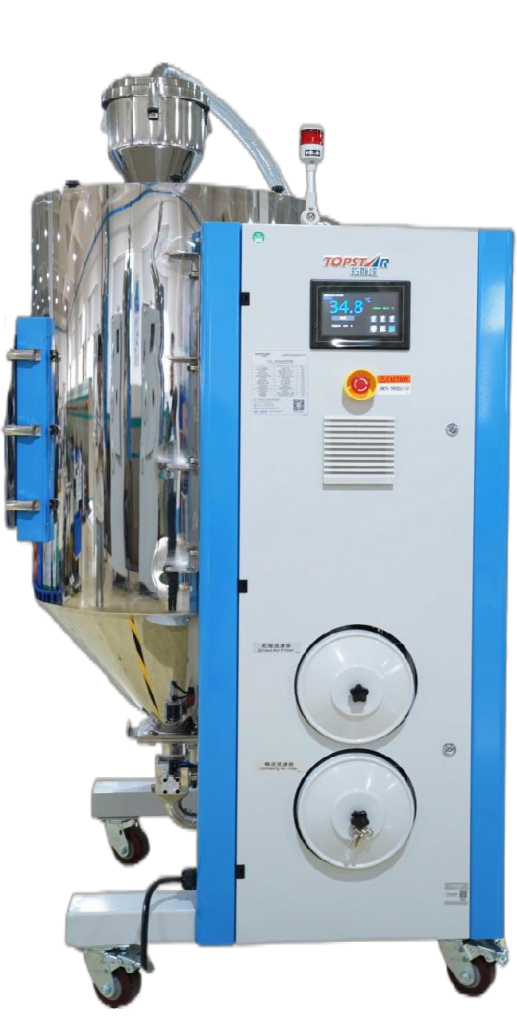
The TCDE series dehumidifying dryers utilize larger and more numerous desiccant towers, enabling the regeneration air dew point to reach as low as -57°C, while the drying air delivered to the raw materials can reach a dew point of up to -38°C. This ensures the equipment remains free from molecular contamination and facilitates the long-term, deep drying of oil-containing raw materials. Traditional plastic dryers often struggle to maintain clean operation once oil enters the process stream; oil can disrupt airflow and compromise drying stability. The TCDE series dryers, however, are systematically engineered with inherent oil resistance from the ground up, thereby effectively mitigating these risks.
Protection, Filtration, and Clean Operation in the TCDE dehumidifying dryers Series
The fans in the TCDE series feature standard oil drain ports that actively purge accumulated oil, preventing blockages and potential damage. The units also feature a built-in high-efficiency oil filter that removes oil contaminants from the drying air, ensuring sustained, long-term clean operation. This capability helps the dryer maintain optimal performance and minimizes the risk of contamination spreading to downstream processing stages. Furthermore, the inclusion of a dedicated oil discharge port reduces both the frequency of cleaning requirements and the complexity of maintenance procedures. When raw materials or the surrounding process environment contain oil contaminants conditions that would typically compromise the efficiency of standard drying systems the TCDE series dehumidifying dryer stands as the ideal solution. In such scenarios, it successfully accomplishes the dual objectives of deep dehumidification and maintaining its internal cleanliness throughout extended periods of operation.
Matching Industry Needs with the Right Dehumidifying Dryer
| Industry/Application | Recommended Model | Key Features | Core Benefits |
|---|---|---|---|
| Optical Components | TCDH-S Series | ISO 14644-1 Class 6, 0.3μm filtration, sealed system | Ultra-clean drying, defect reduction |
| High-End Optical (Anti-Ox) | TDN Nitrogen Dehumidifying Dryer | >98% nitrogen purity, closed-loop system, anti-yellowing | Prevent oxidation, improve product quality |
| Automotive Lighting | TCDH Series | Multi-stage filtration, polished pipelines, sealed feeding | High cleanliness, stable performance |
| Oily Plastic Materials | TCDE Series | Oil-resistant design, -57℃ dew point, oil filtration | Long-term stable drying, reduced maintenance |
| General Manufacturing | 3-in-1 Compact Dehumidifying Dryer | Integrated drying + conveying + dehumidifying | Space-saving, energy-efficient |
Industry-Specific Dryers for Specialized Requirements
Topstar’s specialized dehumidifying dryers feature bespoke structural designs and specific characteristics tailored to meet the unique demands of various industrial sectors. The TCDH-S series achieves optical-grade cleanliness; the TDN series utilizes nitrogen purging to protect light-sensitive optical components; the TCDH series balances the cleanliness and energy efficiency requirements of automotive lighting; while the TCDE series, distinguished by its exceptional durability and long-term stability, effectively processes oil-containing raw materials.
TRENDING POSTS
- TOPS DAY 2026: Turning Industrial AI into Real-World Impact 2026/04/17
- Breaking Through the Full Scene-to-AI Link! Topstar Industrial Data Collection Matrix Achieves Major Technical Breakthro 2026/04/17
- TOPSTAR Selected in “Forbes China AI Top 50” and Wins “2026 Embodied AI Industry Benchmark Award” 2026/04/17
- Topstar Achieves ISO 13849 Functional Safety Certification for Robotics 2026/04/17
HOT TOPIC
- .ervo motor-driven linear robots
- •
- 1.0 guangdong topstar technology co. ltd
- 1.0 topstar china
- 1.0 topstar robot
- 11
- 160℃ mold temperature controller
- 170 ton injection molding machine
- 2
- 21
- 220-ton injection molding machine
- 23
- 260 ton injection molding machine
- 3 axis robot
- 3 axis robots
- 3 in 1 Compact Dehumidifying Dryer
- 3-axis robot
- 3-axis robots
- 39
- 4 axis robot
- 4-axis SCARA robot
- 41
- 460T injection molding machine
- 5-axis CNC machine
- 62
- 90 ton injection molding machine
- accuracy
- Air Chillers
- air-cooled chillers
- all electric injection molding machine
- all electric injection molding machines
- all-electric injection molding machine
- All-electric injection molding machines
- and overall production quality. Therefore
- AP-RubberPlas
- auto cooling system
- auto loader
- Auto Loaders
- automated injection molding machine
- Automation changed engineering
- automation of injection molding robots
- automotive parts injection molding
- Auxiliary Equipment
- auxiliary machine
- Bench Injection Molding Machine
- cabinet dryer
- Cabinet dryer manufacturers
- Cabinet dryers
- cartesian coordinate robot
- Cartesian Coordinate Robots
- Cartesian injection robot
- Cartesian robot
- Central Feeding System
- Central Feeding Systems
- chiller
- CNC Drilling Machine
- CNC Drilling Machines
- cnc engraving machine manufacturer
- cnc laser cutting machine manufacturer
- CNC machine
- CNC Machine Center
- CNC Machine for Sale
- CNC Machine Manufacturing
- CNC Machine Tool
- CNC machine tool product
- CNC Machining Center
- CNC wood carving machine
- Compact Dehumidifying Dryer
- Cooling system
- Cross-Walking Single Axis Servo Cylinder Robot
- Cross-Walking Single-Axis Servo Cylinder Robot
- Cross-Walking Three-Axis/Five-Axis Servo Driven Robot
- cross-walking three-axis/five-axis servo-driven robot
- Dehumidifier Dryer
- Dehumidifying Dryer
- dehumidifying dryers
- delta parallel robot
- Desktop Injection Molding Machine
- Desktop injection molding machines
- Desktop Molding Machine
- desktop plastic injection machine
- Desktop Plastic Injection Molding Machine
- detachable autoloader
- Digital Transformation
- direct clamp injection molding machine
- Direct clamp injection molding machines
- Dosing & mixing system
- Drilling Centers
- Drying and dehumidification system
- drying and dehumidifying equipment
- Drying and Dehumidifying System
- drying system
- effective and efficient. Cabinet dryers are also used in other industries where large quantities of material need to be dried
- efficient injection molding machine
- elbow hydraulic injection molding machines
- electric injection molding machine
- electric injection molding machines
- energy-efficient injection molding robot
- energy-efficient water chiller
- energy-efficient water chillers
- energy-saving injection molding machine
- etc. Among injection molding robots
- exhibition
- features of CNC machine
- Feeding And Conveying System
- Five Axis Machine Center
- Flexible Production Line
- Fully automatic injection molding machine
- Gathering Topstar
- giant injection molding machine
- GMU-600 5-Axis Machining Center
- Granulating & Recycling System
- granulator machine
- gravimetric blender
- Heavy duty injection molding machine
- Heavy-Duty Take-Out Robot
- High-precision electric molding machines
- high-precision plastic molding machines
- high-speed all electric injection molding machine
- high-speed electric injection molding machine
- High-Speed Packaging Injection Molding
- Honeycomb rotor dehumidifier
- hopper dryer
- Hopper Dryers
- horizontal injection molding machine
- Horizontal Injection Molding Machines
- Horizontal Injection Moulding Machine
- Horizontal Mixer manufacturer
- How The CNC Machine Works
- hybrid injection molding machine
- hydraulic injection molding machine
- Hydraulic Injection Molding Machines
- in this article
- Industrial AI
- Industrial Automation
- Industrial robot
- Industrial Robot Chinese brand
- industrial robot parts
- industrial robot supplier
- Industrial robots
- Industry Chain
- Injection Manipulator
- injection manipulator robot
- injection mold machines
- Injection molding
- Injection molding automation
- Injection Molding Automation Solution
- injection molding dryer
- Injection molding equipment
- injection molding hopper dryer
- Injection molding machine
- injection molding machine brand
- Injection Molding Machine Factory
- Injection Molding Machine Manufacture
- Injection molding machine manufacturer
- injection molding machine manufacturers
- Injection molding machine procurement
- injection molding machine robotic arm
- injection molding machine with a robot
- Injection molding machines
- injection molding material dehumidifying
- injection molding plant
- injection molding process
- Injection Molding Robot
- injection molding robot arm
- Injection molding robot automation
- Injection molding robotic arm
- injection molding robots
- injection molding whole plant
- injection moulding dryer
- Injection moulding machine
- injection moulding machines
- Injection Moulding Robots
- Injection Robot
- Injection robot arm
- Injection robot manufacturer
- Injection robot wholesale
- injection robots
- Intelligent Factory
- intelligent injection molding machines
- Intelligent Manufacturing
- intelligent mold temperature
- intelligent mold temperature controller
- Intelligent mould temperature controller
- intelligent whole plant solution
- InterPlas Thailand 2025
- Introducing Injection Robot
- It is the best choice for drying large quantities of material at once. Cabinetmakers use these machines because they are fast
- Large flow water type mold temperature controller
- large injection molding machine
- large injection molding machines
- Learn what industrial automation and robotics is
- linear robot
- linear robots
- low speed sound-proof granulator
- machine plastic molding
- make sure to add some! Improvements (2) Keyphrase in introduction: Your keyphrase or its synonyms appear in the first paragraph of the copy
- manipulator machine
- manufacturing
- Manufacturing Innovation
- medical grade injection molding machines
- Medical Injection Molding
- medical injection molding machine
- medical injection molding machines
- micro injection molding machine
- middle speed granulator
- Mini CNC machine manufacturers.
- mobile cover making machine
- Mold Temperature Control System
- mold temperature controller
- mold temperature controllers
- molding machine
- molding material Dehumidifying System
- mould temperature control system
- mould temperature controller
- mould temperature controller
- mould temperature controllers
- New electric injection molding machine
- Nitrogen Dryer
- nitrogen dryer manufacturer
- nitrogen dryer system manufacturer
- Oil type mold temperature controller
- Oil type mold temperature controllers
- open day
- optical component injection molding
- Optical-grade dehumidifying dryer
- Outbound links: No outbound links appear in this page. Add some! Images: No images appear on this page. Add some! Internal links: No internal links appear in this page
- packaging injection molding
- Packaging Solutions
- PET Preform injection molding
- phone case maker machine
- phone case making machine
- phone cover making machine
- PID Control Mold Temperature Controller
- plastic auto loader
- plastic bottle making machine
- plastic bottle manufacturing
- plastic bucket making machine
- plastic bucket manufacturing
- Plastic chair making machine
- plastic dryer for injection molding
- plastic forming equipment
- Plastic Granulator
- Plastic Granulators
- plastic hopper dryer
- plastic injection machine
- plastic injection machines
- plastic injection molding
- Plastic injection molding equipment
- Plastic injection molding machine
- Plastic Injection Molding Machines
- plastic injection moulding machine
- plastic injection moulding machines
- plastic injection robot
- plastic molding
- Plastic Molding Industry
- Plastic Molding machine
- plastic molding machine 1
- Plastic Molding Machines
- plastic molding press
- plastic moulding machine
- plastic phone case making machine
- plastic-molding machine
- powerful granulator
- Powerful Type Sound-Proof Granulator
- precision injection molding
- precision injection molding machines
- production of plastic seats
- pure water mould temperature controller
- Robot injection molding
- robot injection molding machine
- robot manufacturing companies
- Robotic arm for injection molding machine
- robotic injection molding machines
- robotics in injection molding
- SCARA robot
- SCARA robots
- Screw dosers
- Service-oriented manufacturing
- Servo Cylinder Robot
- servo driven robot
- Servo Driven Robots
- servo injection molding machine
- servo injection robots
- servo motor-driven linear robots
- servo-driven 3-axis robot
- Servo-driven injection molding machine
- Servo-Driven Robot
- Setup of injection machine
- Silicone Injection Molding Machine
- six-axis industrial robot
- Smart Manufacturing
- soundproof granulator
- Sprue Picker
- Stainless Hopper Dryer
- Stainless Hopper Dryers
- star club
- swing arm robot
- T1 Cartesian injection robot
- take-out robot
- take-out robots
- Thailand 4.0
- the choice between servo-driven robots and hydraulic robots will have a certain impact on efficiency
- the most popular injection molding machine
- the type of injection molding robot
- TIC2000 Control System
- TMII injection molding machine
- toggle clamp injection molding machine
- Toggle Hydraulic Injection Molding Machines
- toggle injection molding machine
- Top 10 brands of injection robots
- Topstar
- Topstar Electric Injection Molding Machine InterPlas Thailand 2025 Smart Manufacturing Thailand 4.0
- Topstar Engineering
- Topstar Industrial Robots
- Topstar injection molding intelligent
- Topstar Scara Robots
- Useful Injection molding machine
- Vertical machining centers
- volumetric type blender
- Washing Machine Case Molding Solution
- water chiller
- water chillers
- water distributor
- water type mold temperature controller
- Water Type MoldTemperature Controller
- Water-Cooled Chillers
- Water-cooled Mold Temperature Controller
- water-type mold temperature controller
- Water-Type Mould Temperature Controllers
- We often face choices when performing injection molding. We will choose the type of injection molding machine
- wholesale of injection molding machines
- x carve CNC
- 热门查询 点击次数 展示 排名 topstar