
Plastic Granulator Buying Guide: Compare Low Speed Sound-Proof vs Traditional High-Speed Granulators
2026/07/10 By le zhan
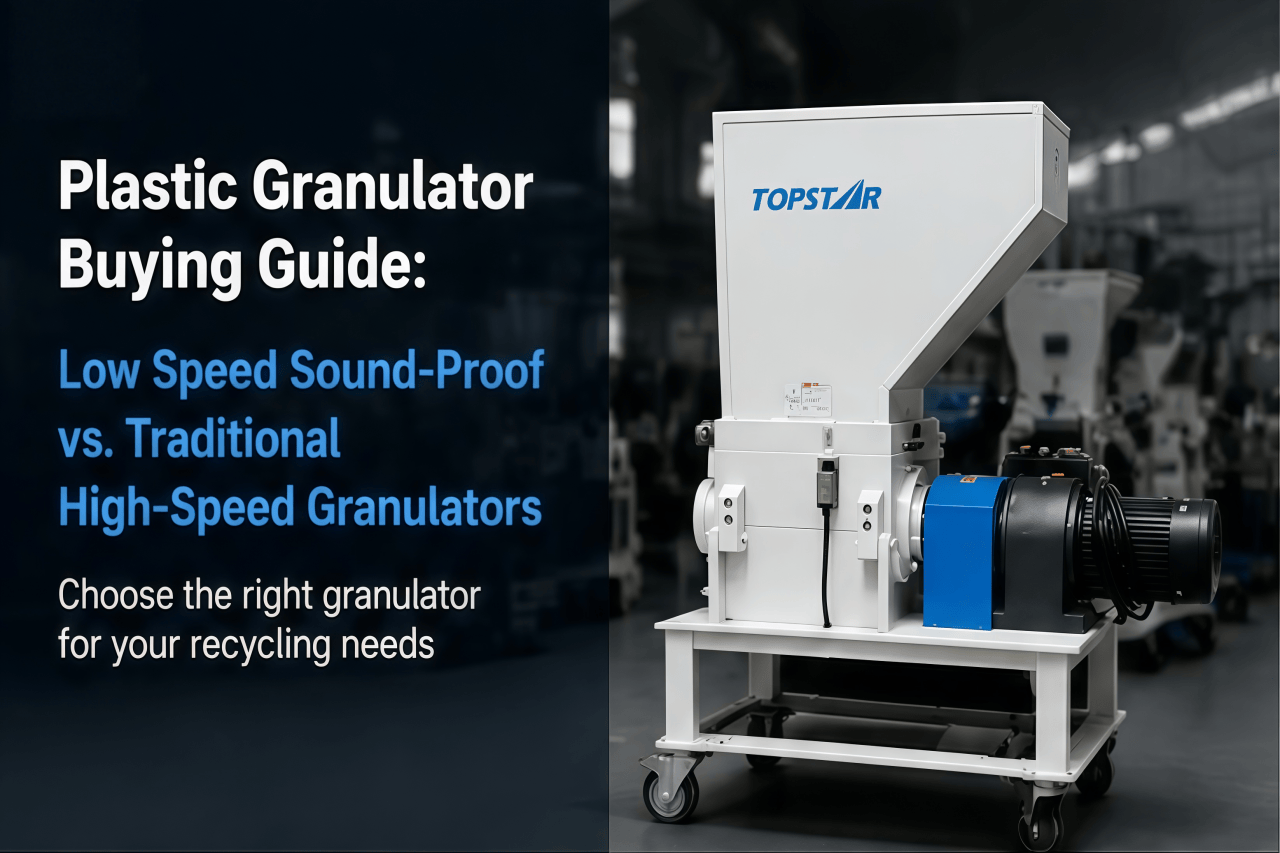
Plastic granulator converts waste materials—such as gate material, runner material, and defective products—into reusable raw materials. Shredders on the market are primarily divided into low-speed, low-noise models and high-speed models, each with its own set of advantages and disadvantages. So, how should you choose when purchasing one? By comparing the subtle differences in their design, performance, and maintenance requirements, we’ll help you understand these distinctions and make the right purchasing decision.
Traditional High-Speed Granulator: Characteristics and Challenges
Traditional high-speed granulators have long been the mainstay of the plastic recycling industry. Extremely high rotor speeds characterize these machines and rely on a cutting action to shred waste plastic. Although they offer high processing capacity and are relatively inexpensive, they also present a series of operational challenges.
Operational Characteristics of Traditional High-Speed Plastic Granulator
The primary operating principle of traditional high-speed granulators is as follows: a rotor equipped with multiple blades rotates at high speed and interacts with stationary blades. This mechanism generates shear and impact forces, rapidly reducing the size of the plastic material. The extremely high rotational speed yields a very high cutting frequency per minute, resulting in remarkable processing efficiency. They are commonly used in centralized recycling operations that require rapid processing of large volumes of mixed waste plastic.
However, this high processing capacity also comes with corresponding drawbacks:
- Noise Pollution:
The high-speed rotation of heavy-duty cutting blades, combined with the sound of plastic impacting the grinding chamber walls, results in severe noise issues. This often requires operators to wear hearing protection and can create an uncomfortable—or even hazardous—work environment. - Dust and Fine Particle Generation:
Vigorous, high-speed cutting actions generate large amounts of dust and fine particles. This not only makes the work environment dirty and cluttered but may also pose health risks; if the dust re-enters the molding process, it can lead to quality issues. - Heat Accumulation and Material Degradation:
High-speed friction and shear forces within the grinding chamber generate significant heat. This heat can cause thermal degradation of plastic materials, leading to changes in molecular structure, reduced mechanical properties, and discoloration. - Energy Consumption:
The power required to drive the rotor at high speeds and overcome material resistance can increase energy consumption per unit of material, thereby impacting operating costs.
Key Features of Low-Speed, Quiet Plastic Granulator
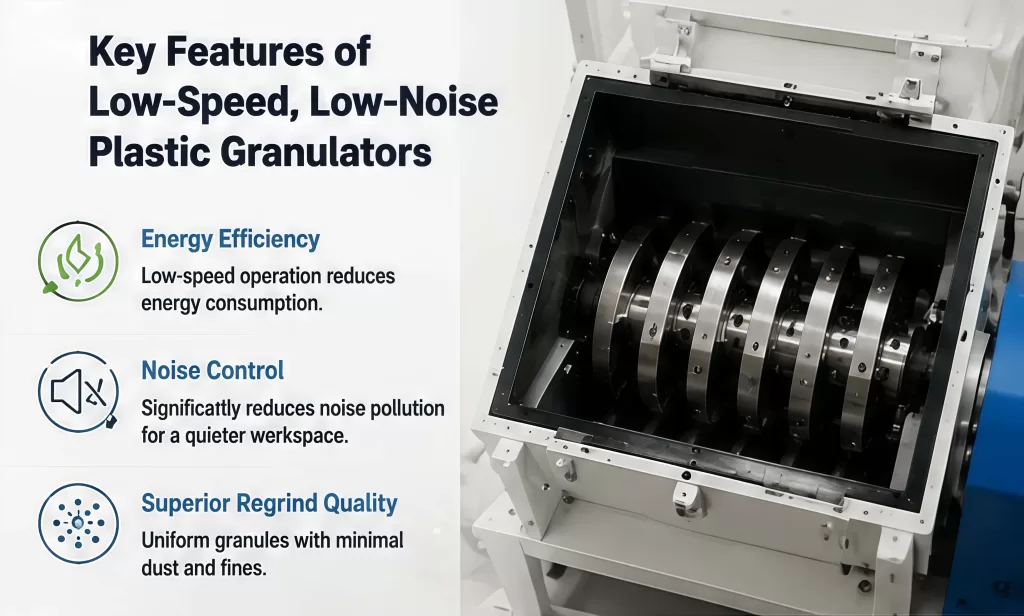
The primary feature of low speed sound-proof granulators is their operating speed, typically around 20 RPM This significantly reduced rotational speed fundamentally changes the cutting process, offering several benefits:
- Energy Savings and Reduced Consumption:
Thanks to low-speed operation, the energy consumption of these plastic granulators is significantly reduced. Their cutting action is more robust, emphasizing mechanical shearing rather than high-impact crushing. - Noise Control:
One of the most obvious advantages is the significant reduction in noise pollution. The low rotational speed minimizes pneumatic noise, blade impact noise, and bearing harmonic noise. T - Improved Recycled Material Quality:
The low-speed, high-torque cutting method produces pellets with a more uniform particle size, with minimal dust and fine debris.
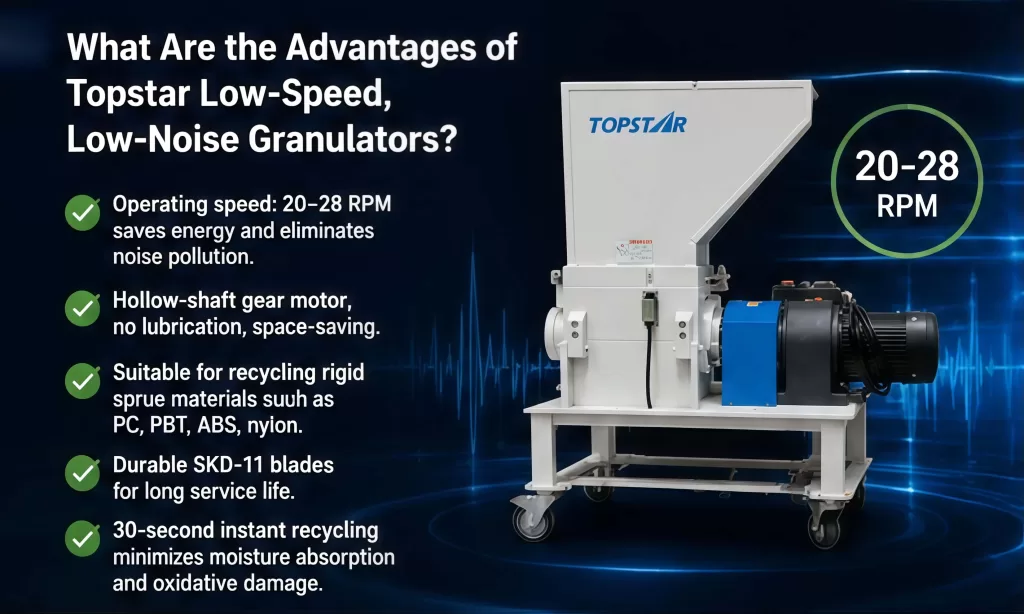
What are the advantages and features of Topstar’s low speed sound-proof granulator?
Topstar’s low speed sound-proof granulators operate at 20–28 revolutions per minute, which is both energy-efficient and reduces noise pollution. They are driven by a hollow-shaft gear motor that requires no lubrication and saves space. It is suitable for recycling hard gate materials such as PC, PBT, ABS, and nylon. The machine also utilizes high-quality SKD-11 blade material to ensure long-term durability and features a 30-second instant recycling function that minimizes wetting and oxidative damage to gate materials.
Durability of SKD-11 Blade Material
The Topstar low speed sound-proof granulator uses high-quality SKD-11 blade material to ensure durability during operation. SKD-11 is a high-carbon, high-chromium tool steel that offers excellent wear resistance and toughness, while maintaining a sharp cutting edge under harsh operating conditions. This material is particularly suitable for processing rigid and abrasive plastics, ensuring stable cutting performance during prolonged operation.
The advantages of using SKD-11 cutting tools are evident in several areas:
- Extended Service Life:
The superior hardness and wear resistance of SKD-11 significantly extend the service life of the cutting tools, reducing the frequency of sharpening or replacement. - Consistent Particle Quality:
Sharp, durable cutting tools enable clean, uniform cutting, minimizing dust and fine particle generation. - Reduced Heat Build-up:
Efficient cutting with sharp tools reduces friction and heat generation, helping to better preserve material properties.
30-Second Instant Recycling Capability of Plastic Granulator
One of the most notable operational advantages of Topstar’s low speed sound-proof granulators is their “30-second instant recycling” capability. This feature allows gate and runner scrap to be shredded directly next to the injection molding machine and returned to the hopper within seconds of being generated. This rapid turnaround process offers several benefits:
- Reduced Moisture Absorption:
Many engineering plastics are hygroscopic, meaning they absorb moisture from the air. If the recycling of gate material (injection molding runner scrap) is delayed, the material becomes exposed to ambient humidity, requiring additional drying before reuse. - Minimizes Oxidation Damage:
Exposure to air causes plastic materials to oxidize, which in turn impairs their mechanical properties and color. The 30-second recycling cycle shortens the exposure time, ensuring that the recycled material retains its original properties as much as possible. - Optimizes Material Flow:
By immediately processing and reusing recycled material, manufacturers can maintain a consistent material blend ratio, thereby achieving more stable processing conditions and improving product quality.
Comparative Analysis: Low-Speed, Low-Noise vs. High-Speed Plastic Granulator
To provide a clear and concise overview, we have summarized the key differences and advantages of low speed sound-proof granulators compared to traditional high-speed granulators.
| Feature/Characteristic | Low-Speed Sound-Proof Granulator | Traditional High-Speed Granulator |
|---|---|---|
| Rotor Speed | 20-28 RPM | 300-800+ RPM |
| Noise Level | Very Low (Sound-proof enclosure) | High (Requires hearing protection/isolation) |
| Energy Consumption | Lower (More efficient cutting) | Higher (High-speed motor, air resistance) |
| Regrind Quality | Uniform granules, minimal dust/fines, less thermal degradation | Variable granule size, higher dust/fines, potential thermal degradation |
| Material Suitability | Rigid sprues (PC, PBT, ABS, Nylon), heat-sensitive materials | General-purpose plastics, less sensitive to heat |
| Blade Material | High-quality SKD-11 (Topstar) | Various tool steels (e.g., D2) |
| Maintenance | Lower (Hollow-shaft motor, durable blades) | Higher (More wear on blades, potential gearbox maintenance) |
| Footprint | Compact (Hollow-shaft motor, integrated design) | Larger (Separate motor/gearbox, less integrated) |
| Recycling Time | Instant (30-second capability) | Delayed (Often requires batch processing) |
| Environmental Impact | Lower noise, less dust, energy saving | Higher noise, more dust, higher energy consumption |
| Typical Application | Beside-the-press recycling, precision molding, cleanroom environments | Centralized recycling, high-volume general-purpose grinding |

How to Choose the Right Plastic Granulator for Your Needs?
We recommend taking a comprehensive approach that considers not only the initial purchase price but also long-term operating costs, material properties, and environmental factors. Here are some recommendations for making an informed choice:
- Evaluate Material Properties and Application Scenarios:
Rigid, brittle materials (e.g., PC, PBT, ABS, nylon): For these materials, which are prone to thermal degradation and dust generation during high-speed processing, we strongly recommend using low speed sound-proof granulators. - General-purpose, less heat-sensitive materials:
If you primarily process less heat-sensitive materials at high throughput and thermal degradation is not a major concern, traditional high-speed granulators may be more cost-effective for achieving high output. - Thick-walled parts/large gate materials:
Both types of plastic granulators can handle these materials, but low-speed pelletizers, with their high torque capabilities, perform particularly well when cutting sturdy, thick-walled parts. - Energy Efficiency:
The energy-saving design inherent in low-speed, quiet pelletizers results in lower electricity costs over their entire service life.
Carefully weighing these factors will help you confidently select the plastic pelletizer that best suits your needs.
TRENDING POSTS
- Breaking Through the Full Scene-to-AI Link! Topstar Industrial Data Collection Matrix Achieves Major Technical Breakthro 2026/07/10
- TOPSTAR Selected in “Forbes China AI Top 50” and Wins “2026 Embodied AI Industry Benchmark Award” 2026/07/10
- Topstar Achieves ISO 13849 Functional Safety Certification for Robotics 2026/07/10
- Topstar Completes Key Puzzle in Embodied Intelligence Data Closed Loop — Industrial AI Capability Foundation Now in Place 2026/07/10
HOT TOPIC
- .ervo motor-driven linear robots
- •
- 1.0 guangdong topstar technology co. ltd
- 1.0 topstar china
- 1.0 topstar robot
- 11
- 160℃ mold temperature controller
- 170 ton injection molding machine
- 2
- 21
- 220-ton injection molding machine
- 23
- 260 ton injection molding machine
- 3 axis robot
- 3 axis robots
- 3 in 1 Compact Dehumidifying Dryer
- 3-axis robot
- 3-axis robots
- 39
- 4 axis robot
- 4-axis SCARA robot
- 41
- 460T injection molding machine
- 5-axis CNC machine
- 62
- 90 ton injection molding machine
- accuracy
- Air Chillers
- air-cooled chillers
- all electric injection molding machine
- all electric injection molding machines
- all-electric injection molding machine
- All-electric injection molding machines
- and overall production quality. Therefore
- AP-RubberPlas
- auto cooling system
- auto loader
- Auto Loaders
- automated injection molding machine
- Automation changed engineering
- automation of injection molding robots
- automotive parts injection molding
- Auxiliary Equipment
- auxiliary machine
- Bench Injection Molding Machine
- cabinet dryer
- Cabinet dryer manufacturers
- Cabinet dryers
- cartesian coordinate robot
- Cartesian Coordinate Robots
- Cartesian injection robot
- Cartesian robot
- Central Feeding System
- Central Feeding Systems
- chiller
- CNC Drilling Machine
- CNC Drilling Machines
- cnc engraving machine manufacturer
- cnc laser cutting machine manufacturer
- CNC machine
- CNC Machine Center
- CNC Machine for Sale
- CNC Machine Manufacturing
- CNC Machine Tool
- CNC machine tool product
- CNC Machining Center
- CNC wood carving machine
- Compact Dehumidifying Dryer
- Cooling system
- Cross-Walking Single Axis Servo Cylinder Robot
- Cross-Walking Single-Axis Servo Cylinder Robot
- Cross-Walking Three-Axis/Five-Axis Servo Driven Robot
- cross-walking three-axis/five-axis servo-driven robot
- Dehumidifier Dryer
- Dehumidifying Dryer
- dehumidifying dryers
- delta parallel robot
- Desktop Injection Molding Machine
- Desktop injection molding machines
- Desktop Molding Machine
- desktop plastic injection machine
- Desktop Plastic Injection Molding Machine
- detachable autoloader
- Digital Transformation
- direct clamp injection molding machine
- Direct clamp injection molding machines
- Dosing & mixing system
- Drilling Centers
- Drying and dehumidification system
- drying and dehumidifying equipment
- Drying and Dehumidifying System
- drying system
- effective and efficient. Cabinet dryers are also used in other industries where large quantities of material need to be dried
- efficient injection molding machine
- elbow hydraulic injection molding machines
- electric injection molding machine
- electric injection molding machines
- energy-efficient injection molding robot
- energy-efficient water chiller
- energy-efficient water chillers
- energy-saving injection molding machine
- etc. Among injection molding robots
- exhibition
- features of CNC machine
- Feeding And Conveying System
- Five Axis Machine Center
- Flexible Production Line
- Fully automatic injection molding machine
- Gathering Topstar
- giant injection molding machine
- GMU-600 5-Axis Machining Center
- Granulating & Recycling System
- granulator machine
- gravimetric blender
- Heavy duty injection molding machine
- Heavy-Duty Take-Out Robot
- High-precision electric molding machines
- high-precision plastic molding machines
- high-speed all electric injection molding machine
- high-speed electric injection molding machine
- High-Speed Packaging Injection Molding
- Honeycomb rotor dehumidifier
- hopper dryer
- Hopper Dryers
- horizontal injection molding machine
- Horizontal Injection Molding Machines
- Horizontal Injection Moulding Machine
- Horizontal Mixer manufacturer
- How The CNC Machine Works
- hybrid injection molding machine
- hydraulic injection molding machine
- Hydraulic Injection Molding Machines
- in this article
- Industrial AI
- Industrial Automation
- Industrial robot
- Industrial Robot Chinese brand
- industrial robot parts
- industrial robot supplier
- Industrial robots
- Industry Chain
- Injection Manipulator
- injection manipulator robot
- injection mold machines
- Injection molding
- Injection molding automation
- Injection Molding Automation Solution
- injection molding dryer
- Injection molding equipment
- injection molding hopper dryer
- Injection molding machine
- injection molding machine brand
- Injection Molding Machine Factory
- Injection Molding Machine Manufacture
- Injection molding machine manufacturer
- injection molding machine manufacturers
- Injection molding machine procurement
- injection molding machine robotic arm
- injection molding machine with a robot
- Injection molding machines
- injection molding material dehumidifying
- injection molding plant
- injection molding process
- Injection Molding Robot
- injection molding robot arm
- Injection molding robot automation
- Injection molding robotic arm
- injection molding robots
- injection molding whole plant
- injection moulding dryer
- Injection moulding machine
- injection moulding machines
- Injection Moulding Robots
- Injection Robot
- Injection robot arm
- Injection robot manufacturer
- Injection robot wholesale
- injection robots
- Intelligent Factory
- intelligent injection molding machines
- Intelligent Manufacturing
- intelligent mold temperature
- intelligent mold temperature controller
- Intelligent mould temperature controller
- intelligent whole plant solution
- InterPlas Thailand 2025
- Introducing Injection Robot
- It is the best choice for drying large quantities of material at once. Cabinetmakers use these machines because they are fast
- Large flow water type mold temperature controller
- large injection molding machine
- large injection molding machines
- Learn what industrial automation and robotics is
- linear robot
- linear robots
- low speed sound-proof granulator
- machine plastic molding
- make sure to add some! Improvements (2) Keyphrase in introduction: Your keyphrase or its synonyms appear in the first paragraph of the copy
- manipulator machine
- manufacturing
- Manufacturing Innovation
- medical grade injection molding machines
- Medical Injection Molding
- medical injection molding machine
- medical injection molding machines
- micro injection molding machine
- middle speed granulator
- Mini CNC machine manufacturers.
- mobile cover making machine
- Mold Temperature Control System
- mold temperature controller
- mold temperature controllers
- molding machine
- molding material Dehumidifying System
- mould temperature control system
- mould temperature controller
- mould temperature controller
- mould temperature controllers
- New electric injection molding machine
- Nitrogen Dryer
- nitrogen dryer manufacturer
- nitrogen dryer system manufacturer
- Oil type mold temperature controller
- Oil type mold temperature controllers
- open day
- optical component injection molding
- Optical-grade dehumidifying dryer
- Outbound links: No outbound links appear in this page. Add some! Images: No images appear on this page. Add some! Internal links: No internal links appear in this page
- packaging injection molding
- Packaging Solutions
- PET Preform injection molding
- phone case maker machine
- phone case making machine
- phone cover making machine
- PID Control Mold Temperature Controller
- plastic auto loader
- plastic bottle making machine
- plastic bottle manufacturing
- plastic bucket making machine
- plastic bucket manufacturing
- Plastic chair making machine
- plastic dryer for injection molding
- plastic forming equipment
- Plastic Granulator
- Plastic Granulators
- plastic hopper dryer
- plastic injection machine
- plastic injection machines
- plastic injection molding
- Plastic injection molding equipment
- Plastic injection molding machine
- Plastic Injection Molding Machines
- plastic injection moulding machine
- plastic injection moulding machines
- plastic injection robot
- plastic molding
- Plastic Molding Industry
- Plastic Molding machine
- plastic molding machine 1
- Plastic Molding Machines
- plastic molding press
- plastic moulding machine
- plastic phone case making machine
- plastic-molding machine
- powerful granulator
- Powerful Type Sound-Proof Granulator
- precision injection molding
- precision injection molding machines
- production of plastic seats
- pure water mould temperature controller
- Robot injection molding
- robot injection molding machine
- robot manufacturing companies
- Robotic arm for injection molding machine
- robotic injection molding machines
- robotics in injection molding
- SCARA robot
- SCARA robots
- Screw dosers
- Service-oriented manufacturing
- Servo Cylinder Robot
- servo driven robot
- Servo Driven Robots
- servo injection molding machine
- servo injection robots
- servo motor-driven linear robots
- servo-driven 3-axis robot
- Servo-driven injection molding machine
- Servo-Driven Robot
- Setup of injection machine
- Silicone Injection Molding Machine
- six-axis industrial robot
- Smart Manufacturing
- soundproof granulator
- Sprue Picker
- Stainless Hopper Dryer
- Stainless Hopper Dryers
- star club
- swing arm robot
- T1 Cartesian injection robot
- take-out robot
- take-out robots
- Thailand 4.0
- the choice between servo-driven robots and hydraulic robots will have a certain impact on efficiency
- the most popular injection molding machine
- the type of injection molding robot
- TIC2000 Control System
- TMII injection molding machine
- toggle clamp injection molding machine
- Toggle Hydraulic Injection Molding Machines
- toggle injection molding machine
- Top 10 brands of injection robots
- Topstar
- Topstar Electric Injection Molding Machine InterPlas Thailand 2025 Smart Manufacturing Thailand 4.0
- Topstar Engineering
- Topstar Industrial Robots
- Topstar injection molding intelligent
- Topstar Scara Robots
- Useful Injection molding machine
- Vertical machining centers
- volumetric type blender
- Washing Machine Case Molding Solution
- water chiller
- water chillers
- water distributor
- water type mold temperature controller
- Water Type MoldTemperature Controller
- Water-Cooled Chillers
- Water-cooled Mold Temperature Controller
- water-type mold temperature controller
- Water-Type Mould Temperature Controllers
- We often face choices when performing injection molding. We will choose the type of injection molding machine
- wholesale of injection molding machines
- x carve CNC
- 热门查询 点击次数 展示 排名 topstar