
Traditional vs Servo Hydraulic Injection Molding Machine: Comparison Guide
2026/08/12 By le zhan
With the advent of all-electric injection molding machines, many have questioned whether traditional hydraulic injection molding machines would gradually fade from the market. However, the reality is quite different. Hydraulic injection molding machine remain among the most widely used production equipment in global manufacturing, particularly for producing large industrial components such as automotive parts and home appliances.
The reason is simple: Different production scenarios require different machine technologies.
According to industry market analysis reports1, hydraulic injection molding machines continue to hold a significant share of the global installed base, thanks to advantages such as durability, flexibility, and cost-effectiveness. Meanwhile, servo hydraulic technology has further improved upon traditional hydraulic systems by introducing variable-speed control, intelligent energy management, and more precise pressure regulation. Therefore, the question to consider is: “Which is better suited to modern production needs—traditional hydraulic injection molding machines or servo hydraulic ones?”
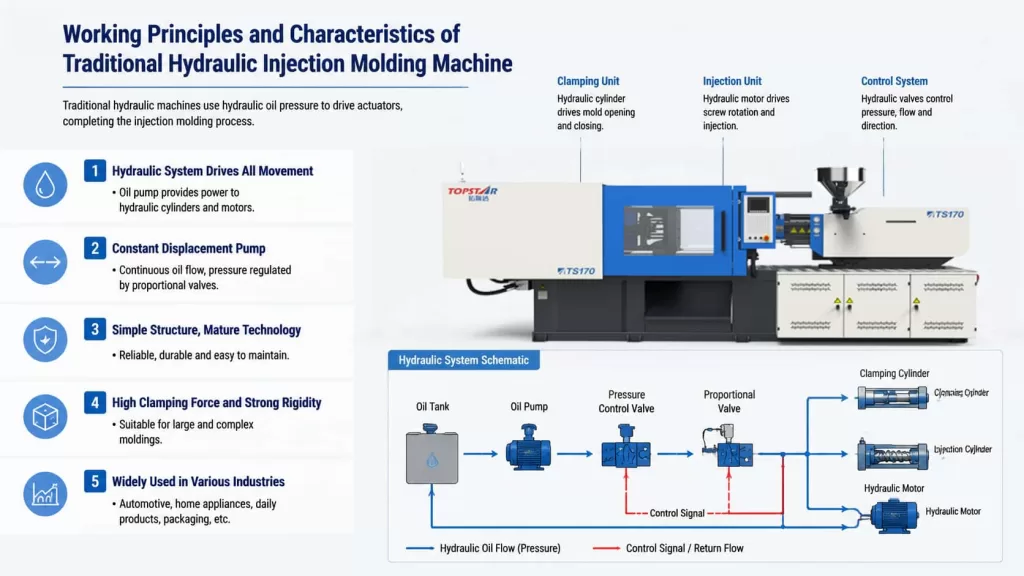
Working Principles and Characteristics of Traditional Hydraulic Injection Molding Machine
Traditional hydraulic injection molding machines use a constant-speed motor to drive a hydraulic pump, generating hydraulic power. The hydraulic system controls key operations, including mold opening and closing, injection, holding pressure, plasticizing, and ejection.
During production, the hydraulic pump runs continuously, while hydraulic valves regulate oil flow and pressure according to process requirements. Thanks to their robust mechanical performance and exceptional adaptability, this type of machine design has been widely adopted for decades.
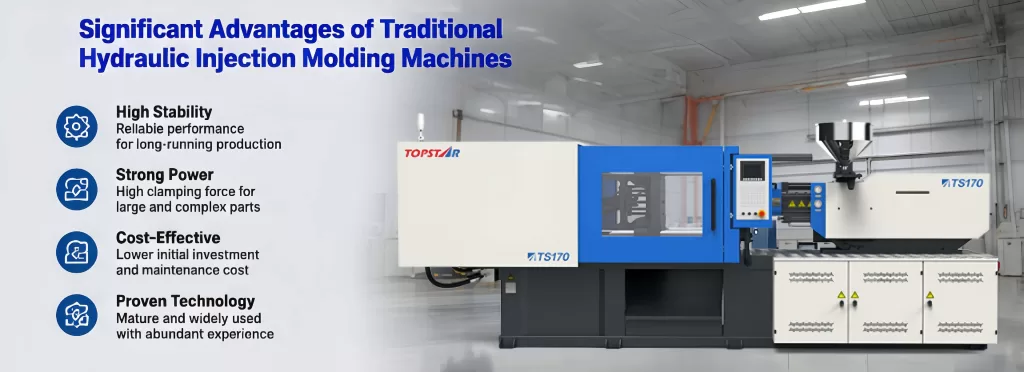
Significant Advantages of Traditional Hydraulic Injection Molding Machines
Powerful power output capabilities
One of the greatest advantages of hydraulic systems is their ability to generate immense force. Large-scale injection molding applications often require high clamping forces, large shot volumes, long holding times, and stable operation under heavy loads. For instance, the production of automotive bumpers, appliance housings, industrial containers, and large structural components often demands clamping forces of hundreds or even thousands of tons. In these scenarios, hydraulic injection molding machines remain highly competitive because hydraulic systems can deliver powerful, sustained output.
Exceptional process adaptability
Another key advantage is process flexibility. Hydraulic systems easily handle diverse production conditions, including various mold designs, multiple plastic materials, different injection speeds, and long-cycle processes. This adaptability explains why many factories continue to use hydraulic injection molding machines even after the advent of all-electric models.
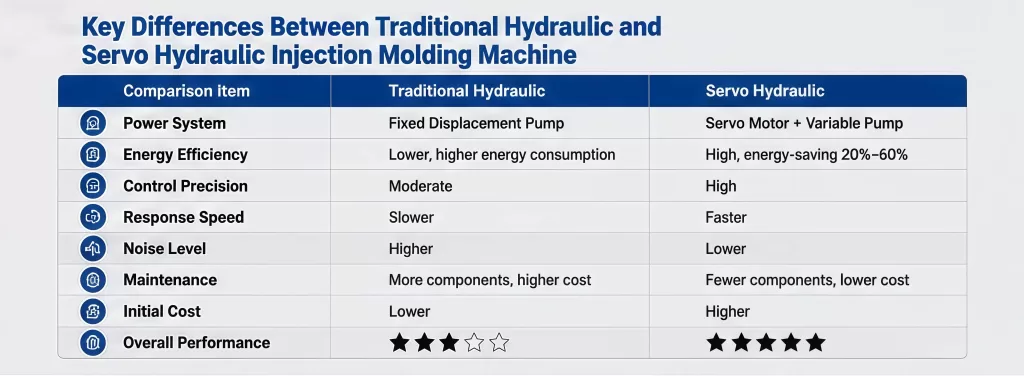
Key Differences Between Traditional Hydraulic and Servo Hydraulic Injection Molding Machine
Energy efficiency is one of the most significant differences between traditional hydraulic and servo hydraulic injection molding machines.
Energy consumption characteristics of traditional hydraulic machines:
Traditional hydraulic systems typically employ constant-speed motors. During operation, the motor runs continuously, and the hydraulic pump maintains pressure, converting excess hydraulic energy into heat. The motor may continue to consume energy even when the machine is idling or performing low-load movements.
This results in higher electricity consumption, rising hydraulic oil temperatures, and increased cooling requirements. For factories performing hundreds of thousands of production cycles annually, these energy losses can significantly drive up operating costs.
Energy-saving technology in servo hydraulic machines:
Servo hydraulic injection molding machines address this issue by integrating hydraulic systems with servo motor control technology. The servo motor automatically adjusts its speed based on actual production demands.
- During the injection phase:
The servo motor increases speed, and the hydraulic pump delivers maximum flow. - During the holding phase:
The motor reduces speed, maintaining only the necessary pressure. - During the standby phase:
The motor enters a low-power operating state.
This intelligent regulation significantly reduces unnecessary energy consumption. Compared to traditional hydraulic machines, servo hydraulic models typically achieve substantial energy savings (depending on the specific production process). For high-volume manufacturing plants, these energy-saving benefits directly enhance long-term production profitability.
Differences in Control Precision and Performance
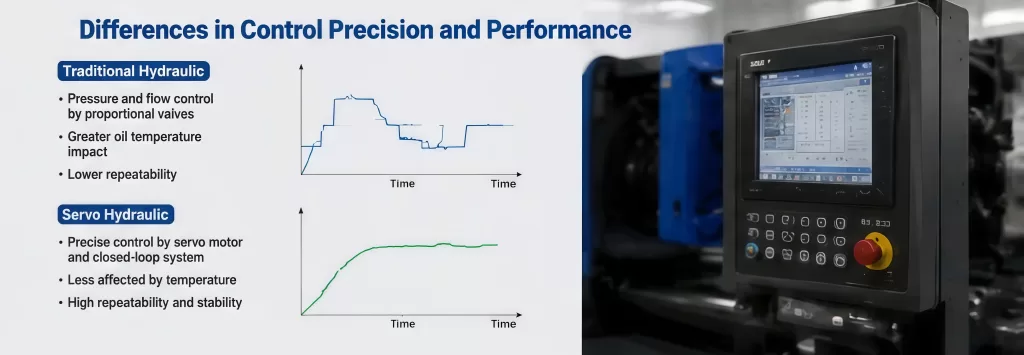
Although traditional hydraulic injection molding machines have maintained strong market competitiveness for decades, modern manufacturing increasingly demands higher molding precision, repeatability, and process control. This demand has driven the development of servo hydraulic injection molding machines, which effectively combine the mechanical advantages of hydraulic systems with intelligent servo control technology.
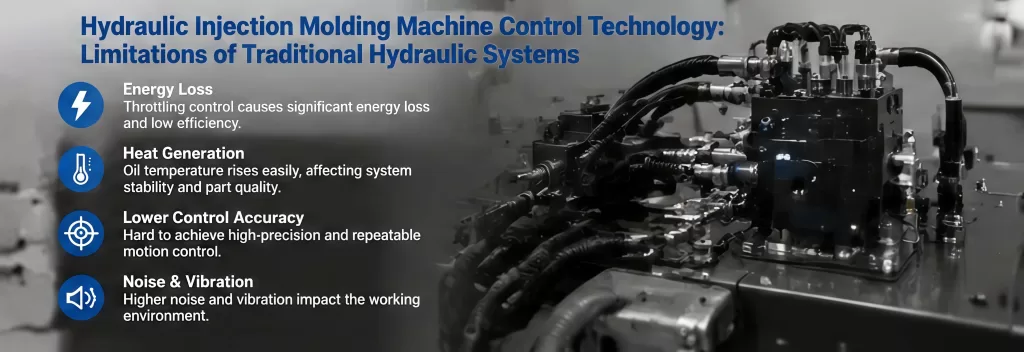
Hydraulic Injection Molding Machine Control Technology: Limitations of Traditional Hydraulic Systems
Traditional hydraulic injection molding machines rely primarily on proportional valves and hydraulic circuits to regulate the machine’s various movements. While these machines offer reliable performance, they have inherent limitations. The machine’s responsiveness depends on its hydraulic control components; in a traditional system, the control process typically involves:
- The controller sending command signals;
- Proportional valves regulating hydraulic flow;
- Hydraulic power driving mechanical motion;
- Sensors providing feedback information.
Because the system involves multiple stages of signal and energy conversion, response speed can be affected by factors such as valve response time, hydraulic oil temperature fluctuations, pressure variations, and mechanical wear.
Servo Control Enhances Precision and Stability
Servo hydraulic injection molding machine achieve intelligent energy and motion control by integrating high-performance servo motors and intelligent controllers into the hydraulic system. Instead of running continuously at a fixed speed, the servo motor adjusts its output based on the machine’s actual operational demands. This results in several technical improvements.
Faster dynamic response in hydraulic injection molding machine:
Servo motors can rapidly adjust speed and torque across different molding stages:
- Injection stage:
The servo motor rotates at high speed, driving the hydraulic pump to deliver maximum flow. This enables faster injection response, a more stable mold-filling process, and superior control over melt flow behavior. - Holding stage:
The servo system maintains the required pressure while reducing motor speed. This avoids unnecessary energy consumption while preserving the stability of the molding process. - Cooling and standby stages:
The system automatically reduces output power, thereby minimizing energy loss from idling, reducing hydraulic oil heating, and lowering cooling requirements.
Thus, servo hydraulic technology enhances both performance and efficiency.
Precision Comparison in Hydraulic Injection Molding: Pressure, Speed, and Repeatability
For manufacturers, precision depends not only on the machine type but, more importantly, on the machine’s effectiveness in controlling critical molding parameters. The main differences lie in the following three areas:
- Injection Speed Control
Traditional hydraulic injection molding machines regulate speed via hydraulic valves, whereas servo hydraulic machines use servo motors to directly control pump output. Advantages include:
- Faster response times;
- Smoother acceleration;
- Reduced speed fluctuations.
These factors are particularly important for applications such as thin-wall molding and multi-stage injection processes.
- Pressure Control Stability
Pressure control directly affects product density, shrinkage, internal stress, and dimensional accuracy. A servo hydraulic injection molding machine can monitor and adjust pressure more dynamically, helping to reduce common molding defects.
- Repeatability in Long-term Production
During long production runs, traditional hydraulic machines may experience issues such as oil temperature changes, fluctuations in hydraulic efficiency, and pressure instability. Servo hydraulic machines use intelligent control algorithms to compensate for these variations, resulting in more stable production, lower scrap rates, and greater consistency.
Selection Recommendations for Different Industries
Manufacturers can make their selection based on production requirements by considering the following scenarios:
- When to choose a traditional hydraulic injection molding machine:
- Products are large and heavy;
- High clamping force is required;
- Initial investment budget is a primary consideration;
- Production conditions are stable and continuous;
- Precision requirements are moderate.
Typical applications include large containers, automotive structural parts, and home appliance housings.
- When to choose a servo hydraulic injection molding machine:
- Energy costs significantly impact production expenses;
- Multiple machines operate continuously in the factory;
- Consistent product quality is required;
- Production processes necessitate frequent parameter adjustments;
- The enterprise plans to implement smart manufacturing.
Typical applications include automotive components, precision industrial parts, consumer goods, and mass production.
Servo hydraulic injection molding machines often represent the most practical production equipment. They combine the proven reliability of hydraulic technology with modern energy-saving technologies and intelligent control functions.
- Injection Molding Machine Market Size, Share & Trends Analysis Report ↩︎
TRENDING POSTS
- Breaking Through the Full Scene-to-AI Link! Topstar Industrial Data Collection Matrix Achieves Major Technical Breakthro 2026/08/12
- TOPSTAR Selected in “Forbes China AI Top 50” and Wins “2026 Embodied AI Industry Benchmark Award” 2026/08/12
- Topstar Achieves ISO 13849 Functional Safety Certification for Robotics 2026/08/12
- Topstar Completes Key Puzzle in Embodied Intelligence Data Closed Loop — Industrial AI Capability Foundation Now in Place 2026/08/12
HOT TOPIC
- .ervo motor-driven linear robots
- •
- 1.0 guangdong topstar technology co. ltd
- 1.0 topstar china
- 1.0 topstar robot
- 11
- 160℃ mold temperature controller
- 170 ton injection molding machine
- 2
- 21
- 220-ton injection molding machine
- 23
- 260 ton injection molding machine
- 3 axis robot
- 3 axis robots
- 3 in 1 Compact Dehumidifying Dryer
- 3-axis robot
- 3-axis robots
- 39
- 4 axis robot
- 4-axis SCARA robot
- 41
- 460T injection molding machine
- 5-axis CNC machine
- 62
- 90 ton injection molding machine
- accuracy
- Air Chillers
- air-cooled chillers
- all electric injection molding machine
- all electric injection molding machines
- all-electric injection molding machine
- All-electric injection molding machines
- and overall production quality. Therefore
- AP-RubberPlas
- auto cooling system
- auto loader
- Auto Loaders
- automated injection molding machine
- Automation changed engineering
- automation of injection molding robots
- automotive parts injection molding
- Auxiliary Equipment
- auxiliary machine
- Bench Injection Molding Machine
- cabinet dryer
- Cabinet dryer manufacturers
- Cabinet dryers
- cartesian coordinate robot
- Cartesian Coordinate Robots
- Cartesian injection robot
- Cartesian robot
- Central Feeding System
- Central Feeding Systems
- chiller
- CNC Drilling Machine
- CNC Drilling Machines
- cnc engraving machine manufacturer
- cnc laser cutting machine manufacturer
- CNC machine
- CNC Machine Center
- CNC Machine for Sale
- CNC Machine Manufacturing
- CNC Machine Tool
- CNC machine tool product
- CNC Machining Center
- CNC wood carving machine
- Compact Dehumidifying Dryer
- Cooling system
- Cross-Walking Single Axis Servo Cylinder Robot
- Cross-Walking Single-Axis Servo Cylinder Robot
- Cross-Walking Three-Axis/Five-Axis Servo Driven Robot
- cross-walking three-axis/five-axis servo-driven robot
- Dehumidifier Dryer
- Dehumidifying Dryer
- dehumidifying dryers
- delta parallel robot
- Desktop Injection Molding Machine
- Desktop injection molding machines
- Desktop Molding Machine
- desktop plastic injection machine
- Desktop Plastic Injection Molding Machine
- detachable autoloader
- Digital Transformation
- direct clamp injection molding machine
- Direct clamp injection molding machines
- Dosing & mixing system
- Drilling Centers
- Drying and dehumidification system
- drying and dehumidifying equipment
- Drying and Dehumidifying System
- drying system
- effective and efficient. Cabinet dryers are also used in other industries where large quantities of material need to be dried
- efficient injection molding machine
- elbow hydraulic injection molding machines
- electric injection molding machine
- electric injection molding machines
- energy-efficient injection molding robot
- energy-efficient water chiller
- energy-efficient water chillers
- energy-saving injection molding machine
- etc. Among injection molding robots
- exhibition
- features of CNC machine
- Feeding And Conveying System
- Five Axis Machine Center
- Flexible Production Line
- Fully automatic injection molding machine
- Gathering Topstar
- giant injection molding machine
- GMU-600 5-Axis Machining Center
- Granulating & Recycling System
- granulator machine
- gravimetric blender
- Heavy duty injection molding machine
- Heavy-Duty Take-Out Robot
- High-precision electric molding machines
- high-precision plastic molding machines
- high-speed all electric injection molding machine
- high-speed electric injection molding machine
- High-Speed Packaging Injection Molding
- Honeycomb rotor dehumidifier
- hopper dryer
- Hopper Dryers
- horizontal injection molding machine
- Horizontal Injection Molding Machines
- Horizontal Injection Moulding Machine
- Horizontal Mixer manufacturer
- How The CNC Machine Works
- hybrid injection molding machine
- hydraulic injection molding machine
- Hydraulic Injection Molding Machines
- in this article
- Industrial AI
- Industrial Automation
- Industrial robot
- Industrial Robot Chinese brand
- industrial robot parts
- industrial robot supplier
- Industrial robots
- Industry Chain
- Injection Manipulator
- injection manipulator robot
- injection mold machines
- Injection molding
- Injection molding automation
- Injection Molding Automation Solution
- injection molding dryer
- Injection molding equipment
- injection molding hopper dryer
- Injection molding machine
- injection molding machine brand
- Injection Molding Machine Factory
- Injection Molding Machine Manufacture
- Injection molding machine manufacturer
- injection molding machine manufacturers
- Injection molding machine procurement
- injection molding machine robotic arm
- injection molding machine with a robot
- Injection molding machines
- injection molding material dehumidifying
- injection molding plant
- injection molding process
- Injection Molding Robot
- injection molding robot arm
- Injection molding robot automation
- Injection molding robotic arm
- injection molding robots
- injection molding whole plant
- injection moulding dryer
- Injection moulding machine
- injection moulding machines
- Injection Moulding Robots
- Injection Robot
- Injection robot arm
- Injection robot manufacturer
- Injection robot wholesale
- injection robots
- Intelligent Factory
- intelligent injection molding machines
- Intelligent Manufacturing
- intelligent mold temperature
- intelligent mold temperature controller
- Intelligent mould temperature controller
- intelligent whole plant solution
- InterPlas Thailand 2025
- Introducing Injection Robot
- It is the best choice for drying large quantities of material at once. Cabinetmakers use these machines because they are fast
- Large flow water type mold temperature controller
- large injection molding machine
- large injection molding machines
- Learn what industrial automation and robotics is
- linear robot
- linear robots
- low speed sound-proof granulator
- machine plastic molding
- make sure to add some! Improvements (2) Keyphrase in introduction: Your keyphrase or its synonyms appear in the first paragraph of the copy
- manipulator machine
- manufacturing
- Manufacturing Innovation
- medical grade injection molding machines
- Medical Injection Molding
- medical injection molding machine
- medical injection molding machines
- micro injection molding machine
- middle speed granulator
- Mini CNC machine manufacturers.
- mobile cover making machine
- Mold Temperature Control System
- mold temperature controller
- mold temperature controllers
- molding machine
- molding material Dehumidifying System
- mould temperature control system
- mould temperature controller
- mould temperature controller
- mould temperature controllers
- New electric injection molding machine
- Nitrogen Dryer
- nitrogen dryer manufacturer
- nitrogen dryer system manufacturer
- Oil type mold temperature controller
- Oil type mold temperature controllers
- open day
- optical component injection molding
- Optical-grade dehumidifying dryer
- Outbound links: No outbound links appear in this page. Add some! Images: No images appear on this page. Add some! Internal links: No internal links appear in this page
- packaging injection molding
- Packaging Solutions
- PET Preform injection molding
- phone case maker machine
- phone case making machine
- phone cover making machine
- PID Control Mold Temperature Controller
- plastic auto loader
- plastic bottle making machine
- plastic bottle manufacturing
- plastic bucket making machine
- plastic bucket manufacturing
- Plastic chair making machine
- plastic dryer for injection molding
- plastic forming equipment
- Plastic Granulator
- Plastic Granulators
- plastic hopper dryer
- plastic injection machine
- plastic injection machines
- plastic injection molding
- Plastic injection molding equipment
- Plastic injection molding machine
- Plastic Injection Molding Machines
- plastic injection moulding machine
- plastic injection moulding machines
- plastic injection robot
- plastic molding
- Plastic Molding Industry
- Plastic Molding machine
- plastic molding machine 1
- Plastic Molding Machines
- plastic molding press
- plastic moulding machine
- plastic phone case making machine
- plastic-molding machine
- powerful granulator
- Powerful Type Sound-Proof Granulator
- precision injection molding
- precision injection molding machines
- production of plastic seats
- pure water mould temperature controller
- Robot injection molding
- robot injection molding machine
- robot manufacturing companies
- Robotic arm for injection molding machine
- robotic injection molding machines
- robotics in injection molding
- SCARA robot
- SCARA robots
- Screw dosers
- Service-oriented manufacturing
- Servo Cylinder Robot
- servo driven robot
- Servo Driven Robots
- servo injection molding machine
- servo injection robots
- servo motor-driven linear robots
- servo-driven 3-axis robot
- Servo-driven injection molding machine
- Servo-Driven Robot
- Setup of injection machine
- Silicone Injection Molding Machine
- six-axis industrial robot
- Smart Manufacturing
- soundproof granulator
- Sprue Picker
- Stainless Hopper Dryer
- Stainless Hopper Dryers
- star club
- swing arm robot
- T1 Cartesian injection robot
- take-out robot
- take-out robots
- Thailand 4.0
- the choice between servo-driven robots and hydraulic robots will have a certain impact on efficiency
- the most popular injection molding machine
- the type of injection molding robot
- TIC2000 Control System
- TMII injection molding machine
- toggle clamp injection molding machine
- Toggle Hydraulic Injection Molding Machines
- toggle injection molding machine
- Top 10 brands of injection robots
- Topstar
- Topstar Electric Injection Molding Machine InterPlas Thailand 2025 Smart Manufacturing Thailand 4.0
- Topstar Engineering
- Topstar Industrial Robots
- Topstar injection molding intelligent
- Topstar Scara Robots
- Useful Injection molding machine
- Vertical machining centers
- volumetric type blender
- Washing Machine Case Molding Solution
- water chiller
- water chillers
- water distributor
- water type mold temperature controller
- Water Type MoldTemperature Controller
- Water-Cooled Chillers
- Water-cooled Mold Temperature Controller
- water-type mold temperature controller
- Water-Type Mould Temperature Controllers
- We often face choices when performing injection molding. We will choose the type of injection molding machine
- wholesale of injection molding machines
- x carve CNC
- 热门查询 点击次数 展示 排名 topstar