
Injection Molding Whole Plant Solution for High-end Liquor Bottle Cap Production
2026/08/26 By le zhan
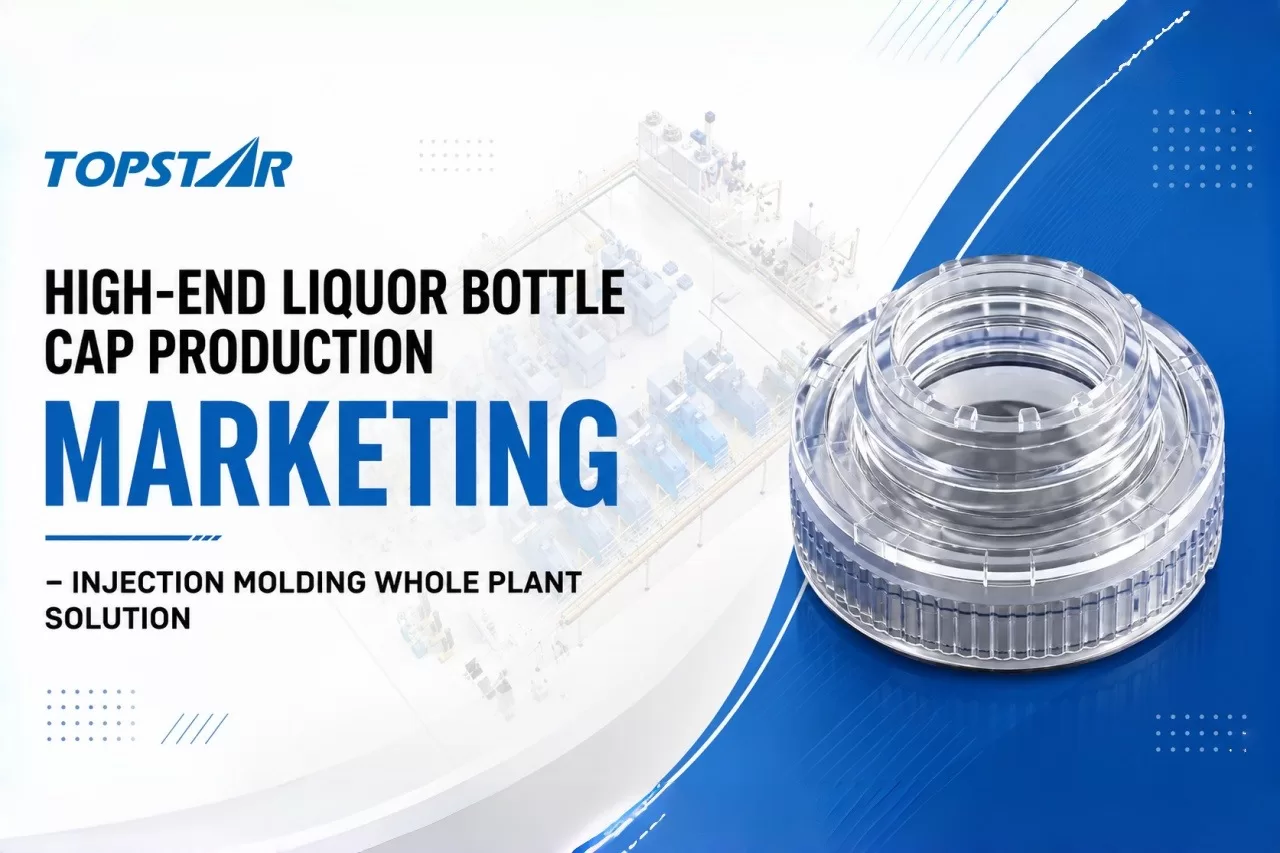
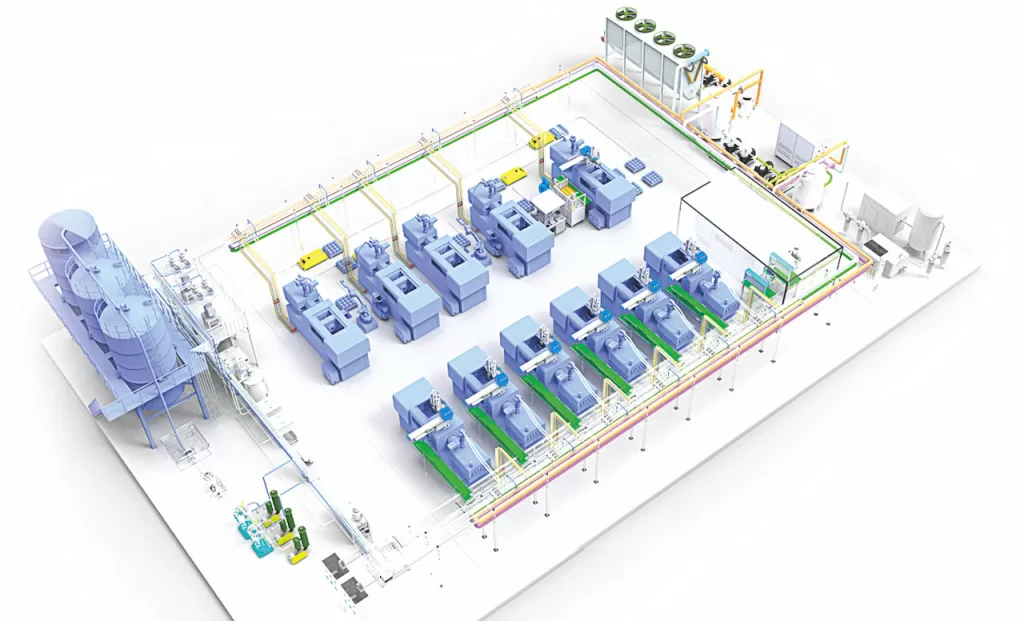
The liquor packaging Industry must meet three basic requirements: compliance with food contact safety standards, a clear and consistent appearance, and reliable sealing performance. To meet these standards, injection molding machines alone are not sufficient; strict control is also required over processes such as material storage, conveyance, drying, cooling, molding, and automated part removal. For customers producing high-end liquor bottle caps, Topstar provides an injection molding whole plant solution that seamlessly integrates a constant-pressure intelligent water system, automated material handling, a central feeding system, dehumidification and drying equipment, injection molding machines, and Cartesian robots.
As a result, the injection molding whole plant solution reduced energy consumption for circulating cooling water by about 30%, cut labor requirements for material handling by more than 60%, and increased overall production efficiency by about 50%.
Why does liquor bottle cap production require a injection molding whole plant solution?
Liquor Bottle cap quality depends on stable material conditions, precise molding parameters, uniform cooling, and controlled product handling. Fluctuations in any production stage can affect the cap’s appearance, dimensions, or sealing reliability. An injection molding whole plant solution manages these stages as a coordinated system rather than letting individual machines operate independently. This approach focuses on three key aspects:
Food Contact Safety
Manual material handling exposes raw materials to dust, moisture, and operators, posing a risk of contamination. Topstar employs enclosed conveying pipelines and automated feeding equipment to establish a clean conveying path from material storage to the injection molding machine.
Clear and Consistent Appearance
Defects are often particularly noticeable on transparent or high-gloss liquor bottle cap components. Moisture or impurity contamination can lead to silver streaks, bubbles, surface imperfections, and reduced transparency. The integrated drying and conveying system precisely controls the material’s condition before molding, helping customers maintain consistent product appearance.
Reliable Sealing Performance
Liquor Bottle caps must maintain precise dimensions and stable sealing performance during transportation, storage, and use. Stable material preparation, cooling, molding, and automated part retrieval processes help enhance product consistency in continuous production.
Core Systems in Topstar’s Turnkey Injection Molding Solutions
Topstar’s injection molding whole plant solution integrates multiple key systems tailored to the specific production requirements of liquor bottle caps.
Constant-pressure Intelligent Water System
Stable cooling water pressure is critical for controlling mold temperature, product cooling, and molding cycles. Pressure fluctuations can cause uneven cooling or longer production cycles. Topstar’s constant-pressure intelligent water system adjusts water supply based on production needs and offers the following advantages:
- Maintains stable cooling water pressure;
- Ensures uniform mold cooling;
- Reduces unnecessary pump operation;
- Improves molding cycle consistency;
- Enables centralized water distribution management.
This system reduces energy consumption for circulating cooling water by approximately 30%.
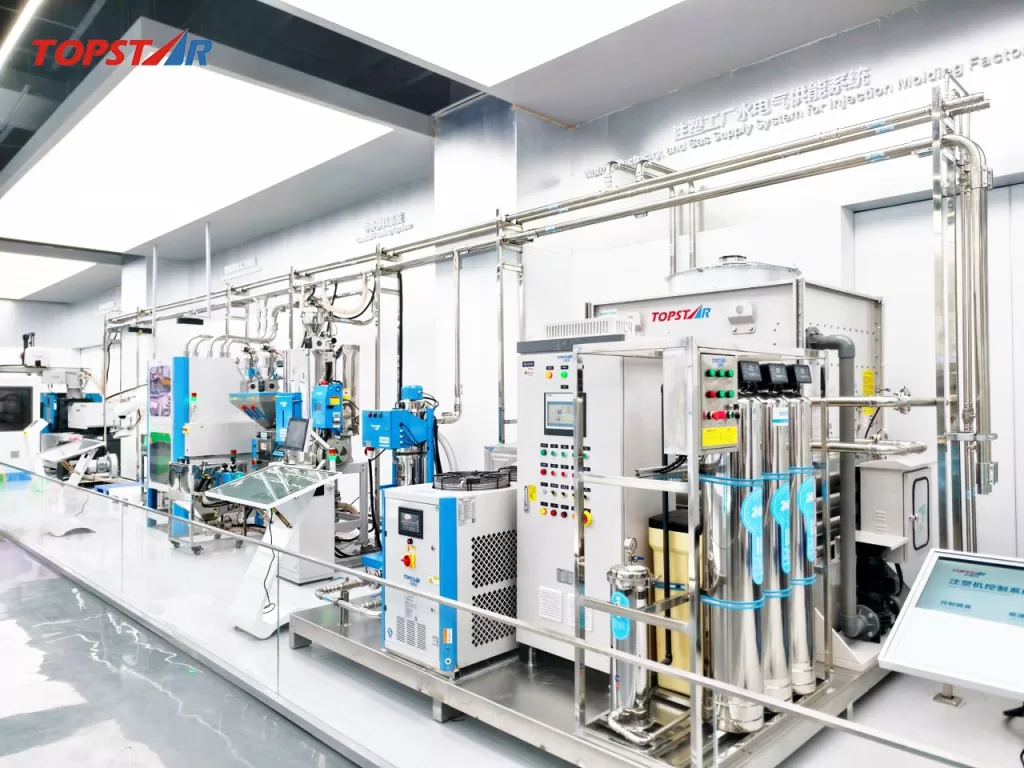
Automated Material Handling
Traditional material handling requires operators to manually transport, open bags, store, and feed materials. These activities are labor-intensive and increase contamination risk.
Topstar uses automated feeding and material-handling equipment to integrate material storage with the production process. Project data shows that this configuration reduces labor requirements for material handling by more than 60%. Automation also improves on-site management and makes material flow between storage areas and production equipment more predictable.
Central feeding system
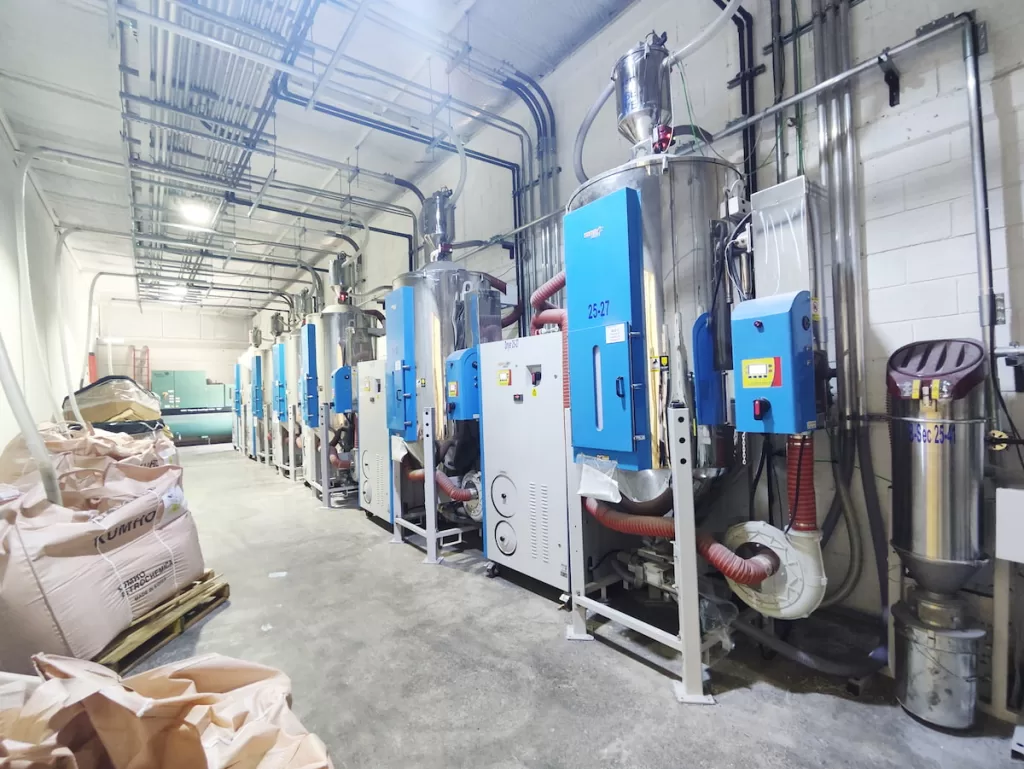
The central feeding system is central to raw material handling. It connects material storage, metering, drying, conveying, and machine-end demands through a centralized network. Raw materials move through enclosed pipelines rather than open containers or manual carts. The system provides:
- Dust-free automated conveying;
- Centralized material distribution to multiple machines;
- Reduced manual feeding;
- Flexible material allocation;
- A cleaner production environment;
- More stable material conveyance.
For liquor bottle cap manufacturers, a central material supply system improves production efficiency while ensuring food-contact safety.
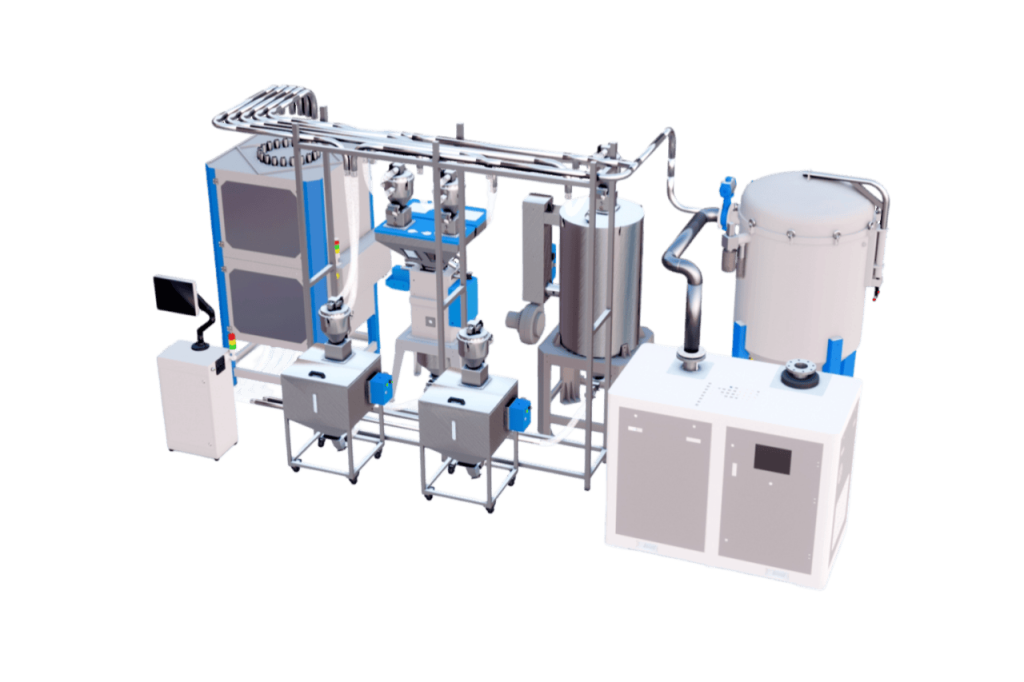
High-Precision Metering and Dehumidification Drying
Precise material metering is critical when manufacturers use different polymers, color concentrates, or additives. Topstar integrates high-precision metering modules to optimize mixing ratios, reduce waste, and maintain product consistency.
This turnkey injection molding solution also combines the central material supply system with a “three-in-one” dehumidifying and drying unit. Removing moisture before molding helps prevent quality issues such as silver streaks, bubbles, moisture-induced surface defects, and reduced transparency. Furthermore, the sealed conveying system after drying prevents the material from reabsorbing moisture before it reaches the injection molding machine.
Quick Changeover Design
Liquor beverage packaging manufacturers often need to produce liquor bottle caps in a variety of colors, designs, and materials. Slow material changeover can cause downtime and reduce production flexibility.
Topstar’s rapid material changeover design helps manufacturers switch between production tasks more efficiently. This design minimizes production interruptions, supports flexible order scheduling, and reduces the risk of material residue in the conveying lines. When combined with other systems, this design boosts overall production efficiency by approximately 50%.
Cartesian Robot for Automatic Part Retrieval
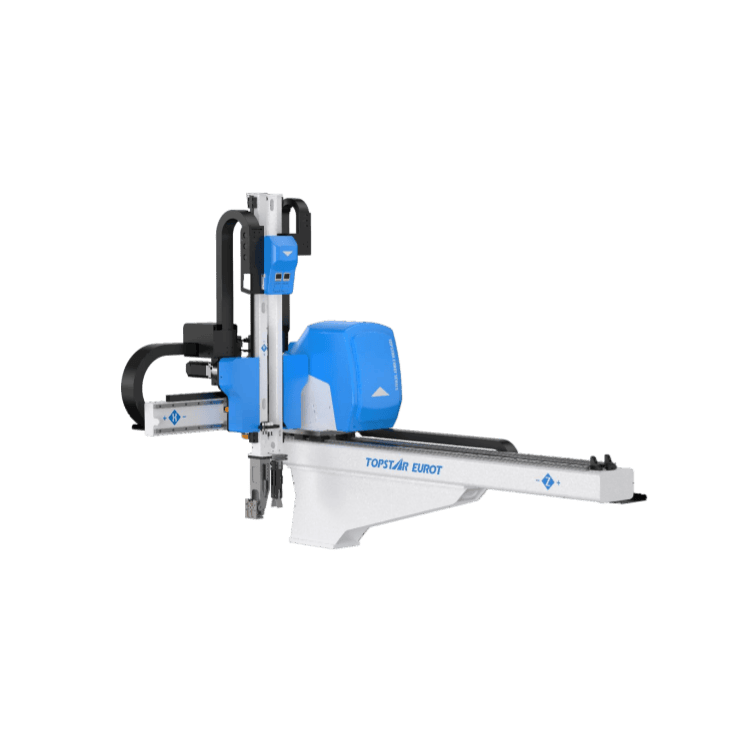
After injection molding, bottle cap assemblies must be retrieved quickly and reliably. Manual retrieval can lead to fluctuating cycle times, contamination, scratches, or product deformation. Topstar uses a Cartesian robot to automatically remove parts at the molding station. Its programmable motion control ensures precise positioning and repeatable handling operations. During part removal, it maintains consistent removal times and precise positioning while minimizing manual contact, thereby reducing the risk of surface damage and facilitating integration with downstream automated equipment. For transparent bottle caps or those with strict aesthetic requirements, controlled robotic handling helps protect the finished product’s surface.
How an Injection Molding Whole Plant Solution Works?
This comprehensive process seamlessly integrates material preparation, utilities, molding, and product handling. It primarily links the following three core stages:
Material Preparation and Conveyance:
Raw materials are managed in a centralized storage area. High-precision weighing modules handle on-demand batching, while a dehumidification and drying system removes moisture. The central material supply system then conveys the processed materials to designated injection molding machines via enclosed piping.
Stable Molding and Cooling:
Injection molding machines process the materials under controlled parameters. Meanwhile, a constant-pressure intelligent water system provides stable cooling conditions, ensuring consistency in molding cycles and product quality.
Automated Part Removal:
After molding, a Cartesian robot retrieves the liquor bottle cap assemblies and conveys them to the next production stage. This process minimizes manual handling and maintains high repeatability in production cycles.
Through this coordinated workflow, the factory integrates material requirements, drying, conveying, cooling, molding, and product removal into a seamless operational process.
Project Outcomes and Manufacturing Value
Topstar’s injection molding whole plant solution for high-end liquor bottle cap production has achieved the following results:
- Energy consumption for circulating cooling water reduced by approximately 30%;
- Labor required for material handling reduced by over 60%;
- Overall production efficiency increased by approximately 50%;
- Cleaner and more automated material handling;
- Reduced risk of product defects caused by moisture issues;
- More stable cooling and molding conditions;
- Precise automated part removal.
Actual results may vary depending on factory layout, material type, production volume, cap design, existing equipment, and automation requirements. These systems work in tandem to reduce process fluctuations and create a cleaner, more transparent, and more efficient factory environment.
For manufacturers planning to build new cap factories or upgrade existing production lines, Topstar can tailor injection molding whole plant solutions based on material properties, product structure, factory layout, production scale, automation level, and future expansion needs.
TRENDING POSTS
- TOPS DAY 2026: Turning Industrial AI into Real-World Impact 2026/08/26
- Breaking Through the Full Scene-to-AI Link! Topstar Industrial Data Collection Matrix Achieves Major Technical Breakthro 2026/08/26
- TOPSTAR Selected in “Forbes China AI Top 50” and Wins “2026 Embodied AI Industry Benchmark Award” 2026/08/26
- Topstar Achieves ISO 13849 Functional Safety Certification for Robotics 2026/08/26
HOT TOPIC
- .ervo motor-driven linear robots
- •
- 1.0 guangdong topstar technology co. ltd
- 1.0 topstar china
- 1.0 topstar robot
- 11
- 160℃ mold temperature controller
- 170 ton injection molding machine
- 2
- 21
- 220-ton injection molding machine
- 23
- 260 ton injection molding machine
- 3 axis robot
- 3 axis robots
- 3 in 1 Compact Dehumidifying Dryer
- 3-axis robot
- 3-axis robots
- 39
- 4 axis robot
- 4-axis SCARA robot
- 41
- 460T injection molding machine
- 5-axis CNC machine
- 62
- 90 ton injection molding machine
- accuracy
- Air Chillers
- air-cooled chillers
- all electric injection molding machine
- all electric injection molding machines
- all-electric injection molding machine
- All-electric injection molding machines
- and overall production quality. Therefore
- AP-RubberPlas
- auto cooling system
- auto loader
- Auto Loaders
- automated injection molding machine
- Automation changed engineering
- automation of injection molding robots
- automotive parts injection molding
- Auxiliary Equipment
- auxiliary machine
- Bench Injection Molding Machine
- cabinet dryer
- Cabinet dryer manufacturers
- Cabinet dryers
- cartesian coordinate robot
- Cartesian Coordinate Robots
- Cartesian injection robot
- Cartesian robot
- Central Feeding System
- Central Feeding Systems
- chiller
- CNC Drilling Machine
- CNC Drilling Machines
- cnc engraving machine manufacturer
- cnc laser cutting machine manufacturer
- CNC machine
- CNC Machine Center
- CNC Machine for Sale
- CNC Machine Manufacturing
- CNC Machine Tool
- CNC machine tool product
- CNC Machining Center
- CNC wood carving machine
- Compact Dehumidifying Dryer
- Cooling system
- Cross-Walking Single Axis Servo Cylinder Robot
- Cross-Walking Single-Axis Servo Cylinder Robot
- Cross-Walking Three-Axis/Five-Axis Servo Driven Robot
- cross-walking three-axis/five-axis servo-driven robot
- Dehumidifier Dryer
- Dehumidifying Dryer
- dehumidifying dryers
- delta parallel robot
- Desktop Injection Molding Machine
- Desktop injection molding machines
- Desktop Molding Machine
- desktop plastic injection machine
- Desktop Plastic Injection Molding Machine
- detachable autoloader
- Digital Transformation
- direct clamp injection molding machine
- Direct clamp injection molding machines
- Dosing & mixing system
- Drilling Centers
- Drying and dehumidification system
- drying and dehumidifying equipment
- Drying and Dehumidifying System
- drying system
- effective and efficient. Cabinet dryers are also used in other industries where large quantities of material need to be dried
- efficient injection molding machine
- elbow hydraulic injection molding machines
- electric injection molding machine
- electric injection molding machines
- energy-efficient injection molding robot
- energy-efficient water chiller
- energy-efficient water chillers
- energy-saving injection molding machine
- etc. Among injection molding robots
- exhibition
- features of CNC machine
- Feeding And Conveying System
- Five Axis Machine Center
- Flexible Production Line
- Fully automatic injection molding machine
- Gathering Topstar
- giant injection molding machine
- GMU-600 5-Axis Machining Center
- Granulating & Recycling System
- granulator machine
- gravimetric blender
- Heavy duty injection molding machine
- Heavy-Duty Take-Out Robot
- High-precision electric molding machines
- high-precision plastic molding machines
- high-speed all electric injection molding machine
- high-speed electric injection molding machine
- High-Speed Packaging Injection Molding
- Honeycomb rotor dehumidifier
- hopper dryer
- Hopper Dryers
- horizontal injection molding machine
- Horizontal Injection Molding Machines
- Horizontal Injection Moulding Machine
- Horizontal Mixer manufacturer
- How The CNC Machine Works
- hybrid injection molding machine
- hydraulic injection molding machine
- Hydraulic Injection Molding Machines
- in this article
- Industrial AI
- Industrial Automation
- Industrial robot
- Industrial Robot Chinese brand
- industrial robot parts
- industrial robot supplier
- Industrial robots
- Industry Chain
- Injection Manipulator
- injection manipulator robot
- injection mold machines
- Injection molding
- Injection molding automation
- Injection Molding Automation Solution
- injection molding dryer
- Injection molding equipment
- injection molding hopper dryer
- Injection molding machine
- injection molding machine brand
- Injection Molding Machine Factory
- Injection Molding Machine Manufacture
- Injection molding machine manufacturer
- injection molding machine manufacturers
- Injection molding machine procurement
- injection molding machine robotic arm
- injection molding machine with a robot
- Injection molding machines
- injection molding material dehumidifying
- injection molding plant
- injection molding process
- Injection Molding Robot
- injection molding robot arm
- Injection molding robot automation
- Injection molding robotic arm
- injection molding robots
- injection molding whole plant
- injection moulding dryer
- Injection moulding machine
- injection moulding machines
- Injection Moulding Robots
- Injection Robot
- Injection robot arm
- Injection robot manufacturer
- Injection robot wholesale
- injection robots
- Intelligent Factory
- intelligent injection molding machines
- Intelligent Manufacturing
- intelligent mold temperature
- intelligent mold temperature controller
- Intelligent mould temperature controller
- intelligent whole plant solution
- InterPlas Thailand 2025
- Introducing Injection Robot
- It is the best choice for drying large quantities of material at once. Cabinetmakers use these machines because they are fast
- Large flow water type mold temperature controller
- large injection molding machine
- large injection molding machines
- Learn what industrial automation and robotics is
- linear robot
- linear robots
- low speed sound-proof granulator
- machine plastic molding
- make sure to add some! Improvements (2) Keyphrase in introduction: Your keyphrase or its synonyms appear in the first paragraph of the copy
- manipulator machine
- manufacturing
- Manufacturing Innovation
- medical grade injection molding machines
- Medical Injection Molding
- medical injection molding machine
- medical injection molding machines
- micro injection molding machine
- middle speed granulator
- Mini CNC machine manufacturers.
- mobile cover making machine
- Mold Temperature Control System
- mold temperature controller
- mold temperature controllers
- molding machine
- molding material Dehumidifying System
- mould temperature control system
- mould temperature controller
- mould temperature controller
- mould temperature controllers
- New electric injection molding machine
- Nitrogen Dryer
- nitrogen dryer manufacturer
- nitrogen dryer system manufacturer
- Oil type mold temperature controller
- Oil type mold temperature controllers
- open day
- optical component injection molding
- Optical-grade dehumidifying dryer
- Outbound links: No outbound links appear in this page. Add some! Images: No images appear on this page. Add some! Internal links: No internal links appear in this page
- packaging injection molding
- Packaging Solutions
- PET Preform injection molding
- phone case maker machine
- phone case making machine
- phone cover making machine
- PID Control Mold Temperature Controller
- plastic auto loader
- plastic bottle making machine
- plastic bottle manufacturing
- plastic bucket making machine
- plastic bucket manufacturing
- Plastic chair making machine
- plastic dryer for injection molding
- plastic forming equipment
- Plastic Granulator
- Plastic Granulators
- plastic hopper dryer
- plastic injection machine
- plastic injection machines
- plastic injection molding
- Plastic injection molding equipment
- Plastic injection molding machine
- Plastic Injection Molding Machines
- plastic injection moulding machine
- plastic injection moulding machines
- plastic injection robot
- plastic molding
- Plastic Molding Industry
- Plastic Molding machine
- plastic molding machine 1
- Plastic Molding Machines
- plastic molding press
- plastic moulding machine
- plastic phone case making machine
- plastic-molding machine
- powerful granulator
- Powerful Type Sound-Proof Granulator
- precision injection molding
- precision injection molding machines
- production of plastic seats
- pure water mould temperature controller
- Robot injection molding
- robot injection molding machine
- robot manufacturing companies
- Robotic arm for injection molding machine
- robotic injection molding machines
- robotics in injection molding
- SCARA robot
- SCARA robots
- Screw dosers
- Service-oriented manufacturing
- Servo Cylinder Robot
- servo driven robot
- Servo Driven Robots
- servo injection molding machine
- servo injection robots
- servo motor-driven linear robots
- servo-driven 3-axis robot
- Servo-driven injection molding machine
- Servo-Driven Robot
- Setup of injection machine
- Silicone Injection Molding Machine
- six-axis industrial robot
- Smart Manufacturing
- soundproof granulator
- Sprue Picker
- Stainless Hopper Dryer
- Stainless Hopper Dryers
- star club
- swing arm robot
- T1 Cartesian injection robot
- take-out robot
- take-out robots
- Thailand 4.0
- the choice between servo-driven robots and hydraulic robots will have a certain impact on efficiency
- the most popular injection molding machine
- the type of injection molding robot
- TIC2000 Control System
- TMII injection molding machine
- toggle clamp injection molding machine
- Toggle Hydraulic Injection Molding Machines
- toggle injection molding machine
- Top 10 brands of injection robots
- Topstar
- Topstar Electric Injection Molding Machine InterPlas Thailand 2025 Smart Manufacturing Thailand 4.0
- Topstar Engineering
- Topstar Industrial Robots
- Topstar injection molding intelligent
- Topstar Scara Robots
- Useful Injection molding machine
- Vertical machining centers
- volumetric type blender
- Washing Machine Case Molding Solution
- water chiller
- water chillers
- water distributor
- water type mold temperature controller
- Water Type MoldTemperature Controller
- Water-Cooled Chillers
- Water-cooled Mold Temperature Controller
- water-type mold temperature controller
- Water-Type Mould Temperature Controllers
- We often face choices when performing injection molding. We will choose the type of injection molding machine
- wholesale of injection molding machines
- x carve CNC
- 热门查询 点击次数 展示 排名 topstar