
Topstar TS130 Injection Molding Machine | Injection Molding Solution for Artificial Plants
2026/08/24 By le zhan

The artificial plant industry experiences distinct seasonal production peaks. Traditional equipment has slow production speeds and limited per-machine capacity, making it difficult to fulfill large orders on time during peak seasons. If injection molding equipment suffers from low output per mold, slow part removal, or unstable continuous operation, factories quickly face capacity bottlenecks.
Topstar offers a dedicated solution for the artificial plant industry, which includes:
- TS130 Artificial Plant Dedicated Machine
- High-power drive design
- Full servo control system
- Custom “one-to-four” mold
- Artificial plant dedicated Cartesian coordinate robot
With this configuration, the comprehensive solution boosts production efficiency by approximately 100 percent; a single TS130 production unit can achieve the output previously required by two traditional machines.
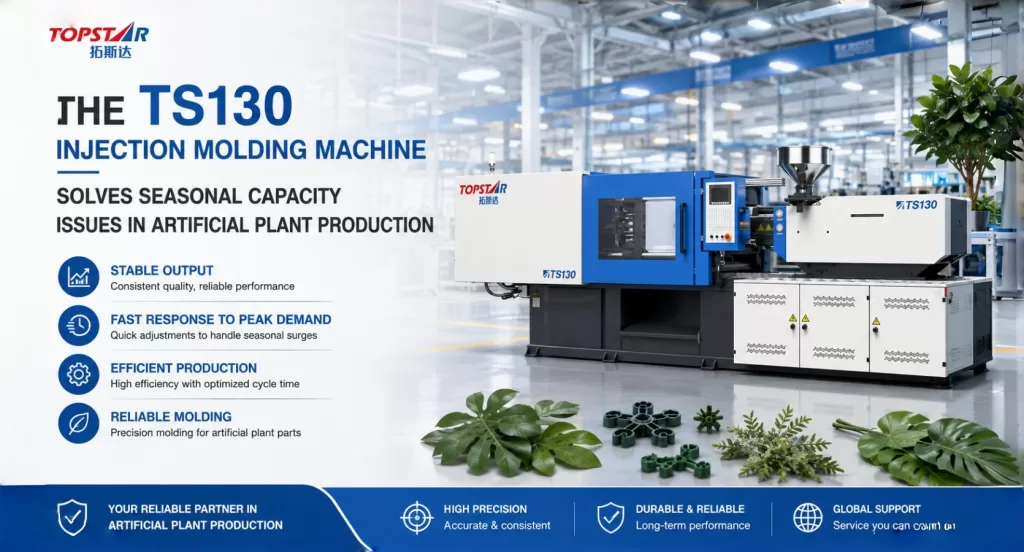
The TS130 Injection Molding Machine Solves Seasonal Capacity Issues in Artificial Plant Production
The demand patterns for artificial plant production differ significantly from those of many traditional plastics manufacturing sectors. Artificial plant suppliers typically align production with the retail industry’s seasonal cycles.
Christmas-related artificial plants are a prime example.
Christmas tree foliage and decorative leaves must be produced before the peak season begins, so orders often concentrate in specific production periods. If production falls behind, factories risk shipping delays, missed on-time deliveries, and reduced capacity to accept additional orders.
For this reason, the primary production challenge is:
How many qualified parts can a single production unit produce within the limited peak-season production window?
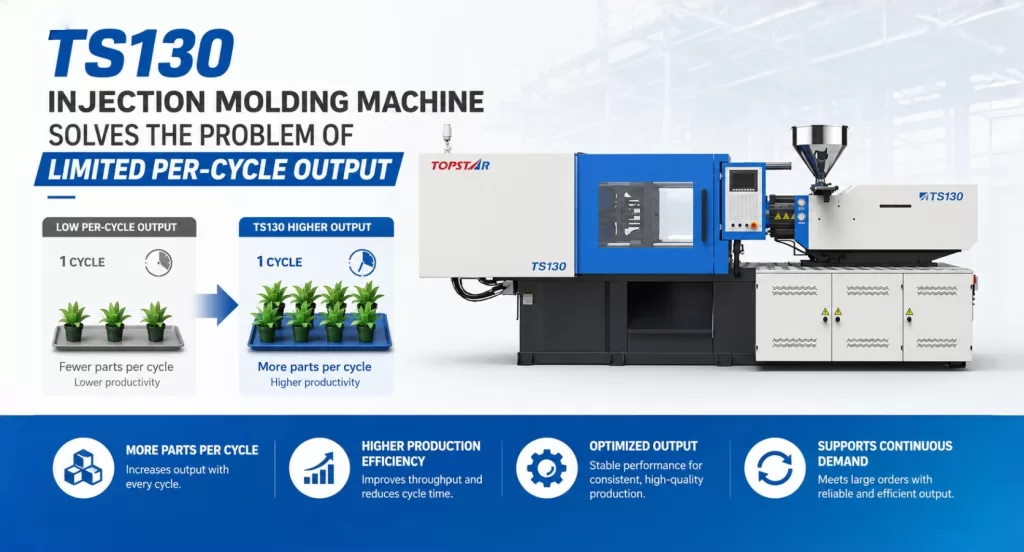
The TS130 Injection Molding Machine Solves the Problem of Limited Output Per Cycle
Traditional single-cavity or low-output injection molding machine configurations can produce only a limited number of parts each time the mold opens. Even if the machine runs stably, per-cycle output limits total daily output.
If demand doubles, manufacturers typically have only two options:
Extend the operating hours of existing equipment or add more machines.
Therefore, Topsta approached the problem differently.
By using the TS130 injection molding machine in conjunction with a custom “one-to-four mold”, the mold can produce four artificial plants in a single molding cycle. The production unit no longer relies solely on increasing machine speed to achieve minor efficiency gains; instead, it increases the number of products produced per successful molding cycle.
The TS130 Injection Molding Machine Features a Dedicated, High-Power, Full-Servo Architecture
While four-cavity molds can increase potential output, they also place higher demands on injection molding machines. Compared to molds with fewer cavities, the equipment must not only maintain stable operation during repetitive, high-volume production but also ensure a continuous, stable supply of sufficient melt to multiple cavities.
Therefore, the TS130 injection molding machine—specifically designed for artificial plants—features two core design elements:
High-Power Drive Design
Full-Servo Control System
These two technologies address different stages of the production process and work together to solve production challenges.
High-Power Design Enables Faster Production Response
When facing peak-season orders, artificial plant manufacturers need equipment that responds quickly and runs continuously to avoid slowing molding cycles with sluggish machine movements. The TS130 artificial plant dedicated machine features a high-power design that delivers stronger motion and faster response times.
This supports high-demand operations, including coordinated mold opening, mold closing, injection, plasticizing, and ejection. It reduces unnecessary wait times while maintaining process stability.
The Full-Servo Control System Achieves a Balance Between Speed and Precision
High power alone cannot ensure production stability for artificial plants. Therefore, the TS130 machine, designed specifically for artificial plants, uses a fully servo-controlled system. This enables faster command response, more precise motion control, stable injection performance, and superior process repeatability. For artificial plant components, a stable servo control system helps the machine more consistently reproduce the required injection molding process curves during production.
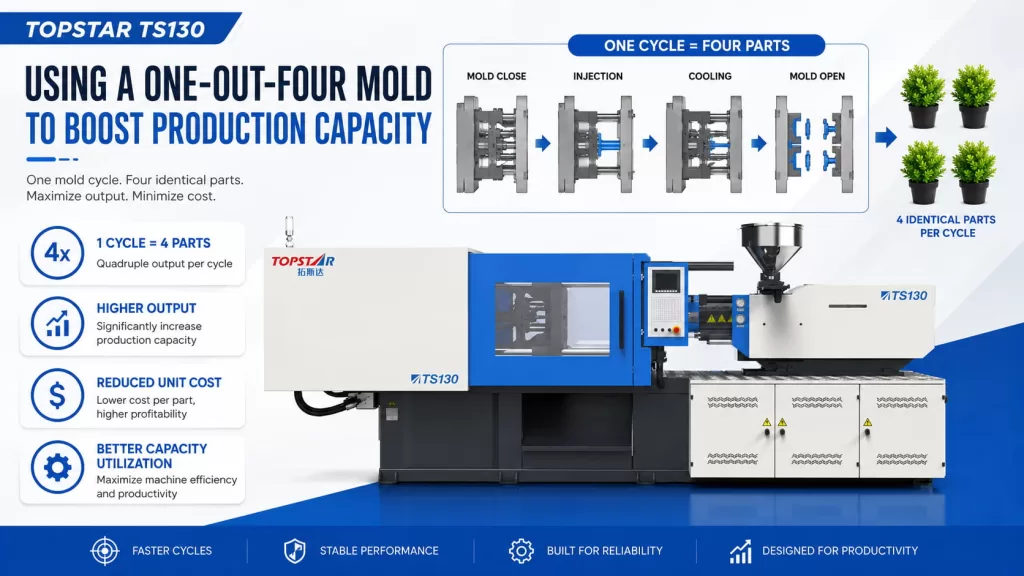
Using a “One-Out-Four Mold” to Boost Production Capacity
The custom “one-out-four mold” is the most direct driver of increased production capacity in this solution.
The “one-out-four mold” contains four molding cavities, enabling the TS130 artificial plant dedicated machine to produce four parts in a single injection molding cycle.
This difference is easy to illustrate with a simple example.
| Production Configuration | Parts Produced per Mold Cycle | Relative Single-Cycle Output |
| Single-cavity configuration | 1 | 1× |
| Two-cavity configuration | 2 | 2× |
| TS130 one-out-four configuration | 4 | 4× |
However, this does not mean the factory’s total output will necessarily increase exactly fourfold, as actual production capacity depends on factors such as mold design, cooling time, cycle parameters, materials, robotic arm operations, and product geometry.
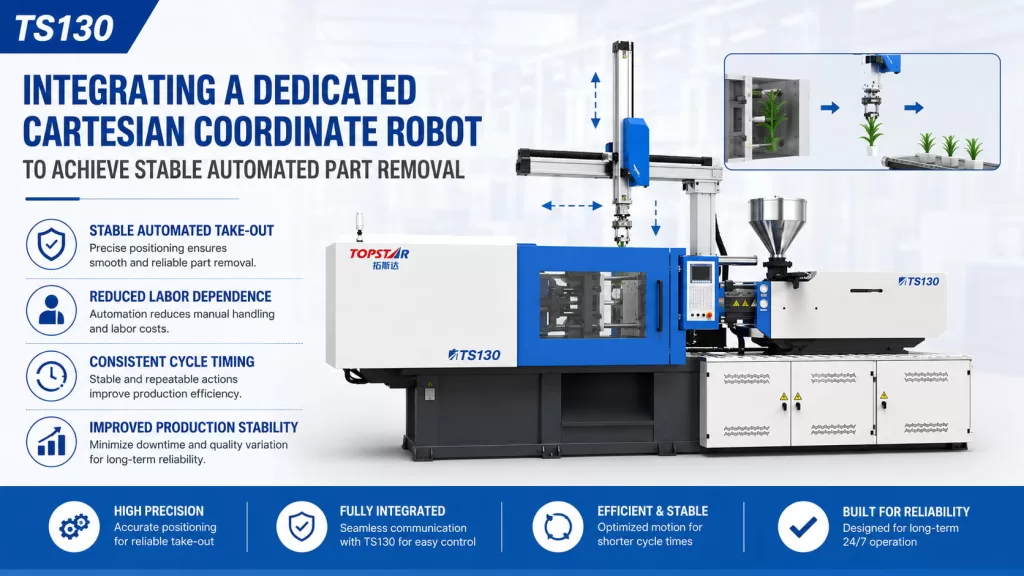
Integrating a Dedicated Cartesian Coordinate Robot to Achieve Stable Automated Part Removal
If the mold produces four parts per cycle but the injection molding robot cannot remove them quickly and reliably, part removal becomes the next bottleneck.
Therefore, we have integrated an artificial plant dedicated Cartesian coordinate robot into this solution.
Under Tpstar’s unified control system, the injection molding machine and Cartesian coordinate robot motion cycles are coordinated, with the Cartesian coordinate robot performing automated part removal after the mold opens.
The sequence of operations can be simplified as follows:
Injection → Cooling → Mold opening → Robot entry → Part removal → Robot exit → Mold closing
A dedicated Cartesian coordinate robot standardizes part removal, ensuring each cycle follows a more predictable rhythm. If the injection molding machine operates at high speed but manual part removal is slow, production potential cannot be fully realized.
Controlled Part Removal Achieved Through High-Precision Servo Positioning
Artificial plant leaves are typically thin or flexible. Rough handling or improper positioning during part removal can cause bending, tearing, or other damage. Dedicated Cartesian coordinate robots utilize high-precision servo positioning to approach the product at a controlled position and perform stable removal. This enables the robot to operate more gently while maintaining speed.
Building More Scalable Injection Molding Production for the Artificial Plant Industry
A key insight from this case study is that increasing production capacity does not necessarily require adding more equipment. In the artificial plant industry, Topstar boosts production capacity by optimizing the value generated per production cycle. In the artificial plant application case, production efficiency increased by about 100% while ensuring more stable operation, a higher yield rate, and lower labor costs. For manufacturers producing Christmas tree leaves and other artificial plant products, this injection molding solution precisely addresses the most pressing challenges during peak seasons.
TRENDING POSTS
- TOPS DAY 2026: Turning Industrial AI into Real-World Impact 2026/08/24
- Breaking Through the Full Scene-to-AI Link! Topstar Industrial Data Collection Matrix Achieves Major Technical Breakthro 2026/08/24
- TOPSTAR Selected in “Forbes China AI Top 50” and Wins “2026 Embodied AI Industry Benchmark Award” 2026/08/24
- Topstar Achieves ISO 13849 Functional Safety Certification for Robotics 2026/08/24
HOT TOPIC
- .ervo motor-driven linear robots
- •
- 1.0 guangdong topstar technology co. ltd
- 1.0 topstar china
- 1.0 topstar robot
- 11
- 160℃ mold temperature controller
- 170 ton injection molding machine
- 2
- 21
- 220-ton injection molding machine
- 23
- 260 ton injection molding machine
- 3 axis robot
- 3 axis robots
- 3 in 1 Compact Dehumidifying Dryer
- 3-axis robot
- 3-axis robots
- 39
- 4 axis robot
- 4-axis SCARA robot
- 41
- 460T injection molding machine
- 5-axis CNC machine
- 62
- 90 ton injection molding machine
- accuracy
- Air Chillers
- air-cooled chillers
- all electric injection molding machine
- all electric injection molding machines
- all-electric injection molding machine
- All-electric injection molding machines
- and overall production quality. Therefore
- AP-RubberPlas
- auto cooling system
- auto loader
- Auto Loaders
- automated injection molding machine
- Automation changed engineering
- automation of injection molding robots
- automotive parts injection molding
- Auxiliary Equipment
- auxiliary machine
- Bench Injection Molding Machine
- cabinet dryer
- Cabinet dryer manufacturers
- Cabinet dryers
- cartesian coordinate robot
- Cartesian Coordinate Robots
- Cartesian injection robot
- Cartesian robot
- Central Feeding System
- Central Feeding Systems
- chiller
- CNC Drilling Machine
- CNC Drilling Machines
- cnc engraving machine manufacturer
- cnc laser cutting machine manufacturer
- CNC machine
- CNC Machine Center
- CNC Machine for Sale
- CNC Machine Manufacturing
- CNC Machine Tool
- CNC machine tool product
- CNC Machining Center
- CNC wood carving machine
- Compact Dehumidifying Dryer
- Cooling system
- Cross-Walking Single Axis Servo Cylinder Robot
- Cross-Walking Single-Axis Servo Cylinder Robot
- Cross-Walking Three-Axis/Five-Axis Servo Driven Robot
- cross-walking three-axis/five-axis servo-driven robot
- Dehumidifier Dryer
- Dehumidifying Dryer
- dehumidifying dryers
- delta parallel robot
- Desktop Injection Molding Machine
- Desktop injection molding machines
- Desktop Molding Machine
- desktop plastic injection machine
- Desktop Plastic Injection Molding Machine
- detachable autoloader
- Digital Transformation
- direct clamp injection molding machine
- Direct clamp injection molding machines
- Dosing & mixing system
- Drilling Centers
- Drying and dehumidification system
- drying and dehumidifying equipment
- Drying and Dehumidifying System
- drying system
- effective and efficient. Cabinet dryers are also used in other industries where large quantities of material need to be dried
- efficient injection molding machine
- elbow hydraulic injection molding machines
- electric injection molding machine
- electric injection molding machines
- energy-efficient injection molding robot
- energy-efficient water chiller
- energy-efficient water chillers
- energy-saving injection molding machine
- etc. Among injection molding robots
- exhibition
- features of CNC machine
- Feeding And Conveying System
- Five Axis Machine Center
- Flexible Production Line
- Fully automatic injection molding machine
- Gathering Topstar
- giant injection molding machine
- GMU-600 5-Axis Machining Center
- Granulating & Recycling System
- granulator machine
- gravimetric blender
- Heavy duty injection molding machine
- Heavy-Duty Take-Out Robot
- High-precision electric molding machines
- high-precision plastic molding machines
- high-speed all electric injection molding machine
- high-speed electric injection molding machine
- High-Speed Packaging Injection Molding
- Honeycomb rotor dehumidifier
- hopper dryer
- Hopper Dryers
- horizontal injection molding machine
- Horizontal Injection Molding Machines
- Horizontal Injection Moulding Machine
- Horizontal Mixer manufacturer
- How The CNC Machine Works
- hybrid injection molding machine
- hydraulic injection molding machine
- Hydraulic Injection Molding Machines
- in this article
- Industrial AI
- Industrial Automation
- Industrial robot
- Industrial Robot Chinese brand
- industrial robot parts
- industrial robot supplier
- Industrial robots
- Industry Chain
- Injection Manipulator
- injection manipulator robot
- injection mold machines
- Injection molding
- Injection molding automation
- Injection Molding Automation Solution
- injection molding dryer
- Injection molding equipment
- injection molding hopper dryer
- Injection molding machine
- injection molding machine brand
- Injection Molding Machine Factory
- Injection Molding Machine Manufacture
- Injection molding machine manufacturer
- injection molding machine manufacturers
- Injection molding machine procurement
- injection molding machine robotic arm
- injection molding machine with a robot
- Injection molding machines
- injection molding material dehumidifying
- injection molding plant
- injection molding process
- Injection Molding Robot
- injection molding robot arm
- Injection molding robot automation
- Injection molding robotic arm
- injection molding robots
- injection molding whole plant
- injection moulding dryer
- Injection moulding machine
- injection moulding machines
- Injection Moulding Robots
- Injection Robot
- Injection robot arm
- Injection robot manufacturer
- Injection robot wholesale
- injection robots
- Intelligent Factory
- intelligent injection molding machines
- Intelligent Manufacturing
- intelligent mold temperature
- intelligent mold temperature controller
- Intelligent mould temperature controller
- intelligent whole plant solution
- InterPlas Thailand 2025
- Introducing Injection Robot
- It is the best choice for drying large quantities of material at once. Cabinetmakers use these machines because they are fast
- Large flow water type mold temperature controller
- large injection molding machine
- large injection molding machines
- Learn what industrial automation and robotics is
- linear robot
- linear robots
- low speed sound-proof granulator
- machine plastic molding
- make sure to add some! Improvements (2) Keyphrase in introduction: Your keyphrase or its synonyms appear in the first paragraph of the copy
- manipulator machine
- manufacturing
- Manufacturing Innovation
- medical grade injection molding machines
- Medical Injection Molding
- medical injection molding machine
- medical injection molding machines
- micro injection molding machine
- middle speed granulator
- Mini CNC machine manufacturers.
- mobile cover making machine
- Mold Temperature Control System
- mold temperature controller
- mold temperature controllers
- molding machine
- molding material Dehumidifying System
- mould temperature control system
- mould temperature controller
- mould temperature controller
- mould temperature controllers
- New electric injection molding machine
- Nitrogen Dryer
- nitrogen dryer manufacturer
- nitrogen dryer system manufacturer
- Oil type mold temperature controller
- Oil type mold temperature controllers
- open day
- optical component injection molding
- Optical-grade dehumidifying dryer
- Outbound links: No outbound links appear in this page. Add some! Images: No images appear on this page. Add some! Internal links: No internal links appear in this page
- packaging injection molding
- Packaging Solutions
- PET Preform injection molding
- phone case maker machine
- phone case making machine
- phone cover making machine
- PID Control Mold Temperature Controller
- plastic auto loader
- plastic bottle making machine
- plastic bottle manufacturing
- plastic bucket making machine
- plastic bucket manufacturing
- Plastic chair making machine
- plastic dryer for injection molding
- plastic forming equipment
- Plastic Granulator
- Plastic Granulators
- plastic hopper dryer
- plastic injection machine
- plastic injection machines
- plastic injection molding
- Plastic injection molding equipment
- Plastic injection molding machine
- Plastic Injection Molding Machines
- plastic injection moulding machine
- plastic injection moulding machines
- plastic injection robot
- plastic molding
- Plastic Molding Industry
- Plastic Molding machine
- plastic molding machine 1
- Plastic Molding Machines
- plastic molding press
- plastic moulding machine
- plastic phone case making machine
- plastic-molding machine
- powerful granulator
- Powerful Type Sound-Proof Granulator
- precision injection molding
- precision injection molding machines
- production of plastic seats
- pure water mould temperature controller
- Robot injection molding
- robot injection molding machine
- robot manufacturing companies
- Robotic arm for injection molding machine
- robotic injection molding machines
- robotics in injection molding
- SCARA robot
- SCARA robots
- Screw dosers
- Service-oriented manufacturing
- Servo Cylinder Robot
- servo driven robot
- Servo Driven Robots
- servo injection molding machine
- servo injection robots
- servo motor-driven linear robots
- servo-driven 3-axis robot
- Servo-driven injection molding machine
- Servo-Driven Robot
- Setup of injection machine
- Silicone Injection Molding Machine
- six-axis industrial robot
- Smart Manufacturing
- soundproof granulator
- Sprue Picker
- Stainless Hopper Dryer
- Stainless Hopper Dryers
- star club
- swing arm robot
- T1 Cartesian injection robot
- take-out robot
- take-out robots
- Thailand 4.0
- the choice between servo-driven robots and hydraulic robots will have a certain impact on efficiency
- the most popular injection molding machine
- the type of injection molding robot
- TIC2000 Control System
- TMII injection molding machine
- toggle clamp injection molding machine
- Toggle Hydraulic Injection Molding Machines
- toggle injection molding machine
- Top 10 brands of injection robots
- Topstar
- Topstar Electric Injection Molding Machine InterPlas Thailand 2025 Smart Manufacturing Thailand 4.0
- Topstar Engineering
- Topstar Industrial Robots
- Topstar injection molding intelligent
- Topstar Scara Robots
- Useful Injection molding machine
- Vertical machining centers
- volumetric type blender
- Washing Machine Case Molding Solution
- water chiller
- water chillers
- water distributor
- water type mold temperature controller
- Water Type MoldTemperature Controller
- Water-Cooled Chillers
- Water-cooled Mold Temperature Controller
- water-type mold temperature controller
- Water-Type Mould Temperature Controllers
- We often face choices when performing injection molding. We will choose the type of injection molding machine
- wholesale of injection molding machines
- x carve CNC
- 热门查询 点击次数 展示 排名 topstar