
How Should Thin-Walled Plastic Parts Be Removed Without Deformation After Molding?
2026/09/18 By le zhan
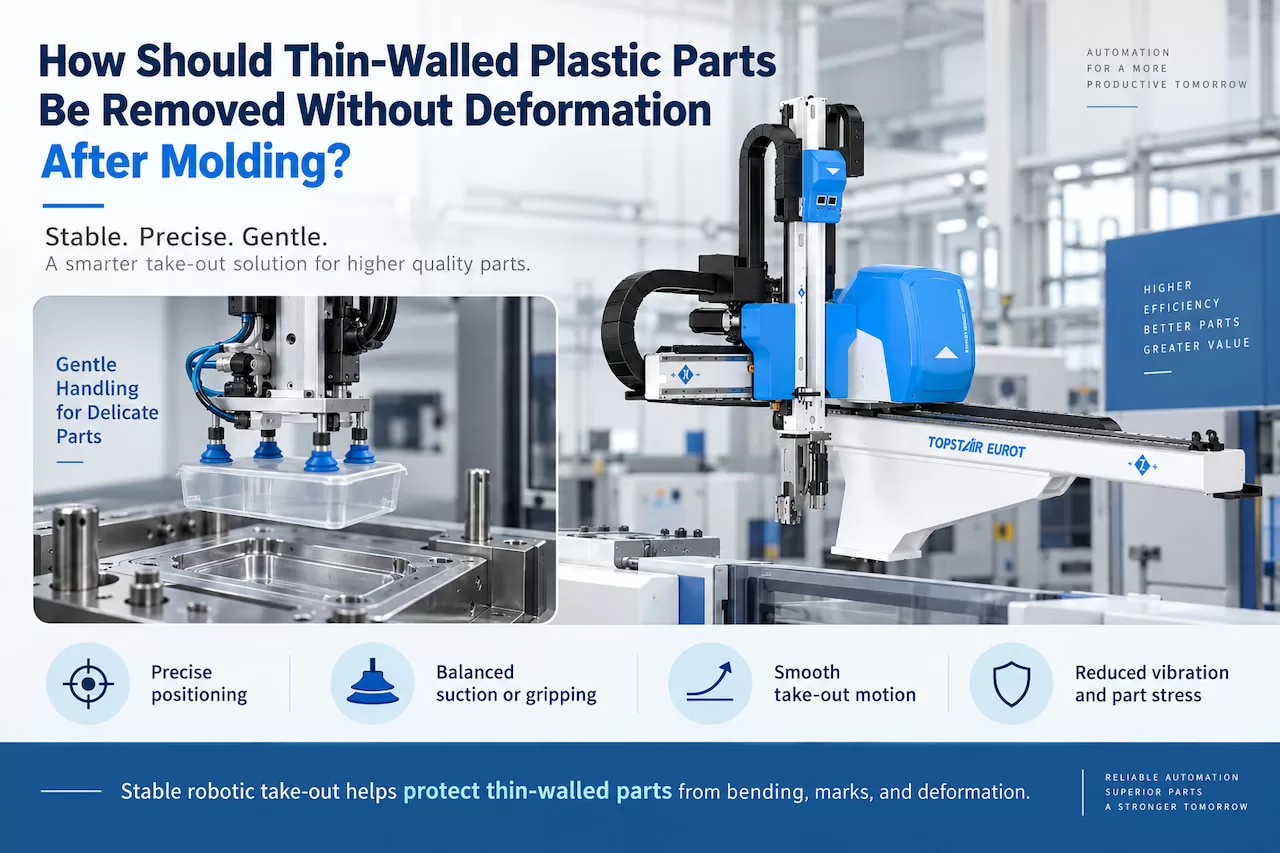
Although thin-walled plastic parts are rigid enough to be ejected from the mold cavity, they remain hot and relatively soft, so they cannot withstand concentrated gripping forces, excessive acceleration, torsional stress, or imprecise removal paths.
This places extremely high demands on automated removal technologies in thin-wall injection molding. Cartesian injection molding robots must not only be capable of rapid part extraction but also able to apply force at appropriate locations, synchronize precisely with the mold-opening position, and avoid violent vibrations.
The guidelines from Autodesk Moldflow also emphasize this fundamental principle: “Molded parts must possess sufficient rigidity to withstand ejection forces without excessive warping or ejection marks. Although ejection at higher temperatures can shorten cooling time, it also increases the risk of deformation.”(Source: Autodesk Moldflow)
Therefore, for thin-walled plastic parts, the removal stage is not simply about speed, but about achieving a removal process that is fast, precisely synchronized, well supported, and controlled in force application.
Why Do Thin-Walled Plastic Parts Deform During Removal?
Immediately after molding, thin-walled plastic parts have relatively low flexural stiffness. Although thin-walled areas typically cool faster than thick-walled areas, they also resist external forces less well. Consequently, if a Cartesian robot gripper is used improperly or accelerates too rapidly, large flat surfaces, narrow ribs, long edges, and lightweight shells are all prone to bending deformation.
The first cause of deformation is premature removal.
If the part’s temperature is too high, the polymer has not yet developed enough rigidity to resist forces from vacuum suction, fixture pressure, gravity, or acceleration.
This raises an important issue: while extending the cooling time can improve rigidity, it also increases the molding cycle time. Therefore, a well-designed take-out robot should allow the part to be removed immediately once it reaches a mechanically stable state, without adding unnecessary cooling time.
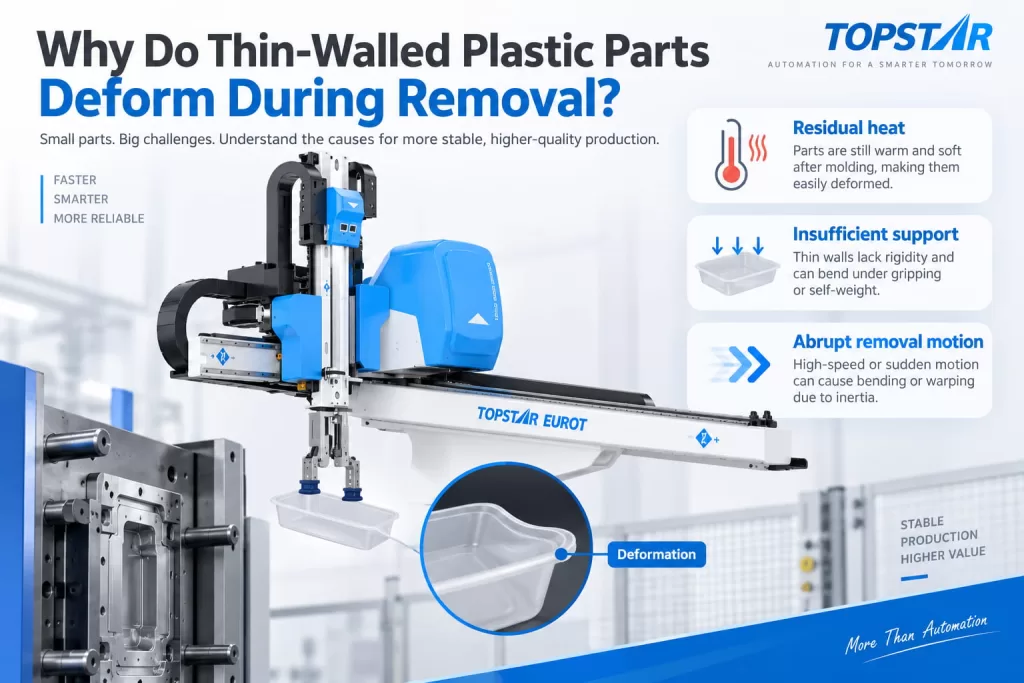
Excessively Concentrated Gripping Force May Cause Deformation in Thin-Walled Plastic Parts
The second issue concerns force distribution.
Placing a large vacuum pad at the center of a flexible panel may cause localized tensile deformation. Similarly, if mechanical clamps are positioned too close to thin edges, they may cause the product to bend or leave indentations.
Therefore, end-effectors used to remove thin-walled parts should typically distribute the applied force across multiple stable areas rather than concentrating it at a single point. Instead of a single, powerful suction point, the end-effector can utilize multiple small suction cups distributed around areas of higher structural strength. The goal is to support the part’s geometry while keeping local stress low.
Deformation Caused by Excessively Abrupt Robot Movements
The third issue concerns the robot’s motion characteristics.
Even with the correct gripping position, rapid acceleration or sudden changes in direction can generate inertial forces that cause high-temperature parts to bend.
Therefore, the take-out robot must combine high speed with stable motion.
The robot should enter the mold quickly, grasp the part, and exit promptly to keep the molding cycle time unaffected. However, once it contacts the product, its acceleration, deceleration, and motion trajectory must be strictly controlled. Excessive vibration at the robot arm or EOAT may also exacerbate deformation. For this reason, in thin-walled part applications, the robot’s rigidity, servo response speed, positioning accuracy, and low-vibration structural design are critical.
Inaccurate removal paths may lead to warping
The fourth reason is a deviation between the Cartesian robot’s path and the actual ejection position.
After thousands of cycles, the mold does not always remain in exactly the same mechanical position. Slight variations in the mold opening stroke, ejector mechanism movement, or the injection molding machine’s operating condition can alter the actual removal position. If the product shifts slightly but the robot continues to follow a fixed path, the end-of-arm tool may pull the product sideways. This can result in a collision with the mold and an off-center grasp. For thin-walled plastic parts that are still hot, these deviations can cause permanent deformation.
How to Remove Thin-Walled Plastic Parts Without Deformation?
Preventing deformation requires comprehensive control of four factors: ejection temperature, support method, robot motion, and synchronization of the removal actions.
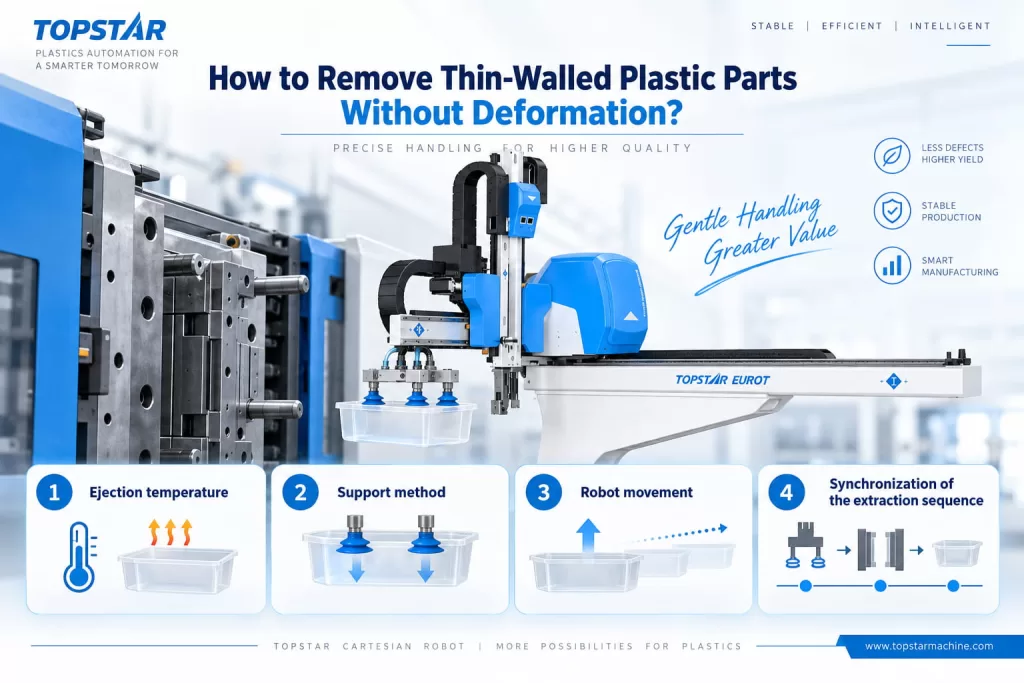
Thin-Walled Plastic Parts Must Have Sufficient Rigidity Before Removal
The primary task is to determine the earliest safe ejection timing.
The part does not need to cool completely to room temperature inside the mold; it only needs to have sufficient rigidity to withstand the stresses generated during ejection and robotic handling. However, premature removal may shorten the molding cycle at the expense of an increased scrap rate. Therefore, the practical goal is to achieve:
Shortest cooling time + sufficient part rigidity + stable robotic removal motion
Uniform cooling is crucial; uneven cooling and shrinkage variations generate internal stresses, causing the part to warp after ejection. Robots cannot correct thermally unstable parts, so mold cooling and removal-motion settings should be optimized in coordination.
A well-distributed and repeatable gripping method is required
The end-effector must support the product at a stable position and apply an appropriate gripping force. For vacuum handling, the following factors should be considered:
Number and location of suction points;
Product surface geometry;
Vacuum level;
Part temperature;
Expected acceleration after removal.
Multi-point suction is particularly effective for large, flexible products, as multiple support points distribute the load and reduce the stress on individual localized areas. The gripping layout must also be repeatable. If a Cartesian robot approaches different positions in different cycles, the same set of fixtures may subject the product to varying stresses.
Precise and Low-Vibration Retrieval Motion Is Required
Although high-speed retrieval can shorten mold opening time, speed alone is not the ultimate goal.
Robot motion must balance the following:
Rapid approach + Precise positioning + Stable gripping + Smooth withdrawal
High positioning repeatability ensures that vacuum cups or grippers align precisely with the intended contact areas. High structural rigidity reduces unnecessary oscillations, while servo control allows precise adjustment of acceleration and deceleration. Therefore, the ideal motion profile should employ rapid movement as the robot disengages from the product, while adopting a more controlled motion during the gripping and initial removal phases.
This approach protects thin-walled structures without unnecessarily slowing down the entire molding cycle.
Synchronization of Robot Movements with Mold and Ejector Mechanism Positions Must Be Achieved
The removal sequence should respond to the injection molding machine’s actual status rather than relying solely on fixed time settings. The Cartesian robot should recognize the following sequence of actions:
Mold fully open → Confirm ejection mechanism/part position → Robot enters → Confirm grasping → Controlled removal → Robot exits mold area.
This prevents the Cartesian robot from attempting to remove the part before the mold or ejection mechanism has reached the specified position. The more precisely the robot’s movements are synchronized with those of the injection molding machine, the less unnecessary tensile or torsional force is applied to the part.
How do Topstar Cartesian robots protect thin-walled plastic parts during the removal process?
When designing Cartesian robots, Topstar considers the practical risks of removing high-temperature, thin-walled plastic parts. Our goal is not only to shorten removal time but also to maintain precise positioning, reduce vibration, control removal force, and ensure synchronization between the robot, the mold, and the ejection mechanism. Thin-walled plastic parts are protected primarily through the following three performance features:
- High positioning accuracy and low vibration
- Mold-opening position compensation and flexible floating control
- Multi-point gripping for better support
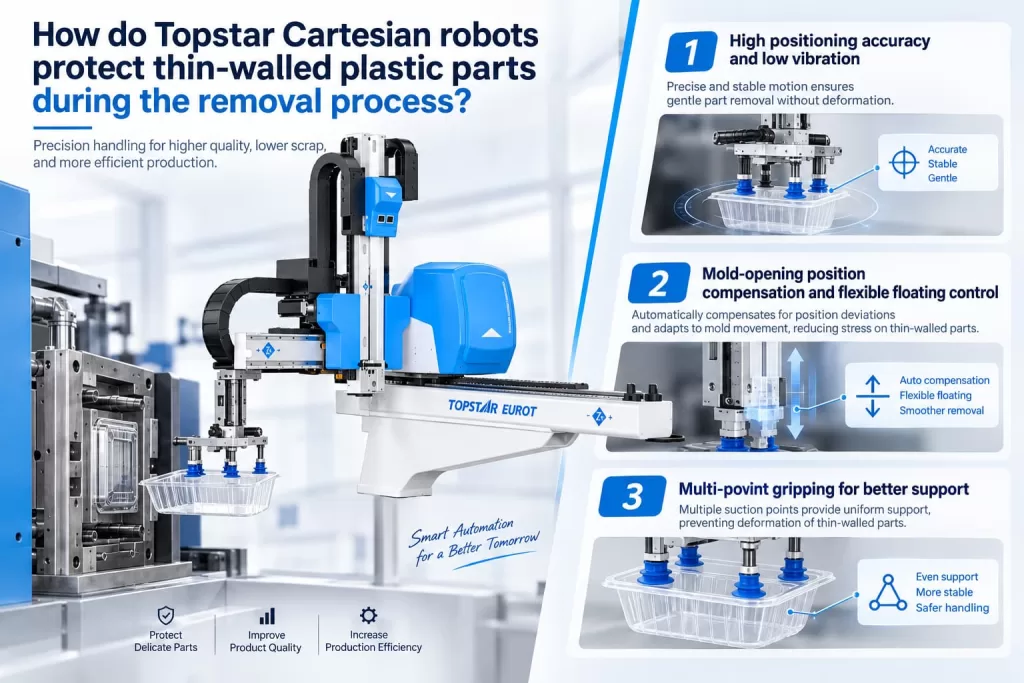
Improving the Stability of Thin-Walled Plastic Part Removal
When it comes to the removal stage of thin-walled parts after molding, avoiding deformation during removal is straightforward:
Selecting a Cartesian injection molding robot with precise positioning, smooth, low-vibration motion, synchronized mold tracking, and evenly distributed gripping force enables rapid part removal without deformation. By meeting these conditions, Topstar’s Cartesian injection molding robots not only reduce mold opening time but also ensure that thin-walled plastic parts maintain consistent geometry and quality across all molding cycles.
TRENDING POSTS
- Breaking Through the Full Scene-to-AI Link! Topstar Industrial Data Collection Matrix Achieves Major Technical Breakthro 2026/09/18
- TOPSTAR Selected in “Forbes China AI Top 50” and Wins “2026 Embodied AI Industry Benchmark Award” 2026/09/18
- Topstar Achieves ISO 13849 Functional Safety Certification for Robotics 2026/09/18
- Topstar Completes Key Puzzle in Embodied Intelligence Data Closed Loop — Industrial AI Capability Foundation Now in Place 2026/09/18
HOT TOPIC
- .ervo motor-driven linear robots
- •
- 1.0 guangdong topstar technology co. ltd
- 1.0 topstar china
- 1.0 topstar robot
- 11
- 160℃ mold temperature controller
- 170 ton injection molding machine
- 2
- 21
- 220-ton injection molding machine
- 23
- 260 ton injection molding machine
- 3 axis robot
- 3 axis robots
- 3 in 1 Compact Dehumidifying Dryer
- 3-axis robot
- 3-axis robots
- 39
- 4 axis robot
- 4-axis SCARA robot
- 41
- 460T injection molding machine
- 5-axis CNC machine
- 62
- 90 ton injection molding machine
- accuracy
- Air Chillers
- air-cooled chillers
- all electric injection molding machine
- all electric injection molding machines
- all-electric injection molding machine
- All-electric injection molding machines
- and overall production quality. Therefore
- AP-RubberPlas
- auto cooling system
- auto loader
- Auto Loaders
- automated injection molding machine
- Automation changed engineering
- automation of injection molding robots
- automotive parts injection molding
- Auxiliary Equipment
- auxiliary machine
- Bench Injection Molding Machine
- cabinet dryer
- Cabinet dryer manufacturers
- Cabinet dryers
- cartesian coordinate robot
- Cartesian Coordinate Robots
- Cartesian injection robot
- Cartesian robot
- Central Feeding System
- Central Feeding Systems
- chiller
- CNC Drilling Machine
- CNC Drilling Machines
- cnc engraving machine manufacturer
- cnc laser cutting machine manufacturer
- CNC machine
- CNC Machine Center
- CNC Machine for Sale
- CNC Machine Manufacturing
- CNC Machine Tool
- CNC machine tool product
- CNC Machining Center
- CNC wood carving machine
- Compact Dehumidifying Dryer
- Cooling system
- Cross-Walking Single Axis Servo Cylinder Robot
- Cross-Walking Single-Axis Servo Cylinder Robot
- Cross-Walking Three-Axis/Five-Axis Servo Driven Robot
- cross-walking three-axis/five-axis servo-driven robot
- Dehumidifier Dryer
- Dehumidifying Dryer
- dehumidifying dryers
- delta parallel robot
- Desktop Injection Molding Machine
- Desktop injection molding machines
- Desktop Molding Machine
- desktop plastic injection machine
- Desktop Plastic Injection Molding Machine
- detachable autoloader
- Digital Transformation
- direct clamp injection molding machine
- Direct clamp injection molding machines
- Dosing & mixing system
- Drilling Centers
- Drying and dehumidification system
- drying and dehumidifying equipment
- Drying and Dehumidifying System
- drying system
- effective and efficient. Cabinet dryers are also used in other industries where large quantities of material need to be dried
- efficient injection molding machine
- elbow hydraulic injection molding machines
- electric injection molding machine
- electric injection molding machines
- energy-efficient injection molding robot
- energy-efficient water chiller
- energy-efficient water chillers
- energy-saving injection molding machine
- etc. Among injection molding robots
- exhibition
- features of CNC machine
- Feeding And Conveying System
- Five Axis Machine Center
- Flexible Production Line
- Fully automatic injection molding machine
- Gathering Topstar
- giant injection molding machine
- GMU-600 5-Axis Machining Center
- Granulating & Recycling System
- granulator machine
- gravimetric blender
- Heavy duty injection molding machine
- Heavy-Duty Take-Out Robot
- High-precision electric molding machines
- high-precision plastic molding machines
- high-speed all electric injection molding machine
- high-speed electric injection molding machine
- High-Speed Packaging Injection Molding
- Honeycomb rotor dehumidifier
- hopper dryer
- Hopper Dryers
- horizontal injection molding machine
- Horizontal Injection Molding Machines
- Horizontal Injection Moulding Machine
- Horizontal Mixer manufacturer
- How The CNC Machine Works
- hybrid injection molding machine
- hydraulic injection molding machine
- Hydraulic Injection Molding Machines
- in this article
- Industrial AI
- Industrial Automation
- Industrial robot
- Industrial Robot Chinese brand
- industrial robot parts
- industrial robot supplier
- Industrial robots
- Industry Chain
- Injection Manipulator
- injection manipulator robot
- injection mold machines
- Injection molding
- Injection molding automation
- Injection Molding Automation Solution
- injection molding dryer
- Injection molding equipment
- injection molding hopper dryer
- Injection molding machine
- injection molding machine brand
- Injection Molding Machine Factory
- Injection Molding Machine Manufacture
- Injection molding machine manufacturer
- injection molding machine manufacturers
- Injection molding machine procurement
- injection molding machine robotic arm
- injection molding machine with a robot
- Injection molding machines
- injection molding material dehumidifying
- injection molding plant
- injection molding process
- Injection Molding Robot
- injection molding robot arm
- Injection molding robot automation
- Injection molding robotic arm
- injection molding robots
- injection molding whole plant
- injection moulding dryer
- Injection moulding machine
- injection moulding machines
- Injection Moulding Robots
- Injection Robot
- Injection robot arm
- Injection robot manufacturer
- Injection robot wholesale
- injection robots
- Intelligent Factory
- intelligent injection molding machines
- Intelligent Manufacturing
- intelligent mold temperature
- intelligent mold temperature controller
- Intelligent mould temperature controller
- intelligent whole plant solution
- InterPlas Thailand 2025
- Introducing Injection Robot
- It is the best choice for drying large quantities of material at once. Cabinetmakers use these machines because they are fast
- Large flow water type mold temperature controller
- large injection molding machine
- large injection molding machines
- Learn what industrial automation and robotics is
- linear robot
- linear robots
- low speed sound-proof granulator
- machine plastic molding
- make sure to add some! Improvements (2) Keyphrase in introduction: Your keyphrase or its synonyms appear in the first paragraph of the copy
- manipulator machine
- manufacturing
- Manufacturing Innovation
- medical grade injection molding machines
- Medical Injection Molding
- medical injection molding machine
- medical injection molding machines
- micro injection molding machine
- middle speed granulator
- Mini CNC machine manufacturers.
- mobile cover making machine
- Mold Temperature Control System
- mold temperature controller
- mold temperature controllers
- molding machine
- molding material Dehumidifying System
- mould temperature control system
- mould temperature controller
- mould temperature controller
- mould temperature controllers
- New electric injection molding machine
- Nitrogen Dryer
- nitrogen dryer manufacturer
- nitrogen dryer system manufacturer
- Oil type mold temperature controller
- Oil type mold temperature controllers
- open day
- optical component injection molding
- Optical-grade dehumidifying dryer
- Outbound links: No outbound links appear in this page. Add some! Images: No images appear on this page. Add some! Internal links: No internal links appear in this page
- packaging injection molding
- Packaging Solutions
- PET Preform injection molding
- phone case maker machine
- phone case making machine
- phone cover making machine
- PID Control Mold Temperature Controller
- plastic auto loader
- plastic bottle making machine
- plastic bottle manufacturing
- plastic bucket making machine
- plastic bucket manufacturing
- Plastic chair making machine
- plastic dryer for injection molding
- plastic forming equipment
- Plastic Granulator
- Plastic Granulators
- plastic hopper dryer
- plastic injection machine
- plastic injection machines
- plastic injection molding
- Plastic injection molding equipment
- Plastic injection molding machine
- Plastic Injection Molding Machines
- plastic injection moulding machine
- plastic injection moulding machines
- plastic injection robot
- plastic molding
- Plastic Molding Industry
- Plastic Molding machine
- plastic molding machine 1
- Plastic Molding Machines
- plastic molding press
- plastic moulding machine
- plastic phone case making machine
- plastic-molding machine
- powerful granulator
- Powerful Type Sound-Proof Granulator
- precision injection molding
- precision injection molding machines
- production of plastic seats
- pure water mould temperature controller
- Robot injection molding
- robot injection molding machine
- robot manufacturing companies
- Robotic arm for injection molding machine
- robotic injection molding machines
- robotics in injection molding
- SCARA robot
- SCARA robots
- Screw dosers
- Service-oriented manufacturing
- Servo Cylinder Robot
- servo driven robot
- Servo Driven Robots
- servo injection molding machine
- servo injection robots
- servo motor-driven linear robots
- servo-driven 3-axis robot
- Servo-driven injection molding machine
- Servo-Driven Robot
- Setup of injection machine
- Silicone Injection Molding Machine
- six-axis industrial robot
- Smart Manufacturing
- soundproof granulator
- Sprue Picker
- Stainless Hopper Dryer
- Stainless Hopper Dryers
- star club
- swing arm robot
- T1 Cartesian injection robot
- take-out robot
- take-out robots
- Thailand 4.0
- the choice between servo-driven robots and hydraulic robots will have a certain impact on efficiency
- the most popular injection molding machine
- the type of injection molding robot
- TIC2000 Control System
- TMII injection molding machine
- toggle clamp injection molding machine
- Toggle Hydraulic Injection Molding Machines
- toggle injection molding machine
- Top 10 brands of injection robots
- Topstar
- Topstar Electric Injection Molding Machine InterPlas Thailand 2025 Smart Manufacturing Thailand 4.0
- Topstar Engineering
- Topstar Industrial Robots
- Topstar injection molding intelligent
- Topstar Scara Robots
- Useful Injection molding machine
- Vertical machining centers
- volumetric type blender
- Washing Machine Case Molding Solution
- water chiller
- water chillers
- water distributor
- water type mold temperature controller
- Water Type MoldTemperature Controller
- Water-Cooled Chillers
- Water-cooled Mold Temperature Controller
- water-type mold temperature controller
- Water-Type Mould Temperature Controllers
- We often face choices when performing injection molding. We will choose the type of injection molding machine
- wholesale of injection molding machines
- x carve CNC
- 热门查询 点击次数 展示 排名 topstar