
How Can Fine Dust on Resin Pellets Be Removed Before Precision Optical Molding?
2026/11/16 By le zhan
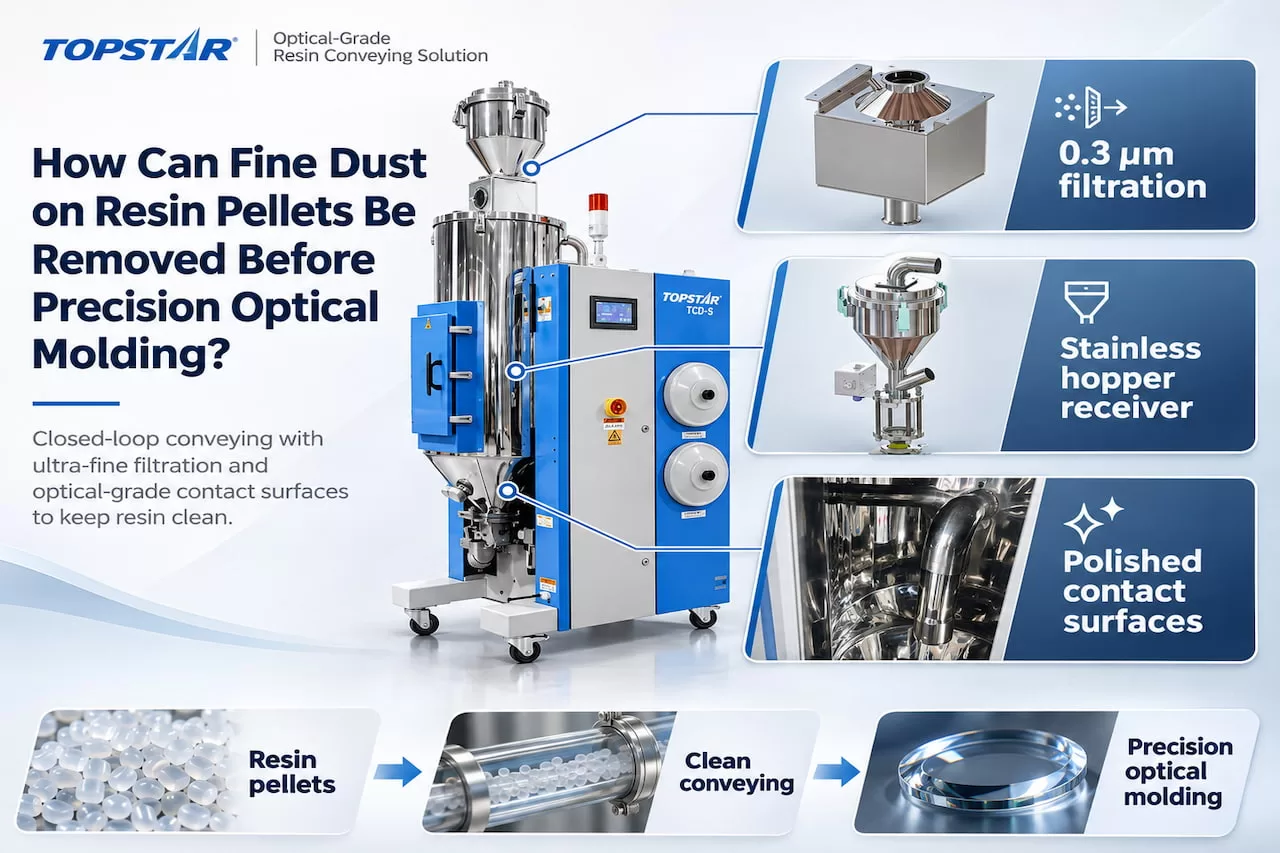
Fine dust particles on resin pellets can cause visible spots, inclusions, and surface defects in precision optical injection-molded parts; these defects are especially noticeable in transparent lenses, LED components, and light guides. To eliminate this type of contamination, simply filtering and drying the air is not sufficient. Operators must first separate loose particles from the resin surface while preventing airborne dust or material handling components from introducing new contaminants. Therefore, for precision optical injection molding, Topstar offers optical-grade dehumidifying dryers that remove fine dust from resin pellets by utilizing an optical-grade stainless steel hopper receiver, 0.3-micron high-efficiency filtration, polished material-contact surfaces, and a fully enclosed conveying system.
Where Does Dust Contamination Come From Before Precision Optical Molding?
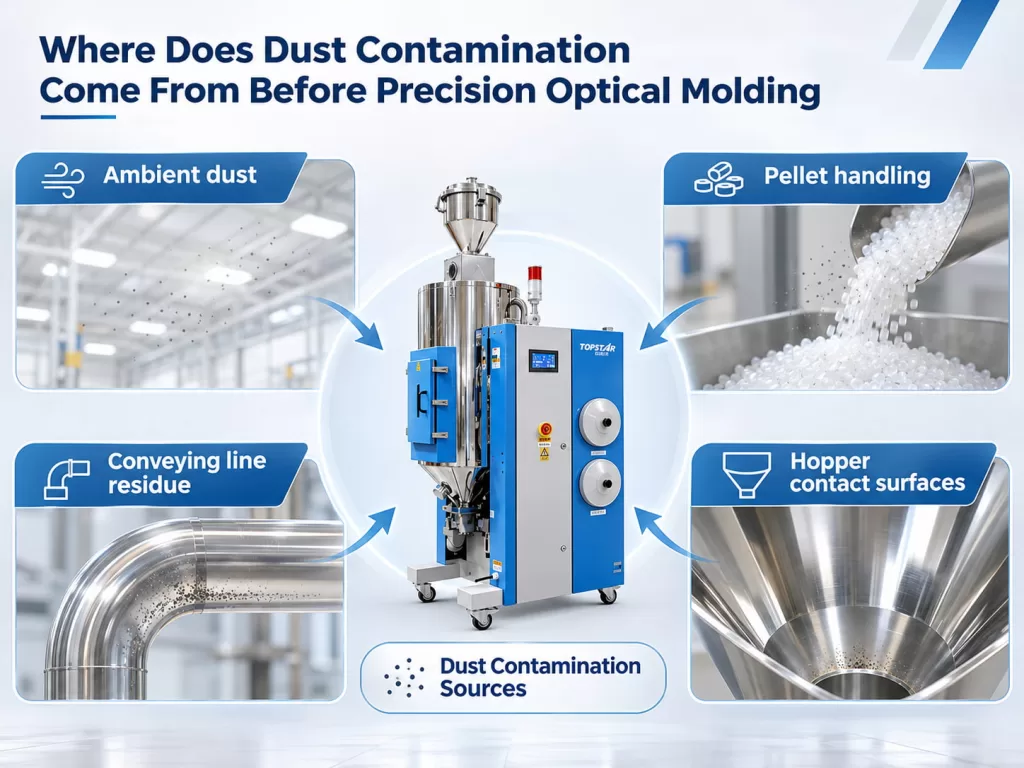
Dust contamination can originate from either the raw materials themselves or from material handling equipment. Resin pellets may become contaminated with fine dust during packaging, transportation, storage, or preliminary processing. Additionally, open feed ports can allow external particles to enter, and friction between pellets in conveying pipes or on other contact surfaces can generate new particles. Therefore, to remove fine dust from resin pellets before injection molding, it is essential to understand these sources of contamination. This is because simply removing existing dust without controlling contamination in subsequent stages will not ensure that the resin remains clean throughout the entire production process.
How Does Dust Accumulate on Resin Pellets During Material Handling?
Fine dust can accumulate on the surface of resin pellets even before they enter the injection molding machine. During packaging and transportation, friction between pellets and between pellets and container walls generates microscopic particles that adhere to the pellet surfaces. Additionally, material cutting, handling, and transfer may introduce external dust.
Unlike many conventional plastic products, optical products have extremely high requirements for appearance and transparency. Even minute foreign particles can become visible inclusions or surface defects after injection molding. Dust contamination can also originate within the material conveying system. For example, worn conveying hoses, dust accumulation in hoppers, and unsealed conveying connections can all introduce additional particles even after an initial cleaning process.
Therefore, dust removal measures must not only eliminate existing contaminants from the resin pellets but also prevent subsequent processing steps from introducing new contaminants.
How can dust be removed from resin pellets for precision optical molding?
Removing dust from resin pellets requires a comprehensive approach combining physical separation, air filtration, and contamination-prevention measures in material handling. These measures address different stages of the drying and dehumidification process: feed hoppers are used to separate loose impurities from the pellet surfaces; high-efficiency filtration systems reduce airborne contaminants; and clean contact surfaces combined with sealed conveying methods effectively prevent secondary contamination.
Removing Dust from Resin Pellets Using Optical-Grade Stainless Steel Hopper Receivers
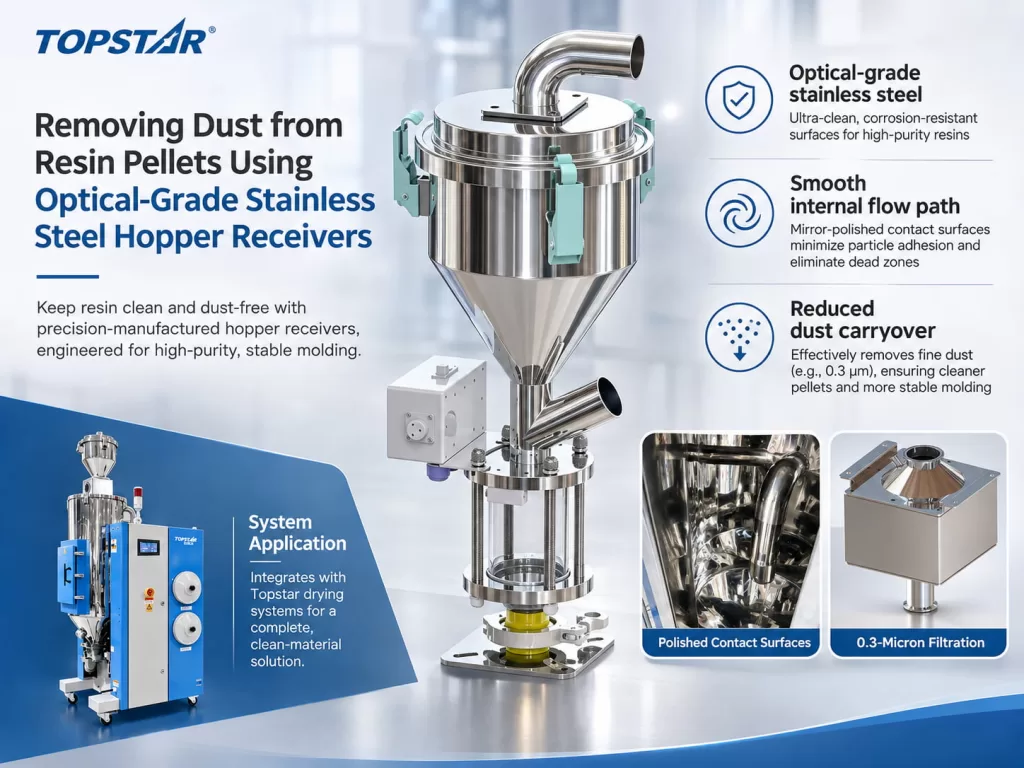
The optical-grade hopper receiver uses controlled airflow to keep the resin pellets loose, separating fine dust from their surfaces. When the airflow enters the material bin, it agitates and disperses the resin pellets, preventing them from packing tightly together. This dynamic process helps release powder and fine particles adhering to the pellet surfaces. Subsequently, the airflow carries away the separated dust, allowing cleaner resin pellets to proceed to subsequent material preparation processes.
Topstar equips its optical-grade dehumidifying dryers with this type of boiling-type hopper receiver, which uses airflow agitation to remove dust. This system provides a dedicated cleaning process before the resin enters the drying and conveying stages.
This ensures that dust is physically separated from the resin before it reaches the injection molding machine, eliminating the need to rely solely on downstream air filtration systems to control contamination.
Preventing Airborne Dust Contamination with 0.3-Micron Filtration
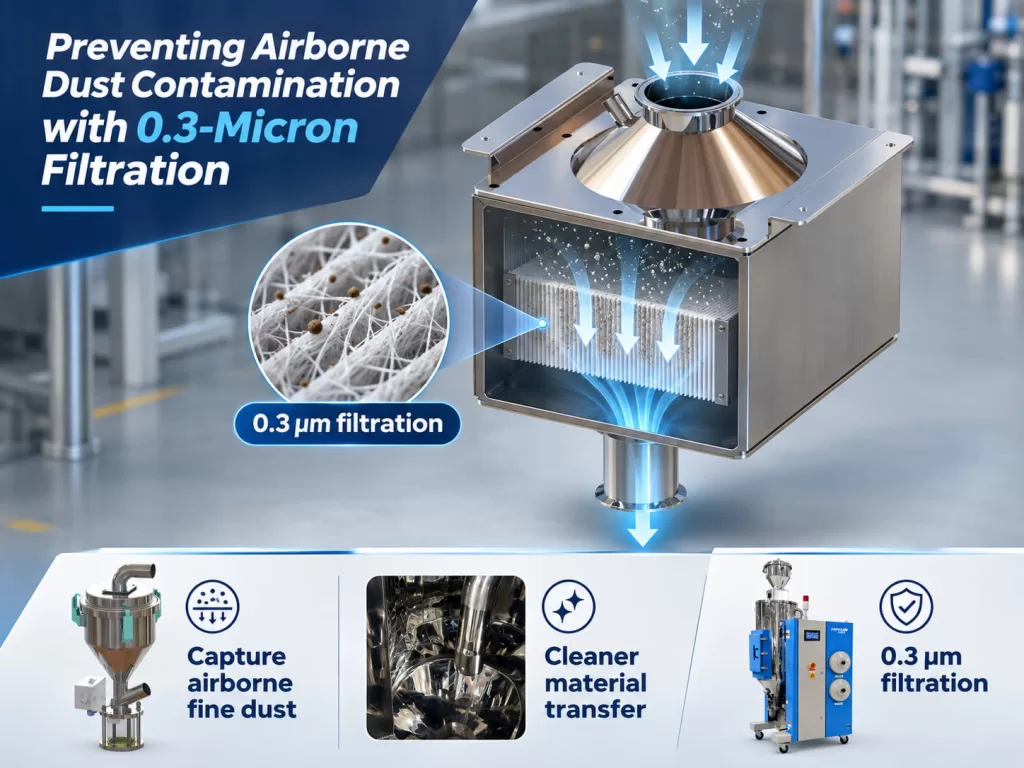
After removing surface dust, it is also essential to ensure that airborne particles do not recontaminate the resin.
High-efficiency 0.3-micron filters capture microscopic particles carried by process airflow, preventing them from entering the protected material-conveying path. The 0.3-micron HEPA filters equipped in Topstar’s TCDH-S series of optical-grade dehumidifying dryers comply with the EN 1822 standard and have a nominal capture efficiency of up to 99.97%. In precision optical injection molding, this filtration mechanism ensures that the process airflow does not become a source of dust contamination. Therefore, for precision optical molding, Topstar integrates these high-efficiency filters into its dehumidifying dryers, ensuring materials are effectively protected during both drying and subsequent handling.
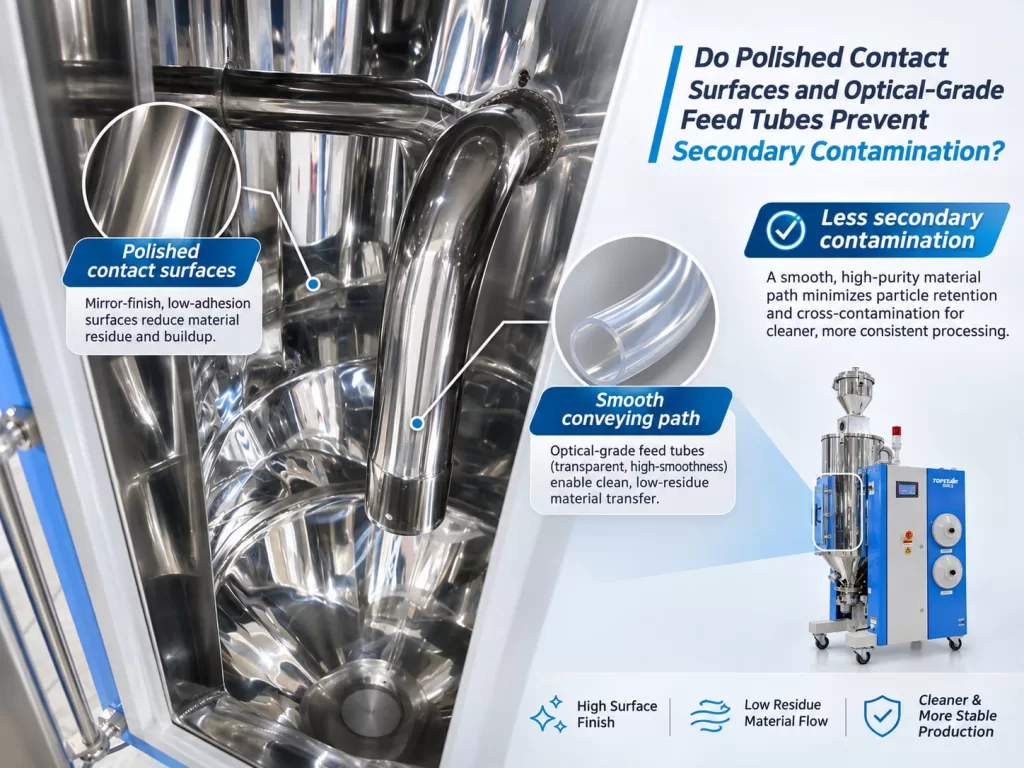
Do Polished Contact Surfaces and Optical-Grade Feed Tubes Prevent Secondary Contamination?
Even after surface dust removal and air filtration, resin may still become contaminated when it contacts equipment components. Rough surfaces and accumulated residues can trap microscopic particles, while worn feed hoses may generate additional dust due to friction.
Topstar addresses these risks through a variety of design features: mirror-polished material-contact surfaces, wear-resistant, optical-grade polyurethane (PU) feed tubing, dust-removal hoppers, and fully sealed storage and conveying lines. These designs help reduce particle buildup, minimize friction-generated dust, and prevent external contamination of the material during conveyance.
Ensuring Resin Purity in Precision Optical Molding
In precision optical injection molding, a single filtration step cannot remove all fine dust. The material hopper first separates loose dust from the surface of the resin particles; a 0.3-micrometer (μm) filter reduces contamination from airborne particles; and polished contact surfaces, combined with a fully enclosed conveying system, effectively prevent secondary contamination. Throughout the drying and feeding process, these measures must work in concert to keep the material clean at all times. This integrated dehumidifying dryer provides a more reliable foundation for material preparation, enabling high-quality optical injection molding.
TRENDING POSTS
- TOPS DAY 2026: Turning Industrial AI into Real-World Impact 2026/11/16
- Breaking Through the Full Scene-to-AI Link! Topstar Industrial Data Collection Matrix Achieves Major Technical Breakthro 2026/11/16
- TOPSTAR Selected in “Forbes China AI Top 50” and Wins “2026 Embodied AI Industry Benchmark Award” 2026/11/16
- Topstar Achieves ISO 13849 Functional Safety Certification for Robotics 2026/11/16
HOT TOPIC
- .ervo motor-driven linear robots
- •
- 1.0 guangdong topstar technology co. ltd
- 1.0 topstar china
- 1.0 topstar robot
- 11
- 160℃ mold temperature controller
- 170 ton injection molding machine
- 2
- 21
- 220-ton injection molding machine
- 23
- 260 ton injection molding machine
- 3 axis robot
- 3 axis robots
- 3 in 1 Compact Dehumidifying Dryer
- 3-axis robot
- 3-axis robots
- 39
- 4 axis robot
- 4-axis SCARA robot
- 41
- 460T injection molding machine
- 5-axis CNC machine
- 62
- 90 ton injection molding machine
- accuracy
- Air Chillers
- air-cooled chillers
- all electric injection molding machine
- all electric injection molding machines
- all-electric injection molding machine
- All-electric injection molding machines
- and overall production quality. Therefore
- AP-RubberPlas
- auto cooling system
- auto loader
- Auto Loaders
- automated injection molding machine
- Automation changed engineering
- automation of injection molding robots
- automotive parts injection molding
- Auxiliary Equipment
- auxiliary machine
- Bench Injection Molding Machine
- cabinet dryer
- Cabinet dryer manufacturers
- Cabinet dryers
- cartesian coordinate robot
- Cartesian Coordinate Robots
- Cartesian injection robot
- Cartesian robot
- Central Feeding System
- Central Feeding Systems
- chiller
- CNC Drilling Machine
- CNC Drilling Machines
- cnc engraving machine manufacturer
- cnc laser cutting machine manufacturer
- CNC machine
- CNC Machine Center
- CNC Machine for Sale
- CNC Machine Manufacturing
- CNC Machine Tool
- CNC machine tool product
- CNC Machining Center
- CNC wood carving machine
- Compact Dehumidifying Dryer
- Cooling system
- Cross-Walking Single Axis Servo Cylinder Robot
- Cross-Walking Single-Axis Servo Cylinder Robot
- Cross-Walking Three-Axis/Five-Axis Servo Driven Robot
- cross-walking three-axis/five-axis servo-driven robot
- Dehumidifier Dryer
- Dehumidifying Dryer
- dehumidifying dryers
- delta parallel robot
- Desktop Injection Molding Machine
- Desktop injection molding machines
- Desktop Molding Machine
- desktop plastic injection machine
- Desktop Plastic Injection Molding Machine
- detachable autoloader
- Digital Transformation
- direct clamp injection molding machine
- Direct clamp injection molding machines
- Dosing & mixing system
- Drilling Centers
- Drying and dehumidification system
- drying and dehumidifying equipment
- Drying and Dehumidifying System
- drying system
- effective and efficient. Cabinet dryers are also used in other industries where large quantities of material need to be dried
- efficient injection molding machine
- elbow hydraulic injection molding machines
- electric injection molding machine
- electric injection molding machines
- energy-efficient injection molding robot
- energy-efficient water chiller
- energy-efficient water chillers
- energy-saving injection molding machine
- etc. Among injection molding robots
- exhibition
- features of CNC machine
- Feeding And Conveying System
- Five Axis Machine Center
- Flexible Production Line
- Fully automatic injection molding machine
- Gathering Topstar
- giant injection molding machine
- GMU-600 5-Axis Machining Center
- Granulating & Recycling System
- granulator machine
- gravimetric blender
- Heavy duty injection molding machine
- Heavy-Duty Take-Out Robot
- High-precision electric molding machines
- high-precision plastic molding machines
- high-speed all electric injection molding machine
- high-speed electric injection molding machine
- High-Speed Packaging Injection Molding
- Honeycomb rotor dehumidifier
- hopper dryer
- Hopper Dryers
- horizontal injection molding machine
- Horizontal Injection Molding Machines
- Horizontal Injection Moulding Machine
- Horizontal Mixer manufacturer
- How The CNC Machine Works
- hybrid injection molding machine
- hydraulic injection molding machine
- Hydraulic Injection Molding Machines
- in this article
- Industrial AI
- Industrial Automation
- Industrial robot
- Industrial Robot Chinese brand
- industrial robot parts
- industrial robot supplier
- Industrial robots
- Industry Chain
- Injection Manipulator
- injection manipulator robot
- injection mold machines
- Injection molding
- Injection molding automation
- Injection Molding Automation Solution
- injection molding dryer
- Injection molding equipment
- injection molding hopper dryer
- Injection molding machine
- injection molding machine brand
- Injection Molding Machine Factory
- Injection Molding Machine Manufacture
- Injection molding machine manufacturer
- injection molding machine manufacturers
- Injection molding machine procurement
- injection molding machine robotic arm
- injection molding machine with a robot
- Injection molding machines
- injection molding material dehumidifying
- injection molding plant
- injection molding process
- Injection Molding Robot
- injection molding robot arm
- Injection molding robot automation
- Injection molding robotic arm
- injection molding robots
- injection molding whole plant
- injection moulding dryer
- Injection moulding machine
- injection moulding machines
- Injection Moulding Robots
- Injection Robot
- Injection robot arm
- Injection robot manufacturer
- Injection robot wholesale
- injection robots
- Intelligent Factory
- intelligent injection molding machines
- Intelligent Manufacturing
- intelligent mold temperature
- intelligent mold temperature controller
- Intelligent mould temperature controller
- intelligent whole plant solution
- InterPlas Thailand 2025
- Introducing Injection Robot
- It is the best choice for drying large quantities of material at once. Cabinetmakers use these machines because they are fast
- Large flow water type mold temperature controller
- large injection molding machine
- large injection molding machines
- Learn what industrial automation and robotics is
- linear robot
- linear robots
- low speed sound-proof granulator
- machine plastic molding
- make sure to add some! Improvements (2) Keyphrase in introduction: Your keyphrase or its synonyms appear in the first paragraph of the copy
- manipulator machine
- manufacturing
- Manufacturing Innovation
- medical grade injection molding machines
- Medical Injection Molding
- medical injection molding machine
- medical injection molding machines
- micro injection molding machine
- middle speed granulator
- Mini CNC machine manufacturers.
- mobile cover making machine
- Mold Temperature Control System
- mold temperature controller
- mold temperature controllers
- molding machine
- molding material Dehumidifying System
- mould temperature control system
- mould temperature controller
- mould temperature controller
- mould temperature controllers
- New electric injection molding machine
- Nitrogen Dryer
- nitrogen dryer manufacturer
- nitrogen dryer system manufacturer
- Oil type mold temperature controller
- Oil type mold temperature controllers
- open day
- optical component injection molding
- Optical-grade dehumidifying dryer
- Outbound links: No outbound links appear in this page. Add some! Images: No images appear on this page. Add some! Internal links: No internal links appear in this page
- packaging injection molding
- Packaging Solutions
- PET Preform injection molding
- phone case maker machine
- phone case making machine
- phone cover making machine
- PID Control Mold Temperature Controller
- plastic auto loader
- plastic bottle making machine
- plastic bottle manufacturing
- plastic bucket making machine
- plastic bucket manufacturing
- Plastic chair making machine
- plastic dryer for injection molding
- plastic forming equipment
- Plastic Granulator
- Plastic Granulators
- plastic hopper dryer
- plastic injection machine
- plastic injection machines
- plastic injection molding
- Plastic injection molding equipment
- Plastic injection molding machine
- Plastic Injection Molding Machines
- plastic injection moulding machine
- plastic injection moulding machines
- plastic injection robot
- plastic molding
- Plastic Molding Industry
- Plastic Molding machine
- plastic molding machine 1
- Plastic Molding Machines
- plastic molding press
- plastic moulding machine
- plastic phone case making machine
- plastic-molding machine
- powerful granulator
- Powerful Type Sound-Proof Granulator
- precision injection molding
- precision injection molding machines
- production of plastic seats
- pure water mould temperature controller
- Robot injection molding
- robot injection molding machine
- robot manufacturing companies
- Robotic arm for injection molding machine
- robotic injection molding machines
- robotics in injection molding
- SCARA robot
- SCARA robots
- Screw dosers
- Service-oriented manufacturing
- Servo Cylinder Robot
- servo driven robot
- Servo Driven Robots
- servo injection molding machine
- servo injection robots
- servo motor-driven linear robots
- servo-driven 3-axis robot
- Servo-driven injection molding machine
- Servo-Driven Robot
- Setup of injection machine
- Silicone Injection Molding Machine
- six-axis industrial robot
- Smart Manufacturing
- soundproof granulator
- Sprue Picker
- Stainless Hopper Dryer
- Stainless Hopper Dryers
- star club
- swing arm robot
- T1 Cartesian injection robot
- take-out robot
- take-out robots
- Thailand 4.0
- the choice between servo-driven robots and hydraulic robots will have a certain impact on efficiency
- the most popular injection molding machine
- the type of injection molding robot
- TIC2000 Control System
- TMII injection molding machine
- toggle clamp injection molding machine
- Toggle Hydraulic Injection Molding Machines
- toggle injection molding machine
- Top 10 brands of injection robots
- Topstar
- Topstar Electric Injection Molding Machine InterPlas Thailand 2025 Smart Manufacturing Thailand 4.0
- Topstar Engineering
- Topstar Industrial Robots
- Topstar injection molding intelligent
- Topstar Scara Robots
- Useful Injection molding machine
- Vertical machining centers
- volumetric type blender
- Washing Machine Case Molding Solution
- water chiller
- water chillers
- water distributor
- water type mold temperature controller
- Water Type MoldTemperature Controller
- Water-Cooled Chillers
- Water-cooled Mold Temperature Controller
- water-type mold temperature controller
- Water-Type Mould Temperature Controllers
- We often face choices when performing injection molding. We will choose the type of injection molding machine
- wholesale of injection molding machines
- x carve CNC
- 热门查询 点击次数 展示 排名 topstar