
How Can TPV Automotive Cup Holders Maintain Shape and Fit Across Injection Molding Production Runs?
2026/11/23 By le zhan
A TPV automotive cup holder must maintain consistent dimensions, gripping performance, and mounting fit throughout repeated production runs. However, TPV’s elastic properties and shear-dependent flow behavior make these requirements sensitive to material preparation, injection conditions, and mold design. A part that passes the initial mold trial may still develop dimensional variations when material batches, plasticization, cooling, or holding pressure change during mass production. Maintaining consistency therefore requires control over both the molding process and the machine’s operating stability. Topstar’s TS and TMII series injection molding machines offer different configurations to support these requirements in TPV automotive cup holders production.
Why is it difficult to achieve stable injection molding of TPV automotive cup holders?
TPV automotive cup holders must satisfy two requirements at the same time: they need sufficient flexibility to accommodate and retain different cup sizes, while maintaining the dimensions required for installation in the vehicle’s center console. These requirements make the molding process more demanding than simply producing a part with the correct overall dimensions. Material flow, wall thickness, gate design, and cooling conditions all influence the final shape and assembly fit.
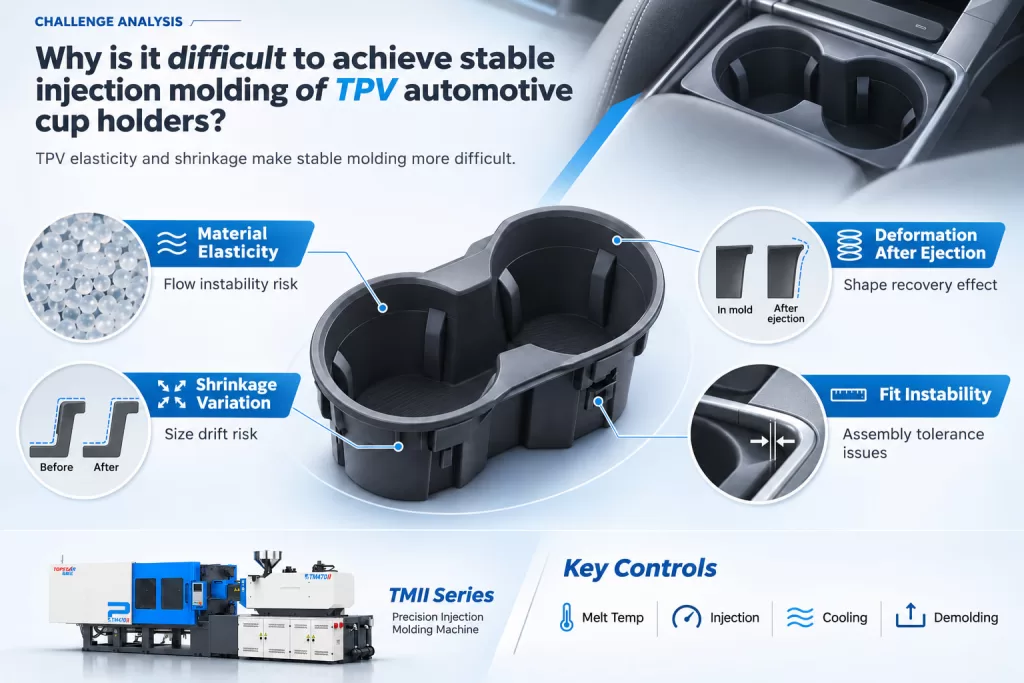
How Do Material Flow Characteristics Affect Mold Filling?
TPV is a thermoplastic vulcanizate that combines thermoplastic processing characteristics with rubber-like elasticity. However, its melt behavior varies according to the formulation, hardness, and grade being processed.
ExxonMobil’s Santoprene TPV Injection Molding Guide describes TPV as a pseudoplastic material, meaning its melt viscosity decreases as shear rate increases. Consequently, injection speed and the shear conditions within the runner and gate influence how readily the material fills the cavity.
In TPV cup holder injection molding, insufficient injection speed can cause premature flow restriction, short shots, or incomplete filling around ribs and mounting features. Excessively high speed, on the other hand, may create excessive shear or unstable filling, increasing the risk of flash.
Manufacturers should therefore consider three factors together:
- Material grade and hardness: Different TPV formulations have different flow characteristics and processing windows.
- Injection speed and pressure: The filling profile must provide sufficient flow without creating excessive pressure or shear.
- Plasticization consistency: Stable screw rotation and repeatable shot preparation help maintain consistent material delivery.
The objective is to establish a filling profile that matches the actual TPV grade and cup holder geometry, rather than applying the same injection settings to every formulation.
How do wall thickness and mold design affect the assembly fit of TPV automotive cup holders?
Wall thickness distribution directly influences how a TPV cup holder cools and retains its shape. The cup-supporting body, bottom section, reinforcing ribs, and mounting clips may have different thicknesses, resulting in different cooling and shrinkage rates.
If these differences are not properly managed, the finished part may develop localized warpage or dimensional variations. These problems can affect the inner cup-holding diameter and the alignment of mounting features.
Gate and runner design also determine how evenly the melt reaches different cavity sections. For this reason, mold engineers should pay particular attention to:
- Balanced filling of the cup body, supporting ribs, and mounting features.
- Consistent wall thickness to reduce differential shrinkage.
- Uniform mold temperature across different cavity regions.
- Adequate mold support and platen parallelism to maintain stable cavity alignment.
These factors must be evaluated together. A stable injection molding machine cannot fully compensate for an unbalanced runner layout, poorly distributed cooling channels, or unsuitable mold geometry.
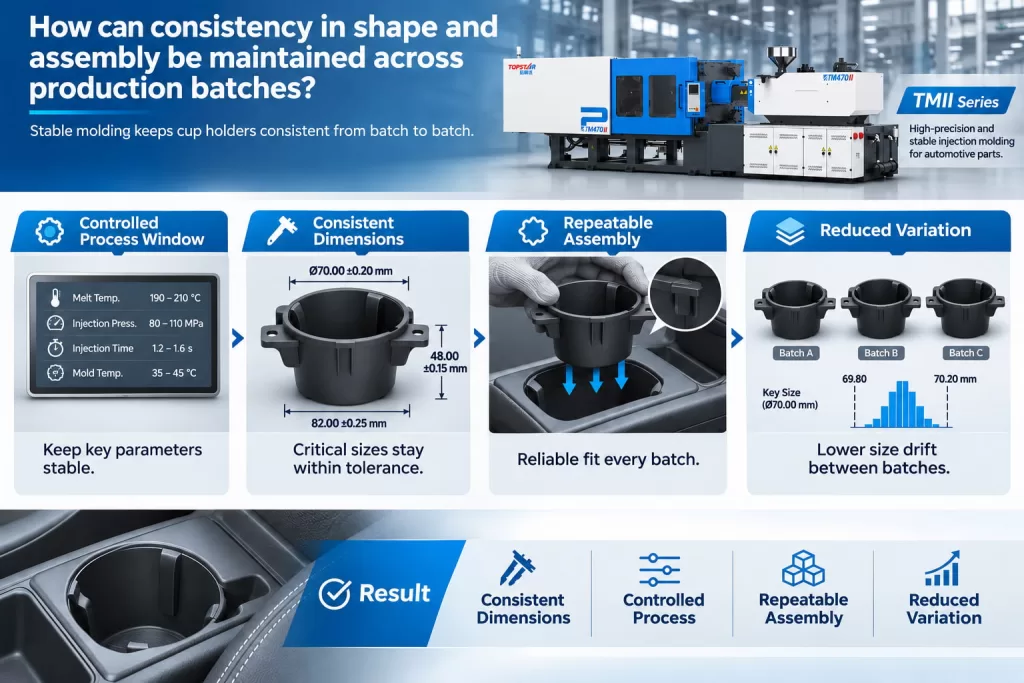
How can consistency in shape and assembly be maintained across production batches?
An acceptable first-off sample does not guarantee that every subsequent TPV cup holder will meet the same dimensional and functional requirements. During continuous production, variations in material batches, plasticization, holding pressure, cooling, and demolding can affect the finished part. Manufacturers therefore need repeatable machine settings and practical inspection procedures to verify that both dimensions and assembly performance remain consistent. Equipment configuration also becomes important because stable injection and plasticization provide the foundation for repeatable production.
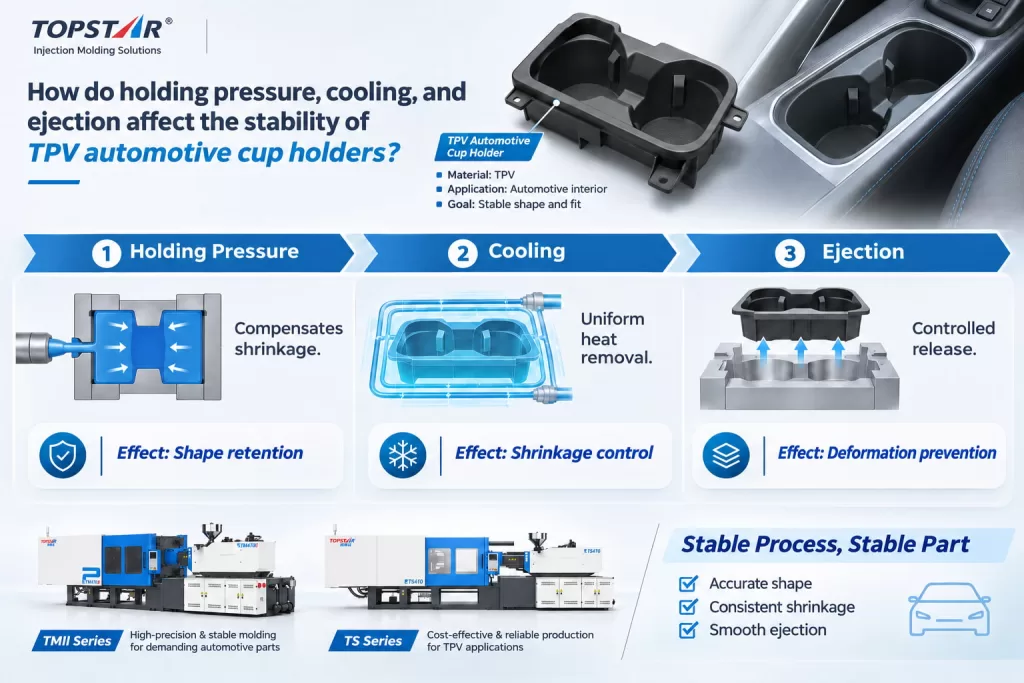
How do holding pressure, cooling, and ejection affect the stability of TPV automotive cup holders?
After cavity filling, holding pressure compensates for volumetric shrinkage as the TPV melt cools. If the holding pressure is insufficient or the holding time is too short, the part may develop localized shrinkage or dimensional variations. Excessive holding pressure can also cause overpacking and unnecessary residual stress.
Cooling must be controlled across the entire cup holder. Differences in wall thickness and mold temperature can cause some sections to shrink faster than others, potentially distorting the cup-holding diameter or mounting interfaces.
TPV’s elastic properties also influence demolding. Softer grades may deform more easily under concentrated ejector forces, so the ejector arrangement and removal sequence should suit the material hardness and part geometry.
For consistent production, manufacturers should optimize holding pressure, V/P switching, cooling time, and ejection conditions together. The finished part should be evaluated after cooling and dimensional stabilization, not only immediately after ejection.
How Can Manufacturers Verify Dimensional and Assembly Consistency?
Dimensional inspection alone cannot confirm that a cup holder performs correctly in its intended application. Manufacturers should combine measurement with functional fit testing and production repeatability checks.
Dimensional inspection
| Inspection item | What should be verified? |
|---|---|
| Overall height and diameter | Conformity to product drawings |
| Inner cup-holding diameter | Correct cup accommodation and retention |
| Wall thickness | Consistency across the body and supporting sections |
| Mounting clips and interfaces | Compatibility with the center-console assembly |
| Part weight | Consistency of filling and packing |
Functional fit testing
Check whether different cup sizes can be inserted, held securely, and removed without excessive force. Also verify that the cup holder fits the designated center-console mounting position without interference or loose connections.
Where the application requires long-term durability, repeated insertion and removal testing can help identify changes in gripping performance or deformation.
Production repeatability
Compare samples from different molding cycles, mold cavities, and TPV material batches. When changing material lots, check whether differences in processing behavior affect part weight, dimensions, or functional fit. Adjustments should remain within the resin supplier’s recommended processing window.
Combining these checks helps manufacturers identify whether variations originate from machine settings, mold conditions, or material differences.
How Do Topstar’s TS and TMII Series Support Production?
Topstar’s TS and TMII series both feature TPV automotive cup holders as documented application examples. Their configurations address different aspects of injection stability and plasticization control.
TS Series Injection Molding Machine
The TS series uses a hydraulic circuit and control system designed for stable machine operation. Its diagonal twin injection cylinders and linear guide structure support smooth injection-unit movement, while the optimized platen structure provides stable mold support and helps limit structural deformation during clamping.
For TPV cup holder production, these features provide a stable mechanical foundation for maintaining repeatable injection and mold-clamping conditions.
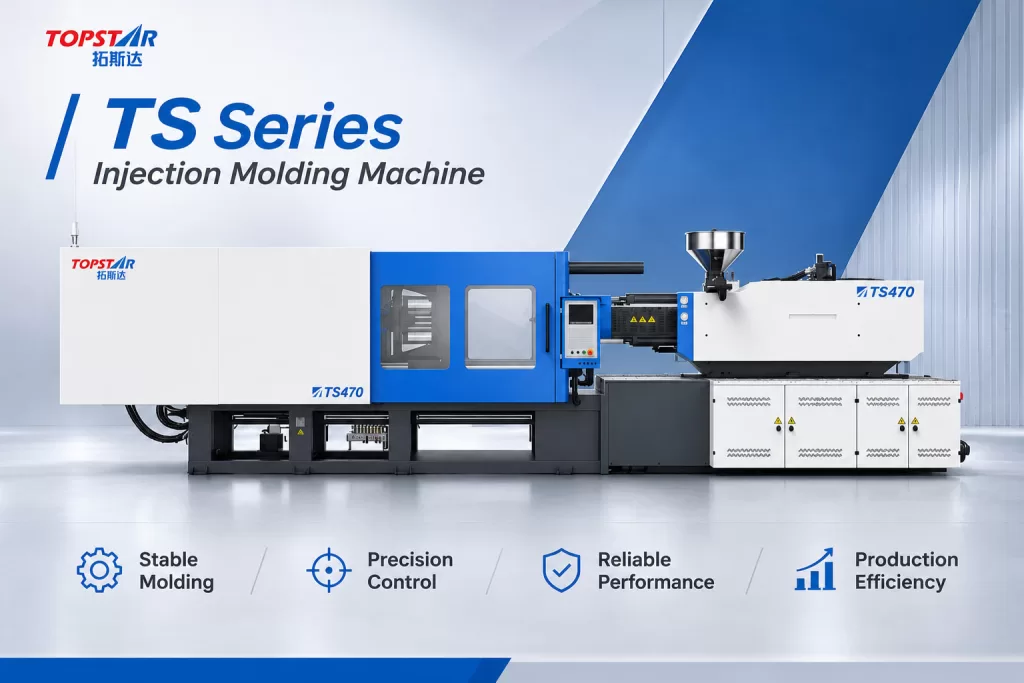
Topstar TS Series Injection Molding Machine
TMII Series Injection Molding Machine
The TMII series combines servo-driven operation with Topstar’s control program to support process adjustment. Its proportional back-pressure system offers multi-stage back-pressure settings, allowing engineers to adjust plasticization conditions according to the TPV grade and production requirements.
The series also uses diagonal twin injection cylinders and linear guides to support stable injection-unit movement.
For applications where plasticization consistency and back-pressure adjustment are important, these configurations provide additional process-control options.
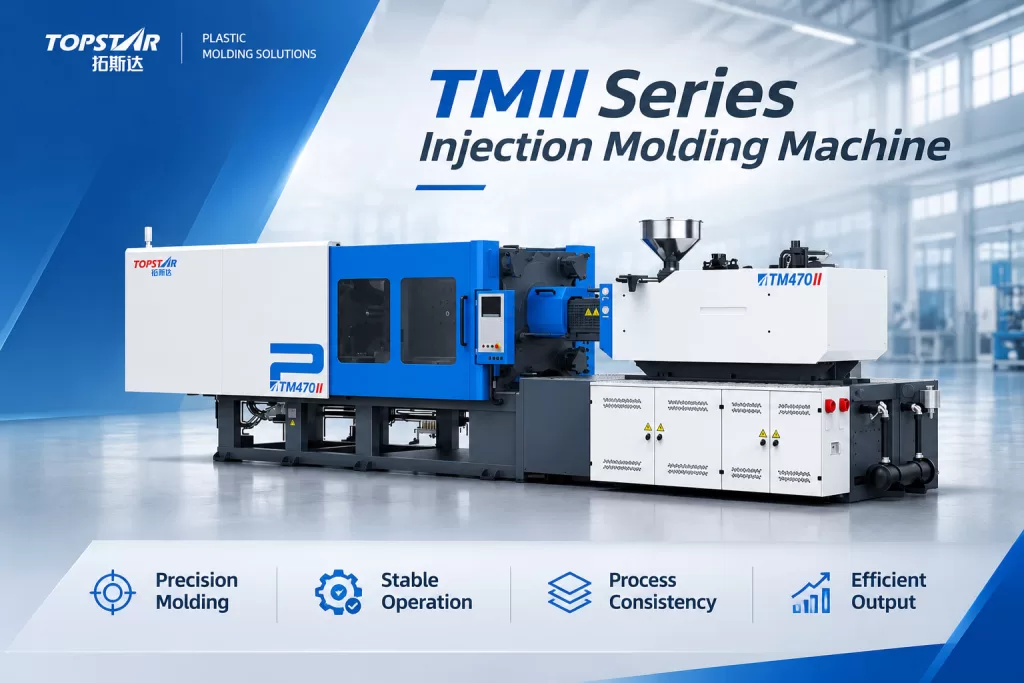
Topstar TMII Series Injection Molding Machine
The choice between a TS Series Injection Molding Machine and a TMII Series Injection Molding Machine should depend on the required shot volume, TPV formulation, mold configuration, and desired level of plasticization control. Neither machine configuration replaces the need for appropriate mold design and process validation.
How Can TPV Automotive Cup Holders Maintain Consistent Shape and Fit?
Consistent TPV automotive cup holders depend on coordinated material plasticization, balanced cavity filling, controlled holding pressure, uniform cooling, and suitable ejection. Manufacturers must also verify the inner cup-holding diameter, wall thickness, mounting dimensions, and functional retention across repeated production runs. Topstar’s TS and TMII series provide different injection and plasticization configurations to support these requirements. The final machine selection and process settings should be established through the specific TPV grade, mold design, and production trial results.
TRENDING POSTS
- TOPS DAY 2026: Turning Industrial AI into Real-World Impact 2026/11/23
- Breaking Through the Full Scene-to-AI Link! Topstar Industrial Data Collection Matrix Achieves Major Technical Breakthro 2026/11/23
- TOPSTAR Selected in “Forbes China AI Top 50” and Wins “2026 Embodied AI Industry Benchmark Award” 2026/11/23
- Topstar Achieves ISO 13849 Functional Safety Certification for Robotics 2026/11/23
HOT TOPIC
- .ervo motor-driven linear robots
- •
- 1.0 guangdong topstar technology co. ltd
- 1.0 topstar china
- 1.0 topstar robot
- 11
- 160℃ mold temperature controller
- 170 ton injection molding machine
- 2
- 21
- 220-ton injection molding machine
- 23
- 260 ton injection molding machine
- 3 axis robot
- 3 axis robots
- 3 in 1 Compact Dehumidifying Dryer
- 3-axis robot
- 3-axis robots
- 39
- 4 axis robot
- 4-axis SCARA robot
- 41
- 460T injection molding machine
- 5-axis CNC machine
- 62
- 90 ton injection molding machine
- accuracy
- Air Chillers
- air-cooled chillers
- all electric injection molding machine
- all electric injection molding machines
- all-electric injection molding machine
- All-electric injection molding machines
- and overall production quality. Therefore
- AP-RubberPlas
- auto cooling system
- auto loader
- Auto Loaders
- automated injection molding machine
- Automation changed engineering
- automation of injection molding robots
- automotive parts injection molding
- Auxiliary Equipment
- auxiliary machine
- Bench Injection Molding Machine
- cabinet dryer
- Cabinet dryer manufacturers
- Cabinet dryers
- cartesian coordinate robot
- Cartesian Coordinate Robots
- Cartesian injection robot
- Cartesian robot
- Central Feeding System
- Central Feeding Systems
- chiller
- CNC Drilling Machine
- CNC Drilling Machines
- cnc engraving machine manufacturer
- cnc laser cutting machine manufacturer
- CNC machine
- CNC Machine Center
- CNC Machine for Sale
- CNC Machine Manufacturing
- CNC Machine Tool
- CNC machine tool product
- CNC Machining Center
- CNC wood carving machine
- Compact Dehumidifying Dryer
- Cooling system
- Cross-Walking Single Axis Servo Cylinder Robot
- Cross-Walking Single-Axis Servo Cylinder Robot
- Cross-Walking Three-Axis/Five-Axis Servo Driven Robot
- cross-walking three-axis/five-axis servo-driven robot
- Dehumidifier Dryer
- Dehumidifying Dryer
- dehumidifying dryers
- delta parallel robot
- Desktop Injection Molding Machine
- Desktop injection molding machines
- Desktop Molding Machine
- desktop plastic injection machine
- Desktop Plastic Injection Molding Machine
- detachable autoloader
- Digital Transformation
- direct clamp injection molding machine
- Direct clamp injection molding machines
- Dosing & mixing system
- Drilling Centers
- Drying and dehumidification system
- drying and dehumidifying equipment
- Drying and Dehumidifying System
- drying system
- effective and efficient. Cabinet dryers are also used in other industries where large quantities of material need to be dried
- efficient injection molding machine
- elbow hydraulic injection molding machines
- electric injection molding machine
- electric injection molding machines
- energy-efficient injection molding robot
- energy-efficient water chiller
- energy-efficient water chillers
- energy-saving injection molding machine
- etc. Among injection molding robots
- exhibition
- features of CNC machine
- Feeding And Conveying System
- Five Axis Machine Center
- Flexible Production Line
- Fully automatic injection molding machine
- Gathering Topstar
- giant injection molding machine
- GMU-600 5-Axis Machining Center
- Granulating & Recycling System
- granulator machine
- gravimetric blender
- Heavy duty injection molding machine
- Heavy-Duty Take-Out Robot
- High-precision electric molding machines
- high-precision plastic molding machines
- high-speed all electric injection molding machine
- high-speed electric injection molding machine
- High-Speed Packaging Injection Molding
- Honeycomb rotor dehumidifier
- hopper dryer
- Hopper Dryers
- horizontal injection molding machine
- Horizontal Injection Molding Machines
- Horizontal Injection Moulding Machine
- Horizontal Mixer manufacturer
- How The CNC Machine Works
- hybrid injection molding machine
- hydraulic injection molding machine
- Hydraulic Injection Molding Machines
- in this article
- Industrial AI
- Industrial Automation
- Industrial robot
- Industrial Robot Chinese brand
- industrial robot parts
- industrial robot supplier
- Industrial robots
- Industry Chain
- Injection Manipulator
- injection manipulator robot
- injection mold machines
- Injection molding
- Injection molding automation
- Injection Molding Automation Solution
- injection molding dryer
- Injection molding equipment
- injection molding hopper dryer
- Injection molding machine
- injection molding machine brand
- Injection Molding Machine Factory
- Injection Molding Machine Manufacture
- Injection molding machine manufacturer
- injection molding machine manufacturers
- Injection molding machine procurement
- injection molding machine robotic arm
- injection molding machine with a robot
- Injection molding machines
- injection molding material dehumidifying
- injection molding plant
- injection molding process
- Injection Molding Robot
- injection molding robot arm
- Injection molding robot automation
- Injection molding robotic arm
- injection molding robots
- injection molding whole plant
- injection moulding dryer
- Injection moulding machine
- injection moulding machines
- Injection Moulding Robots
- Injection Robot
- Injection robot arm
- Injection robot manufacturer
- Injection robot wholesale
- injection robots
- Intelligent Factory
- intelligent injection molding machines
- Intelligent Manufacturing
- intelligent mold temperature
- intelligent mold temperature controller
- Intelligent mould temperature controller
- intelligent whole plant solution
- InterPlas Thailand 2025
- Introducing Injection Robot
- It is the best choice for drying large quantities of material at once. Cabinetmakers use these machines because they are fast
- Large flow water type mold temperature controller
- large injection molding machine
- large injection molding machines
- Learn what industrial automation and robotics is
- linear robot
- linear robots
- low speed sound-proof granulator
- machine plastic molding
- make sure to add some! Improvements (2) Keyphrase in introduction: Your keyphrase or its synonyms appear in the first paragraph of the copy
- manipulator machine
- manufacturing
- Manufacturing Innovation
- medical grade injection molding machines
- Medical Injection Molding
- medical injection molding machine
- medical injection molding machines
- micro injection molding machine
- middle speed granulator
- Mini CNC machine manufacturers.
- mobile cover making machine
- Mold Temperature Control System
- mold temperature controller
- mold temperature controllers
- molding machine
- molding material Dehumidifying System
- mould temperature control system
- mould temperature controller
- mould temperature controller
- mould temperature controllers
- New electric injection molding machine
- Nitrogen Dryer
- nitrogen dryer manufacturer
- nitrogen dryer system manufacturer
- Oil type mold temperature controller
- Oil type mold temperature controllers
- open day
- optical component injection molding
- Optical-grade dehumidifying dryer
- Outbound links: No outbound links appear in this page. Add some! Images: No images appear on this page. Add some! Internal links: No internal links appear in this page
- packaging injection molding
- Packaging Solutions
- PET Preform injection molding
- phone case maker machine
- phone case making machine
- phone cover making machine
- PID Control Mold Temperature Controller
- plastic auto loader
- plastic bottle making machine
- plastic bottle manufacturing
- plastic bucket making machine
- plastic bucket manufacturing
- Plastic chair making machine
- plastic dryer for injection molding
- plastic forming equipment
- Plastic Granulator
- Plastic Granulators
- plastic hopper dryer
- plastic injection machine
- plastic injection machines
- plastic injection molding
- Plastic injection molding equipment
- Plastic injection molding machine
- Plastic Injection Molding Machines
- plastic injection moulding machine
- plastic injection moulding machines
- plastic injection robot
- plastic molding
- Plastic Molding Industry
- Plastic Molding machine
- plastic molding machine 1
- Plastic Molding Machines
- plastic molding press
- plastic moulding machine
- plastic phone case making machine
- plastic-molding machine
- powerful granulator
- Powerful Type Sound-Proof Granulator
- precision injection molding
- precision injection molding machines
- production of plastic seats
- pure water mould temperature controller
- Robot injection molding
- robot injection molding machine
- robot manufacturing companies
- Robotic arm for injection molding machine
- robotic injection molding machines
- robotics in injection molding
- SCARA robot
- SCARA robots
- Screw dosers
- Service-oriented manufacturing
- Servo Cylinder Robot
- servo driven robot
- Servo Driven Robots
- servo injection molding machine
- servo injection robots
- servo motor-driven linear robots
- servo-driven 3-axis robot
- Servo-driven injection molding machine
- Servo-Driven Robot
- Setup of injection machine
- Silicone Injection Molding Machine
- six-axis industrial robot
- Smart Manufacturing
- soundproof granulator
- Sprue Picker
- Stainless Hopper Dryer
- Stainless Hopper Dryers
- star club
- swing arm robot
- T1 Cartesian injection robot
- take-out robot
- take-out robots
- Thailand 4.0
- the choice between servo-driven robots and hydraulic robots will have a certain impact on efficiency
- the most popular injection molding machine
- the type of injection molding robot
- TIC2000 Control System
- TMII injection molding machine
- toggle clamp injection molding machine
- Toggle Hydraulic Injection Molding Machines
- toggle injection molding machine
- Top 10 brands of injection robots
- Topstar
- Topstar Electric Injection Molding Machine InterPlas Thailand 2025 Smart Manufacturing Thailand 4.0
- Topstar Engineering
- Topstar Industrial Robots
- Topstar injection molding intelligent
- Topstar Scara Robots
- Useful Injection molding machine
- Vertical machining centers
- volumetric type blender
- Washing Machine Case Molding Solution
- water chiller
- water chillers
- water distributor
- water type mold temperature controller
- Water Type MoldTemperature Controller
- Water-Cooled Chillers
- Water-cooled Mold Temperature Controller
- water-type mold temperature controller
- Water-Type Mould Temperature Controllers
- We often face choices when performing injection molding. We will choose the type of injection molding machine
- wholesale of injection molding machines
- x carve CNC
- 热门查询 点击次数 展示 排名 topstar