
How Does Centrifugal Gas-Liquid Separation Differ From Gravity Separation in Mold Temperature Control?
2026/09/28 By le zhan
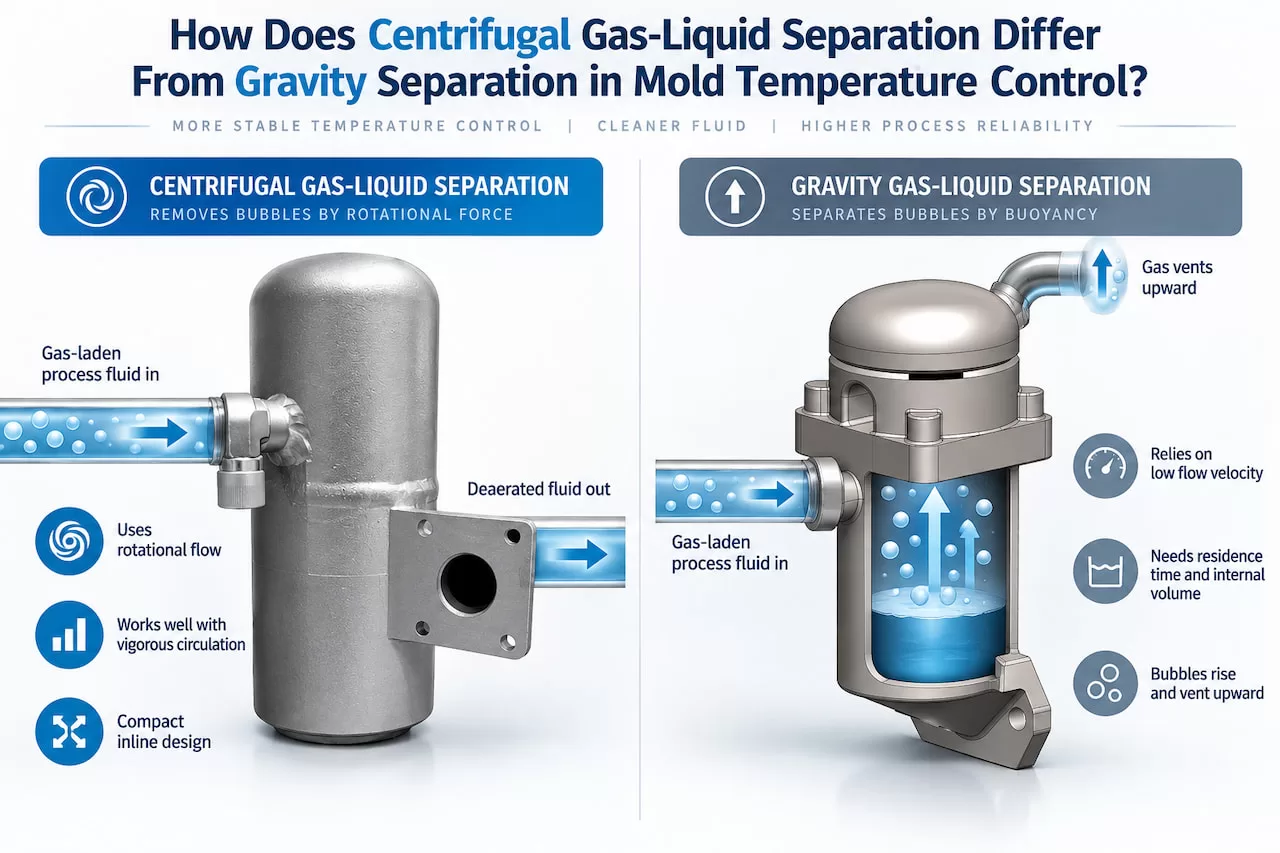
In mold temperature control, although centrifugal and gravitational gas-liquid separation share the same objective, their separation principles differ fundamentally. Centrifugal separation uses a high-speed rotating flow: under centrifugal force, the denser liquid moves outward, while the less dense gas accumulates in the center. Gravitational separation reduces the fluid flow velocity within a larger chamber, allowing bubbles—due to their lower density—time to rise naturally to the surface. Both methods collect the separated gas and discharge it from the top of the separator tank. Still, they differ in their dependence on flow velocity and the operating scenarios they can handle.
Differences Between the Two Principles of Gas-Liquid Separation in Mold Temperature Control
Both methods remove gas from the circulating medium, but they rely on different separation forces.
Centrifugal gas-liquid separation uses rotational flow. As the gas-liquid mixture spins inside the separator, centrifugal force pushes the denser liquid toward the outer wall, while the lighter gas stays closer to the center before the system collects and discharges it.
The separation process works as follows:
Gas-liquid mixture enters → Forms a rotating flow → Liquid moves outward → Gas remains near the center → Gas is collected and discharged.
Gravity gas-liquid separation reduces the flow velocity inside a larger chamber. Because gas is less dense than liquid, bubbles naturally rise to the top while the liquid remains below and continues circulating.
The separation process works as follows:
Gas-liquid mixture enters → Forms a rotating flow → Liquid moves outward → Gas remains near the center → Gas is collected and discharged.
The key difference is straightforward: centrifugal separation relies on flow velocity and rotational force, while gravity separation relies on low flow velocity, density difference, buoyancy, and sufficient residence time.
How does flow velocity affect these two methods differently?
Flow velocity is one of the most important distinctions between these two mold temperature control technologies.
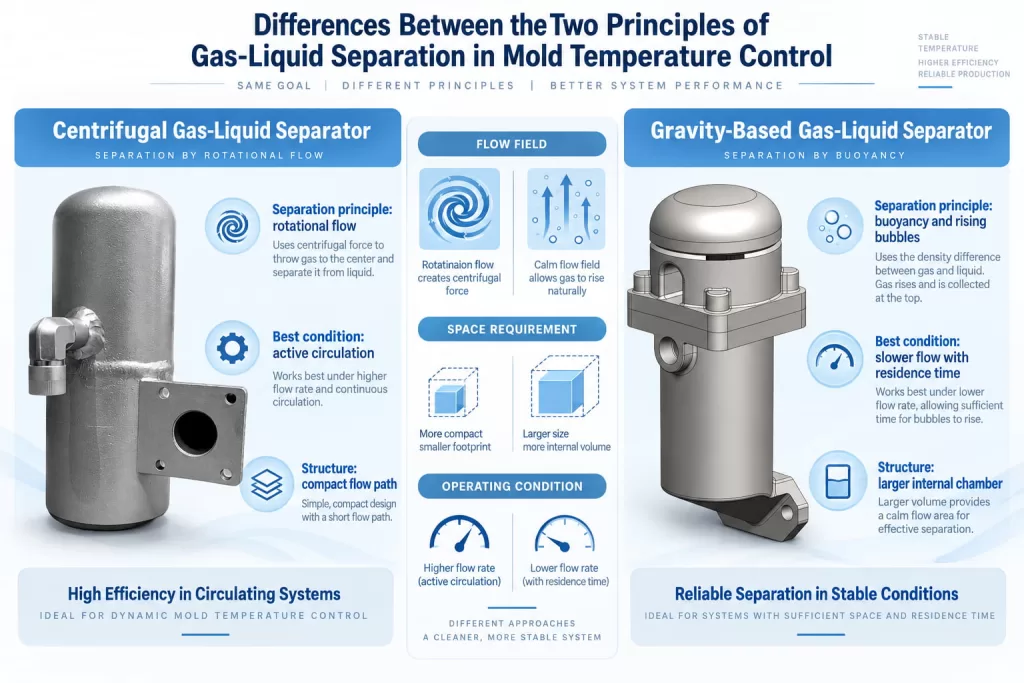
Centrifugal separation relies heavily on fluid motion. The gas-liquid mixture must enter the separator at a sufficient velocity to generate an effective rotational flow. Once the system establishes this rotational flow field, density differences cause the heavier liquid and lighter gas to follow separate paths.
In other words, centrifugal gas-liquid separation utilizes flow velocity as part of its separation mechanism. This does not mean that higher flow velocities always yield better results. The system must properly coordinate the separator’s geometry, inlet direction, circulation flow rate, and pump characteristics. If the rotational flow is too weak, the centrifugal effect decreases; if turbulence becomes too strong, it can destabilize the gas-liquid interface. Therefore, centrifugal separators must operate within a controlled flow rate range rather than at maximum circulation speed.
The operating principle of gravity separation is almost the opposite.
A larger chamber reduces the flow velocity of the incoming medium, giving bubbles ample time to escape the liquid and rise upward. If the medium flows through the gravity separator tank too quickly, the liquid may carry smaller bubbles away before they have enough time to rise. For this reason, the effectiveness of gravity separation depends largely on residence time, separator volume, and sufficiently low internal flow velocities.
How Are Gases Separated During Mold Temperature Control Collected and Vented?
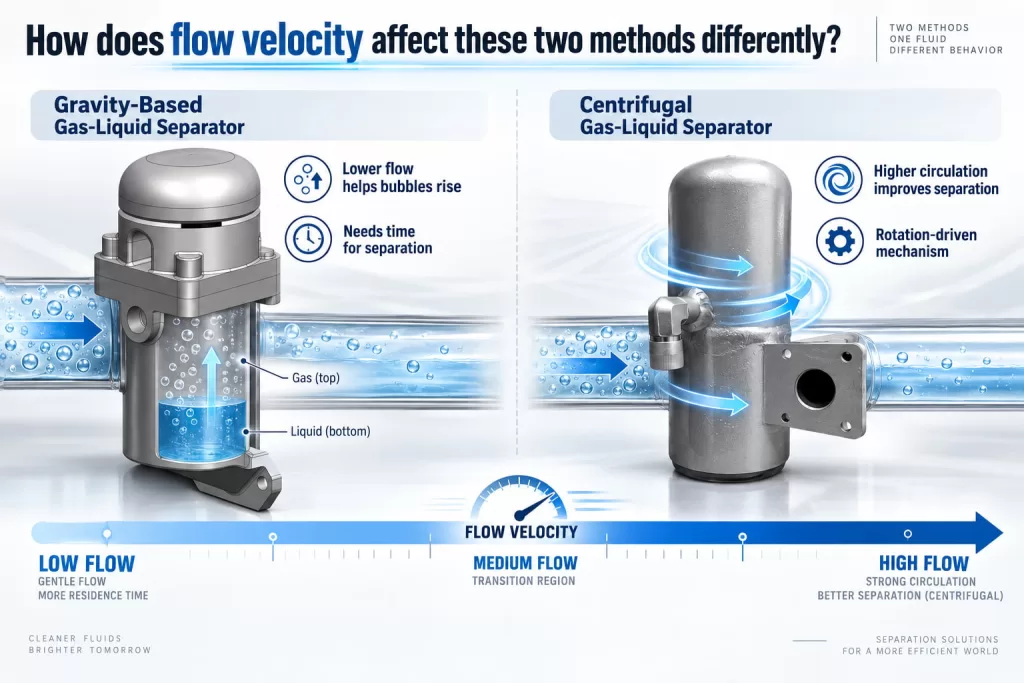
After separation, both systems collect gas in the upper part of the tank and discharge it through a top vent, while the liquid continues circulating through the mold temperature control unit.
In a centrifugal gas-liquid separation mold temperature controller, gas first concentrates near the center of the rotating flow before moving into the upper collection area. In a gravity-type gas-liquid separation mold temperature controller, bubbles rise directly to the top as the fluid slows inside the separation chamber.
Both separator designs offer an additional advantage: the internal gas space helps buffer pressure fluctuations caused by the heating expansion or cooling contraction of the circulating fluid. This helps minimize excessive pressure changes, thereby ensuring more stable operation of the mold temperature controller.
The main difference is the gas path before venting:
Centrifugal: Rotational separation → Gas concentrates near the center → Upper collection area → Venting.
Gravity-type: Flow slows → Bubbles rise → Upper collection area → Venting.
Which separation method is better suited for different operating conditions?
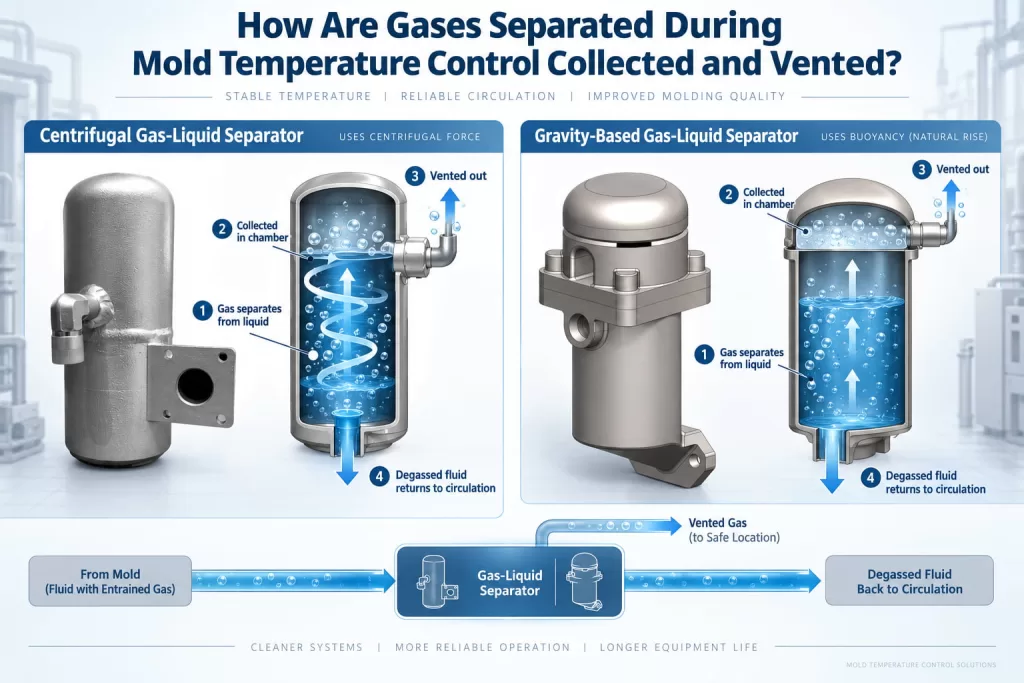
A centrifugal gas-liquid separation mold temperature controller generally works better in systems with relatively strong circulation flow that require continuous gas separation within a compact flow path. Its performance depends on sufficient fluid velocity to create stable rotational separation.
A gravity-type gas-liquid separation mold temperature controller works best when the system provides sufficient internal volume and residence time. By slowing the fluid, it allows bubbles to rise naturally before the liquid returns to the circulation loop.
In practice, neither method is universally better. The correct choice should match the actual mold temperature control conditions, including pump performance, circulation flow, heat-transfer medium, piping resistance, operating temperature, system pressure, and mold circuit design.
Match the Separation Method to the Circulation System
The practical differences between the two are as follows:
Centrifugal gas-liquid separation utilizes flow velocity and centrifugal force to achieve rapid phase separation;
Gravity-based gas-liquid separation, by contrast, reduces flow velocity and relies on density differences, buoyancy, and sufficient residence time to achieve separation.
Both methods collect the separated gas within the tank and discharge it through a vent at the top; they also provide buffer space to accommodate pressure fluctuations generated during heating and cooling.
For mold temperature controllers using centrifugal gas-liquid separation technology, engineers should focus on circulation flow rate and the separator’s flow-path design; for those using gravitational gas-liquid separation, the separator volume, internal flow-rate control, bubble rise time, and the gas-collection chamber design are more critical.
Therefore, the key to selection lies in choosing a technology whose operating principle matches the actual circulation conditions.
TRENDING POSTS
- Breaking Through the Full Scene-to-AI Link! Topstar Industrial Data Collection Matrix Achieves Major Technical Breakthro 2026/09/28
- TOPSTAR Selected in “Forbes China AI Top 50” and Wins “2026 Embodied AI Industry Benchmark Award” 2026/09/28
- Topstar Achieves ISO 13849 Functional Safety Certification for Robotics 2026/09/28
- Topstar Completes Key Puzzle in Embodied Intelligence Data Closed Loop — Industrial AI Capability Foundation Now in Place 2026/09/28
HOT TOPIC
- .ervo motor-driven linear robots
- •
- 1.0 guangdong topstar technology co. ltd
- 1.0 topstar china
- 1.0 topstar robot
- 11
- 160℃ mold temperature controller
- 170 ton injection molding machine
- 2
- 21
- 220-ton injection molding machine
- 23
- 260 ton injection molding machine
- 3 axis robot
- 3 axis robots
- 3 in 1 Compact Dehumidifying Dryer
- 3-axis robot
- 3-axis robots
- 39
- 4 axis robot
- 4-axis SCARA robot
- 41
- 460T injection molding machine
- 5-axis CNC machine
- 62
- 90 ton injection molding machine
- accuracy
- Air Chillers
- air-cooled chillers
- all electric injection molding machine
- all electric injection molding machines
- all-electric injection molding machine
- All-electric injection molding machines
- and overall production quality. Therefore
- AP-RubberPlas
- auto cooling system
- auto loader
- Auto Loaders
- automated injection molding machine
- Automation changed engineering
- automation of injection molding robots
- automotive parts injection molding
- Auxiliary Equipment
- auxiliary machine
- Bench Injection Molding Machine
- cabinet dryer
- Cabinet dryer manufacturers
- Cabinet dryers
- cartesian coordinate robot
- Cartesian Coordinate Robots
- Cartesian injection robot
- Cartesian robot
- Central Feeding System
- Central Feeding Systems
- chiller
- CNC Drilling Machine
- CNC Drilling Machines
- cnc engraving machine manufacturer
- cnc laser cutting machine manufacturer
- CNC machine
- CNC Machine Center
- CNC Machine for Sale
- CNC Machine Manufacturing
- CNC Machine Tool
- CNC machine tool product
- CNC Machining Center
- CNC wood carving machine
- Compact Dehumidifying Dryer
- Cooling system
- Cross-Walking Single Axis Servo Cylinder Robot
- Cross-Walking Single-Axis Servo Cylinder Robot
- Cross-Walking Three-Axis/Five-Axis Servo Driven Robot
- cross-walking three-axis/five-axis servo-driven robot
- Dehumidifier Dryer
- Dehumidifying Dryer
- dehumidifying dryers
- delta parallel robot
- Desktop Injection Molding Machine
- Desktop injection molding machines
- Desktop Molding Machine
- desktop plastic injection machine
- Desktop Plastic Injection Molding Machine
- detachable autoloader
- Digital Transformation
- direct clamp injection molding machine
- Direct clamp injection molding machines
- Dosing & mixing system
- Drilling Centers
- Drying and dehumidification system
- drying and dehumidifying equipment
- Drying and Dehumidifying System
- drying system
- effective and efficient. Cabinet dryers are also used in other industries where large quantities of material need to be dried
- efficient injection molding machine
- elbow hydraulic injection molding machines
- electric injection molding machine
- electric injection molding machines
- energy-efficient injection molding robot
- energy-efficient water chiller
- energy-efficient water chillers
- energy-saving injection molding machine
- etc. Among injection molding robots
- exhibition
- features of CNC machine
- Feeding And Conveying System
- Five Axis Machine Center
- Flexible Production Line
- Fully automatic injection molding machine
- Gathering Topstar
- giant injection molding machine
- GMU-600 5-Axis Machining Center
- Granulating & Recycling System
- granulator machine
- gravimetric blender
- Heavy duty injection molding machine
- Heavy-Duty Take-Out Robot
- High-precision electric molding machines
- high-precision plastic molding machines
- high-speed all electric injection molding machine
- high-speed electric injection molding machine
- High-Speed Packaging Injection Molding
- Honeycomb rotor dehumidifier
- hopper dryer
- Hopper Dryers
- horizontal injection molding machine
- Horizontal Injection Molding Machines
- Horizontal Injection Moulding Machine
- Horizontal Mixer manufacturer
- How The CNC Machine Works
- hybrid injection molding machine
- hydraulic injection molding machine
- Hydraulic Injection Molding Machines
- in this article
- Industrial AI
- Industrial Automation
- Industrial robot
- Industrial Robot Chinese brand
- industrial robot parts
- industrial robot supplier
- Industrial robots
- Industry Chain
- Injection Manipulator
- injection manipulator robot
- injection mold machines
- Injection molding
- Injection molding automation
- Injection Molding Automation Solution
- injection molding dryer
- Injection molding equipment
- injection molding hopper dryer
- Injection molding machine
- injection molding machine brand
- Injection Molding Machine Factory
- Injection Molding Machine Manufacture
- Injection molding machine manufacturer
- injection molding machine manufacturers
- Injection molding machine procurement
- injection molding machine robotic arm
- injection molding machine with a robot
- Injection molding machines
- injection molding material dehumidifying
- injection molding plant
- injection molding process
- Injection Molding Robot
- injection molding robot arm
- Injection molding robot automation
- Injection molding robotic arm
- injection molding robots
- injection molding whole plant
- injection moulding dryer
- Injection moulding machine
- injection moulding machines
- Injection Moulding Robots
- Injection Robot
- Injection robot arm
- Injection robot manufacturer
- Injection robot wholesale
- injection robots
- Intelligent Factory
- intelligent injection molding machines
- Intelligent Manufacturing
- intelligent mold temperature
- intelligent mold temperature controller
- Intelligent mould temperature controller
- intelligent whole plant solution
- InterPlas Thailand 2025
- Introducing Injection Robot
- It is the best choice for drying large quantities of material at once. Cabinetmakers use these machines because they are fast
- Large flow water type mold temperature controller
- large injection molding machine
- large injection molding machines
- Learn what industrial automation and robotics is
- linear robot
- linear robots
- low speed sound-proof granulator
- machine plastic molding
- make sure to add some! Improvements (2) Keyphrase in introduction: Your keyphrase or its synonyms appear in the first paragraph of the copy
- manipulator machine
- manufacturing
- Manufacturing Innovation
- medical grade injection molding machines
- Medical Injection Molding
- medical injection molding machine
- medical injection molding machines
- micro injection molding machine
- middle speed granulator
- Mini CNC machine manufacturers.
- mobile cover making machine
- Mold Temperature Control System
- mold temperature controller
- mold temperature controllers
- molding machine
- molding material Dehumidifying System
- mould temperature control system
- mould temperature controller
- mould temperature controller
- mould temperature controllers
- New electric injection molding machine
- Nitrogen Dryer
- nitrogen dryer manufacturer
- nitrogen dryer system manufacturer
- Oil type mold temperature controller
- Oil type mold temperature controllers
- open day
- optical component injection molding
- Optical-grade dehumidifying dryer
- Outbound links: No outbound links appear in this page. Add some! Images: No images appear on this page. Add some! Internal links: No internal links appear in this page
- packaging injection molding
- Packaging Solutions
- PET Preform injection molding
- phone case maker machine
- phone case making machine
- phone cover making machine
- PID Control Mold Temperature Controller
- plastic auto loader
- plastic bottle making machine
- plastic bottle manufacturing
- plastic bucket making machine
- plastic bucket manufacturing
- Plastic chair making machine
- plastic dryer for injection molding
- plastic forming equipment
- Plastic Granulator
- Plastic Granulators
- plastic hopper dryer
- plastic injection machine
- plastic injection machines
- plastic injection molding
- Plastic injection molding equipment
- Plastic injection molding machine
- Plastic Injection Molding Machines
- plastic injection moulding machine
- plastic injection moulding machines
- plastic injection robot
- plastic molding
- Plastic Molding Industry
- Plastic Molding machine
- plastic molding machine 1
- Plastic Molding Machines
- plastic molding press
- plastic moulding machine
- plastic phone case making machine
- plastic-molding machine
- powerful granulator
- Powerful Type Sound-Proof Granulator
- precision injection molding
- precision injection molding machines
- production of plastic seats
- pure water mould temperature controller
- Robot injection molding
- robot injection molding machine
- robot manufacturing companies
- Robotic arm for injection molding machine
- robotic injection molding machines
- robotics in injection molding
- SCARA robot
- SCARA robots
- Screw dosers
- Service-oriented manufacturing
- Servo Cylinder Robot
- servo driven robot
- Servo Driven Robots
- servo injection molding machine
- servo injection robots
- servo motor-driven linear robots
- servo-driven 3-axis robot
- Servo-driven injection molding machine
- Servo-Driven Robot
- Setup of injection machine
- Silicone Injection Molding Machine
- six-axis industrial robot
- Smart Manufacturing
- soundproof granulator
- Sprue Picker
- Stainless Hopper Dryer
- Stainless Hopper Dryers
- star club
- swing arm robot
- T1 Cartesian injection robot
- take-out robot
- take-out robots
- Thailand 4.0
- the choice between servo-driven robots and hydraulic robots will have a certain impact on efficiency
- the most popular injection molding machine
- the type of injection molding robot
- TIC2000 Control System
- TMII injection molding machine
- toggle clamp injection molding machine
- Toggle Hydraulic Injection Molding Machines
- toggle injection molding machine
- Top 10 brands of injection robots
- Topstar
- Topstar Electric Injection Molding Machine InterPlas Thailand 2025 Smart Manufacturing Thailand 4.0
- Topstar Engineering
- Topstar Industrial Robots
- Topstar injection molding intelligent
- Topstar Scara Robots
- Useful Injection molding machine
- Vertical machining centers
- volumetric type blender
- Washing Machine Case Molding Solution
- water chiller
- water chillers
- water distributor
- water type mold temperature controller
- Water Type MoldTemperature Controller
- Water-Cooled Chillers
- Water-cooled Mold Temperature Controller
- water-type mold temperature controller
- Water-Type Mould Temperature Controllers
- We often face choices when performing injection molding. We will choose the type of injection molding machine
- wholesale of injection molding machines
- x carve CNC
- 热门查询 点击次数 展示 排名 topstar