
How Should You Select a Cartesian Robot for a 550-1000Ton Injection Molding Machine?
2026/10/02 By le zhan
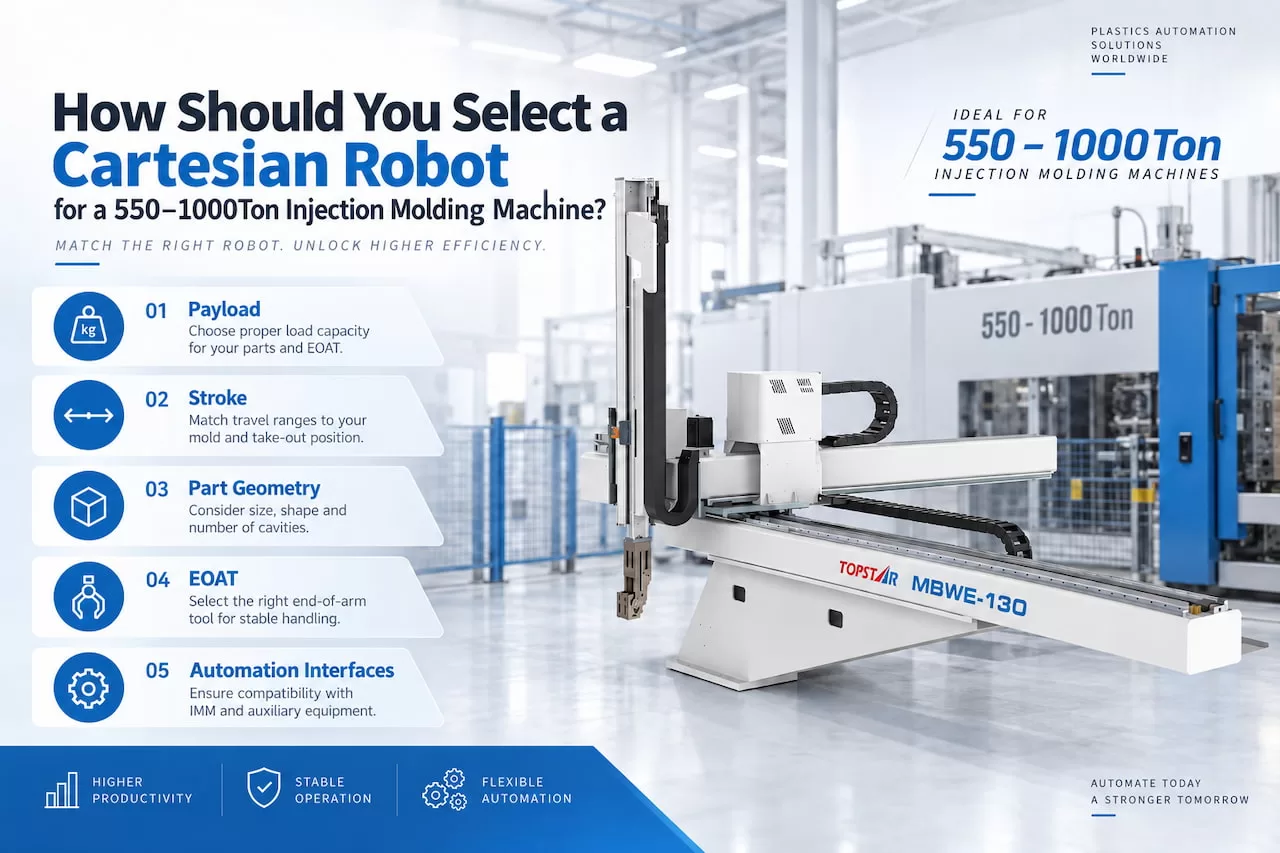
Selecting the right Cartesian robot for a 550-1000Ton Injection Molding Machine requires more than considering clamping force alone. The robot must safely handle the molded part and EOAT, reach the required mold depth and placement position, complete part removal within the target cycle time, and communicate reliably with the injection molding machine and downstream equipment. Key selection factors include payload capacity, vertical and horizontal travel, product geometry, EOAT design, part retrieval time, three-axis or five-axis configuration, and automation interfaces.
How should payload and stroke be matched for a 550-1000ton injection molding machine?
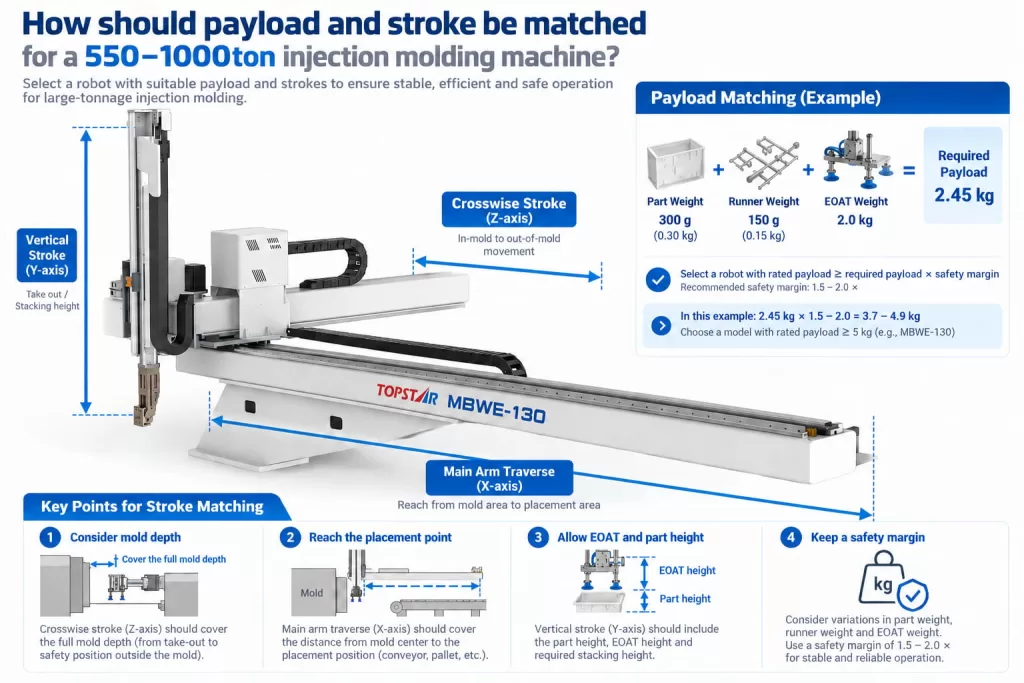
For 550-1000ton injection molding machines, payload capacity is the primary consideration, as large molds typically produce heavier parts and require larger end-of-arm tooling.
However, Cartesian robots in injection molding handle more than just molded parts. Their payload may include parts, runners, fixtures, vacuum grippers, cylinders, sensors, inserts, and other EOAT. If selection is based solely on part weight, the robot’s actual operating load may come too close to its rated load limit once the complete end-of-arm tooling is installed.
From an engineering perspective, the robot must maintain sufficient load margin during acceleration, lifting, and high-speed lateral movement. For 550-1000ton injection molding machines, the robot must have enough downward travel to access the mold area, enough horizontal travel to clear the platen, and enough travel along the machine body to deliver the molded part to a conveyor belt, fixture, or downstream station.
The selection principle is simple:
Select stroke lengths based on the mold’s actual geometric dimensions and placement location, not solely on the injection molding machine’s tonnage.
How do part geometry and EOAT selection influence the selection of a Cartesian robot?
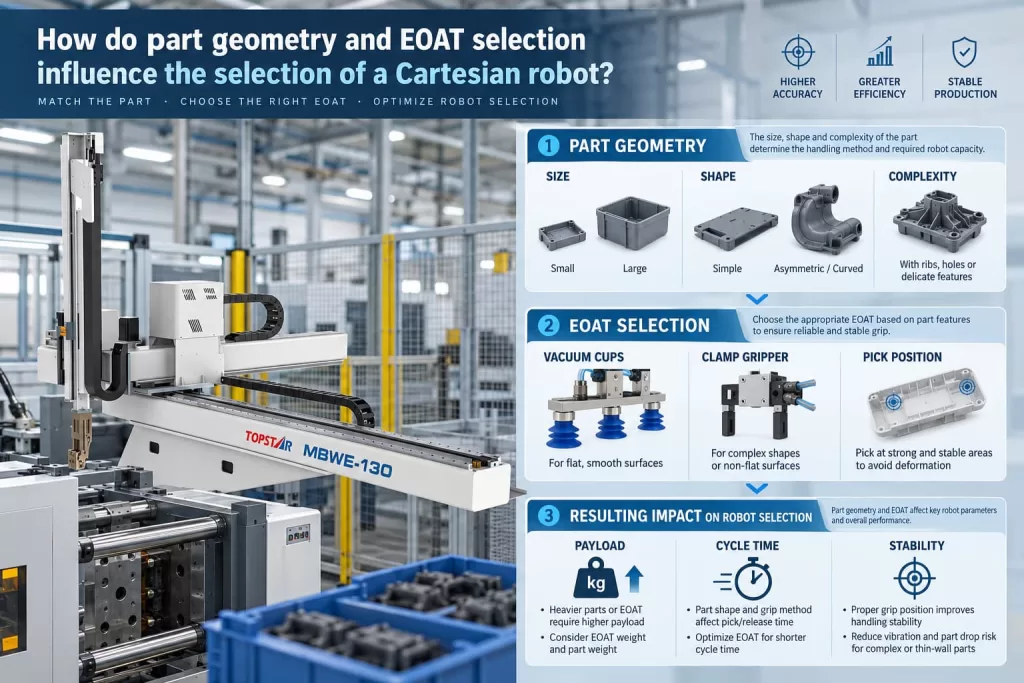
When selecting a Cartesian robot for 550-1000ton injection molding machines, EOAT design is critical. If you only need a simple vacuum suction cup fixture to remove the product, the robot needs only a simple “pick-and-place” motion sequence. If the process involves insert loading, part rotation, sprue separation, trimming, inspection, or precise orientation adjustment before placement, the end-of-arm tooling becomes heavier, and the motion paths become more complex.
This directly affects the required axis configuration.
When the task primarily involves vertical mold entry, demolding, lateral movement, and simple placement, a three-axis Cartesian robot typically suffices. However, when the product or fixture requires posture adjustment, insert handling, or approaching downstream equipment at different angles, a five-axis robot is more suitable.
Therefore, for large injection molding machines, the complete handling process should be clearly defined before selection:
Insertion into the mold → Product pickup → Ejection → (If necessary) Orientation adjustment → Transfer → Placement or subsequent processing.
If the selected robot’s travel range and axis configuration cannot complete the above process, then even if its rated load capacity meets the requirements, the robot is considered a poor fit.
Evaluating Cycle Time and Motion Performance
For Cartesian robots used with large injection molding machines, the key performance indicator is the total removal time, not just the maximum axial speed. The robot must enter the mold, grasp the product, safely retract, and quickly exit the clamping area to avoid delaying the next molding cycle.
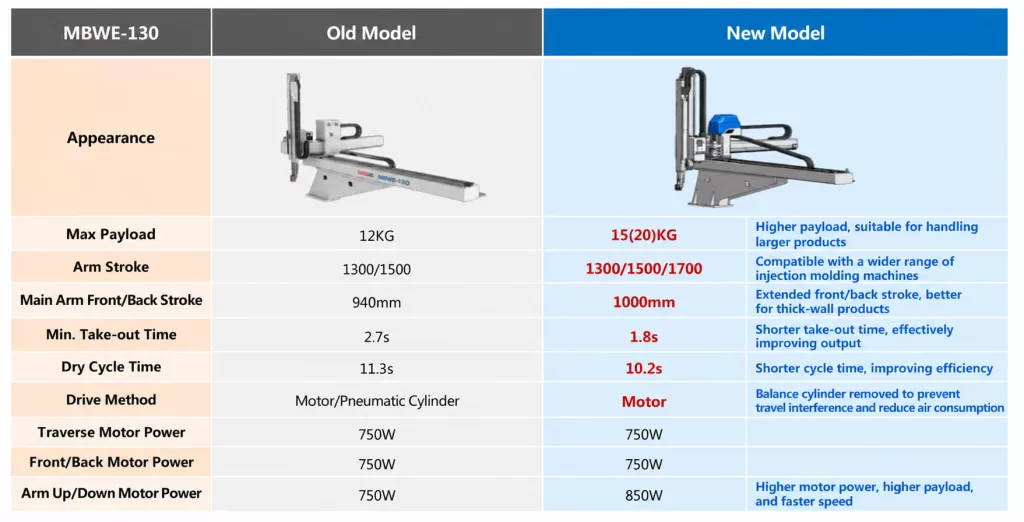
Topstar’s upgraded MBWE-130V model reduces the minimum removal time from 2.7 seconds to 1.8 seconds and shortens the reference empty cycle time from 11.3 seconds to 10.2 seconds. Faster demolding lets the injection molding machine begin closing the mold sooner, improving overall production efficiency.
However, speed must match the load and stroke. When long arms carry heavy-duty EOAT, the robot must control acceleration and deceleration carefully to suppress vibration and maintain stable placement. To this end, the MBWE-130V increases vertical-axis motor power from 750 W to 850 W and uses a fully motor-driven design, supporting heavier loads and enabling faster, more stable motion.
The goal of selection is not to pursue the highest speed, but to achieve the shortest stable retrieval time under actual load and stroke conditions.
What Are the Most Important Automation Interfaces for 550-1000ton injection molding machines?
The final step in the selection process is to determine how the robot will communicate with 550-1000ton injection molding machines and other equipment in the automation cell. Cartesian injection molding robots must coordinate at least the following signals and statuses: mold opening permission, ejection conditions, robot entry, part confirmation, robot withdrawal signal, and mold closing permission. More complex automation cells may also require connections to conveyor belts, insert feeding systems, vision inspection, trimming devices, stacking equipment, safety devices, or the factory MES system.
For the 550-1,000 ton range, Topstar’s MBWE series Cartesian robots serves as an excellent reference example. This series features an MES interface, high-capacity I/O, and customizable programming to meet diverse automation needs.
Cartesian Robot Selection Guide for 550-1000ton injection molding machine
Taking the Topstar MBWE-130V configuration as an example, the following parameters are provided for reference:
Maximum payload: 15 kg (optional/configurable up to 20 kg)
Arm reach: 1,300 / 1,500 / 1,700 mm
Main Arm Forward/Backward Stroke: 1,000 mm
Minimum Pickup Time: 1.8 s
Reference Empty Cycle Time: 10.2 s
Transverse Motor Power: 750 W
Forward/Backward Motor Power: 750 W
Vertical Arm Motor Power: 850 W
Note: The above data should be used solely as a selection reference and does not constitute a universal specification standard applicable to all 550-1000ton injection molding automation units. Final decisions should follow these steps:
Confirm the weight of the product and EOAT → Verify the travel required to enter the mold and place the part → Determine the complete motion sequence → Select a 3-axis or 5-axis configuration → Verify the pickup time under load → Confirm the interface between the injection molding machine and peripheral equipment.
For 550-1000ton injection molding machines, a suitable Cartesian robot should safely handle the actual payload, reach all specified positions, complete the demolding operation within the target cycle time, and integrate seamlessly with the entire automation system.
TRENDING POSTS
- Breaking Through the Full Scene-to-AI Link! Topstar Industrial Data Collection Matrix Achieves Major Technical Breakthro 2026/10/02
- TOPSTAR Selected in “Forbes China AI Top 50” and Wins “2026 Embodied AI Industry Benchmark Award” 2026/10/02
- Topstar Achieves ISO 13849 Functional Safety Certification for Robotics 2026/10/02
- Topstar Completes Key Puzzle in Embodied Intelligence Data Closed Loop — Industrial AI Capability Foundation Now in Place 2026/10/02
HOT TOPIC
- .ervo motor-driven linear robots
- •
- 1.0 guangdong topstar technology co. ltd
- 1.0 topstar china
- 1.0 topstar robot
- 11
- 160℃ mold temperature controller
- 170 ton injection molding machine
- 2
- 21
- 220-ton injection molding machine
- 23
- 260 ton injection molding machine
- 3 axis robot
- 3 axis robots
- 3 in 1 Compact Dehumidifying Dryer
- 3-axis robot
- 3-axis robots
- 39
- 4 axis robot
- 4-axis SCARA robot
- 41
- 460T injection molding machine
- 5-axis CNC machine
- 62
- 90 ton injection molding machine
- accuracy
- Air Chillers
- air-cooled chillers
- all electric injection molding machine
- all electric injection molding machines
- all-electric injection molding machine
- All-electric injection molding machines
- and overall production quality. Therefore
- AP-RubberPlas
- auto cooling system
- auto loader
- Auto Loaders
- automated injection molding machine
- Automation changed engineering
- automation of injection molding robots
- automotive parts injection molding
- Auxiliary Equipment
- auxiliary machine
- Bench Injection Molding Machine
- cabinet dryer
- Cabinet dryer manufacturers
- Cabinet dryers
- cartesian coordinate robot
- Cartesian Coordinate Robots
- Cartesian injection robot
- Cartesian robot
- Central Feeding System
- Central Feeding Systems
- chiller
- CNC Drilling Machine
- CNC Drilling Machines
- cnc engraving machine manufacturer
- cnc laser cutting machine manufacturer
- CNC machine
- CNC Machine Center
- CNC Machine for Sale
- CNC Machine Manufacturing
- CNC Machine Tool
- CNC machine tool product
- CNC Machining Center
- CNC wood carving machine
- Compact Dehumidifying Dryer
- Cooling system
- Cross-Walking Single Axis Servo Cylinder Robot
- Cross-Walking Single-Axis Servo Cylinder Robot
- Cross-Walking Three-Axis/Five-Axis Servo Driven Robot
- cross-walking three-axis/five-axis servo-driven robot
- Dehumidifier Dryer
- Dehumidifying Dryer
- dehumidifying dryers
- delta parallel robot
- Desktop Injection Molding Machine
- Desktop injection molding machines
- Desktop Molding Machine
- desktop plastic injection machine
- Desktop Plastic Injection Molding Machine
- detachable autoloader
- Digital Transformation
- direct clamp injection molding machine
- Direct clamp injection molding machines
- Dosing & mixing system
- Drilling Centers
- Drying and dehumidification system
- drying and dehumidifying equipment
- Drying and Dehumidifying System
- drying system
- effective and efficient. Cabinet dryers are also used in other industries where large quantities of material need to be dried
- efficient injection molding machine
- elbow hydraulic injection molding machines
- electric injection molding machine
- electric injection molding machines
- energy-efficient injection molding robot
- energy-efficient water chiller
- energy-efficient water chillers
- energy-saving injection molding machine
- etc. Among injection molding robots
- exhibition
- features of CNC machine
- Feeding And Conveying System
- Five Axis Machine Center
- Flexible Production Line
- Fully automatic injection molding machine
- Gathering Topstar
- giant injection molding machine
- GMU-600 5-Axis Machining Center
- Granulating & Recycling System
- granulator machine
- gravimetric blender
- Heavy duty injection molding machine
- Heavy-Duty Take-Out Robot
- High-precision electric molding machines
- high-precision plastic molding machines
- high-speed all electric injection molding machine
- high-speed electric injection molding machine
- High-Speed Packaging Injection Molding
- Honeycomb rotor dehumidifier
- hopper dryer
- Hopper Dryers
- horizontal injection molding machine
- Horizontal Injection Molding Machines
- Horizontal Injection Moulding Machine
- Horizontal Mixer manufacturer
- How The CNC Machine Works
- hybrid injection molding machine
- hydraulic injection molding machine
- Hydraulic Injection Molding Machines
- in this article
- Industrial AI
- Industrial Automation
- Industrial robot
- Industrial Robot Chinese brand
- industrial robot parts
- industrial robot supplier
- Industrial robots
- Industry Chain
- Injection Manipulator
- injection manipulator robot
- injection mold machines
- Injection molding
- Injection molding automation
- Injection Molding Automation Solution
- injection molding dryer
- Injection molding equipment
- injection molding hopper dryer
- Injection molding machine
- injection molding machine brand
- Injection Molding Machine Factory
- Injection Molding Machine Manufacture
- Injection molding machine manufacturer
- injection molding machine manufacturers
- Injection molding machine procurement
- injection molding machine robotic arm
- injection molding machine with a robot
- Injection molding machines
- injection molding material dehumidifying
- injection molding plant
- injection molding process
- Injection Molding Robot
- injection molding robot arm
- Injection molding robot automation
- Injection molding robotic arm
- injection molding robots
- injection molding whole plant
- injection moulding dryer
- Injection moulding machine
- injection moulding machines
- Injection Moulding Robots
- Injection Robot
- Injection robot arm
- Injection robot manufacturer
- Injection robot wholesale
- injection robots
- Intelligent Factory
- intelligent injection molding machines
- Intelligent Manufacturing
- intelligent mold temperature
- intelligent mold temperature controller
- Intelligent mould temperature controller
- intelligent whole plant solution
- InterPlas Thailand 2025
- Introducing Injection Robot
- It is the best choice for drying large quantities of material at once. Cabinetmakers use these machines because they are fast
- Large flow water type mold temperature controller
- large injection molding machine
- large injection molding machines
- Learn what industrial automation and robotics is
- linear robot
- linear robots
- low speed sound-proof granulator
- machine plastic molding
- make sure to add some! Improvements (2) Keyphrase in introduction: Your keyphrase or its synonyms appear in the first paragraph of the copy
- manipulator machine
- manufacturing
- Manufacturing Innovation
- medical grade injection molding machines
- Medical Injection Molding
- medical injection molding machine
- medical injection molding machines
- micro injection molding machine
- middle speed granulator
- Mini CNC machine manufacturers.
- mobile cover making machine
- Mold Temperature Control System
- mold temperature controller
- mold temperature controllers
- molding machine
- molding material Dehumidifying System
- mould temperature control system
- mould temperature controller
- mould temperature controller
- mould temperature controllers
- New electric injection molding machine
- Nitrogen Dryer
- nitrogen dryer manufacturer
- nitrogen dryer system manufacturer
- Oil type mold temperature controller
- Oil type mold temperature controllers
- open day
- optical component injection molding
- Optical-grade dehumidifying dryer
- Outbound links: No outbound links appear in this page. Add some! Images: No images appear on this page. Add some! Internal links: No internal links appear in this page
- packaging injection molding
- Packaging Solutions
- PET Preform injection molding
- phone case maker machine
- phone case making machine
- phone cover making machine
- PID Control Mold Temperature Controller
- plastic auto loader
- plastic bottle making machine
- plastic bottle manufacturing
- plastic bucket making machine
- plastic bucket manufacturing
- Plastic chair making machine
- plastic dryer for injection molding
- plastic forming equipment
- Plastic Granulator
- Plastic Granulators
- plastic hopper dryer
- plastic injection machine
- plastic injection machines
- plastic injection molding
- Plastic injection molding equipment
- Plastic injection molding machine
- Plastic Injection Molding Machines
- plastic injection moulding machine
- plastic injection moulding machines
- plastic injection robot
- plastic molding
- Plastic Molding Industry
- Plastic Molding machine
- plastic molding machine 1
- Plastic Molding Machines
- plastic molding press
- plastic moulding machine
- plastic phone case making machine
- plastic-molding machine
- powerful granulator
- Powerful Type Sound-Proof Granulator
- precision injection molding
- precision injection molding machines
- production of plastic seats
- pure water mould temperature controller
- Robot injection molding
- robot injection molding machine
- robot manufacturing companies
- Robotic arm for injection molding machine
- robotic injection molding machines
- robotics in injection molding
- SCARA robot
- SCARA robots
- Screw dosers
- Service-oriented manufacturing
- Servo Cylinder Robot
- servo driven robot
- Servo Driven Robots
- servo injection molding machine
- servo injection robots
- servo motor-driven linear robots
- servo-driven 3-axis robot
- Servo-driven injection molding machine
- Servo-Driven Robot
- Setup of injection machine
- Silicone Injection Molding Machine
- six-axis industrial robot
- Smart Manufacturing
- soundproof granulator
- Sprue Picker
- Stainless Hopper Dryer
- Stainless Hopper Dryers
- star club
- swing arm robot
- T1 Cartesian injection robot
- take-out robot
- take-out robots
- Thailand 4.0
- the choice between servo-driven robots and hydraulic robots will have a certain impact on efficiency
- the most popular injection molding machine
- the type of injection molding robot
- TIC2000 Control System
- TMII injection molding machine
- toggle clamp injection molding machine
- Toggle Hydraulic Injection Molding Machines
- toggle injection molding machine
- Top 10 brands of injection robots
- Topstar
- Topstar Electric Injection Molding Machine InterPlas Thailand 2025 Smart Manufacturing Thailand 4.0
- Topstar Engineering
- Topstar Industrial Robots
- Topstar injection molding intelligent
- Topstar Scara Robots
- Useful Injection molding machine
- Vertical machining centers
- volumetric type blender
- Washing Machine Case Molding Solution
- water chiller
- water chillers
- water distributor
- water type mold temperature controller
- Water Type MoldTemperature Controller
- Water-Cooled Chillers
- Water-cooled Mold Temperature Controller
- water-type mold temperature controller
- Water-Type Mould Temperature Controllers
- We often face choices when performing injection molding. We will choose the type of injection molding machine
- wholesale of injection molding machines
- x carve CNC
- 热门查询 点击次数 展示 排名 topstar