
How Should You Select Plastic Granulating Equipment for PC, ABS, and Nylon Sprues?
2026/10/26 By le zhan
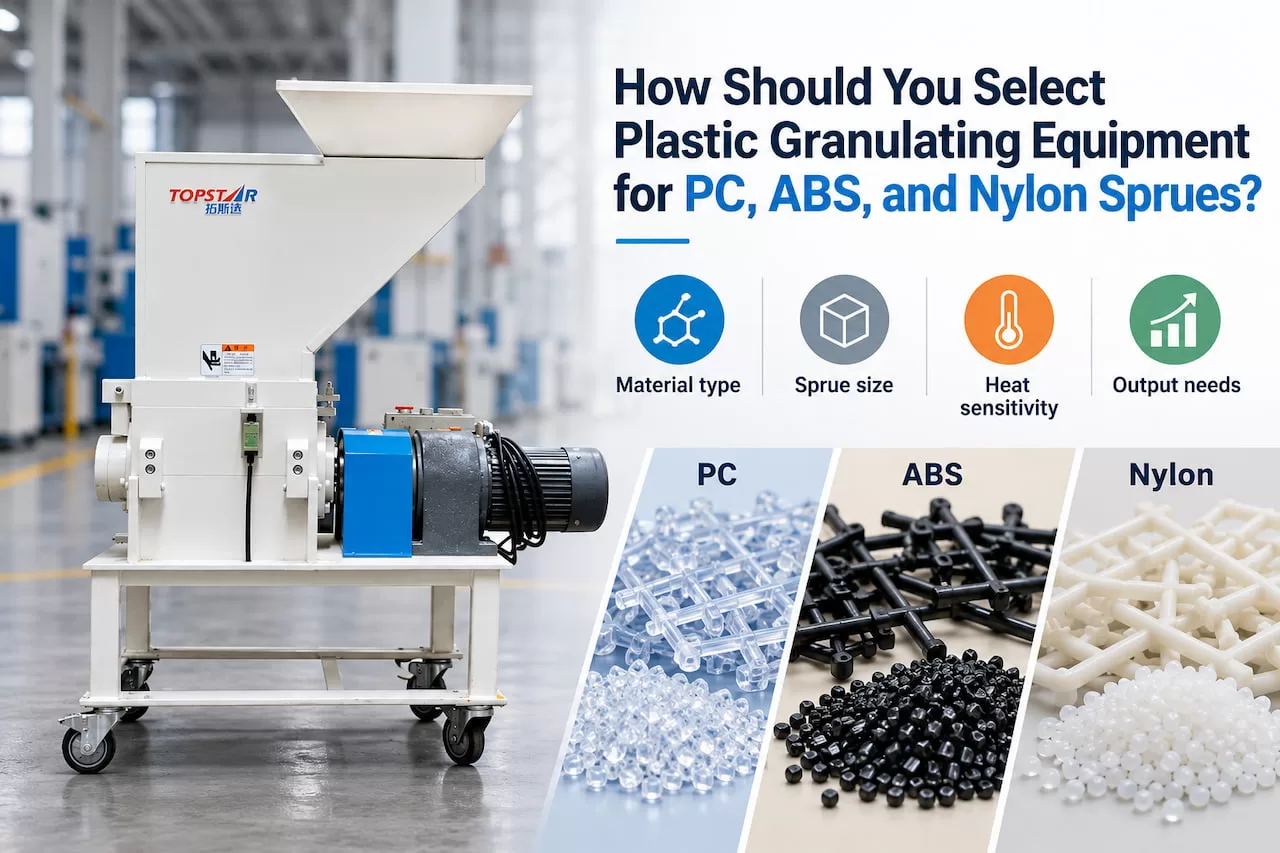
First, we believe it is important to start with the characteristics of the waste material itself, rather than focusing solely on motor power or shredder size. PC gate material is both hard and highly impact-resistant; ABS combines rigidity with toughness; and nylon, depending on the grade, may exhibit high hardness, wear resistance, or reinforced properties. These physical properties directly determine the cutting torque, rotor speed, cutter design, and dust control methods required for plastic granulating equipment.
To address the need for recycling hard gate material right next to injection molding machines, Topstar’s TGL series low speed sound-proof granulator feature a screenless, high-torque design with a speed range of 20–28 rpm, specifically engineered to process hard gate materials such as PC, nylon, and ABS. Below, we will provide specific guidance on how to make the right choice and highlight some of the key advantages of the TGL series to help you make a more informed decision.
Selecting Plastic Granulating Equipment Based on Material and Sprue Characteristics
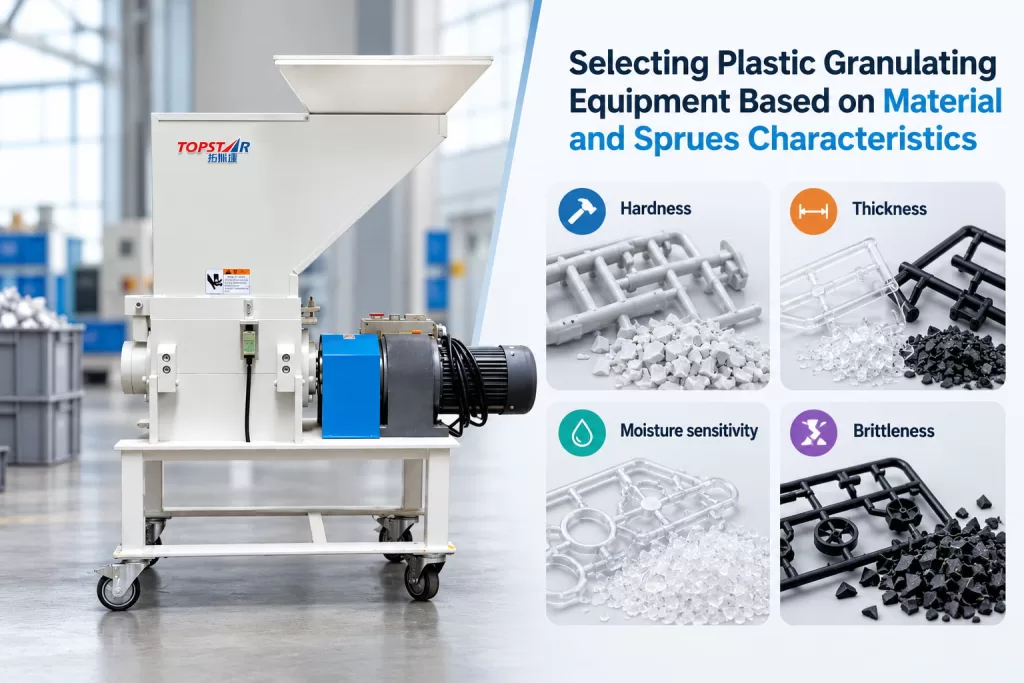
Before selecting a plastic granulator, it is essential to identify the polymer grade, sprue size, wall thickness, and type of reinforcing material, and to determine whether the scrap is hard, tough, flexible, or abrasive.
For example, thin-walled, unreinforced nylon sprues place a vastly different load on the shredding blades than thick-walled, glass-fiber-reinforced nylon sprues. Similarly, PC and ABS grades that have been modified to enhance impact strength exhibit different shredding characteristics. Therefore, the selection should be based on the actual injection molding scrap generated.
What Are the Differences Between PC, ABS, and Nylon Sprues?
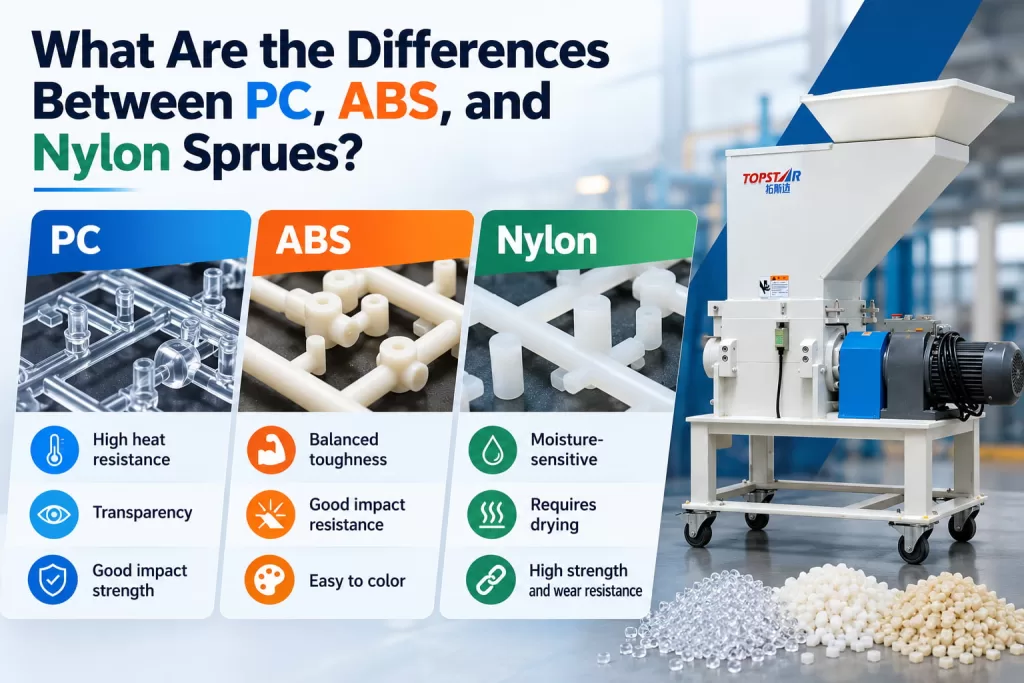
PC is generally hard, but it should not simply be classified as a “brittle” material. Commercial-grade PC for injection molding typically offers excellent impact resistance. Take Covestro, for example: several of its Makrolon injection-molding-grade PC grades feature “enhanced impact strength” as a core characteristic. This means that thick PC gate material may not break easily during shredding, so the cutting tools must have stronger cutting grip rather than relying solely on impact to break it apart.
ABS behaves differently. The styrene in its composition imparts rigidity to the material, while butadiene provides ductility and impact resistance. You can cut ABS runners cleanly, but thick cross-sections and impact-modified grades may require more torque.
Nylon materials offer high hardness, rigidity, wear resistance, and heat resistance, along with greater stiffness and mechanical strength than many other materials. However, these properties can accelerate cutting tool wear during processing, so you should consider them carefully when selecting equipment.
The Importance of “Low Speed, High Torque” for Processing Hard Gate Material
When processing hard gate material (runner material) next to an injection molding machine, using a lower rotor speed offers greater advantages than simply increasing the speed. The key lies in applying sufficient torque to shear the gate material gradually, while minimizing unnecessary impact, heat generation, noise, and the production of powder (fine particles).
Topstar’s TGL series plastic granulator operates at 20–28 rpm and features a gear-driven, screenless design. The TGL series handles hard gates and runner scrap from PC, nylon, ABS, PBT, and similar materials. This low-speed design not only reduces noise and powder generation but also ensures a relatively uniform particle size distribution in the recycled material.
One point to note:
Even at low operating speeds, the grinder needs enough cutting capacity and torque to handle the thickest runners you may encounter during production. If the gate material is much larger, thicker, or heavier than typical in-line scrap, you may need a more powerful plastic granulator—even when the polymer itself falls within the TGL series’ application range.
Selecting Plastic Granulating Equipment Based on Recycled Material Quality and Production Processes
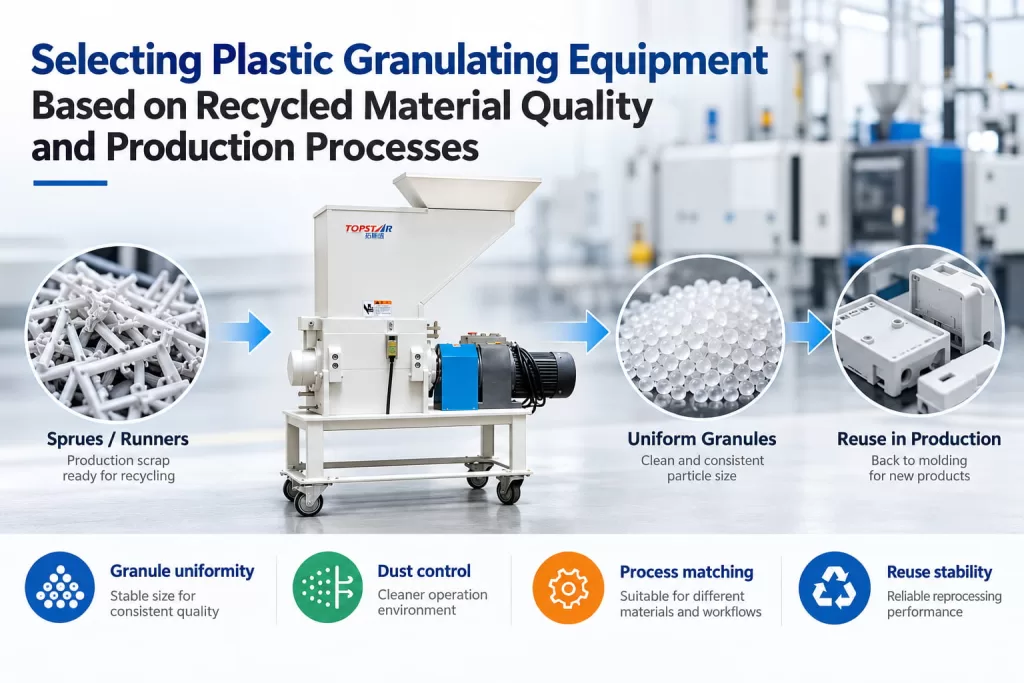
Once the material’s cutting characteristics are understood, the focus of equipment selection should shift to the production system. Even if a particular pelletizer is capable of physically cutting the gate, it is still not the ideal choice if its throughput, pellet quality, noise level, footprint, or recycling method do not align with the injection molding production unit. Particularly in line-side recycling scenarios, plastic granulating equipment must be able to reliably process the scrap generated from every mold cycle without becoming a production bottleneck or generating excessive dust around the injection molding machine.
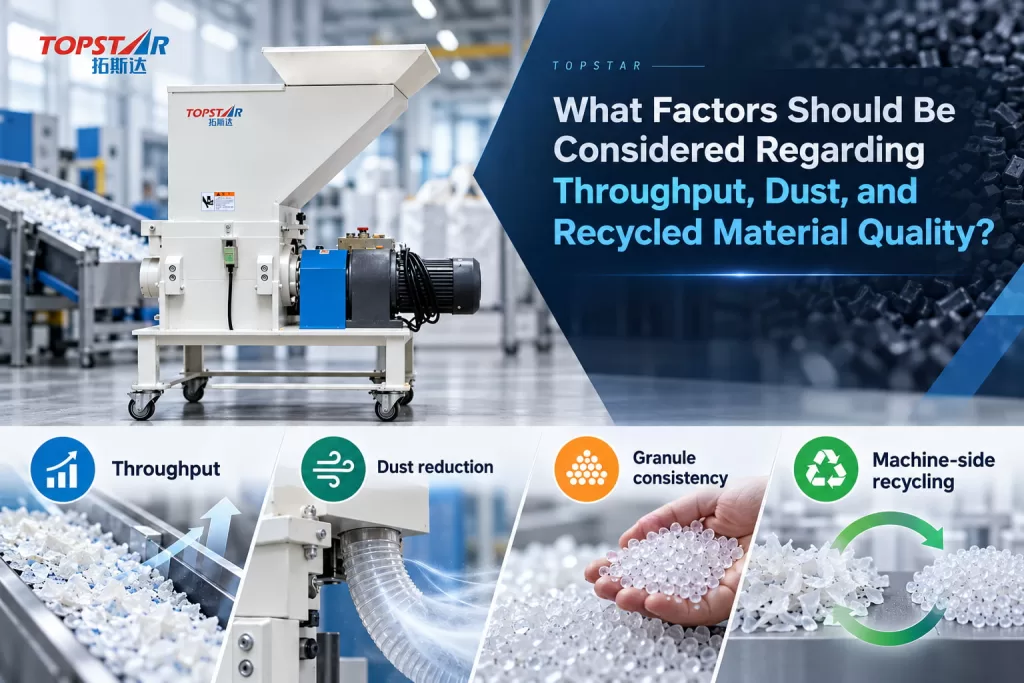
What Factors Should Be Considered Regarding Throughput, Dust, and Recycled Material Quality?
Selecting the right plastic granulating equipment requires more than confirming that it can cut the sprue. The equipment must also match the actual scrap volume, the required regrind quality, and the way recycled material will return to production.
Match throughput to the actual scrap rate.
Calculate the weight of runners and defective parts generated per injection molding cycle, then compare it with the granulator’s practical processing capacity. Do not select equipment only by injection molding machine tonnage, because two machines with the same clamping force can generate very different amounts of runner material.
Control particle size, dust, and noise.
If the goal is uniform machine-side regrind with minimal fines, a screenless, low-speed plastic granulator is a suitable option. Topstar’s TGL series uses a screenless design to produce relatively uniform particles with low dust generation, while its double-layer sound-insulated hopper helps reduce operating noise.
Consider how quickly the regrind returns to production.
When you plan to reuse recycled material directly, keep its time outside the production process to a minimum to help reduce moisture absorption and oxidation. Topstar’s TGL series supports “30-second immediate recycling,” so you can granulate sprues and runners and return them to the material cycle shortly after molding.
These factors determine whether a low-speed, machine-side granulator can support stable recycling without becoming a bottleneck in the injection molding cell.
When Should You Choose the Topstar TGL Series?
The Topstar TGL series is ideal for processing hard gates, runners, and small defective parts right next to injection molding machines. It is particularly well-suited for applications requiring low rotational speed, low dust, low noise, and instant recycling. Its scope of application covers gate materials made of hard PC, nylon, ABS, and PBT.
At the same time, the TGL low speed sound-proof granulator combines multiple features:
It features a rotor operating at 20–28 rpm, a screenless design, gear motor drive, a compact footprint, and cutting blades specifically designed for the repeated recycling of engineering plastics.
However, don’t choose the TGL series based solely on whether you process PC, ABS, or nylon. Large injection-molded parts, thick blocks, high scrap volumes, and materials with high reinforcing-material content often require greater cutting force or a more powerful plastic granulator.
Topstar also offers granulator machines covering other series and features:
The TGL series is primarily designed for processing hard sprues at the injection molding machine;
The TGP series of high-performance machines is designed to handle thicker products and larger volumes of hard plastic scrap.
Selection Logic for Plastic Granulation Equipment for PC, ABS, and Nylon Sprues
We recommend following this clear process when selecting plastic granulating equipment for PC, ABS, and nylon sprue scrap:
Identify the specific resin grade → Examine the gate thickness and geometry → Calculate the scrap processing volume → Assess the content of reinforcing materials and the risk of cutter wear → Define tolerance limits for dust and noise → Determine whether to use an in-line or centralized recovery system → Select the appropriate plastic pelletizing equipment based on these factors.
For PC, ABS, and nylon gate material, the core objective is not merely to “shred plastic.” The right Plastic granulator machine should be capable of reliably crushing hard runners while minimizing the generation of fine dust, heat, and noise, and reducing maintenance requirements. When the scrap consists of typical PC, ABS, or nylon runners, the Topstar TGL series low speed sound-proof granulator is an ideal choice.
TRENDING POSTS
- TOPS DAY 2026: Turning Industrial AI into Real-World Impact 2026/10/26
- Breaking Through the Full Scene-to-AI Link! Topstar Industrial Data Collection Matrix Achieves Major Technical Breakthro 2026/10/26
- TOPSTAR Selected in “Forbes China AI Top 50” and Wins “2026 Embodied AI Industry Benchmark Award” 2026/10/26
- Topstar Achieves ISO 13849 Functional Safety Certification for Robotics 2026/10/26
HOT TOPIC
- .ervo motor-driven linear robots
- •
- 1.0 guangdong topstar technology co. ltd
- 1.0 topstar china
- 1.0 topstar robot
- 11
- 160℃ mold temperature controller
- 170 ton injection molding machine
- 2
- 21
- 220-ton injection molding machine
- 23
- 260 ton injection molding machine
- 3 axis robot
- 3 axis robots
- 3 in 1 Compact Dehumidifying Dryer
- 3-axis robot
- 3-axis robots
- 39
- 4 axis robot
- 4-axis SCARA robot
- 41
- 460T injection molding machine
- 5-axis CNC machine
- 62
- 90 ton injection molding machine
- accuracy
- Air Chillers
- air-cooled chillers
- all electric injection molding machine
- all electric injection molding machines
- all-electric injection molding machine
- All-electric injection molding machines
- and overall production quality. Therefore
- AP-RubberPlas
- auto cooling system
- auto loader
- Auto Loaders
- automated injection molding machine
- Automation changed engineering
- automation of injection molding robots
- automotive parts injection molding
- Auxiliary Equipment
- auxiliary machine
- Bench Injection Molding Machine
- cabinet dryer
- Cabinet dryer manufacturers
- Cabinet dryers
- cartesian coordinate robot
- Cartesian Coordinate Robots
- Cartesian injection robot
- Cartesian robot
- Central Feeding System
- Central Feeding Systems
- chiller
- CNC Drilling Machine
- CNC Drilling Machines
- cnc engraving machine manufacturer
- cnc laser cutting machine manufacturer
- CNC machine
- CNC Machine Center
- CNC Machine for Sale
- CNC Machine Manufacturing
- CNC Machine Tool
- CNC machine tool product
- CNC Machining Center
- CNC wood carving machine
- Compact Dehumidifying Dryer
- Cooling system
- Cross-Walking Single Axis Servo Cylinder Robot
- Cross-Walking Single-Axis Servo Cylinder Robot
- Cross-Walking Three-Axis/Five-Axis Servo Driven Robot
- cross-walking three-axis/five-axis servo-driven robot
- Dehumidifier Dryer
- Dehumidifying Dryer
- dehumidifying dryers
- delta parallel robot
- Desktop Injection Molding Machine
- Desktop injection molding machines
- Desktop Molding Machine
- desktop plastic injection machine
- Desktop Plastic Injection Molding Machine
- detachable autoloader
- Digital Transformation
- direct clamp injection molding machine
- Direct clamp injection molding machines
- Dosing & mixing system
- Drilling Centers
- Drying and dehumidification system
- drying and dehumidifying equipment
- Drying and Dehumidifying System
- drying system
- effective and efficient. Cabinet dryers are also used in other industries where large quantities of material need to be dried
- efficient injection molding machine
- elbow hydraulic injection molding machines
- electric injection molding machine
- electric injection molding machines
- energy-efficient injection molding robot
- energy-efficient water chiller
- energy-efficient water chillers
- energy-saving injection molding machine
- etc. Among injection molding robots
- exhibition
- features of CNC machine
- Feeding And Conveying System
- Five Axis Machine Center
- Flexible Production Line
- Fully automatic injection molding machine
- Gathering Topstar
- giant injection molding machine
- GMU-600 5-Axis Machining Center
- Granulating & Recycling System
- granulator machine
- gravimetric blender
- Heavy duty injection molding machine
- Heavy-Duty Take-Out Robot
- High-precision electric molding machines
- high-precision plastic molding machines
- high-speed all electric injection molding machine
- high-speed electric injection molding machine
- High-Speed Packaging Injection Molding
- Honeycomb rotor dehumidifier
- hopper dryer
- Hopper Dryers
- horizontal injection molding machine
- Horizontal Injection Molding Machines
- Horizontal Injection Moulding Machine
- Horizontal Mixer manufacturer
- How The CNC Machine Works
- hybrid injection molding machine
- hydraulic injection molding machine
- Hydraulic Injection Molding Machines
- in this article
- Industrial AI
- Industrial Automation
- Industrial robot
- Industrial Robot Chinese brand
- industrial robot parts
- industrial robot supplier
- Industrial robots
- Industry Chain
- Injection Manipulator
- injection manipulator robot
- injection mold machines
- Injection molding
- Injection molding automation
- Injection Molding Automation Solution
- injection molding dryer
- Injection molding equipment
- injection molding hopper dryer
- Injection molding machine
- injection molding machine brand
- Injection Molding Machine Factory
- Injection Molding Machine Manufacture
- Injection molding machine manufacturer
- injection molding machine manufacturers
- Injection molding machine procurement
- injection molding machine robotic arm
- injection molding machine with a robot
- Injection molding machines
- injection molding material dehumidifying
- injection molding plant
- injection molding process
- Injection Molding Robot
- injection molding robot arm
- Injection molding robot automation
- Injection molding robotic arm
- injection molding robots
- injection molding whole plant
- injection moulding dryer
- Injection moulding machine
- injection moulding machines
- Injection Moulding Robots
- Injection Robot
- Injection robot arm
- Injection robot manufacturer
- Injection robot wholesale
- injection robots
- Intelligent Factory
- intelligent injection molding machines
- Intelligent Manufacturing
- intelligent mold temperature
- intelligent mold temperature controller
- Intelligent mould temperature controller
- intelligent whole plant solution
- InterPlas Thailand 2025
- Introducing Injection Robot
- It is the best choice for drying large quantities of material at once. Cabinetmakers use these machines because they are fast
- Large flow water type mold temperature controller
- large injection molding machine
- large injection molding machines
- Learn what industrial automation and robotics is
- linear robot
- linear robots
- low speed sound-proof granulator
- machine plastic molding
- make sure to add some! Improvements (2) Keyphrase in introduction: Your keyphrase or its synonyms appear in the first paragraph of the copy
- manipulator machine
- manufacturing
- Manufacturing Innovation
- medical grade injection molding machines
- Medical Injection Molding
- medical injection molding machine
- medical injection molding machines
- micro injection molding machine
- middle speed granulator
- Mini CNC machine manufacturers.
- mobile cover making machine
- Mold Temperature Control System
- mold temperature controller
- mold temperature controllers
- molding machine
- molding material Dehumidifying System
- mould temperature control system
- mould temperature controller
- mould temperature controller
- mould temperature controllers
- New electric injection molding machine
- Nitrogen Dryer
- nitrogen dryer manufacturer
- nitrogen dryer system manufacturer
- Oil type mold temperature controller
- Oil type mold temperature controllers
- open day
- optical component injection molding
- Optical-grade dehumidifying dryer
- Outbound links: No outbound links appear in this page. Add some! Images: No images appear on this page. Add some! Internal links: No internal links appear in this page
- packaging injection molding
- Packaging Solutions
- PET Preform injection molding
- phone case maker machine
- phone case making machine
- phone cover making machine
- PID Control Mold Temperature Controller
- plastic auto loader
- plastic bottle making machine
- plastic bottle manufacturing
- plastic bucket making machine
- plastic bucket manufacturing
- Plastic chair making machine
- plastic dryer for injection molding
- plastic forming equipment
- Plastic Granulator
- Plastic Granulators
- plastic hopper dryer
- plastic injection machine
- plastic injection machines
- plastic injection molding
- Plastic injection molding equipment
- Plastic injection molding machine
- Plastic Injection Molding Machines
- plastic injection moulding machine
- plastic injection moulding machines
- plastic injection robot
- plastic molding
- Plastic Molding Industry
- Plastic Molding machine
- plastic molding machine 1
- Plastic Molding Machines
- plastic molding press
- plastic moulding machine
- plastic phone case making machine
- plastic-molding machine
- powerful granulator
- Powerful Type Sound-Proof Granulator
- precision injection molding
- precision injection molding machines
- production of plastic seats
- pure water mould temperature controller
- Robot injection molding
- robot injection molding machine
- robot manufacturing companies
- Robotic arm for injection molding machine
- robotic injection molding machines
- robotics in injection molding
- SCARA robot
- SCARA robots
- Screw dosers
- Service-oriented manufacturing
- Servo Cylinder Robot
- servo driven robot
- Servo Driven Robots
- servo injection molding machine
- servo injection robots
- servo motor-driven linear robots
- servo-driven 3-axis robot
- Servo-driven injection molding machine
- Servo-Driven Robot
- Setup of injection machine
- Silicone Injection Molding Machine
- six-axis industrial robot
- Smart Manufacturing
- soundproof granulator
- Sprue Picker
- Stainless Hopper Dryer
- Stainless Hopper Dryers
- star club
- swing arm robot
- T1 Cartesian injection robot
- take-out robot
- take-out robots
- Thailand 4.0
- the choice between servo-driven robots and hydraulic robots will have a certain impact on efficiency
- the most popular injection molding machine
- the type of injection molding robot
- TIC2000 Control System
- TMII injection molding machine
- toggle clamp injection molding machine
- Toggle Hydraulic Injection Molding Machines
- toggle injection molding machine
- Top 10 brands of injection robots
- Topstar
- Topstar Electric Injection Molding Machine InterPlas Thailand 2025 Smart Manufacturing Thailand 4.0
- Topstar Engineering
- Topstar Industrial Robots
- Topstar injection molding intelligent
- Topstar Scara Robots
- Useful Injection molding machine
- Vertical machining centers
- volumetric type blender
- Washing Machine Case Molding Solution
- water chiller
- water chillers
- water distributor
- water type mold temperature controller
- Water Type MoldTemperature Controller
- Water-Cooled Chillers
- Water-cooled Mold Temperature Controller
- water-type mold temperature controller
- Water-Type Mould Temperature Controllers
- We often face choices when performing injection molding. We will choose the type of injection molding machine
- wholesale of injection molding machines
- x carve CNC
- 热门查询 点击次数 展示 排名 topstar