
How Do You Find the Main Bottleneck in an Injection Molding Cycle?
2026/11/25 By le zhan
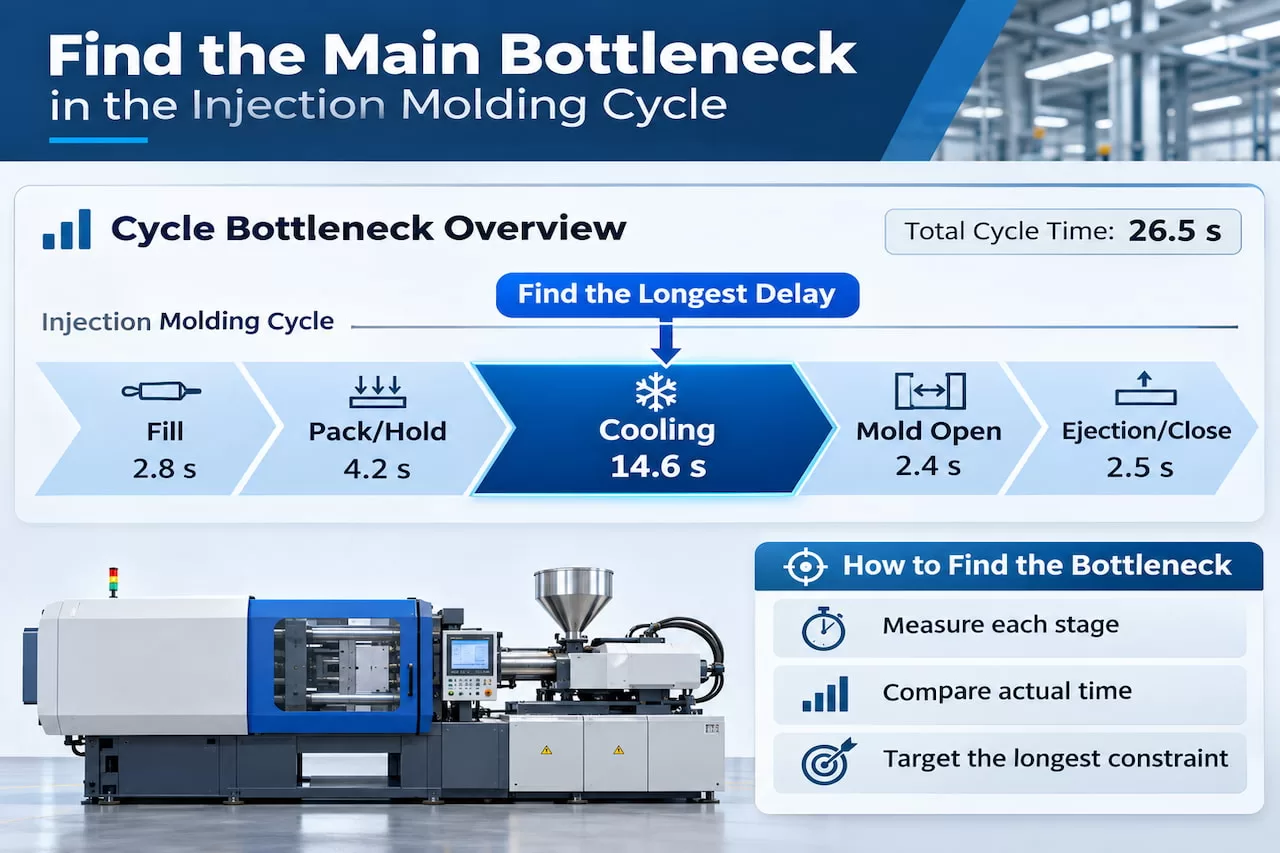
A production cycle may appear to be limited by cooling, injection, or mold movement, but the longest operation is not always the one restricting output. To find the actual bottleneck in an Injection Molding Cycle, manufacturers must record the time spent on filling, packing, cooling, plasticizing, mold opening and closing, and part removal. They must also identify which operations overlap and which ones delay the next cycle. This requires more than checking programmed times: engineers need to examine actual machine movements, automation sequences, and production conditions to determine where time is being lost.
What Are the Key Production Stages, and How Should They Be Measured?
Before identifying a production bottleneck, engineers need to understand the complete molding sequence and how its individual stages contribute to cycle time. Each operation serves a different purpose, and its duration depends on part geometry, resin properties, mold design, machine settings, and automation requirements. More importantly, the time programmed into a Plastic Injection Molding Machine does not always match the time consumed during actual production. Reliable analysis therefore starts with identifying each stage and recording its actual operating duration.
Which Operations Make Up a Complete Injection Molding Cycle?
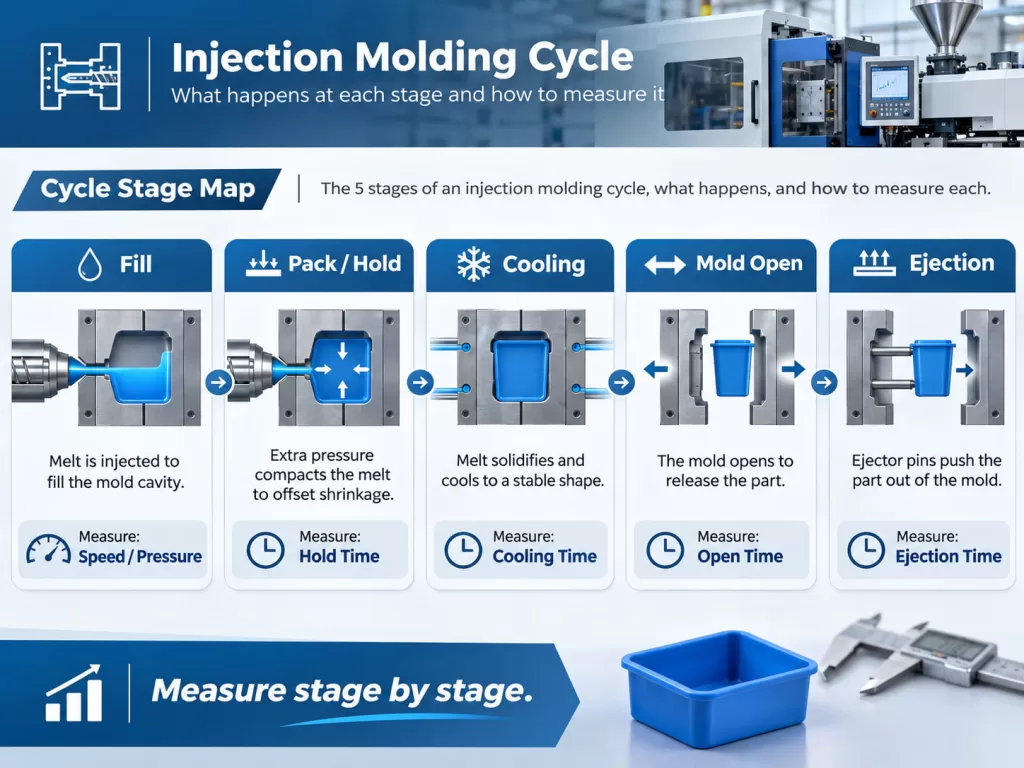
A complete injection molding cycle consists of several interconnected operations. Understanding these injection molding cycle stages helps engineers determine where production time is spent.
| Cycle Stage | Main Operation | Factors Affecting Duration |
|---|---|---|
| Mold closing and clamping | Closes the mold and establishes clamping force | Mold size, movement distance, machine settings |
| Injection filling | Forces molten plastic into the cavity | Injection speed, pressure, viscosity, cavity geometry |
| Packing and holding | Compensates for material shrinkage | Holding pressure, gate design, material properties |
| Cooling | Allows the molded part to solidify sufficiently for ejection | Wall thickness, mold temperature, cooling-channel design |
| Plasticizing | Melts and prepares material for the next shot | Screw speed, back pressure, shot volume |
| Mold opening and ejection | Opens the mold and releases the part | Mold structure, ejection design, part geometry |
| Robot take-out | Removes and transfers the molded part | Robot movement, gripping time, transfer distance |
These operations do not always run sequentially. Screw plasticizing commonly overlaps with the cooling stage, while robot take-out is coordinated with mold opening and ejection.
Consequently, overall cycle time depends on the timing and coordination of these operations, not simply the sum of their individual durations.
How Should You Measure Actual Injection Molding Cycle Times?
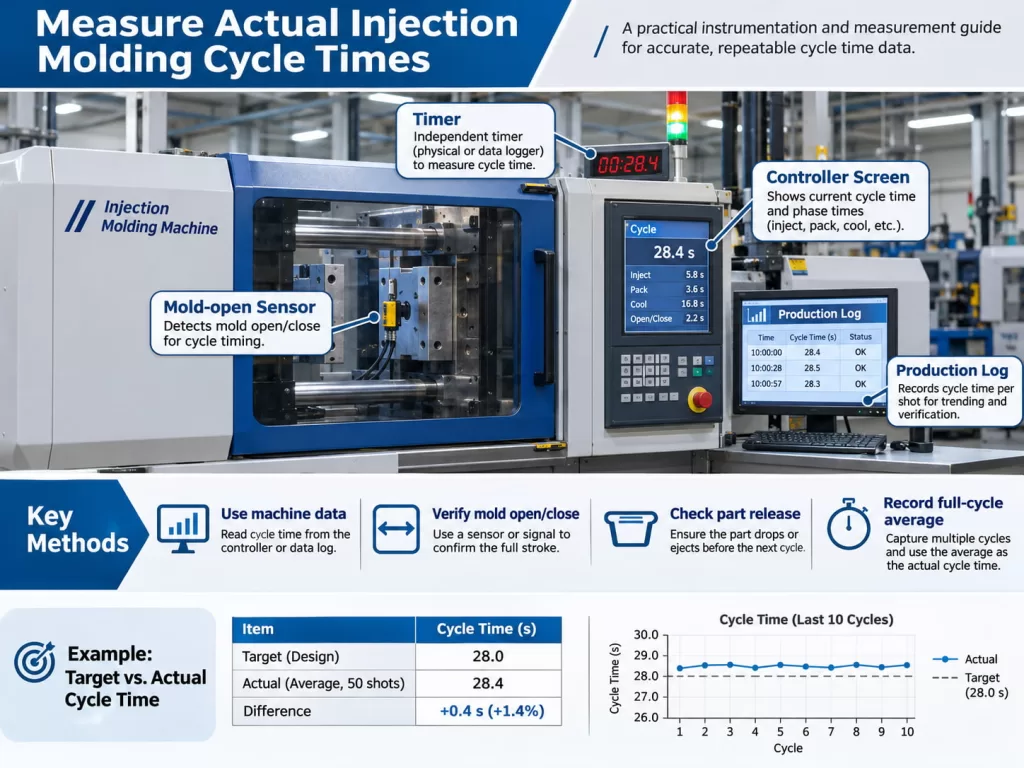
A reliable injection cycle time analysis must use actual operating data rather than relying exclusively on programmed settings.
Three steps establish a useful measurement baseline.
Record actual stage durations.
Collect the execution times for injection, holding, cooling, plasticizing, mold opening and closing, and ejection. Compare actual values with programmed settings to identify delays or differences between the expected and actual sequence.
For example, the product brochure for the Topstar TEII series injection molding machines lists features such as molding cycle monitoring, the display of actual molding data (including USB logging capabilities), mold opening/closing curves, and real-time injection speed and pressure curves. These functions provide valuable information for cycle analysis. As for the specific details regarding the timing of individual stages, these should be verified based on the actual controller configuration.(Category Brochure)
Compare consecutive production cycles.
Observe several consecutive cycles after production has stabilized. Check whether a particular stage consistently takes longer than expected or whether its duration fluctuates between cycles. Significant variation may indicate unstable process conditions, inconsistent material supply, or equipment interruptions.
Use a consistent cycle-time reference.
Measure from the start of one mold-closing operation to the start of the next. Keep machine cycle time separate from the complete production-cell cycle, which also includes robot movements and downstream operations.
This distinction helps identify whether delays originate from the injection molding machine or from the surrounding automation system.
Injection Molding Cycle Analysis: How Can You Identify the Constraint That Limits Production?
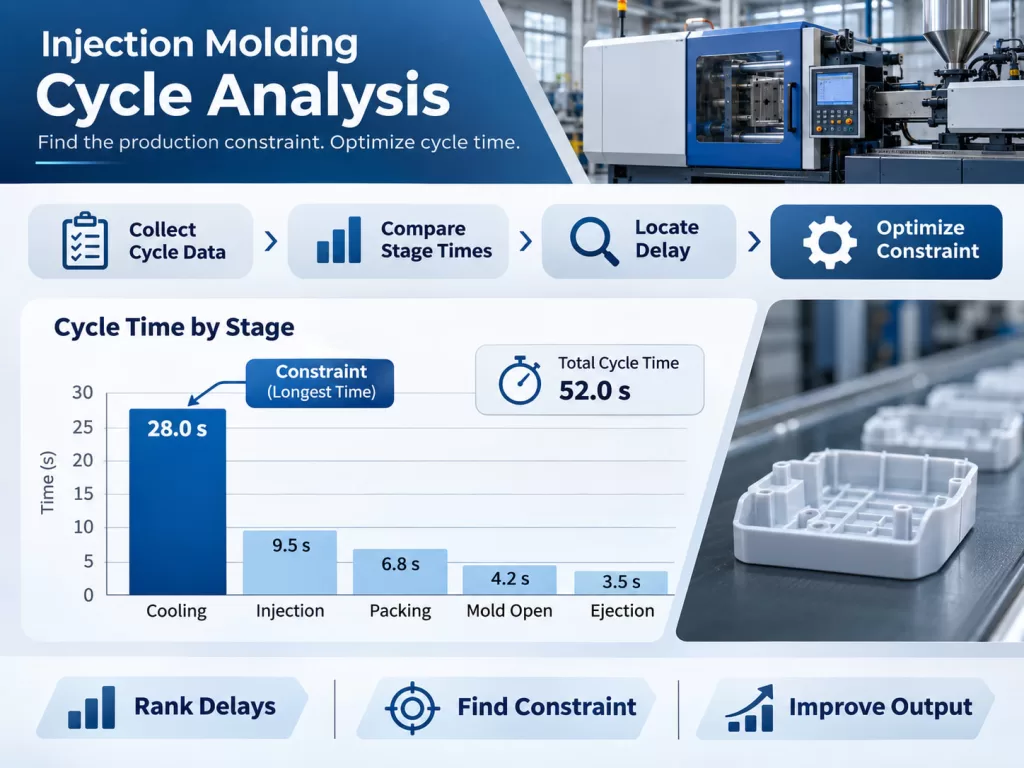
Once actual stage durations have been recorded, the next step is to determine which operation controls when the next molding cycle can begin. This requires examining overlapping operations, machine movements, mold conditions, and material behavior. Engineers should also investigate whether Auxiliary Equipment or an Injection Molding Robot introduces additional waiting time. The objective is to identify the constraint that actually limits production output, rather than simply selecting the operation with the longest recorded duration.
Why Doesn’t the Longest Injection Molding Cycle Stage Always Determine Cycle Time?
The longest individual operation does not necessarily determine the overall cycle time because some operations run simultaneously.
Cooling and plasticizing provide a common example. While the molded part remains inside the mold, the screw can prepare the next shot. If plasticizing finishes before cooling ends, it does not extend the cycle. However, if plasticizing takes longer than the available cooling period, the machine must wait for material preparation to finish.
Consider this simplified example, assuming both operations start at the same time:
| Operation | Actual Duration |
|---|---|
| Cooling | 12 seconds |
| Plasticizing | 8 seconds |
Because plasticizing finishes during cooling, the combined period is 12 seconds, not 20 seconds.
If plasticizing takes 14 seconds instead, it extends the combined period by approximately 2 seconds, making plasticizing the limiting operation.
The same principle applies to automation. An Injection Molding Robot may complete part removal while the mold is open. However, if gripping and transfer take longer than the available mold-open window, the next mold-closing operation must wait.
Engineers should therefore analyze the complete production timeline and identify the critical path. This is more reliable than ranking individual operations by duration.
A 2025 review published in Polymers reports that cooling can account for approximately 50%–80% of injection molding cycle time in many applications. However, this does not mean cooling is always the production bottleneck. The actual constraint depends on how cooling interacts with plasticizing, ejection, and automation. (Gaspar-Cunha et al., 2025)
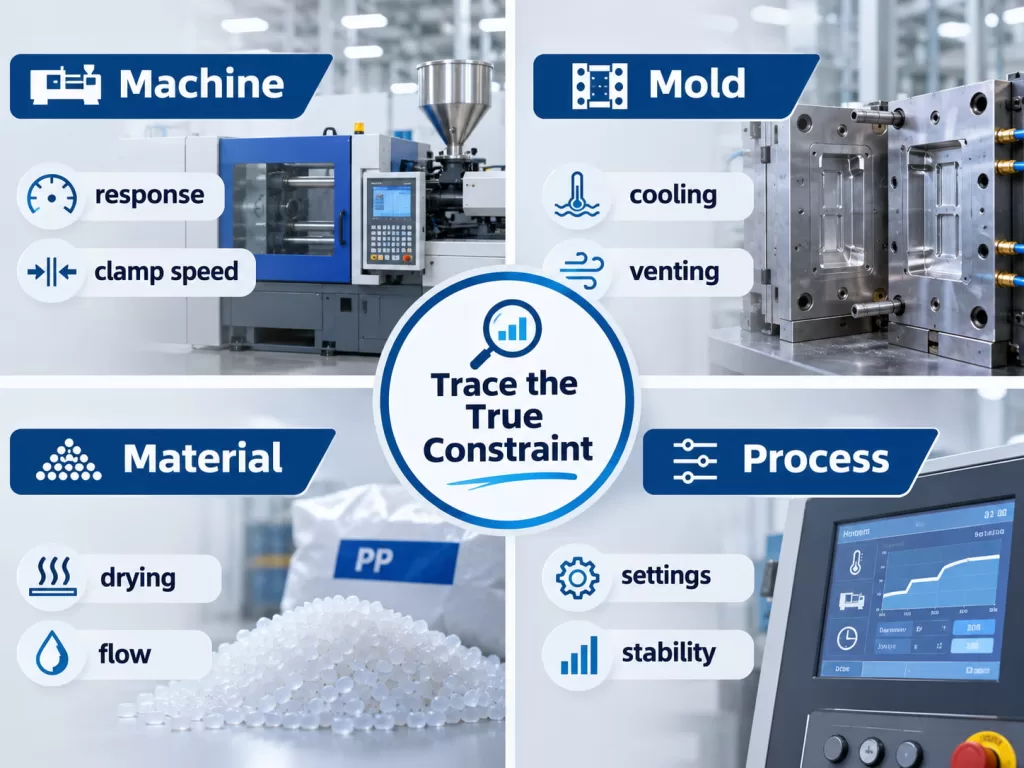
Does the bottleneck stem from the injection molding machine, the mold, the material, or the process?
After identifying the operation that delays the next cycle, engineers should investigate its underlying cause. The same timing problem can originate from different parts of the production system.
Machine-related constraints: Slow injection response, insufficient plasticizing capacity, long mold movements, or unstable machine operation can extend individual stages.
Mold-related constraints: Thick product sections, inefficient cooling channels, unbalanced runners, difficult ejection, or unsuitable mold opening requirements can restrict production speed.
Material-related constraints: High melt viscosity, inadequate drying, inconsistent resin properties, or material-batch variations may increase filling or plasticizing time.
Process-related constraints: Excessive holding time, unsuitable V/P switching, unnecessary cooling time, or poorly coordinated robot movements can create avoidable delays.
Auxiliary Equipment must also be considered. Interruptions in material drying, automatic feeding, or cooling-water supply may stop production even when the injection molding machine itself is operating normally.
The key is to distinguish between a machine-cycle constraint and a production-cell constraint. A machine may complete its molding sequence efficiently, while the robot or downstream equipment still delays the next production cycle.
How Can You Verify an Injection Molding Cycle Bottleneck Before Changing Process Settings?
A suspected bottleneck should be confirmed through controlled trials before machine settings are changed significantly.
Start by adjusting one suspected constraint while keeping other production conditions stable.
For example, if cooling appears to limit production, conduct a controlled trial with a small reduction in cooling time. Check whether the next cycle starts earlier and whether the molded parts still meet dimensional and appearance requirements.
If plasticizing appears to be the constraint, examine screw speed, back pressure, shot volume, and material consistency. If robot take-out is delaying mold closure, investigate gripping time, movement distance, and synchronization with the injection molding machine.
After each adjustment, compare four results:
- Overall cycle time: Did the complete production cycle become shorter?
- Part quality: Did weight, dimensions, and appearance remain within specification?
- Defect rate: Did the adjustment introduce short shots, flash, warpage, or other defects?
- Repeatability: Was the improvement maintained across consecutive production cycles?
If shortening a particular operation does not reduce the overall cycle time, that operation was not controlling the production sequence. Another constraint may still be determining when the next cycle can begin.
Likewise, a shorter cycle is not a genuine improvement if it causes more rejected parts or unstable production.
Analyze comprehensively and eliminate major bottlenecks
Finding the main bottleneck requires measuring actual stage durations, accounting for overlapping operations, and identifying what delays the next cycle. Engineers must then determine whether the constraint originates from the machine, mold, material, process settings, or auxiliary equipment. Controlled trials should confirm that addressing the constraint improves overall cycle time without compromising part quality. The objective is not simply to accelerate individual operations, but to establish the shortest stable and repeatable production cycle under actual manufacturing conditions.
TRENDING POSTS
- TOPS DAY 2026: Turning Industrial AI into Real-World Impact 2026/11/25
- Breaking Through the Full Scene-to-AI Link! Topstar Industrial Data Collection Matrix Achieves Major Technical Breakthro 2026/11/25
- TOPSTAR Selected in “Forbes China AI Top 50” and Wins “2026 Embodied AI Industry Benchmark Award” 2026/11/25
- Topstar Achieves ISO 13849 Functional Safety Certification for Robotics 2026/11/25
HOT TOPIC
- .ervo motor-driven linear robots
- •
- 1.0 guangdong topstar technology co. ltd
- 1.0 topstar china
- 1.0 topstar robot
- 11
- 160℃ mold temperature controller
- 170 ton injection molding machine
- 2
- 21
- 220-ton injection molding machine
- 23
- 260 ton injection molding machine
- 3 axis robot
- 3 axis robots
- 3 in 1 Compact Dehumidifying Dryer
- 3-axis robot
- 3-axis robots
- 39
- 4 axis robot
- 4-axis SCARA robot
- 41
- 460T injection molding machine
- 5-axis CNC machine
- 62
- 90 ton injection molding machine
- accuracy
- Air Chillers
- air-cooled chillers
- all electric injection molding machine
- all electric injection molding machines
- all-electric injection molding machine
- All-electric injection molding machines
- and overall production quality. Therefore
- AP-RubberPlas
- auto cooling system
- auto loader
- Auto Loaders
- automated injection molding machine
- Automation changed engineering
- automation of injection molding robots
- automotive parts injection molding
- Auxiliary Equipment
- auxiliary machine
- Bench Injection Molding Machine
- cabinet dryer
- Cabinet dryer manufacturers
- Cabinet dryers
- cartesian coordinate robot
- Cartesian Coordinate Robots
- Cartesian injection robot
- Cartesian robot
- Central Feeding System
- Central Feeding Systems
- chiller
- CNC Drilling Machine
- CNC Drilling Machines
- cnc engraving machine manufacturer
- cnc laser cutting machine manufacturer
- CNC machine
- CNC Machine Center
- CNC Machine for Sale
- CNC Machine Manufacturing
- CNC Machine Tool
- CNC machine tool product
- CNC Machining Center
- CNC wood carving machine
- Compact Dehumidifying Dryer
- Cooling system
- Cross-Walking Single Axis Servo Cylinder Robot
- Cross-Walking Single-Axis Servo Cylinder Robot
- Cross-Walking Three-Axis/Five-Axis Servo Driven Robot
- cross-walking three-axis/five-axis servo-driven robot
- Dehumidifier Dryer
- Dehumidifying Dryer
- dehumidifying dryers
- delta parallel robot
- Desktop Injection Molding Machine
- Desktop injection molding machines
- Desktop Molding Machine
- desktop plastic injection machine
- Desktop Plastic Injection Molding Machine
- detachable autoloader
- Digital Transformation
- direct clamp injection molding machine
- Direct clamp injection molding machines
- Dosing & mixing system
- Drilling Centers
- Drying and dehumidification system
- drying and dehumidifying equipment
- Drying and Dehumidifying System
- drying system
- effective and efficient. Cabinet dryers are also used in other industries where large quantities of material need to be dried
- efficient injection molding machine
- elbow hydraulic injection molding machines
- electric injection molding machine
- electric injection molding machines
- energy-efficient injection molding robot
- energy-efficient water chiller
- energy-efficient water chillers
- energy-saving injection molding machine
- etc. Among injection molding robots
- exhibition
- features of CNC machine
- Feeding And Conveying System
- Five Axis Machine Center
- Flexible Production Line
- Fully automatic injection molding machine
- Gathering Topstar
- giant injection molding machine
- GMU-600 5-Axis Machining Center
- Granulating & Recycling System
- granulator machine
- gravimetric blender
- Heavy duty injection molding machine
- Heavy-Duty Take-Out Robot
- High-precision electric molding machines
- high-precision plastic molding machines
- high-speed all electric injection molding machine
- high-speed electric injection molding machine
- High-Speed Packaging Injection Molding
- Honeycomb rotor dehumidifier
- hopper dryer
- Hopper Dryers
- horizontal injection molding machine
- Horizontal Injection Molding Machines
- Horizontal Injection Moulding Machine
- Horizontal Mixer manufacturer
- How The CNC Machine Works
- hybrid injection molding machine
- hydraulic injection molding machine
- Hydraulic Injection Molding Machines
- in this article
- Industrial AI
- Industrial Automation
- Industrial robot
- Industrial Robot Chinese brand
- industrial robot parts
- industrial robot supplier
- Industrial robots
- Industry Chain
- Injection Manipulator
- injection manipulator robot
- injection mold machines
- Injection molding
- Injection molding automation
- Injection Molding Automation Solution
- injection molding dryer
- Injection molding equipment
- injection molding hopper dryer
- Injection molding machine
- injection molding machine brand
- Injection Molding Machine Factory
- Injection Molding Machine Manufacture
- Injection molding machine manufacturer
- injection molding machine manufacturers
- Injection molding machine procurement
- injection molding machine robotic arm
- injection molding machine with a robot
- Injection molding machines
- injection molding material dehumidifying
- injection molding plant
- injection molding process
- Injection Molding Robot
- injection molding robot arm
- Injection molding robot automation
- Injection molding robotic arm
- injection molding robots
- injection molding whole plant
- injection moulding dryer
- Injection moulding machine
- injection moulding machines
- Injection Moulding Robots
- Injection Robot
- Injection robot arm
- Injection robot manufacturer
- Injection robot wholesale
- injection robots
- Intelligent Factory
- intelligent injection molding machines
- Intelligent Manufacturing
- intelligent mold temperature
- intelligent mold temperature controller
- Intelligent mould temperature controller
- intelligent whole plant solution
- InterPlas Thailand 2025
- Introducing Injection Robot
- It is the best choice for drying large quantities of material at once. Cabinetmakers use these machines because they are fast
- Large flow water type mold temperature controller
- large injection molding machine
- large injection molding machines
- Learn what industrial automation and robotics is
- linear robot
- linear robots
- low speed sound-proof granulator
- machine plastic molding
- make sure to add some! Improvements (2) Keyphrase in introduction: Your keyphrase or its synonyms appear in the first paragraph of the copy
- manipulator machine
- manufacturing
- Manufacturing Innovation
- medical grade injection molding machines
- Medical Injection Molding
- medical injection molding machine
- medical injection molding machines
- micro injection molding machine
- middle speed granulator
- Mini CNC machine manufacturers.
- mobile cover making machine
- Mold Temperature Control System
- mold temperature controller
- mold temperature controllers
- molding machine
- molding material Dehumidifying System
- mould temperature control system
- mould temperature controller
- mould temperature controller
- mould temperature controllers
- New electric injection molding machine
- Nitrogen Dryer
- nitrogen dryer manufacturer
- nitrogen dryer system manufacturer
- Oil type mold temperature controller
- Oil type mold temperature controllers
- open day
- optical component injection molding
- Optical-grade dehumidifying dryer
- Outbound links: No outbound links appear in this page. Add some! Images: No images appear on this page. Add some! Internal links: No internal links appear in this page
- packaging injection molding
- Packaging Solutions
- PET Preform injection molding
- phone case maker machine
- phone case making machine
- phone cover making machine
- PID Control Mold Temperature Controller
- plastic auto loader
- plastic bottle making machine
- plastic bottle manufacturing
- plastic bucket making machine
- plastic bucket manufacturing
- Plastic chair making machine
- plastic dryer for injection molding
- plastic forming equipment
- Plastic Granulator
- Plastic Granulators
- plastic hopper dryer
- plastic injection machine
- plastic injection machines
- plastic injection molding
- Plastic injection molding equipment
- Plastic injection molding machine
- Plastic Injection Molding Machines
- plastic injection moulding machine
- plastic injection moulding machines
- plastic injection robot
- plastic molding
- Plastic Molding Industry
- Plastic Molding machine
- plastic molding machine 1
- Plastic Molding Machines
- plastic molding press
- plastic moulding machine
- plastic phone case making machine
- plastic-molding machine
- powerful granulator
- Powerful Type Sound-Proof Granulator
- precision injection molding
- precision injection molding machines
- production of plastic seats
- pure water mould temperature controller
- Robot injection molding
- robot injection molding machine
- robot manufacturing companies
- Robotic arm for injection molding machine
- robotic injection molding machines
- robotics in injection molding
- SCARA robot
- SCARA robots
- Screw dosers
- Service-oriented manufacturing
- Servo Cylinder Robot
- servo driven robot
- Servo Driven Robots
- servo injection molding machine
- servo injection robots
- servo motor-driven linear robots
- servo-driven 3-axis robot
- Servo-driven injection molding machine
- Servo-Driven Robot
- Setup of injection machine
- Silicone Injection Molding Machine
- six-axis industrial robot
- Smart Manufacturing
- soundproof granulator
- Sprue Picker
- Stainless Hopper Dryer
- Stainless Hopper Dryers
- star club
- swing arm robot
- T1 Cartesian injection robot
- take-out robot
- take-out robots
- Thailand 4.0
- the choice between servo-driven robots and hydraulic robots will have a certain impact on efficiency
- the most popular injection molding machine
- the type of injection molding robot
- TIC2000 Control System
- TMII injection molding machine
- toggle clamp injection molding machine
- Toggle Hydraulic Injection Molding Machines
- toggle injection molding machine
- Top 10 brands of injection robots
- Topstar
- Topstar Electric Injection Molding Machine InterPlas Thailand 2025 Smart Manufacturing Thailand 4.0
- Topstar Engineering
- Topstar Industrial Robots
- Topstar injection molding intelligent
- Topstar Scara Robots
- Useful Injection molding machine
- Vertical machining centers
- volumetric type blender
- Washing Machine Case Molding Solution
- water chiller
- water chillers
- water distributor
- water type mold temperature controller
- Water Type MoldTemperature Controller
- Water-Cooled Chillers
- Water-cooled Mold Temperature Controller
- water-type mold temperature controller
- Water-Type Mould Temperature Controllers
- We often face choices when performing injection molding. We will choose the type of injection molding machine
- wholesale of injection molding machines
- x carve CNC
- 热门查询 点击次数 展示 排名 topstar