
How Much Electricity Does an Injection Molding Machine Use per Hour?
2024/04/10 By Topstar
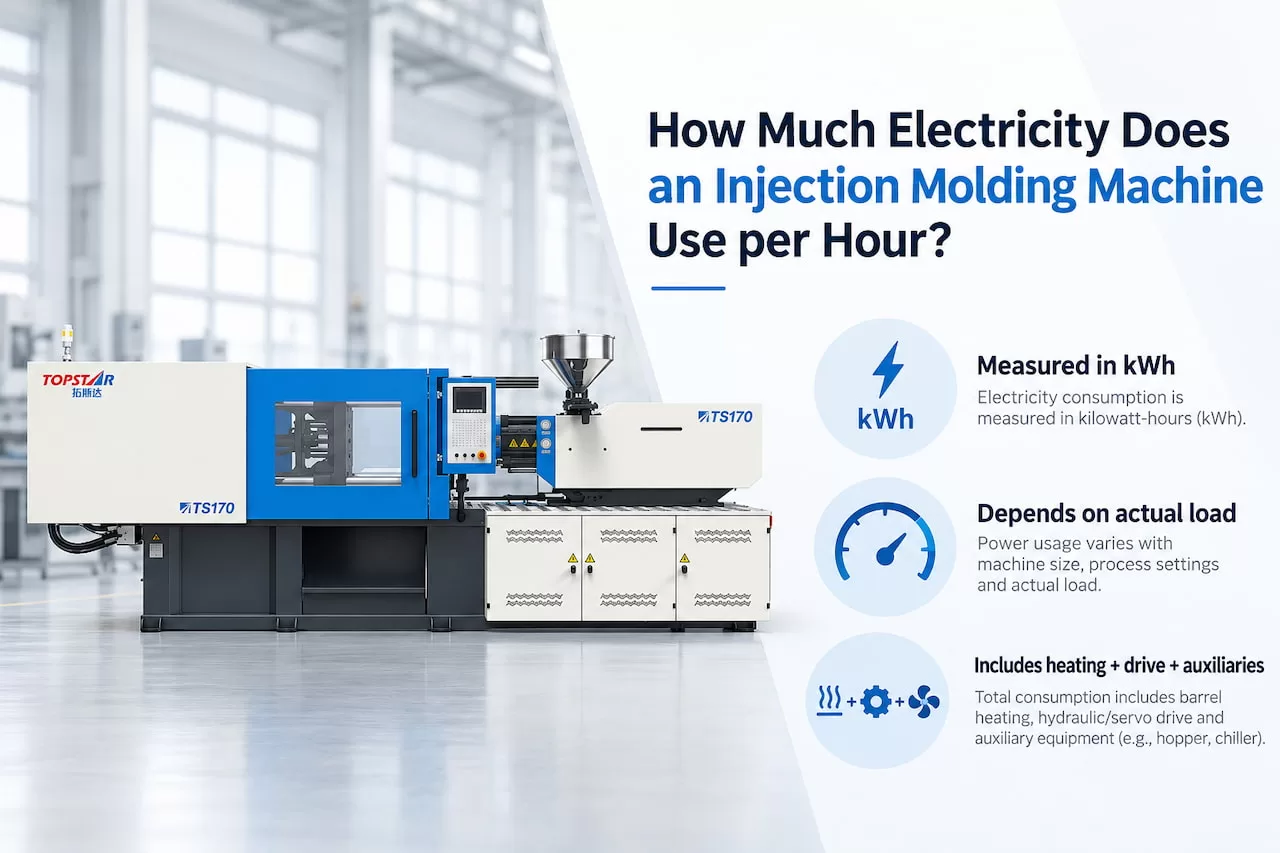
The energy consumption of an injection molding machine depends on the machine itself, the materials used, the mold, and the production cycle. Topstar’s early TS series reference tables show that, depending on the model, hourly electricity consumption ranges from approximately 5 to 20.9 kWh. Of course, these figures are for reference only and do not represent a universal energy consumption range for all injection molding machines.
To estimate production energy consumption, measure the average operating power and multiply it by the operating time. For example, if a machine’s average operating power is 12 kW, its hourly electricity consumption is 12 kWh. When evaluating operational efficiency, it is also necessary to calculate the electricity consumption required to produce each qualified product and clarify whether this energy consumption data includes auxiliary equipment.
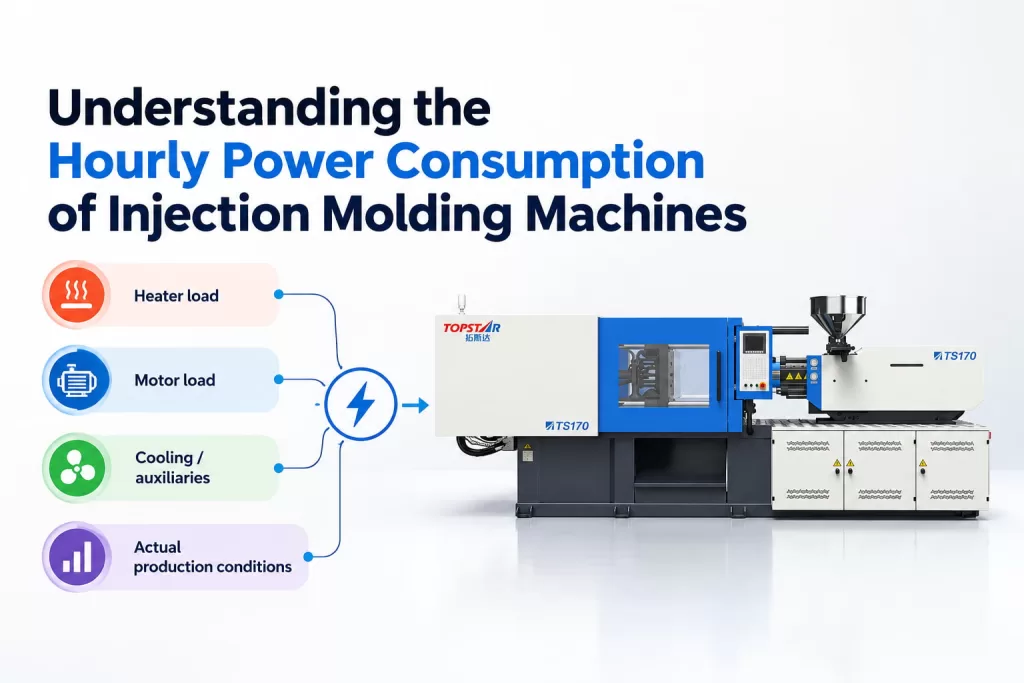
Understanding the Hourly Power Consumption of Injection Molding Machines
When estimating power consumption, it is not sufficient to rely solely on the rated power listed on the machine’s nameplate. Installed capacity, actual operating requirements, and cumulative power consumption are distinct metrics. Therefore, you need to understand these differences to grasp why the power consumption of the same machine may vary when performing different production tasks.
Why Does the Power Consumption of Injection Molding Machines Vary?
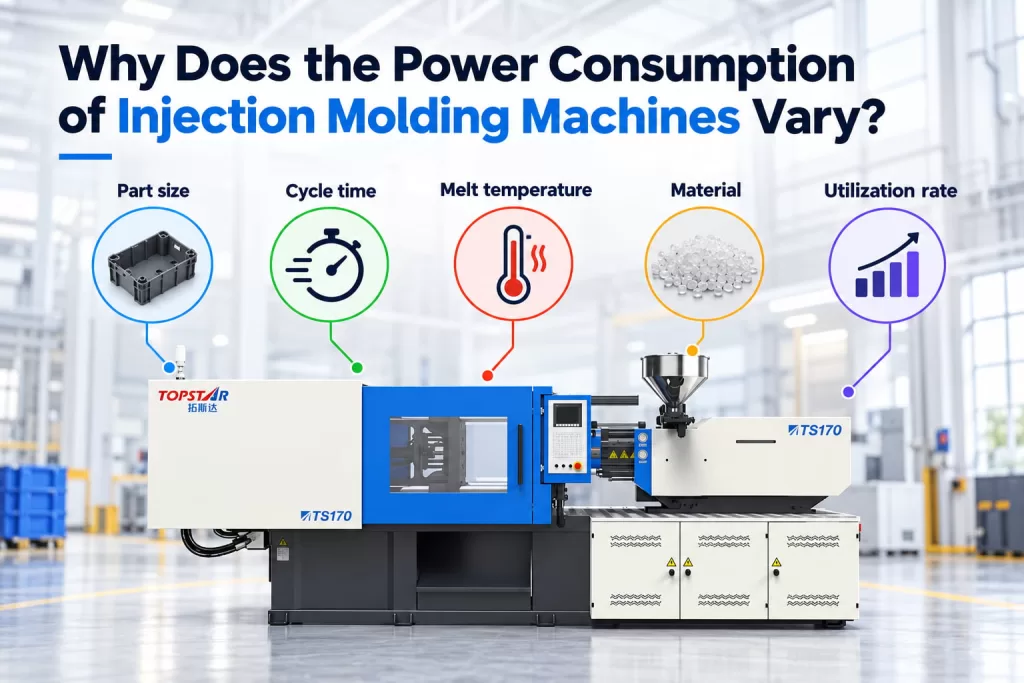
Energy requirements vary across different stages, such as clamping, injection, holding pressure, plastification, cooling, and ejection. Brief peaks that occur during the injection stage do not represent the average energy consumption over the entire production cycle.
The type of material and injection volume affect heating and plastification requirements. Mold design, pressure requirements, and cycle time settings determine the duration and intensity of the machine’s operations. Downtime during production increases standby energy consumption while reducing output.
The machine’s technical configuration also affects power consumption. Traditional hydraulic injection molding machines experience energy losses during pump operation and hydraulic transmission; servo-hydraulic injection molding machines can adjust pump output based on actual demand; and all-electric injection molding machines use electric power to perform primary movements.
Research by the National Institute of Standards and Technology (NIST) in the United States has proposed a method for estimating energy consumption based on the power and duration of each stage of the injection molding process. This method supports evaluations tailored to specific application scenarios, rather than providing a general figure based solely on machine specifications.
When comparing different machines, ensure that the comparison is conducted under the same conditions regarding material, mold, production goals, and quality requirements.
How is the energy consumption of an injection molding machine calculated?
Please ensure that the units used are consistent:
| Measurement | Unit | Meaning |
|---|---|---|
| Installed power | kW | Rated equipment capacity |
| Average operating power | kW | Average measured demand during a defined period |
| Electricity consumption | kWh | Energy used during that period |
| Energy per acceptable part | kWh/part | Electricity divided by accepted output |
The basic calculation formula is:
Electricity consumption (kWh) = Average actual power (kW) × Operating time (h)
For example, suppose a plastic molding machine has an average power of 12 kW during an 8-hour production shift:
12 × 8 = 96 kWh
If the electricity rate is $0.12/kWh, the energy cost is:
96 × $0.12 = $11.52
This is a sample calculation and not actual data from Topstar. This calculation does not include demand charges, taxes, or other billing items.
For a more accurate result, subtract the starting meter reading from the ending meter reading. If energy consumption during the startup, production, and standby phases significantly impacts the overall production plan, it is recommended to record energy consumption for these phases separately. Before comparing results, clearly define the scope of measurement. Results will differ between measurements taken solely for the plastic molding machine itself and those for the entire production unit, which includes auxiliary equipment such as robots, dryers, mold temperature controllers, and chillers.
Reducing Energy Consumption While Ensuring Quality
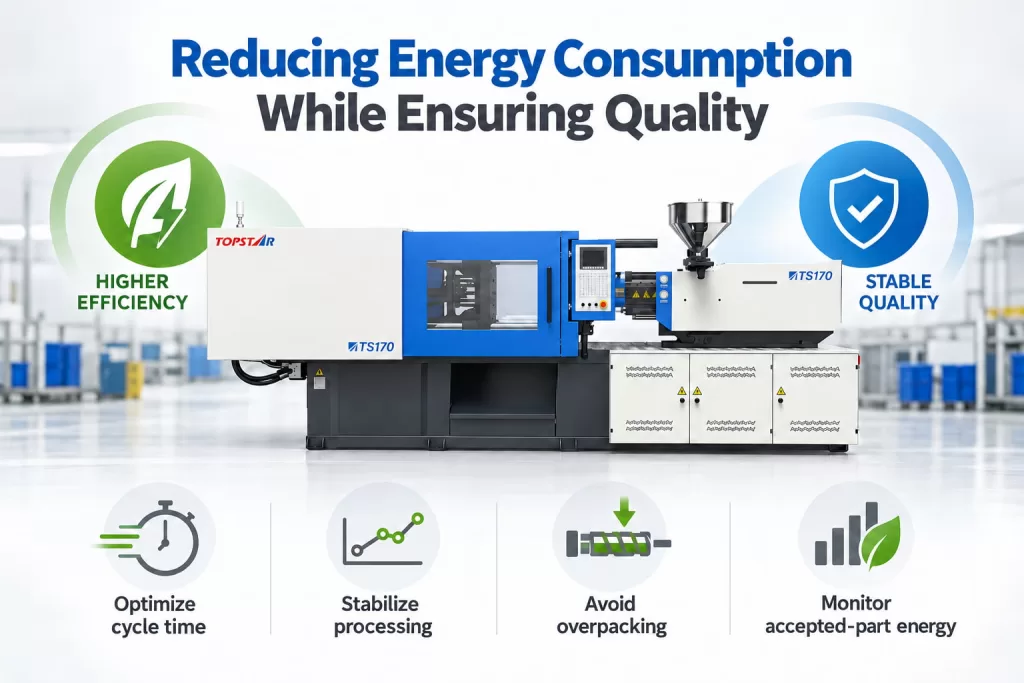
After continuously measuring energy consumption, evaluate whether proposed changes can reduce electricity usage while meeting established production volume requirements. If production speed slows or the scrap rate increases, the metric “reduction in hourly electricity consumption” may be misleading. Therefore, when optimizing processes and selecting equipment, energy consumption measurements should be considered in conjunction with cycle time, yield of conforming parts, and product quality.
What Process Adjustments Can Reduce Energy Consumption Per Part?
Energy consumption per part in injection molding can be reduced by eliminating unnecessary cooling and holding times, avoiding excessive pressure, and matching the plasticizing parameters to the material used and the molding cycle. When making these adjustments, it is essential to ensure part quality meets specifications and to maintain (or increase) the output of conforming parts.
Lowering the barrel temperature or slowing the injection speed does not necessarily result in energy savings; these actions may instead increase filling resistance, lengthen the molding cycle, or lead to a higher scrap rate. When making adjustments, validation should be based on the metric “measured power consumption divided by the yield of qualified products.”
Power Consumption Data for the Topstar TS Series
Charts previously released by Topstar provide the following reference values:

These historical data reflect differences among various reference machine models. They are not guaranteed energy consumption values for specific molds, nor do they represent current ordering specifications. Note: The charts do not provide sufficient testing details to reproduce the relevant results independently; they are for reference only.
If the average power consumption for a given application during an 8-hour production cycle is 12.3 kW, the total energy consumption would be 98.4 kWh. This estimate assumes that the measured average value is representative.
Please compare the Topstar injection molding machine series with your production requirements. For electric injection molding machines, please refer to our guide on energy consumption for electric injection molding machines.
How Much Electricity Does an Injection Molding Machine Actually Consume?
Based on historical reference data from the Topstar TS series, the hourly electricity consumption of an injection molding machine is approximately 5–20.9 kWh, with the exact figure depending on the machine model and test conditions. Actual energy consumption can vary depending on the material you process, the mold, the molding cycle, and the machine configuration. For example, if the measured average power consumption is 12 kW, this means the machine consumes 12 kWh per hour, for a total of 96 kilowatt-hours over eight hours. Factories can calculate production costs based on actual energy consumption and, by optimizing process parameters such as cooling, holding pressure, and plasticizing—while ensuring product quality—reduce the energy required to produce a single conforming part.
TRENDING POSTS
- TOPS DAY 2026: Turning Industrial AI into Real-World Impact 2024/04/10
- Breaking Through the Full Scene-to-AI Link! Topstar Industrial Data Collection Matrix Achieves Major Technical Breakthro 2024/04/10
- TOPSTAR Selected in “Forbes China AI Top 50” and Wins “2026 Embodied AI Industry Benchmark Award” 2024/04/10
- Topstar Achieves ISO 13849 Functional Safety Certification for Robotics 2024/04/10
HOT TOPIC
- .ervo motor-driven linear robots
- •
- 1.0 guangdong topstar technology co. ltd
- 1.0 topstar china
- 1.0 topstar robot
- 11
- 160℃ mold temperature controller
- 170 ton injection molding machine
- 2
- 21
- 220-ton injection molding machine
- 23
- 260 ton injection molding machine
- 3 axis robot
- 3 axis robots
- 3 in 1 Compact Dehumidifying Dryer
- 3-axis robot
- 3-axis robots
- 39
- 4 axis robot
- 4-axis SCARA robot
- 41
- 460T injection molding machine
- 5-axis CNC machine
- 62
- 90 ton injection molding machine
- accuracy
- Air Chillers
- air-cooled chillers
- all electric injection molding machine
- all electric injection molding machines
- all-electric injection molding machine
- All-electric injection molding machines
- and overall production quality. Therefore
- AP-RubberPlas
- auto cooling system
- auto loader
- Auto Loaders
- automated injection molding machine
- Automation changed engineering
- automation of injection molding robots
- automotive parts injection molding
- Auxiliary Equipment
- auxiliary machine
- Bench Injection Molding Machine
- cabinet dryer
- Cabinet dryer manufacturers
- Cabinet dryers
- cartesian coordinate robot
- Cartesian Coordinate Robots
- Cartesian injection robot
- Cartesian robot
- Central Feeding System
- Central Feeding Systems
- chiller
- CNC Drilling Machine
- CNC Drilling Machines
- cnc engraving machine manufacturer
- cnc laser cutting machine manufacturer
- CNC machine
- CNC Machine Center
- CNC Machine for Sale
- CNC Machine Manufacturing
- CNC Machine Tool
- CNC machine tool product
- CNC Machining Center
- CNC wood carving machine
- Compact Dehumidifying Dryer
- Cooling system
- Cross-Walking Single Axis Servo Cylinder Robot
- Cross-Walking Single-Axis Servo Cylinder Robot
- Cross-Walking Three-Axis/Five-Axis Servo Driven Robot
- cross-walking three-axis/five-axis servo-driven robot
- Dehumidifier Dryer
- Dehumidifying Dryer
- dehumidifying dryers
- delta parallel robot
- Desktop Injection Molding Machine
- Desktop injection molding machines
- Desktop Molding Machine
- desktop plastic injection machine
- Desktop Plastic Injection Molding Machine
- detachable autoloader
- Digital Transformation
- direct clamp injection molding machine
- Direct clamp injection molding machines
- Dosing & mixing system
- Drilling Centers
- Drying and dehumidification system
- drying and dehumidifying equipment
- Drying and Dehumidifying System
- drying system
- effective and efficient. Cabinet dryers are also used in other industries where large quantities of material need to be dried
- efficient injection molding machine
- elbow hydraulic injection molding machines
- electric injection molding machine
- electric injection molding machines
- energy-efficient injection molding robot
- energy-efficient water chiller
- energy-efficient water chillers
- energy-saving injection molding machine
- etc. Among injection molding robots
- exhibition
- features of CNC machine
- Feeding And Conveying System
- Five Axis Machine Center
- Flexible Production Line
- Fully automatic injection molding machine
- Gathering Topstar
- giant injection molding machine
- GMU-600 5-Axis Machining Center
- Granulating & Recycling System
- granulator machine
- gravimetric blender
- Heavy duty injection molding machine
- Heavy-Duty Take-Out Robot
- High-precision electric molding machines
- high-precision plastic molding machines
- high-speed all electric injection molding machine
- high-speed electric injection molding machine
- High-Speed Packaging Injection Molding
- Honeycomb rotor dehumidifier
- hopper dryer
- Hopper Dryers
- horizontal injection molding machine
- Horizontal Injection Molding Machines
- Horizontal Injection Moulding Machine
- Horizontal Mixer manufacturer
- How The CNC Machine Works
- hybrid injection molding machine
- hydraulic injection molding machine
- Hydraulic Injection Molding Machines
- in this article
- Industrial AI
- Industrial Automation
- Industrial robot
- Industrial Robot Chinese brand
- industrial robot parts
- industrial robot supplier
- Industrial robots
- Industry Chain
- Injection Manipulator
- injection manipulator robot
- injection mold machines
- Injection molding
- Injection molding automation
- Injection Molding Automation Solution
- injection molding dryer
- Injection molding equipment
- injection molding hopper dryer
- Injection molding machine
- injection molding machine brand
- Injection Molding Machine Factory
- Injection Molding Machine Manufacture
- Injection molding machine manufacturer
- injection molding machine manufacturers
- Injection molding machine procurement
- injection molding machine robotic arm
- injection molding machine with a robot
- Injection molding machines
- injection molding material dehumidifying
- injection molding plant
- injection molding process
- Injection Molding Robot
- injection molding robot arm
- Injection molding robot automation
- Injection molding robotic arm
- injection molding robots
- injection molding whole plant
- injection moulding dryer
- Injection moulding machine
- injection moulding machines
- Injection Moulding Robots
- Injection Robot
- Injection robot arm
- Injection robot manufacturer
- Injection robot wholesale
- injection robots
- Intelligent Factory
- intelligent injection molding machines
- Intelligent Manufacturing
- intelligent mold temperature
- intelligent mold temperature controller
- Intelligent mould temperature controller
- intelligent whole plant solution
- InterPlas Thailand 2025
- Introducing Injection Robot
- It is the best choice for drying large quantities of material at once. Cabinetmakers use these machines because they are fast
- Large flow water type mold temperature controller
- large injection molding machine
- large injection molding machines
- Learn what industrial automation and robotics is
- linear robot
- linear robots
- low speed sound-proof granulator
- machine plastic molding
- make sure to add some! Improvements (2) Keyphrase in introduction: Your keyphrase or its synonyms appear in the first paragraph of the copy
- manipulator machine
- manufacturing
- Manufacturing Innovation
- medical grade injection molding machines
- Medical Injection Molding
- medical injection molding machine
- medical injection molding machines
- micro injection molding machine
- middle speed granulator
- Mini CNC machine manufacturers.
- mobile cover making machine
- Mold Temperature Control System
- mold temperature controller
- mold temperature controllers
- molding machine
- molding material Dehumidifying System
- mould temperature control system
- mould temperature controller
- mould temperature controller
- mould temperature controllers
- New electric injection molding machine
- Nitrogen Dryer
- nitrogen dryer manufacturer
- nitrogen dryer system manufacturer
- Oil type mold temperature controller
- Oil type mold temperature controllers
- open day
- optical component injection molding
- Optical-grade dehumidifying dryer
- Outbound links: No outbound links appear in this page. Add some! Images: No images appear on this page. Add some! Internal links: No internal links appear in this page
- packaging injection molding
- Packaging Solutions
- PET Preform injection molding
- phone case maker machine
- phone case making machine
- phone cover making machine
- PID Control Mold Temperature Controller
- plastic auto loader
- plastic bottle making machine
- plastic bottle manufacturing
- plastic bucket making machine
- plastic bucket manufacturing
- Plastic chair making machine
- plastic dryer for injection molding
- plastic forming equipment
- Plastic Granulator
- Plastic Granulators
- plastic hopper dryer
- plastic injection machine
- plastic injection machines
- plastic injection molding
- Plastic injection molding equipment
- Plastic injection molding machine
- Plastic Injection Molding Machines
- plastic injection moulding machine
- plastic injection moulding machines
- plastic injection robot
- plastic molding
- Plastic Molding Industry
- Plastic Molding machine
- plastic molding machine 1
- Plastic Molding Machines
- plastic molding press
- plastic moulding machine
- plastic phone case making machine
- plastic-molding machine
- powerful granulator
- Powerful Type Sound-Proof Granulator
- precision injection molding
- precision injection molding machines
- production of plastic seats
- pure water mould temperature controller
- Robot injection molding
- robot injection molding machine
- robot manufacturing companies
- Robotic arm for injection molding machine
- robotic injection molding machines
- robotics in injection molding
- SCARA robot
- SCARA robots
- Screw dosers
- Service-oriented manufacturing
- Servo Cylinder Robot
- servo driven robot
- Servo Driven Robots
- servo injection molding machine
- servo injection robots
- servo motor-driven linear robots
- servo-driven 3-axis robot
- Servo-driven injection molding machine
- Servo-Driven Robot
- Setup of injection machine
- Silicone Injection Molding Machine
- six-axis industrial robot
- Smart Manufacturing
- soundproof granulator
- Sprue Picker
- Stainless Hopper Dryer
- Stainless Hopper Dryers
- star club
- swing arm robot
- T1 Cartesian injection robot
- take-out robot
- take-out robots
- Thailand 4.0
- the choice between servo-driven robots and hydraulic robots will have a certain impact on efficiency
- the most popular injection molding machine
- the type of injection molding robot
- TIC2000 Control System
- TMII injection molding machine
- toggle clamp injection molding machine
- Toggle Hydraulic Injection Molding Machines
- toggle injection molding machine
- Top 10 brands of injection robots
- Topstar
- Topstar Electric Injection Molding Machine InterPlas Thailand 2025 Smart Manufacturing Thailand 4.0
- Topstar Engineering
- Topstar Industrial Robots
- Topstar injection molding intelligent
- Topstar Scara Robots
- Useful Injection molding machine
- Vertical machining centers
- volumetric type blender
- Washing Machine Case Molding Solution
- water chiller
- water chillers
- water distributor
- water type mold temperature controller
- Water Type MoldTemperature Controller
- Water-Cooled Chillers
- Water-cooled Mold Temperature Controller
- water-type mold temperature controller
- Water-Type Mould Temperature Controllers
- We often face choices when performing injection molding. We will choose the type of injection molding machine
- wholesale of injection molding machines
- x carve CNC
- 热门查询 点击次数 展示 排名 topstar